Google Review Automation for Opus EHR: Build Trust Fast
💡 Google review automation for Opus EHR helps rehab centers and behavioral health clinics turn patient wins into online trust. Curogram syncs with...
12 min read
Mira Gwehn Revilla
:
February 11, 2026
A family in crisis types "addiction treatment near me" into Google. Three results show up on the map. Your center is not one of them. This is not a website problem. It is a review problem.
Google's local search now puts heavy weight on how fast you get new reviews. This metric is called review velocity. It matters more than how many total reviews you have. A facility with 20 fresh five-star reviews from the last 90 days can outrank one with 200 old reviews.
For rehab centers using Opus EHR, this opens a huge door. Every discharge, every program finish, and every alumni check-in is a chance to earn a new review.
But most centers let these moments pass. Staff forget to ask. Patients move on. And the reviews never come.
That is where medical SEO for Opus practices gets its edge. When you tie review requests to real clinical events inside Opus, you create a system that runs on its own. No clipboards at the front desk. No awkward phone calls. Just a text that goes out at the right time, to the right person.
Curogram plugs right into Opus EHR to make this happen. It sends a short, warm SMS to patients at the moment they feel most grateful. The result is a steady stream of new Google reviews that push your rehab center Google rankings higher, week after week.
In this guide, we will break down why review velocity matters for local SEO. We will show you how to use Opus EHR milestones to drive it. We will also explain how the right keywords in patient reviews can expand your reach to more families who need help now.
Most rehab centers spend money on website SEO. They build blogs, fix title tags, and add service pages. These efforts help, but they miss the biggest piece of the puzzle: the Google Map Pack.
When someone searches "drug rehab near me" or "alcohol treatment center," Google shows three local results on a map before any website links appear. This is the Map Pack. It is the first thing families see. And for local behavioral health searches, those top three spots get over 70% of all clicks.
Your website can rank on page one and still lose to a center that shows up in the Map Pack. That is because the Map Pack plays by different rules. It cares less about blog posts and more about your Google Business Profile, your reviews, and how active your listing looks.
This is where behavioral health search visibility starts and ends for most families. They see the star ratings, read a few reviews, and make a call. If your center is not in those top three spots, you are almost invisible.
|
Think of it this way: Say Center A has a great website with 50 pages of content. But it has 40 Google reviews, and the last one came in six months ago. Center B has a basic website. But it has 25 reviews, and 15 of them came in during the last 60 days. Google is likely to show Center B higher in the Map Pack because it looks more active and current. |
Google calls this the "freshness factor." The search engine wants to show users results that reflect what is happening now, not what happened two years ago. A facility with 50 five-star reviews from 2023 looks stale compared to one that earns five new reviews every month in 2026.
This matters even more in the addiction treatment Map Pack. Families looking for help are in urgent need. Google knows this. It wants to show them centers that are clearly open, active, and serving patients right now. Fresh reviews prove that better than any blog post ever could.
There is also a trust factor at play. When a parent is looking for a rehab center for their child, they are not just reading your "About Us" page. They want to see what real patients say.
They want a lot of voices saying the same thing: "This place helped me." A high volume of reviews creates what you might call a "consensus of care." It gives families the peace of mind they need to pick up the phone.
|
Consider the numbers: If your center gets two reviews per month, that is 24 in a year. Your competitor down the road gets eight per month, totaling 96 in a year. Even if your star rating is the same, Google sees that competitor as more trusted and more relevant. Their behavioral health search visibility grows while yours stays flat. |
The lesson is simple. Website SEO alone cannot fix a weak Google Business Profile. You need a plan that feeds your profile with fresh, real reviews on a steady basis.
This plan should not rely on your front desk staff to remember to ask. It should be built into the clinical process itself.
For Opus EHR users, that plan already exists. The data that triggers a review request is already in your system. You just need the right tool to connect the dots. That is what the next section is about.
Review velocity for behavioral health is not about asking every person in the waiting room for a Google review. It is about asking the right person at the right time. Opus EHR already tracks the moments that matter most. The key is turning those moments into review requests.
The highest-value trigger is discharge. When a patient completes a program and is marked "successfully discharged" in Opus, that is the peak of their gratitude.
They feel strong, hopeful, and thankful for the care they received. A simple SMS that arrives within hours of that event gets a far better response than a follow-up email sent two weeks later.
|
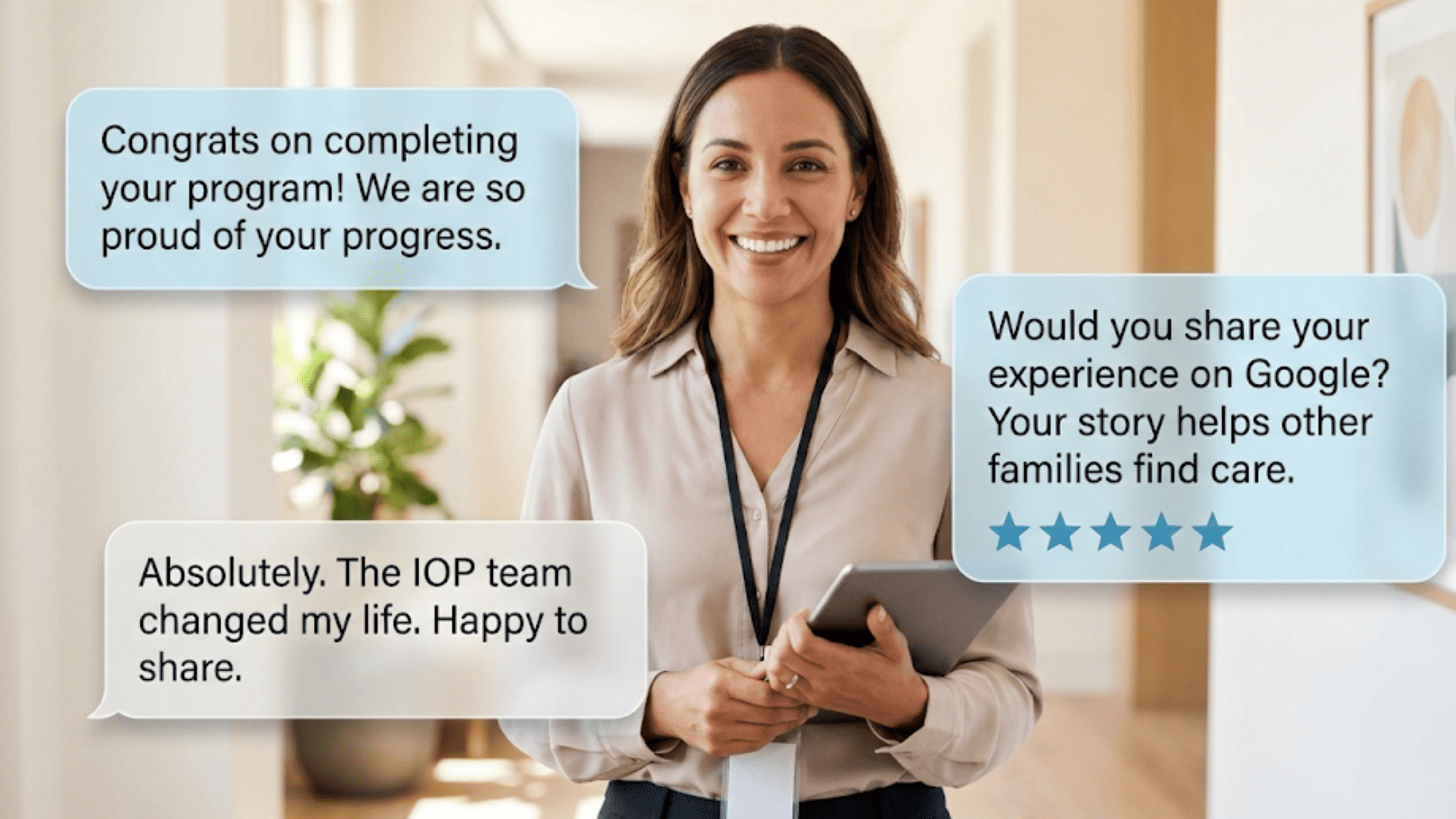
Here is how it works with Curogram: Opus EHR flags the discharge. Curogram picks up the signal and sends a short, warm text. It might say something like, "We are so proud of your progress. Would you share your experience on Google?" The link goes right to your Google Business Profile. The patient taps, writes a few lines, and you have a new review. No staff time needed. |
But discharge is just one trigger. Think about the other milestones Opus tracks. A patient completes detox and moves into IOP. That is a win worth capturing.
A client hits 30 days in a sober living program. That is another. Each of these events is a moment of pride for the patient and a chance for you to build your review velocity.
Alumni milestones are even more powerful for long-term results. Imagine a system that sends a message at 90 days, 6 months, and 1 year after a patient leaves your center. These "anniversary" messages serve two purposes.
First, they reconnect you with alumni who may refer others. Second, they create a long tail of review activity that keeps your Google profile active month after month.
|
Consider a center that discharges 30 patients per month: If 20% leave a review at discharge, that is 6 new reviews per month. Now add alumni messages. If even 10% of your alumni base responds to a 90-day check-in, you could see another 3 to 5 reviews monthly. That gives you 9 to 11 fresh reviews every month, which is a pace most competitors cannot match with manual methods. |
There is one more layer that protects your star rating. Curogram can send a short "pulse check" before the actual review request.
This is a quick one-question text: "How was your experience at [Center Name]?" If the patient responds with a positive score, they get the Google review link. If they respond with a low score, the message routes to your internal team for follow-up.
This is not review gating. You are not blocking anyone from leaving a Google review. You are simply creating two paths.
Satisfied patients go to Google. Unhappy patients go to a person on your team who can listen, respond, and resolve the concern. This keeps your Google Business Profile optimization for rehabs focused on real, positive outcomes while still giving every patient a voice.
The result is a review engine that runs inside your existing workflow. Your clinical staff do not need to change how they chart. Your front desk does not need new scripts. The whole system lives inside Opus and Curogram, working quietly in the background.

Getting more reviews is only half the battle. What patients write inside those reviews matters just as much for your local rankings.
Google reads every word of every review, and it uses that text to decide what your center is known for. This is where medical SEO for Opus practices gets a major boost that most marketing teams overlook.
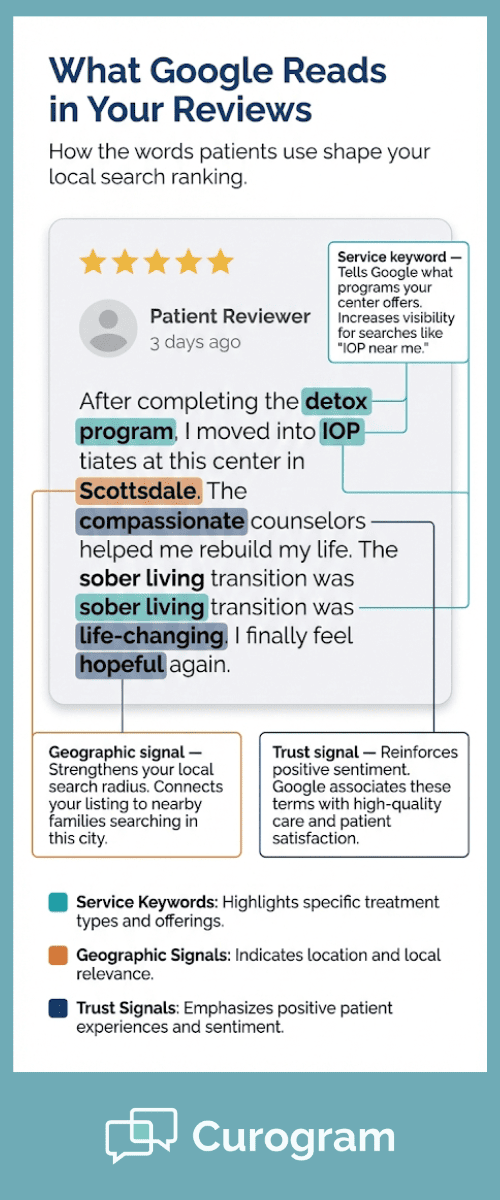
When a patient writes, "The detox program saved my life," Google connects the word "detox" to your facility. When another patient writes, "The IOP counselors were amazing," Google links "IOP" to your listing.
Over time, these words build a profile of your center in Google's eyes. The more often specific terms show up in your reviews, the more likely Google is to show your center when someone searches for those terms.
This is called semantic search. It means Google does not just match exact words anymore. It understands meaning and context.
A review that says "The outpatient program helped me get back on my feet" tells Google your center offers outpatient care, even if the patient did not use that exact clinical term. Every review adds another data point that shapes how Google sees your services.
|
Here is a real-world example: Say, your center offers detox, residential treatment, IOP, and sober living. If 80% of your reviews only mention "rehab" in a general way, Google has a weak picture of what you do. But if patients write about each specific program, Google builds a rich, detailed profile. A family searching "IOP near me" is more likely to see your center because multiple reviews mention IOP by name. |
You cannot tell patients what to write. That would feel forced and could violate Google's policies. But you can shape the review prompt to guide their thinking.
Instead of a generic "Please leave us a review," Curogram can send a message that says, "We would love to hear about your experience in our program. What part of your journey meant the most to you?" This nudge leads patients to write about specific services, therapists, or moments from their care.
The geographic angle is just as important. When a patient writes, "This is the best recovery center in Scottsdale," Google takes note.
That review just added a geographic signal to your listing. It tells Google your center is relevant to people searching in Scottsdale. The more reviews that mention your city, neighborhood, or region, the stronger your local "geofence" becomes.
Think of it like drawing a circle on a map. Each review that names your area makes that circle a little bigger and a little brighter. A center with 30 reviews that mention "Phoenix" or "Scottsdale" will show up for more local searches than a center with 30 reviews that only say "great place." The words patients use shape the size of your reach.
This is one reason why review diversity matters. If your center treats people for alcohol use, opioid use, and mental health conditions, you want reviews that cover all three.

A profile full of reviews that only mention alcohol recovery leaves a gap. Google will not show you for opioid treatment searches because it has no data to support that connection. Each service line needs its own set of reviews to fill out the picture.
There is also a content value angle here. Google treats patient reviews as user-generated content. This is content that real people create, not your marketing team.
In Google's eyes, user-generated content is some of the most trusted material on the web. A review written by a real patient carries more weight for local ranking than a polished blog post on your website.
Think about it from Google's point of view. Your website says you offer "compassionate, evidence-based addiction treatment." That is marketing copy. But when 15 patients write reviews that use the word "compassionate" on their own, Google sees that as proof. The claim on your site just got backed up by real-world voices.
|
So how do you put this to work?
Adjust your alumni outreach to target sober living graduates. Send more milestone messages to that group. Fill the gap and watch your reach grow. |
This is where review velocity and keyword strategy work together. Speed without substance does not help. Getting 20 reviews that all say "nice place" will not move the needle. But getting 20 reviews that mention specific programs, staff qualities, and your city name creates a wave of signals that push your center up in local search results.
Every day, families search Google for help with addiction and mental health. They do not scroll through ten pages of results. They look at the Map Pack, check the star ratings, and call the first center that feels trustworthy.
Social proof is the engine behind that trust. It is not your website copy. It is not your ad spend. It is real patients sharing real stories. When your Google profile shows dozens of recent five-star reviews, it tells families, "People like you came here and got better."
For behavioral health facilities, this social proof has to be current and consistent. A burst of reviews from a year ago does not carry the same weight as a steady stream of new ones. Google rewards centers that show ongoing activity because it signals that the facility is open, thriving, and helping people right now.
This is how you turn clinical success into market dominance. Each discharge, each milestone, each alumni check-in becomes a building block for your online presence.
Over time, the reviews stack up, the keywords spread across your services, and your local reach grows wider.
How Curogram Drives Review Velocity Without Adding Staff Work
Curogram was built to work inside the tools your team already uses. For Opus EHR facilities, this means review requests happen without your staff lifting a finger.
Curogram connects to Opus EHR and listens for key events: discharge, program completion, and alumni milestones. When one of these events fires, Curogram sends a HIPAA-compliant SMS to the patient. The message is short, warm, and includes a direct link to your Google Business Profile.
Before the review link goes out, a quick pulse check gauges the patient's mood. Positive responses go straight to Google. Negative responses route to your care team for private follow-up. This protects your star rating without blocking anyone from giving feedback.
The results add up fast. Centers using Curogram with Opus EHR often see review volume grow by 3x to 5x within the first 90 days. That means more fresh reviews, more keyword-rich content on your profile, and stronger local rankings.
Curogram also tracks every message. You can see who received a review request, who opened it, and who left a review. This data lets your marketing team spot trends and adjust the timing or wording of messages to get even better results.
Beyond reviews, Curogram gives your facility tools for secure texting, broadcast SMS for alumni outreach, and two-way messaging for ongoing patient support. It is a full communication platform designed for behavioral health teams that need to stay compliant and connected.
If your center runs on Opus EHR and you want to turn every clinical win into a Google review, Curogram is the simplest way to make that happen. No extra apps, no manual work, and no guesswork.
Local search is where families find help. If your rehab center does not show up in the Map Pack, you are losing patients to centers that do.
Review velocity is the fastest path to the top. It is not about collecting hundreds of old reviews. It is about earning new reviews every week, tied to real clinical moments. Google rewards that pattern with higher rankings.
Opus EHR already tracks the events that matter. Discharges, program completions, and alumni milestones are all moments when patients are ready to share. Curogram connects to those events and sends the review request for you, right on time, every time.
The keywords inside those reviews matter just as much as the volume. When patients write about your specific programs and your city, they build a detailed map of your center in Google's eyes. That map is what drives addiction treatment Map Pack placement and expands your reach to more families.
This is not about gaming the system. It is about showing Google what your center does best through the voices of real people. That is the kind of signal no ad budget can buy.
The centers that win in local search are the ones that treat reviews like a clinical process, not a marketing afterthought. Build it into your workflow. Automate the ask. Respond to every review. And let the results speak for themselves.
If you are ready to turn your Opus EHR workflow into a local search advantage, Curogram can help you get there. Schedule a 10-Minute Demo and see the difference review velocity makes.
Ready to turn your Opus EHR workflow into a local search advantage? Book a quick demo with us and see the difference review velocity makes.
Most centers that use Curogram with Opus EHR begin to see a shift in their Map Pack position within 60 to 90 days. This depends on the number of reviews coming in each month and how active your competitors are.
Review velocity measures how fast new reviews come in, not the total number. Google gives more weight to recent reviews because they reflect your current level of care and activity.
Google treats reviews as user-generated content, which it considers more trustworthy than marketing copy. When real patients use words like "detox" or "IOP," Google connects those services to your profile with higher confidence.
💡 Google review automation for Opus EHR helps rehab centers and behavioral health clinics turn patient wins into online trust. Curogram syncs with...
💡 Reputation management in Konica Minolta Exa has become crucial for radiology centers. It improves their online presence, attracts new patients,...
💡 Digital patient intake for Opus EHR helps addiction treatment and behavioral health clinics speed up admissions and reduce paperwork. Patients...