💡 Google review automation for Opus EHR helps rehab centers and behavioral health clinics turn patient wins into online trust. Curogram syncs with Opus to send review requests at the right time.
  • Sends SMS review prompts when patients hit key milestones like program completion
  • Filters negative feedback to a private dashboard before it reaches Google
  • Boosts review velocity to help your facility rank higher in local search
  • Keeps all outreach HIPAA-compliant and safe under 42 CFR Part 2
  • Lets you target family members and alumni for added social proof
By using patient feedback automation for Opus, treatment centers build the kind of digital trust that drives new admissions and strengthens their local SEO presence.

A family in crisis types "rehab near me" into Google at 2 a.m. They see three listings in the Map Pack. One has 14 reviews from two years ago. Another has 112 recent reviews and a 4.8-star rating. Which one do they call?

That choice often comes down to trust. And in behavioral health, trust starts with what other patients and families say about your facility online. The problem is that most rehab centers do great clinical work but have almost nothing to show for it on Google.

This is the "silent success" problem. Patients who recover tend to move on with their lives. They rarely think about leaving a review.

Meanwhile, those who leave early or feel upset are far more likely to post online. The result is a review profile that does not reflect the real quality of your care.

Google review automation for Opus EHR solves this gap. By connecting Curogram to your Opus clinical workflow, you can send review requests at the exact moment when patients feel most grateful.

This is not about gaming the system. It is about making sure the voice of recovery is heard. When families search for addiction treatment, they deserve to see honest feedback from people who got better at your facility.

In this guide, we will cover how to time your review requests using Opus milestones, how to protect patient privacy, and how to use reviews to dominate local search results.

Whether you run a detox center, a PHP program, or a full residential facility, this approach to behavioral health reputation management can change how your community sees your work.

The "Silent Success" Villain: Why Great Outcomes Go Unnoticed

Your clinical team helps people rebuild their lives every day. But if you look at your Google Business Profile, you might not see that story. Most rehab centers struggle with a review gap that hides their best work from the families who need it most.

The Disproportional Negative

People who leave treatment early or feel unhappy are far more likely to write a review. A patient who walks out against medical advice might post a one-star rating that same night.

But a patient who completes 90 days of residential care and returns to a stable life? They are already focused on their next chapter.

This creates a lopsided picture:

Imagine a SUD facility that treats 200 patients a year and has a 70% completion rate. That means 140 people had a good outcome. But if only 5 of them leave a review, while 15 of the 60 who left early post negative comments, your Google profile tells a very different story than reality.


This pattern hurts your addiction treatment Google reviews in a real way. Families who search for help see the bad reviews first and move on to the next listing. Your best outcomes stay silent.

The Momentum Gap

Google cares about review freshness. A burst of reviews from 2023 does not help you rank well in 2026. The search engine wants to see a steady stream of new feedback. This signals that your facility is active, busy, and still doing good work.

Without a system in place, review requests happen by chance. A front desk staff member might remember to ask one patient but forget the next three. A counselor might bring it up during a discharge session, then not again for weeks. This "hit or miss" approach creates long gaps with zero new reviews.

When your last review is three months old, Google may push your listing lower in the Map Pack. A local rival with 10 new reviews each month will outrank you, even if their care is not as strong. Review velocity, the rate at which you earn new reviews, is one of the most important factors for rehab center local SEO.

The Manual Burden

Let's be honest about the clinical setting. A discharge session is an emotional moment. The counselor is focused on safety planning, aftercare steps, and saying goodbye. Asking "Can you leave us a Google review?" in that moment feels wrong.

And it is not just about timing. Clinical staff have full schedules. They are running groups, writing notes, handling crises, and managing caseloads.

Adding "ask for a review" to their task list is not realistic. Even if they remember, many feel awkward about it.

This is where patient feedback automation for Opus makes a real difference. Instead of relying on people to remember, the system handles the request on its own. The right message goes to the right person at the right time, with zero extra work for your team.

Consider the math:

If your facility discharges 15 patients per month and your staff remembers to ask 3 of them for a review, you might get 1 or 2 new reviews. With automation tied to Opus milestones, you can reach all 15. Even a 30% response rate gives you 4 to 5 new reviews each month. Over a year, that is 50+ fresh reviews instead of 12.


The silent success problem is not about the quality of your care. It is about whether anyone outside your walls ever hears about it. Without a system to capture patient feedback at the right moment, your best outcomes stay invisible to the families who need them most.

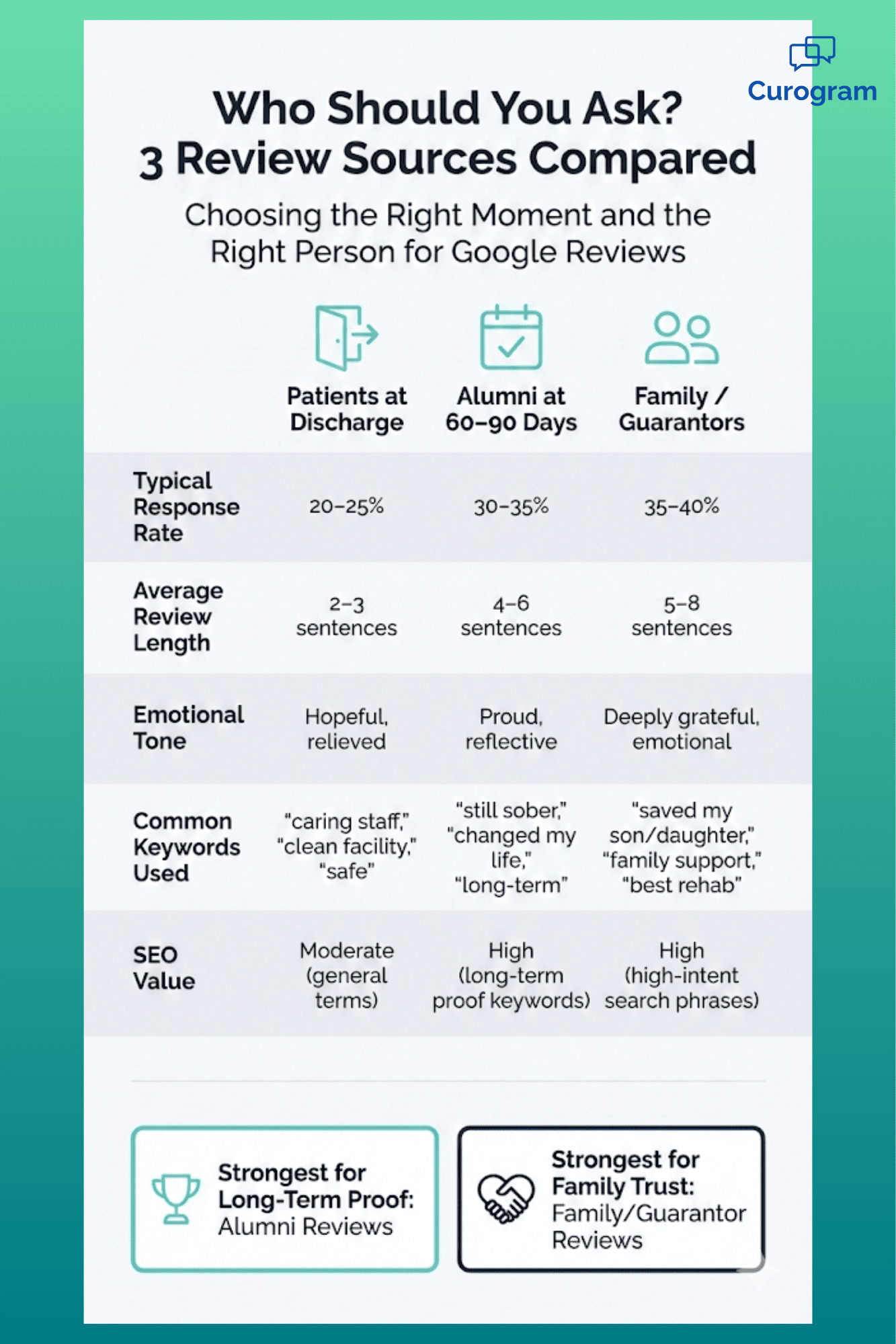
Review source matrix showing response rates and SEO value for behavioral health facilities

Milestone-Based Automation: Timing the "Ask" in Opus EHR

Timing is everything when it comes to review requests. Ask too early and the patient is still in the thick of treatment. Ask too late and the moment has passed. Google review automation for Opus EHR lets you set triggers based on real clinical events so the request lands at the best possible time.

The Transition Point

When a patient is marked as "Graduated" or "Moved to IOP" in Opus, that status change can trigger an automated SMS through Curogram. At this point, the patient has just reached a major milestone. They feel proud, hopeful, and grateful to the team that helped them get there.

Here is an example:

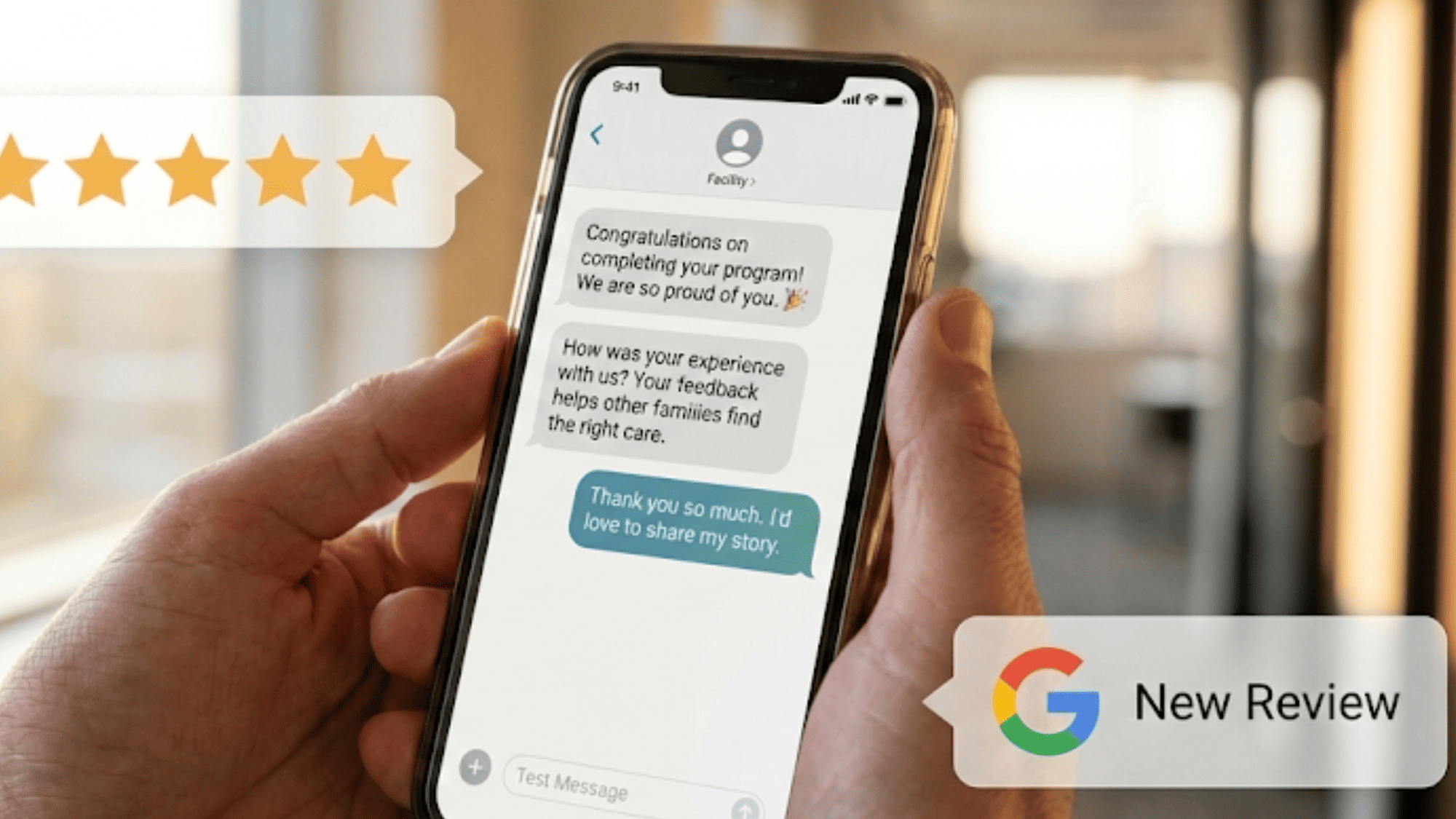
Say, a patient finishes a 30-day residential program and transitions to outpatient care. Within a few hours of that status update in Opus, they receive a simple text: "How was your experience with us?" The message is warm, short, and easy to act on.


This approach works because it catches people at their peak of positive feeling. They are not burned out or overwhelmed.

They have clear heads and strong emotions about what they just went through. A review written in that window tends to be detailed, sincere, and full of the kind of specific feedback that helps other families feel confident about choosing your facility.

The Alumni Engagement

Recovery does not end at discharge. Many patients feel even more grateful at the 60 or 90-day sobriety mark than they did on their last day in treatment.

By then, they can see how far they have come. They are back at work, with family, or living on their own for the first time in years.

Curogram lets you set up automated review prompts for alumni at these later milestones. A simple check-in text at 90 days might say: "We are proud of your progress. Would you share your story to help others find the right care?"

These alumni reviews are often the most powerful ones you will receive. They speak to long-term results, not just the treatment experience. A family reading a review that says "Six months later, my son is still sober and working again" is far more convincing than a review written on discharge day.

This kind of follow-up also supports your SUD facility digital trust. It shows that you care about patients beyond the billing cycle. And it creates a library of reviews that cover different time points in the recovery journey.

Internal Sentiment Filtering

Not every patient is happy. And that is okay. What matters is how you handle it. Curogram uses a smart two-step process before sending anyone to Google.

First, the system sends a private survey. This is an internal check-in that asks the patient to rate their experience. If the score is low, the feedback stays on your Curogram dashboard. Your team gets an alert and can reach out to resolve the issue directly

If the score is high, the system then invites the patient to share their review on Google. This way, you catch problems early and give unhappy patients a private channel to be heard.

Here is a practical example:

A patient who had a billing issue during treatment might give a 2 out of 5 on the internal survey. Instead of that complaint going straight to Google, your admin team sees it first. They can fix the billing error, follow up with the patient, and turn a bad experience into a good one.


This filter does not hide real problems. It gives you a chance to respond before they become public. And it means the reviews that do reach Google are honest reflections of patients who truly had a good experience at your facility.

Dominating Local SEO: The "Map Pack" Advantage

When someone searches "rehab near me" or "addiction treatment in [city]," Google shows three local results at the top of the page. This is the Map Pack, and it is the most valuable real estate in local search. Getting your facility into that top three can mean the difference between a full census and empty beds.

Reviews are one of the biggest factors that decide who shows up in the Map Pack. Not just the number of reviews or your star rating, but how often you get new ones. This section breaks down exactly how automated reviews help your facility win that prime position and drive more admissions.

Review Velocity and Volume

Google wants to show users the most relevant and active businesses. One of the ways it measures "active" is review velocity, or how often new reviews come in. A facility that gets 8 to 10 new reviews each month signals to Google that it is busy, trusted, and worth showing to searchers.

Compare that to a competitor who got 50 reviews last year but has not had a new one in three months. Their profile looks stale. Google takes notice and may drop them lower in the rankings.

Here is where automation gives you a clear edge:

Let us say your facility discharges 20 patients per month. Without automation, maybe 2 leave a review. With Curogram's milestone-based triggers through Opus, you reach all 20. Even at a 25% response rate, that is 5 new reviews every month like clockwork.

Over 12 months, that adds up to 60 new reviews. Your competitor who relies on manual asks might get 15 in the same period. Which listing do you think Google will favor?

Volume also matters.

A facility with 200 reviews carries more weight than one with 30, even if both have a 4.8-star rating. More reviews give Google more data to confirm that your rating is not a fluke. It also gives searchers more confidence. A family is far more likely to call a facility with hundreds of reviews than one with a handful.


Keyword-Rich Feedback

Here is something many facilities overlook. When patients write reviews, they naturally use the words and phrases that other people search for.

A review that says "The detox staff was caring and helped me through the worst days" tells Google that your facility is relevant to searches about detox services.

Another patient might write "Great PHP program. I learned coping skills I still use today." That review helps your listing rank for searches related to PHP treatment in your area.

You cannot control what patients write, and you should not try to. But when you ask for reviews at the right clinical moment, patients tend to be more specific.

A patient who just finished residential care and moved to IOP will naturally mention those program details. Their review becomes free, organic SEO content for your listing.

This is one of the hidden strengths of tying review requests to Opus milestones. Because the request comes right after a specific program event, the patient's response often names that program.

Over time, your Google Business Profile fills up with reviews that mention detox, residential, PHP, IOP, and aftercare. Google sees those keywords and connects your facility to those search terms.

For rehab center local SEO, this kind of natural keyword coverage is worth more than any meta tag or blog post. Reviews are user-generated content, and Google trusts them as honest signals about what your business does.

The "Social Proof" Click

Rankings get you seen, but reviews get you chosen. Let us walk through what actually happens when a family searches for treatment options.

They see the Map Pack with three listings. Your facility has 4.8 stars and 187 reviews. The second listing has 4.2 stars and 43 reviews. The third has 4.9 stars but only 8 reviews.

Most families will click on your listing first. The high star rating gives them confidence. The large number of reviews tells them that the rating is reliable. The low review count on the third listing, despite the higher rating, makes it feel unproven.

Your Google review profile is often the first real impression a family has of your facility. Not your website. Not your brochure. Your reviews.

Once they click through to your listing, they scan the most recent reviews. They look for stories that match their situation.

A mother looking for help for her adult son wants to read reviews from other parents. A young adult in crisis wants to see reviews from people their age.

This is why steady review volume matters so much. A fresh stream of reviews means families are more likely to find a story that speaks to them. It also means the reviews they see are current, which reinforces that your facility is still delivering great care right now.

Turning Reviews Into Admission Calls

Let us put real numbers behind this:

Say, your facility currently appears in the Map Pack for 10 local search terms. With consistent review automation, your listing could rank for 20 to 30 terms within 6 months as keyword-rich reviews build up.

If each of those search terms gets 100 searches per month and your click-through rate from the Map Pack is 15%, that is 300 to 450 profile views per month. If 10% of those views turn into a phone call, that is 30 to 45 new calls.

Even if only a third of those calls convert to admissions, you are looking at 10 to 15 new patients per month from organic search alone.

These are not paid ads. These are families who found you because real patients and families shared their honest stories.


That is the power of behavioral health reputation management done right. The Map Pack advantage is not about tricks or shortcuts. It is about building a steady, honest, and recent body of reviews that tells Google and families the same thing: this facility does great work.

When you pair that with Google review automation for Opus EHR through Curogram, you turn every successful outcome into a signal that brings the next patient through your doors.

Privacy, Ethics, and 42 CFR Part 2 in Reviews

In addiction treatment, patient privacy carries extra weight. Federal law under 42 CFR Part 2 protects substance use disorder records even beyond standard HIPAA rules.

This means your review process must be careful, neutral, and fully compliant. The good news is that Curogram was built with these rules in mind.

Neutral Language Requests

Every SMS review request sent through Curogram uses privacy-safe language. The text never mentions the type of treatment, the patient's condition, or any clinical detail. A typical message reads: "How was your experience with us?" That is it.

This simple wording does two things. It keeps you compliant with 42 CFR Part 2 by avoiding any reference to substance use treatment.

It also lets the patient decide how much to share in their own words. Some will write detailed stories. Others will keep it brief. Either way, the choice is theirs.

Professional Response Workflows

Responding to reviews is just as important as getting them. Curogram lets you set up automated "Thank You" replies for positive reviews. These templates use general language and never confirm or deny that the reviewer was a patient.

For negative reviews, the system sends an internal alert to your team. This gives you time to craft a thoughtful, professional response that does not reveal any Protected Health Information.

A good response might say: "We take all feedback seriously. Please contact our office so we can address your concerns directly."

This workflow protects your facility from accidental HIPAA violations while still showing the public that you listen and care. It is a key part of building digital trust with families who are watching how you handle criticism.

The "Voice of the Family"

Often, the most grateful person is not the patient but the family member. A parent who watched their child struggle and then recover through your program has a powerful story to tell.

Curogram allows you to target "Guarantors" or "Family Contacts" listed in Opus for review requests. This opens a whole new source of honest, emotional feedback. A mother writing "This place saved my son's life" carries enormous weight for other families in the same position.

Family reviews also tend to use search-friendly language like "best rehab for my daughter" or "great family support during treatment." This boosts your addiction treatment Google reviews with terms that match real searches.

Smartphone showing an automated review request text message from a rehab facility

Turn Your Success Stories into Your Best Marketing

Every five-star review is a success story written by the people who lived it. No ad campaign can match the trust that comes from a real patient or family member sharing their experience. The facilities that grow the fastest are the ones that capture these stories consistently and use them as the core of their marketing strategy.

Think of your review profile as a living case study library. Each new review adds proof that your clinical approach works.

When a potential patient or family member visits your Google listing, they are not reading ad copy. They are reading real outcomes from real people.

This is why review automation is not just an SEO tactic. It is a marketing strategy that feeds itself. More reviews lead to better rankings.

Better rankings lead to more profile views. More views lead to more calls. And more calls lead to more admissions, which creates more successful outcomes to review.

Your facility's greatest marketing asset is the work you already do. Google review automation for Opus EHR simply makes sure that work is visible to the people who need it.


How Curogram Turns Opus EHR Into a Review Engine


Curogram is the most advanced and HIPAA-compliant patient texting platform built to work with almost any EMR, including Opus EHR. It automates front desk functions, streamlines patient outreach, and increases revenue for medical practices and treatment centers alike.

For behavioral health and SUD facilities, Curogram turns the Opus clinical workflow into a review-generating engine. Here is how it works in practice.

When a patient hits a milestone in Opus, such as program completion or a step-down in care level, Curogram detects the status change and sends a timed SMS. The message uses neutral, compliant language that respects patient privacy while inviting honest feedback.

Before any feedback reaches Google, it passes through Curogram's internal sentiment filter. Low scores stay on your private dashboard so your team can follow up.

High scores trigger a gentle prompt to share the experience publicly. This two-step process protects your online profile while giving every patient a voice.

Curogram also lets you reach alumni and family contacts stored in Opus. This means you can send check-in messages at 60 or 90 days post-discharge, capturing the long-term gratitude that makes reviews truly powerful.

Beyond reviews, Curogram offers automated appointment reminders, electronic patient forms, text-to-pay billing, and secure internal messaging. All of these features work together to reduce phone calls, cut no-show rates, and free up your staff for clinical work.

The platform integrates with Opus as a seamless add-on, with no need for double data entry. Staff training takes about 10 minutes. And because Curogram is HIPAA-compliant, every message and workflow meets the strict privacy standards that behavioral health facilities require.

Conclusion

The best marketing your facility can do is let recovered patients and grateful families speak for you. No website redesign, paid ad, or brochure will ever match the trust that comes from honest, recent Google reviews.

But those reviews will not happen on their own. The patients who get better move on. The staff who could ask are busy saving lives. And every day without fresh reviews is a day your competitors climb higher in the search results.

Google review automation for Opus EHR through Curogram fixes this problem at the source. It ties review requests to the clinical moments that matter: program completion, care transitions, and long-term sobriety milestones.

It filters feedback so your team can catch issues early. And it does all of this without adding a single task to your staff's workload.

The impact goes far beyond SEO. A strong review profile builds the kind of SUD facility digital trust that turns a scared parent's late-night search into a phone call. It shows families that your facility does not just promise results but delivers them, as told by the people who were there.

You already do the hard work of helping people recover. Curogram makes sure that work shows up where families are looking. With steady review velocity, keyword-rich feedback, and full compliance with HIPAA and 42 CFR Part 2, your facility can own the Map Pack in your local market.

Stop letting your best outcomes stay invisible. Schedule a quick demo with today to see how Curogram and Opus EHR can turn your success stories into your strongest growth channel.


Frequently Asked Questions

Will this help our SEO ranking?
Yes. Review count, star rating, and review freshness are top-tier ranking factors for the Google Local Pack. A steady flow of new reviews signals to Google that your facility is active and trusted, which pushes your listing higher in "rehab near me" searches.
What if we get a negative review?
Curogram's built-in feedback loop sends a private survey before directing anyone to Google. If a patient scores low, the feedback stays on your internal dashboard so your team can reach out and resolve the issue before it becomes a public review.
Is it HIPAA compliant to ask for reviews?

Yes, as long as the request uses neutral language and is sent through a secure platform like Curogram. The message must not reference treatment details, and patients should never be pressured or offered rewards in exchange for a review.

How does Curogram know when to send a review request through Opus EHR?

Curogram syncs with Opus and detects status changes like "Graduated" or "Moved to IOP." When a patient hits one of these milestones, the system sends a timed SMS review request with no manual effort from your staff.

Why does review velocity matter more than total review count for local SEO?

Google favors businesses that receive new reviews on a steady basis. A facility with 5 fresh reviews each month will often outrank a rival with more total reviews but no recent activity, because freshness signals ongoing quality.


How Tebra Users Can Automate Review Requests

How Tebra Users Can Automate Review Requests

💡 For small healthcare practices, every review matters. Yet many patients won’t leave feedback unless prompted. Manually requesting reviews takes...

Read More
Reputation Management in InSync EMR with Curogram

Reputation Management in InSync EMR with Curogram

💡 Reputation management in InSync helps behavioral health practices manage online presence. With automation, you can collect more positive reviews...

Read More
Reputation Management in StreamlineMD for Radiology Teams

Reputation Management in StreamlineMD for Radiology Teams

💡 Reputation management in StreamlineMD helps radiology, vascular, and IR practices build a stronger online presence through automated feedback...

Read More