13 min read
Secure Texting for Opus EHR: Bridging the Gap in Behavioral Healthcare
Mira Gwehn Revilla
:
February 4, 2026
- Engages high-intent leads within seconds using secure two-way messaging
- Meets both HIPAA and 42 CFR Part 2 rules for substance use disorder privacy
- Connects counselors, nurses, and case managers in real-time group threads
- Allows patients to respond via browser link without needing an app
- Logs every message for audits and compliance reviews
A person calls your facility at 2 a.m. asking for help. They are ready to change their life. But your phone lines close at 5 p.m. By morning, that moment of courage may be gone.
In addiction treatment, timing is everything. The gap between a person reaching out and walking through your doors can mean the difference between recovery and relapse. For centers using Opus EHR, slow or unsafe communication puts both patients and compliance at risk.
That is where HIPAA compliant texting for Opus EHR changes the game. By using a secure platform like Curogram, treatment facilities can respond to leads in seconds, not hours.
This means catching patients at their most ready state and guiding them toward admission before doubt sets in.
But speed alone is not enough. Substance use disorder texting must also follow strict federal rules.
Unlike general health records, addiction treatment data has extra privacy shields under 42 CFR Part 2. Your texting tool needs to handle both HIPAA and these tighter federal standards.
Secure messaging also solves a hidden problem inside your walls. Care teams in residential settings often struggle to stay in sync. Nurses, counselors, and case managers work different shifts.
Without a central hub, updates get lost. Patients fall through the cracks. Staff resort to personal phones, creating huge compliance gaps.
Opus EHR messaging integration through Curogram connects your entire team on one secure platform. It works on phones and desktops. Every message is logged and ready for audits. Patients can reply without downloading any app.
This guide will show you how secure texting bridges the gap in behavioral health care coordination. You will learn how to capture more leads, protect patient privacy, and keep your team aligned from first contact to discharge.
The "Latency" Villain: Why Slow Communication Stalls Recovery
In behavioral health and addiction treatment, slow responses can cost lives. When someone finally decides to seek help, that window of willingness is small. A delay of even a few hours can mean a lost patient and, far worse, a lost chance at recovery.
The Window of Willingness
Picture this: A mother calls about her son at 11 p.m. He just agreed to enter treatment after months of refusing. She leaves a voicemail. By the time your admissions team calls back the next morning, he has changed his mind.
This scenario plays out every day at treatment centers across the country. The moment of clarity that leads someone to seek help for substance use disorder is fragile.
Fear, denial, and cravings quickly fill the gap. If your facility cannot engage that person within minutes, another center will. Or worse, no one will.
Text messages have a 98% open rate, and most are read within three minutes. Compare that to email, which sits unread for hours or days.
For high-intent leads, HIPAA-compliant SMS for addiction treatment gives your team the speed needed to convert interest into intake. A quick text saying "We got your message and can help. Ready to talk?" keeps that door open until a counselor can follow up.
The Fragmented Care Team
Speed matters inside your facility too. Residential treatment centers run around the clock. Nurses handle one shift. Counselors cover another. Case managers work days. When information gets trapped in silos, patient care suffers.
Consider a real-world example:
A patient tells their counselor during a morning session that they are thinking about leaving. The counselor makes a note in Opus but has no way to alert the nursing staff or front desk in real time. By the afternoon shift, no one has seen the update. The patient walks out against medical advice.
This kind of breakdown in behavioral health care coordination happens when teams rely on paper notes, phone tag, or chance hallway chats. Secure group messaging creates a direct line between all team members.
When a counselor flags a concern, the nurse on duty sees it instantly. The case manager can start planning next steps. Everyone stays on the same page, even across shift changes.
The Personal Device Liability
Here is the dirty secret of many treatment centers: Staff text each other on personal phones. They do it for speed. A quick message to a coworker feels faster than logging into the EHR or waiting for a callback.
But every time staff use iMessage, WhatsApp, or standard SMS to share patient info, they create a compliance nightmare. Personal phones lack encryption. Messages live on devices that can be lost, stolen, or accessed by others. None of these chats are logged for audits.
For addiction treatment centers, the stakes are even higher. Under 42 CFR Part 2, any data that could identify a person as having a substance use disorder requires extra protection. A casual text like "Did you see John in Group B today?" could count as a violation if it links a name to treatment status.
42 CFR Part 2 compliant messaging solves this problem at the root. Staff get the speed they want through a secure channel that meets federal rules.
Every message is encrypted. Every exchange is logged. Personal phones stay personal, and work chats stay protected.
The latency villain is not just about slow responses to new leads. It is about the gaps that form when care teams cannot communicate fast enough or safely enough. Secure texting closes those gaps, so your facility can focus on what matters most: helping patients heal.

Security Beyond HIPAA: 42 CFR Part 2 & SUD Privacy
Most healthcare providers know about HIPAA. But if your facility treats addiction, you face a second layer of rules that many texting platforms ignore. These extra standards can make or break your compliance status during audits.
Enhanced Confidentiality for Substance Use Records
HIPAA protects general health information. But 42 CFR Part 2 goes further for substance use disorder records. This federal rule says that any data identifying a patient as seeking or receiving addiction treatment needs tighter controls.
Why the extra layer? Stigma. A leaked mental health diagnosis can hurt someone's job or relationships. A leaked addiction record can destroy them. Congress created 42 CFR Part 2 to encourage people to seek help without fear of exposure.
What does this mean for your texting platform? Standard HIPAA-compliant tools may not be enough.
The system must restrict access so only authorized staff see substance use disorder texting threads. It must prevent casual sharing or forwarding. And it must give patients control over who can view their records.
For example:
Imagine a patient enters detox at your facility. Their employer calls asking if they are enrolled. Under 42 CFR Part 2, you cannot confirm or deny treatment without written consent from the patient. If your texting system allows any staff member to see and share that data, you risk a breach.
Curogram's secure messaging keeps substance use records in a protected layer. Staff access is role-based.
Only team members assigned to a specific patient can view their threads. This protects your facility and your patients from accidental or improper disclosure.
Audit-Ready Logs
When federal auditors come knocking, they want to see proof. Who sent what message? When? To whom? Did the recipient read it?
Personal phones and standard SMS leave no usable trail. Messages get deleted. Timestamps are unreliable. There is no way to prove who saw what information or when.
Opus EHR messaging integration through Curogram changes this. Every message sent through the platform is time-stamped and stored.
You can pull up a full log showing the exact flow of any conversation. This protects your facility during compliance reviews and gives you backup in case of disputes.
Consider a scenario where a former patient claims they never received discharge instructions. Without message logs, it is your word against theirs.
With Curogram, you can show the exact date, time, and delivery status of every text you sent. You can prove the patient opened the secure link and viewed the content.
These logs also help with internal quality checks. Supervisors can review how quickly admissions staff respond to leads.
They can spot patterns where messages go unanswered. This data turns into training opportunities and better outcomes for future patients.
Secure Document Sharing
Admissions is more than just phone calls. Your team needs to collect insurance cards, IDs, and clinical assessments before a patient can start treatment. The faster you verify benefits and gather paperwork, the faster you can admit.
Secure texting makes this process simple. Your admissions team can request documents via text. The patient snaps a photo of their insurance card and sends it through a secure link. The image goes straight into a compliant channel, where your team can verify benefits inside Opus.
Compare this to the outdated way: Asking patients to email documents (not secure), fax them (who owns a fax?), or bring hard copies (delays intake by days). Secure document sharing cuts the verification of benefits process from days to hours, or even minutes.
For behavioral health centers, every hour saved in admissions is an hour sooner a patient can start healing. And every document exchanged through secure channels is one less compliance risk on your plate.

The Digital Staff Room: Internal Coordination for Care Teams
A treatment center is only as strong as its team. Counselors, nurses, doctors, case managers, and front desk staff all play a role in patient recovery. But when these groups cannot talk to each other in real time, cracks form. Patients slip through. Care quality drops.
Secure texting creates a digital staff room where your entire team stays connected. Think of it as a group chat with guardrails, built for healthcare and ready for audits.
Secure Group Threads
In a residential treatment facility, dozens of people may touch a single patient case. The intake coordinator sets up the file. The medical team handles detox. The counselor leads therapy. The case manager plans aftercare. If any of these links break, the patient suffers.
Group threads let you create channels for specific patient cases or care teams. Everyone with access sees the same updates in real time. No more hunting down the right person or waiting for shift change reports.
Here is a practical example:
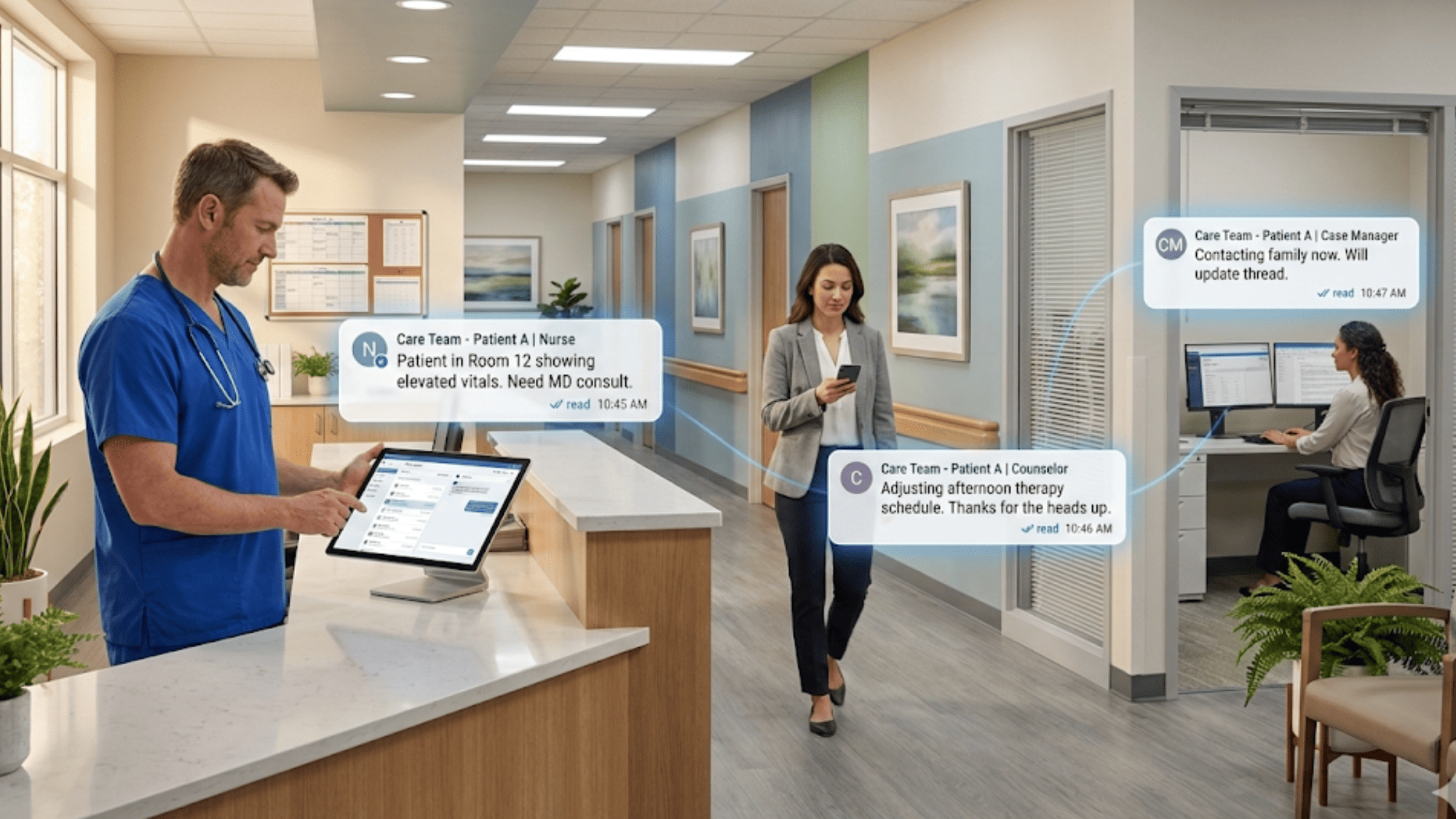
A patient in your detox unit starts showing signs of severe withdrawal. The nurse sends a message to the care team thread: "Patient in Room 12 showing elevated vitals. Need MD consult."
The on-call doctor sees it within seconds and responds with orders. The counselor, seeing the thread, adjusts the afternoon therapy schedule. Everyone adapts without a single phone call.
This kind of behavioral health care coordination used to require pagers, overhead pages, or physically walking the halls. Secure group threads replace all of that with instant, documented exchanges.
You can also set up threads by role or department. Admissions can have their own channel. Nursing can have theirs.
When cross-team updates are needed, staff can post to shared threads. This keeps chatter organized and ensures the right people see the right messages.
Status Visibility
Have you ever sent an important message and wondered if it was received? In healthcare, that doubt can be dangerous. A missed handoff during a shift change can lead to a patient not getting their medication. A lost update can mean a crisis goes unaddressed.
Secure texting through Curogram shows delivery and read status for every message. You know the exact moment your message landed and when the other person opened it. This removes the guesswork that plagues phone calls and voicemails.
Consider shift handoffs:
The day nurse finishes her rounds and sends a summary to the night team: "Patient A requested pain review. Patient B had a family visit, seemed down after. Patient C stable."
Before leaving, she can see that the night nurse read the message. No more hoping the voicemail was heard or the paper note was found.
This status visibility also helps supervisors track response times. If a message sits unread for too long, the system can send reminders. You can set alerts for critical threads so urgent issues never slip through.
For admissions, status visibility is a game-changer. Your team sends a welcome text to a new lead. You see it was delivered and read within two minutes, but no reply comes.
That is a signal to follow up with a phone call right away, while the lead is still engaged. Without read receipts, you might wait hours, assuming the person just had not seen the text yet.
Desktop & Mobile Sync
Not everyone on your team works the same way. Clinicians on the floor need mobile access. They move from room to room and cannot sit at a desk all day. Administrative staff in the office prefer desktop screens where they can manage multiple threads at once.
Curogram syncs across both. The same conversation that a nurse reads on her phone appears on the billing clerk's desktop.
Messages sent from one device show up instantly on the other. No one is out of the loop because of where they happen to be working.
This sync also supports hybrid work. A case manager working from home can jump into a patient thread just as easily as if she were in the office. A weekend on-call counselor can handle urgent messages from a tablet. The platform goes wherever your team goes.
Here is how this plays out in practice:
Your admissions coordinator sits at her desk, managing a queue of new leads on her desktop. She texts a patient who just filled out an online form: "Hi, thanks for reaching out. Can we schedule a call today to go over your options?"
Meanwhile, the admissions director is in a meeting but gets a mobile alert that a VIP referral just came in. He can review the conversation on his phone and chime in without leaving the room.
Desktop and mobile sync also helps during crises. A patient in early recovery reaches out at 10 p.m. with thoughts of relapse. The on-call counselor gets the alert on her phone.
She can respond immediately, then loop in the nursing station via the group thread. The night supervisor, checking in from home, sees the exchange on her laptop and can offer backup support if needed.
Reducing AMA Discharges
Against medical advice discharges are a constant threat in addiction treatment. Patients in early recovery face intense cravings and emotional swings. A bad phone call with a family member or a tough group session can push someone toward the door.
Fast internal communication helps your team intervene before it is too late. When a counselor notices warning signs, such as isolation or negative talk, they can alert the care team instantly.
The nursing staff can check in during rounds. The case manager can call the family to address concerns. This coordinated response often makes the difference.
Without secure messaging, these alerts get delayed. A note in the chart might not be seen until the next shift. A voicemail might go unheard. By the time someone acts, the patient has already left.
Secure group threads turn your facility into a rapid-response unit. The moment someone flags a risk, the whole team can mobilize. That kind of teamwork saves lives.
Accelerate the Path to Recovery
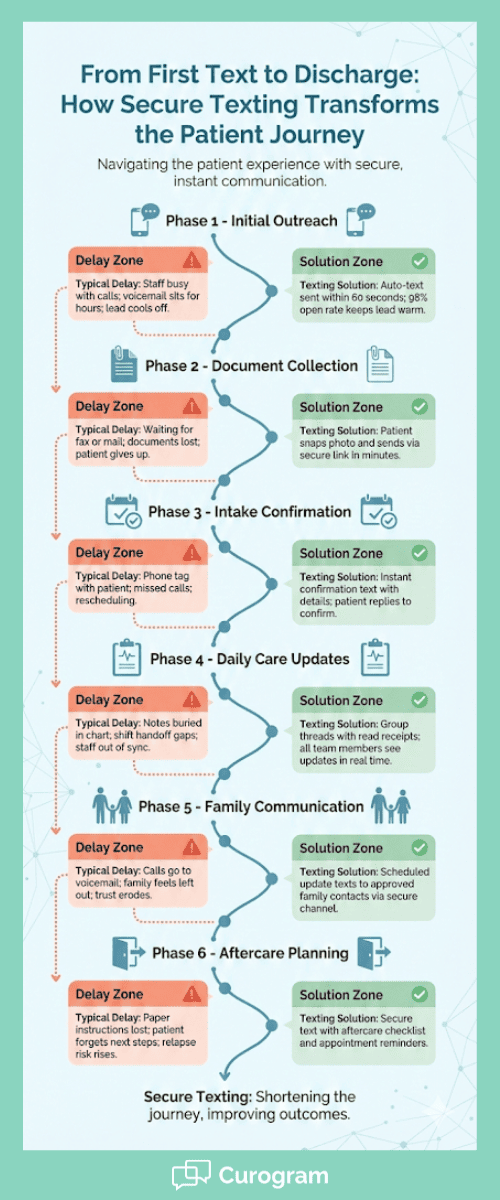
Every day a patient waits for treatment is a day they risk changing their mind. The journey from first contact to admission should be as short and smooth as possible.
Secure texting removes the friction that slows intake. Leads get instant responses. Documents arrive in minutes, not days. Insurance checks start right away. Your admissions team can guide patients through each step without playing phone tag.
Inside your facility, care teams stay aligned from day one. Group threads ensure that counselors, nurses, and case managers all see the same updates. When someone flags a concern, the whole team can respond before it becomes a crisis.
For outpatient programs, texting keeps patients connected between visits. A quick check-in text can catch warning signs early. A reminder before a group session reduces no-shows. This ongoing contact builds trust and supports lasting recovery.
The goal is not just speed for its own sake. It is about closing the gap where patients fall through. Every missed call, delayed email, or lost note is a chance for doubt to creep in. Secure texting fills those gaps with real-time, documented communication.
When your facility can move faster and communicate better, more patients make it through intake. More patients complete treatment. More lives change. That is the true value of Opus EHR messaging integration through Curogram.
How Curogram Speeds Up Admissions and Connects Care Teams
Curogram brings HIPAA compliant texting for Opus EHR to behavioral health and addiction treatment centers. The platform is built for the unique needs of facilities that must meet both HIPAA and 42 CFR Part 2 compliant messaging standards.
With Curogram, your admissions team can respond to leads within seconds. Text messages reach patients directly on their phones, with a 98% open rate that far exceeds email or voicemail.
Patients reply through a secure browser link without needing to download an app. This removes barriers for people in crisis or early recovery who may not have time or patience for extra steps.
Inside your facility, Curogram creates a digital hub for care teams. Counselors, nurses, and case managers can all join secure group threads tied to specific patient cases.
Everyone sees the same updates in real time. Status visibility shows when messages are delivered and read, so no one wonders if their handoff note was received.
The platform syncs across desktop and mobile devices. Office staff can manage threads on a computer screen while clinicians on the floor respond from their phones. This keeps everyone in the loop no matter where they work.
Every message is encrypted, logged, and ready for audits. You can pull full conversation histories to show compliance during federal reviews. Role-based access ensures that only authorized staff see sensitive substance use disorder records.
Curogram also supports secure document sharing. Patients can send insurance cards, IDs, and assessments through the same texting channel. This speeds up verification of benefits and shortens the path from lead to intake.
For behavioral health and addiction treatment centers seeking faster admissions and tighter care coordination, Curogram delivers. Schedule a 10-minute demo to see how secure texting for Opus EHR can transform your facility.
Conclusion
Slow communication costs lives in addiction and mental health treatment. When a patient reaches out for help, every hour of delay risks losing them. When care teams miss updates, patients slip through the cracks.
HIPAA compliant texting for Opus EHR solves both problems at once. It gives your admissions team the speed to engage leads in real time. It gives your care staff a secure channel to stay in sync across shifts and departments.
The platform goes beyond basic HIPAA rules. For facilities treating substance use disorders, 42 CFR Part 2 compliant messaging is not optional. Curogram meets these tighter standards, protecting patient privacy and keeping your facility audit-ready.
Patients also benefit. They can respond to texts without downloading an app. They can send documents through a secure link in seconds. This makes the intake process faster and easier for people who may already feel overwhelmed.
Inside your walls, secure group threads create a digital staff room. Counselors, nurses, and case managers all see the same updates. Status visibility removes the guesswork from shift handoffs. Desktop and mobile sync means no one is out of the loop, no matter where they work.
The result is better behavioral health care coordination from first contact to discharge. Faster response times mean more leads convert to admissions. Tighter teamwork means fewer AMA discharges. Stronger compliance means less risk during audits.
If your facility uses Opus EHR, secure texting is the missing link between your clinical system and real-world patient engagement. Curogram brings Opus EHR messaging integration that fits the way your team already works.
Schedule a 10-minute demo today to see how secure texting for Opus EHR can help your facility drive admissions and provide a higher standard of coordinated care.
Provide a higher standard of coordinated care. Schedule a quick demo now to see how secure texting for Opus EHR can help your facility drive admissions.
Frequently Asked Questions
No. When your team sends a secure text, the patient receives a standard SMS with a link. Clicking the link opens a browser-based chat that is fully encrypted. The patient can respond, send photos, or view documents without ever installing anything.
Staff can flag warning signs in a shared thread that the whole team sees instantly. This allows counselors, nurses, and case managers to coordinate a fast response before a patient decides to leave.
Patients in crisis or early recovery often lack the time or resources to install apps. A browser link works on any phone and opens in seconds, removing a major barrier to engagement.