13 min read

Broadcast Messaging for Opus EHR: Mass Texting for Rehab Clinics

Broadcast Messaging for Opus EHR: Mass Texting for Rehab Clinics
💡 Broadcast messaging for Opus EHR lets addiction treatment centers and behavioral health clinics send mass texts to filtered patient groups through Curogram.
  • Send urgent alerts about closures or schedule changes to all patients at once
  • Reach alumni with recovery support texts and event invites
  • Filter recipients by program type, counselor, or admission date
  • Stay compliant with HIPAA, 42 CFR Part 2, and TCPA rules
  • Replace 50+ hours of manual phone calls with a single message
By connecting with the Opus EHR patient database, Curogram turns one-to-one texting into a powerful one-to-many outreach tool. Facilities can scale their Opus EHR patient outreach without adding staff.

Picture this. A storm is heading your way, and your clinic needs to close in two hours. You have 300 active patients, plus an alumni list of over 1,000 people. How do you reach them all in time?

If your answer is "start calling," you already know the problem. Your front desk team can make maybe 15 calls per hour.

That means only a small fraction of your patients hear from you before the doors shut. The rest show up to a locked building, confused and frustrated.

This is the gap that broadcast messaging for Opus EHR fills. With Curogram, your clinic can send a single text to hundreds or even thousands of patients in seconds.

No one has to dial a phone. No one has to sort through spreadsheets. The message lands on nearly every phone it is sent to.

For addiction treatment clinics and behavioral health centers, this kind of reach is not just a nice-to-have. It is a safety net. Whether you need to send addiction treatment clinic alerts during a crisis or keep your alumni engaged with weekly check-ins, mass patient texting for behavioral health gives your team the power to act fast.

Think about the moments that matter most in recovery. A patient leaves your program and needs to feel connected. An alumnus is looking for a support group meeting. A new therapy track opens up and you want your former clients to know. These are the moments where one message can change a life.

In this guide, we will break down how broadcast messaging works with Opus EHR, why email and phone calls fall short, and how your facility can use bulk SMS for rehab facilities to save time, stay compliant, and build a stronger recovery community.

The "Communication Void" Villain: Why Email and Manual Calls Fail

Most behavioral health clinics rely on three tools to reach patients: email, phone calls, and maybe a bulletin board in the lobby. Each of these has serious flaws that put your patients and your team at a loss.

The Email Graveyard

Let's start with email. Open rates in healthcare hover around 20% to 40%. In the behavioral health world, the numbers are often worse. Many patients in early recovery do not check email on a regular basis. Some do not have a working email address at all.

Imagine you send an email on Monday about a schedule change for Wednesday's group session. By the time Wednesday comes, four out of five patients never saw it. They show up at the wrong time or skip the session entirely. The result is wasted clinical hours and gaps in care.

Email also has a spam problem. Filters catch messages from clinic domains all the time. Even patients who want to stay informed may never see your updates because the message sits in a junk folder. For something as time-sensitive as a closure notice or a safety alert, email is simply too slow and too easy to miss.

The Manual Calling Bottleneck

Phone calls seem more reliable, but they come with a hidden cost: time. Let's say your clinic has 200 active patients and you need to tell them about a last-minute closure. If each call takes three minutes, that is 600 minutes of staff time, or 10 full hours.

Your front desk team cannot spare 10 hours on a normal day, let alone during a crisis. And that estimate assumes every patient picks up on the first try.

In reality, many calls go to voicemail. Staff then has to leave a message, note the call in the chart, and try again later.

For a facility running an IOP or PHP program, this manual process pulls your team away from the work that matters most. Counselors should be running groups, not sitting at a desk making calls. Office staff should be handling intake, not reading the same script 200 times.

The phone call model also breaks down as your patient base grows. A clinic with 50 patients can maybe get by with manual calls. A clinic with 500 cannot. And if you have a large alumni network, calling each person one by one is simply not an option.

The Segmented Silence

Here is a problem that does not get enough attention: What if you do not need to reach all your patients, just a specific group?

Consider this scenario:

Say, your Thursday night relapse prevention group has moved to a new room. You only need to text the 25 people in that group, not your entire patient list. Without a broadcast tool tied to your EHR, your staff has to dig through Opus to find those names, pull their phone numbers, and call or text each one by hand.


This leads to errors. Someone gets missed. A wrong number gets called. A patient who left the program months ago gets a confusing message. These small mistakes add up and erode trust.

The segmented silence is one of the biggest reasons facilities explore Opus EHR patient outreach tools. They need a way to send the right message to the right people without turning it into a research project for their admin team.

When email goes unread, phone calls eat up your day, and targeted outreach turns into guesswork, the result is a communication void. Your patients feel disconnected.

Your staff feels overworked. And your facility misses chances to provide timely support. Broadcast messaging for Opus EHR closes this void by giving you a fast, filtered, and scalable way to reach anyone on your patient list.

Strategic Use Cases for Opus Broadcast Messaging

Broadcast messaging is not just a tool for emergencies. It is a daily, weekly, and monthly asset that touches nearly every part of your facility's work. Here are the three most impactful ways to use it:

Urgent Operational Alerts

Weather closures, power outages, and last-minute schedule changes happen more often than anyone would like. When they do, your patients need to know right away.

With broadcast messaging for Opus EHR, you can send a single text to every active patient in seconds.

For example:

If a snowstorm forces your clinic to close on a Tuesday morning, one message can reach your entire IOP and PHP roster before anyone gets in their car. The text might read: "Due to weather, all Tuesday sessions are canceled. We will resume Wednesday at normal hours."


This prevents a wave of no-shows and confused phone calls. It also keeps patients safe.

For someone in early recovery, driving through a storm to reach a closed clinic can be more than a frustration. It can feel like a setback. A quick alert removes that stress.

Addiction treatment clinic alerts also matter for safety events. If a gas leak forces you to move to a backup site, your patients need that new address fast. A broadcast message delivers it in seconds, not hours.

Alumni and Recovery Support

The day a patient leaves your program is not the end of the relationship. For many, it is the beginning of a new and fragile chapter. Alumni engagement SMS helps your facility stay present in their lives long after discharge.

You can use broadcast messaging to send weekly inspiration texts, like a short quote or a reminder to attend a local meeting. You can invite alumni to monthly events, holiday gatherings, or support groups hosted at your clinic.

Here is a real-world example of how this might work:

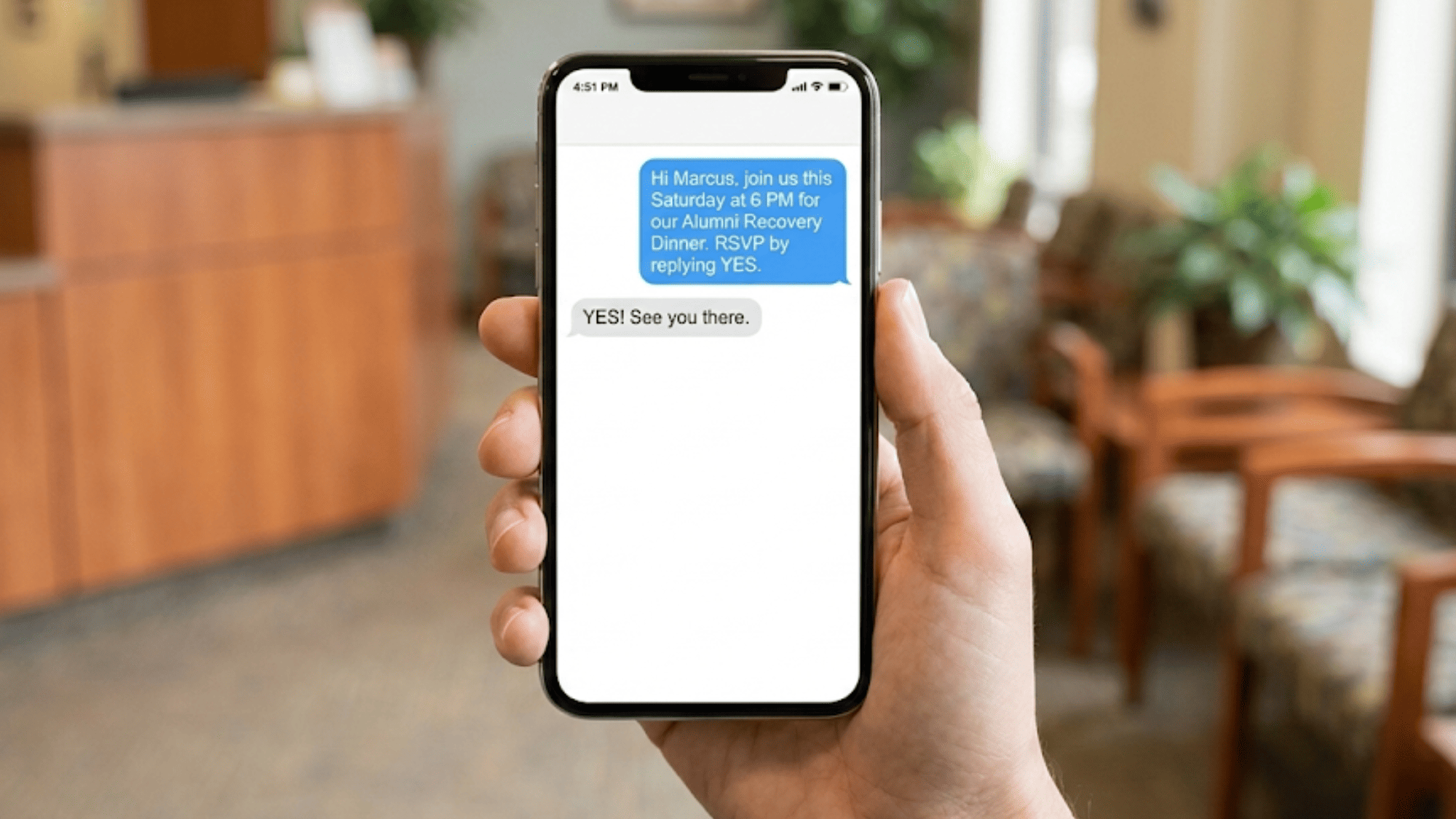
Say, your facility runs a monthly alumni dinner. Instead of relying on social media posts or flyers, you send a broadcast text to your alumni list: "Join us this Saturday at 6 PM for our Alumni Recovery Dinner. RSVP by replying YES." Within an hour, you have a headcount, and your alumni feel valued and connected.


This kind of outreach does more than fill seats. It builds a sense of community that supports long-term recovery.

Studies on addiction treatment show that ongoing contact with a treatment community can improve outcomes. Alumni engagement SMS makes that contact easy and consistent.

Program and Health Updates

Your facility is always growing. Maybe you just added a new therapy track. Maybe you hired a new counselor who is an expert in trauma work. Maybe you opened evening hours for your outpatient program.

Each of these changes is a chance to re-engage current and former patients. Broadcast messaging lets you share the news with a simple text: "Exciting update! We now offer art therapy as part of our PHP program. Ask your counselor for details."

This kind of mass patient texting for behavioral health turns your patient database into a living audience. Instead of hoping people see a post on your website, you deliver the update right to their phone.

Program updates also help drive re-enrollment. A former client who completed IOP last year may be looking for extra support. A text about your new alumni wellness group could be the nudge they need to come back.

This is how bulk SMS for rehab facilities pays for itself. It keeps your pipeline warm and your community informed, all without adding tasks to your admin team's plate.

Broadcast text message inviting alumni to recovery dinner on smartphone screen

Compliance and Etiquette in Mass Messaging

Sending hundreds of texts at once is powerful. But in behavioral health and addiction treatment, it also comes with serious rules.

Your facility handles some of the most sensitive patient data in all of healthcare. Getting compliance wrong can mean hefty fines, loss of trust, and even legal action.

This section covers the three pillars of compliant broadcast messaging: privacy laws, anti-spam rules, and message tone.

HIPAA and 42 CFR Part 2 Security

HIPAA protects patient health data across all healthcare settings. But if your facility treats substance use disorders, you also fall under 42 CFR Part 2.

This federal rule adds an extra layer of protection for SUD records. It limits who can access them and how they can be shared.

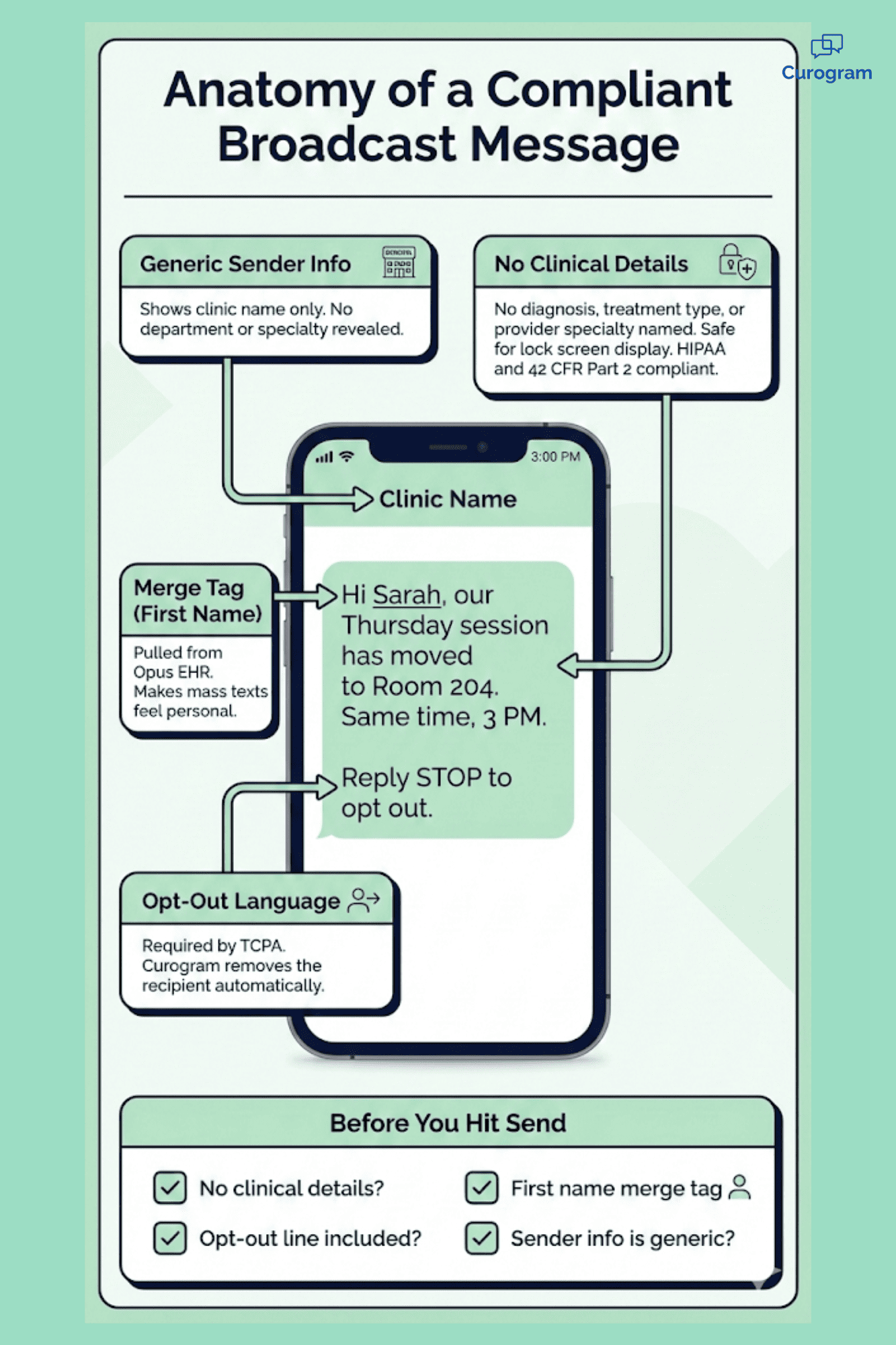
So what does this mean for broadcast messaging? It means your texts must never include clinical details. You cannot send a message that says, "Reminder: Your group therapy for alcohol use disorder meets at 3 PM." That message reveals a diagnosis, which violates both HIPAA and 42 CFR Part 2.

Instead, a compliant message would look like this: "Reminder: Your Thursday group meets at 3 PM. See you there!" This keeps the content generic. It does not name a condition, a treatment type, or any clinical detail.

Curogram's platform is built with these rules in mind. When you send a broadcast through Curogram, the message is stripped of clinical identifiers.

The text preview on a patient's lock screen will not show any protected data. This matters because anyone who picks up that phone, whether it is the patient, a family member, or a coworker, will only see a simple, safe message.

For facilities using Opus EHR, this layer of security works hand-in-hand with the patient database. You can filter your audience by program type or admission date without ever exposing that data in the message itself. The targeting happens on your end. The patient only sees a clean, generic text.

Here is a practical tip:

Before you send any broadcast, read the message out loud and ask yourself: "If a stranger saw this text on someone's phone, would they learn anything about that person's health?" If the answer is yes, rewrite it.


TCPA and 10DLC Compliance

The Telephone Consumer Protection Act, or TCPA, governs how businesses send texts to consumers. If you send a bulk message to someone who never agreed to receive it, you could face fines of up to $1,500 per message. For a broadcast sent to 500 people, that adds up fast.

This is where opt-in and opt-out rules come in. Every patient on your broadcast list must have given clear consent to receive texts.

This usually happens at intake, when a patient signs a form that includes texting consent. Curogram tracks this consent for you, so your team does not have to manage a separate spreadsheet.

Opt-out is just as important. Every broadcast message should include a simple way for the recipient to stop getting texts. Something like "Reply STOP to opt out" is standard.

Curogram handles this step on its own. When a patient replies STOP, they are removed from future broadcasts right away. No staff action is needed.

10DLC stands for 10-Digit Long Code. It is a system that phone carriers use to verify that businesses sending text messages are real and trusted.

Before you can send bulk SMS for rehab facilities, your phone number must be registered through the 10DLC process. This registration tells carriers that your messages are not spam.

Curogram walks your facility through 10DLC registration as part of the setup process. Once you are approved, your messages get better delivery rates and are less likely to be flagged or blocked by carriers. Think of it as a trust badge for your texting number.

Here is an example of how this plays out in real life:

A facility sends a broadcast to 300 patients about a new group schedule. Because the facility is 10DLC registered and every patient opted in, the delivery rate is above 95%. Compare that to a facility using an unregistered number, where carriers may block up to 30% of the messages.


Message Personalization

Compliance is about more than just following rules. It is also about tone. In behavioral health, every message your facility sends carries weight.

A cold, robotic text can feel jarring to someone who is going through a hard time. A warm, personal text can feel like a lifeline.

This is where merge tags come in. Curogram lets you pull data from Opus, like a patient's first name, and insert it into your broadcast. So instead of sending "Dear Patient," your message says "Hi Sarah." That small change makes a big difference in how the message is received.

Merge tags help you maintain what clinicians call the therapeutic alliance. Even though a broadcast goes to many people, each person feels like the message was meant for them. This is especially important for alumni engagement SMS, where the goal is to keep people connected and supported.

Here is an example of how tone and personalization work together:

  • Generic: "A new support group starts next Monday. Call for details."

  • Personalized: "Hi Marcus, we are starting a new support group next Monday at 6 PM. We would love to see you there. Reply YES if you plan to come."


The second version uses the patient's name, gives a clear time, and invites a reply. It feels like a message from someone who cares, not a system that is blasting out texts.

One more thing to keep in mind: Do not over-message. Sending too many broadcasts can feel overwhelming, especially for patients in early recovery.

A good rule of thumb is to limit non-urgent broadcasts to once or twice a week. Urgent alerts, of course, go out as needed. But your weekly updates and event invites should follow a steady, predictable rhythm that your patients can count on.

Visual breakdown of a HIPAA-safe broadcast SMS with labeled compliance callouts

Operational ROI: Scaling Outreach with Zero Extra Effort

Every hour your staff spends on the phone is an hour they cannot spend on patient care. Broadcast messaging for Opus EHR shifts the balance by turning hours of manual work into seconds of automated outreach.

Reclaiming Staff Time

Let's put some numbers to it:

If your clinic has 200 active patients and a staff member spends three minutes per call, that is 10 hours to reach everyone. If they need to follow up with those who did not answer, add another five hours. That is nearly two full workdays consumed by a single round of calls.


A broadcast message does the same job in under a minute. One text, one click, 200 patients reached.

Your staff can then use those 15 hours on tasks that actually need a human touch, like running groups, handling intake, or supporting patients in crisis.

Over the course of a month, the time savings stack up fast. If your team sends just four broadcasts that would have been phone call rounds, that is up to 60 hours saved. At an average front desk wage of $18 per hour, that is over $1,000 a month returned to your budget.

Driving Maintenance Revenue

Alumni and former outpatient clients are not just names in a database. They are potential re-enrollments. A well-timed broadcast about a new wellness group or a seasonal check-in can bring former clients back through your doors.

Facilities that use alumni engagement SMS on a regular basis report stronger connections with past patients. When a former client sees a text about a new PHP track or an alumni event, it keeps your clinic top of mind. If they need support again, they think of you first.

This is how Opus EHR patient outreach drives revenue without adding a single marketing expense. Your patient list is already built. Broadcast messaging just puts it to work.

Reducing Administrative Friction

When your outreach is scattered across personal phones, sticky notes, and email drafts, no one knows who said what to whom. Broadcast messaging centralizes everything inside the Curogram dashboard.

Every message is logged. Every reply is tracked. Your leadership team can see exactly what was sent, when it was sent, and how patients responded. This creates one source of truth for all mass patient texting for behavioral health, which makes audits simpler and keeps your team on the same page.

One Message, Infinite Impact

The power of broadcast messaging goes beyond saving time or money. It changes the way your facility relates to its community.

Think about what one well-timed text can do. A patient who was about to skip a session gets a reminder and shows up. An alumnus who was feeling alone gets an invite to a recovery dinner and reconnects. A former client who did not know about your new evening IOP learns about it and re-enrolls.

Each of those outcomes started with a single message. Multiply that by hundreds of recipients, and you begin to see the ripple effect.

Addiction treatment is built on connection. Recovery does not happen in isolation. When your facility can reach its entire community with one click, you create a safety net that stretches far beyond your walls. Every broadcast is a chance to say, "We are still here. You are still part of this."

That is the real ROI of broadcast messaging for Opus EHR. It is not just about fewer phone calls or faster alerts. It is about building a recovery community that stays connected, informed, and supported at every stage of the journey.


What Sets Curogram Apart for Mass Patient Texting


Curogram is the most advanced and HIPAA-compliant patient texting platform that integrates directly with Opus EHR. For behavioral health and addiction treatment facilities, this integration means your patient data is always current, your outreach is always compliant, and your team is always in sync.

The platform connects to your Opus EHR patient database, so you never have to export lists by hand or update contact info in two places. When a new patient is added to Opus, they are ready to receive broadcasts through Curogram.

Curogram manages compliance for you. From opt-in tracking to opt-out handling to 10DLC registration, the platform takes the guesswork out of legal requirements. Your team can focus on crafting the right message instead of worrying about fines or blocked numbers.

Every broadcast you send is logged in one central dashboard. Leadership can review message history, track reply rates, and confirm that outreach is happening on schedule. This visibility is critical for facilities that answer to accreditation bodies or state licensing boards.

Curogram also supports secure 2-way texting for follow-up conversations. When a patient replies to a broadcast, the exchange moves into an encrypted 1:1 thread. This means you can handle sensitive questions without breaking HIPAA or 42 CFR Part 2 rules.

For facilities that want to send addiction treatment clinic alerts, alumni engagement SMS, or routine program updates, Curogram gives you the reach of a mass texting platform with the security of a healthcare-grade system. It is the bridge between your EHR data and your patient community, and it works without adding a single task to your admin team's day.

Conclusion

The way your facility communicates shapes the way your patients experience care. When messages get lost in email inboxes or buried under voicemail, people fall through the cracks. In behavioral health and addiction treatment, those cracks can have real consequences.

Broadcast messaging for Opus EHR gives your team the ability to reach every patient, every alumnus, and every stakeholder with a single click. No phone trees. No guesswork. No wasted hours.

With Curogram, you get a tool built for the unique demands of your field. It respects the privacy rules that protect your patients. It handles the compliance steps that protect your facility. And it delivers messages that feel personal, timely, and supportive.

Whether you need to send urgent closure alerts, share program updates, or keep your alumni community connected, broadcast messaging turns your Opus patient list into your most powerful outreach channel.

The clinics that thrive in this space are the ones that stay in touch. They do not wait for patients to call. They do not hope that an email gets read. They reach out, and they do it at scale.

If your facility is still relying on manual calls and email blasts, you are spending time and money on methods that most of your patients will never see. Bulk SMS for rehab facilities is not a luxury. It is the standard your community expects.

Streamline your facility's outreach. Schedule a demo today to see how broadcast messaging for Opus EHR can help you mobilize your patient community.


Frequently Asked Questions

Can we send messages to specific groups in Opus?
Yes. Curogram lets you filter your patient list based on data exported from Opus. You can sort by program type, counselor, or admission date. For example, if you only need to reach your Monday IOP group, you can build a filtered list and send a broadcast just to those patients. This means your Thursday PHP group will not get a message that does not apply to them.
What happens when a patient replies to a broadcast?
When a patient replies, the response goes into a private 1:1 chat thread inside Curogram. Your team can then handle that patient's question or concern one-on-one. The reply does not go back to the full broadcast group. This protects privacy and keeps individual conversations separate from mass outreach.
Is there a limit to how many texts we can send?

No. Whether you are texting 10 patients or 10,000, Curogram is built to handle large-scale volume. The system maintains high delivery rates regardless of the size of your send. This makes it ideal for facilities with large alumni networks or multiple locations.

How does Curogram pull patient data from Opus EHR for broadcasts?

Curogram syncs with your Opus EHR database so you can filter recipients by program type, counselor, or admission date without manual data entry or spreadsheet exports.

How does Curogram prevent HIPAA violations in broadcast messages?

The platform strips clinical identifiers from outgoing texts, so lock screen previews never reveal diagnoses, treatment types, or other protected health information.


How Opus EHR Broadcast Alerts Keep Patients Safe in a Crisis

How Opus EHR Broadcast Alerts Keep Patients Safe in a Crisis

💡 Opus EHR broadcast alerts through Curogram let behavioral health centers send urgent SMS updates to patients in seconds. Notify all scheduled...

Read More
Boost Alumni Engagement for Addiction Treatment With Broadcast SMS

Boost Alumni Engagement for Addiction Treatment With Broadcast SMS

💡 Addiction treatment centers can boost long-term recovery and grow referrals by using alumni engagement for addiction treatment through the Opus...

Read More
Broadcast Messaging for Cerbo: Scaling Community via Bulk SMS

Broadcast Messaging for Cerbo: Scaling Community via Bulk SMS

💡 Broadcast messaging for Cerbo lets integrative and functional medicine practices send bulk SMS to their entire patient base at once. SMS has a...

Read More