Broadcast Messaging for Opus EHR: Mass Texting for Rehab Clinics
💡 Broadcast messaging for Opus EHR lets addiction treatment centers and behavioral health clinics send mass texts to filtered patient groups...
12 min read
Mira Gwehn Revilla
:
Updated on February 17, 2026
The day a patient leaves your treatment center is not the end of their story. It's the start of the hardest chapter. Without a plan to stay in touch, that patient may drift away and lose the support they need most.
This is the gap that alumni engagement for addiction treatment is built to close. When your facility keeps the door open through simple, regular outreach, you do two things at once. You help former patients stay on track. And you build a pipeline of loyal advocates who send new referrals your way.
The problem? Most centers rely on email blasts or annual events that former patients never see. A person in early recovery is not checking their inbox for a monthly update. They are focused on daily survival. They need a message that meets them where they are, right on their phone.
That is where the Opus EHR and Curogram link changes the game. With broadcast SMS, your alumni team can reach hundreds of past patients in seconds.
You can send sober date shoutouts, group invites, quick pulse checks, and resource links, all from one dashboard tied to your Opus records.
This is not just a nice touch. It is a growth engine. Centers that invest in rehab alumni outreach see higher referral rates, stronger brand trust, and better long-term outcomes for the people they serve.
In this guide, you will learn how to build a full alumni SMS plan using Curogram and Opus EHR. We will cover the real cost of silence after discharge, walk through proven campaign types, and show you how to build a recovery community that scales.
Whether you are an alumni lead, a marketing director, or a clinical director, this article will give you a clear path forward.
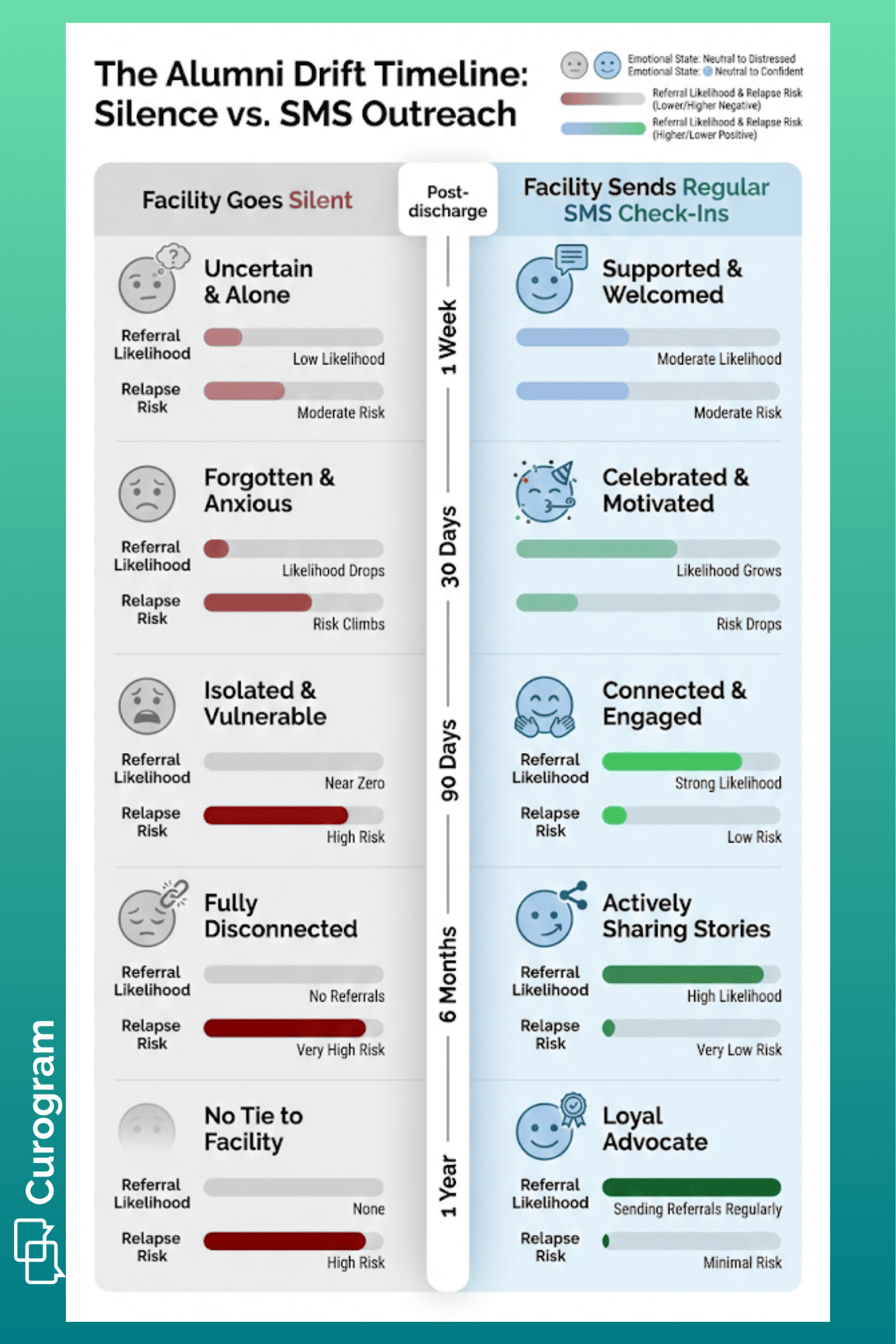
When a patient walks out the door for the last time, the clock starts ticking. Every day that goes by without contact from your facility is a day that patient feels more alone. This is the "post-discharge silence" trap, and it is one of the biggest threats to long-term patient retention.
Think about what your patient just left behind. In treatment, they had a daily schedule, group therapy, peers, and staff who knew their name. Now they are home, facing triggers, old habits, and a world that did not stop while they were away.
If your center does not reach out, the message is clear to them: "You are on your own now." That feeling of being forgotten can undo months of hard work.
The first 90 days after discharge are the most fragile window. A simple text that says, "We are thinking of you," can be the thread that keeps someone tied to their support network.
Rehab alumni outreach does not need to be complex. It just needs to exist. A short message at the right moment can remind a former patient that they still belong to a community that cares.
Here is a hard truth: Most alumni are not reading your emails. Open rates for email in the health care space hover around 20%. That means 8 out of 10 former patients never see your updates.
Why? Because someone in early recovery is not sitting at a desk sorting through their inbox. They are at work, in a meeting, cooking dinner, or trying to stay busy to avoid cravings. Email is easy to ignore. Text is not.
SMS open rates sit above 90%, and most texts get read within three minutes. When you use SUD recovery support SMS through Curogram, your message lands right on the screen your alumni are already looking at.
Compare that to a full HTML email with graphics and a long subject line. The email may look great in your marketing tool, but it collects dust in a spam folder. The text, short and direct, gets noticed.
Now, let's talk about growth. Happy alumni are the single best source of new leads for any treatment center.
When someone has a good outcome and feels connected to your program, they tell people. A friend, a coworker, a family member in crisis, they all hear about your center first.
But here is the catch. If you go quiet after discharge, you lose that "top of mind" spot. When their friend needs help six months later, they may not think of you at all. They might search online, call their doctor, or pick the first name they find.
This is the referral gap, and it costs centers real money. Think about what a single new admission is worth to your business. Now, picture losing five or ten of those each year because your alumni forgot your name.
With Opus EHR alumni messaging, you can send regular, low-effort updates that keep your brand front and center. A quick text about an upcoming event or a simple "How are you doing?" goes a long way. Over time, that tiny touchpoint builds loyalty. And loyalty drives referrals.
Behavioral health community building starts with showing up, not once, but over and over again. When your alumni feel like they still matter to your team, they become your loudest champions. When they go silent, so does your referral pipeline.
The fix is not more staff or bigger budgets. It is a smarter system. And that system starts with a text.
Sending random texts will not build trust. You need a plan with clear goals for each type of message. The best alumni campaigns are timely, short, and tied to a real purpose.
Here are three proven campaign types you can launch right now using Curogram and Opus EHR:
Recovery is full of small wins that deserve big praise. With Opus data, your team can track key dates for each alumni, such as their 30-day, 60-day, 90-day, and one-year marks. Curogram lets you set up broadcast messages that go out to everyone hitting a milestone in a given week.
|
Picture this: A former patient is having a rough Tuesday. Their phone buzzes. The text reads, "Congrats on 90 days! We are so proud of your progress. Keep going." That one message could be the boost they need to get through the day. |
This kind of SUD recovery support SMS does not feel like marketing. It feels like care. And that is why it works. You are not selling anything. You are just showing up at the right time.
For best results, keep these texts to two or three lines. Use first names where you can. Add a heart emoji or an exclamation point to keep the tone warm. Avoid clinical language. Think of how a friend would text, not how a doctor would write a chart note.
Most centers host alumni events, whether it is a weekly Zoom call, a monthly speaker night, or a summer cookout. The problem is not the event. It is getting people to show up.
Email invites get lost. Flyers get tossed. But a text that says, "Alumni Zoom tonight at 7 PM. Click here to join," has a far better shot at filling seats.
Curogram makes it easy to send these invites to your full alumni list or to a filtered group. You can even add a "Click to RSVP" link so you know who is coming. This helps your staff plan for the right group size and follow up with those who do not respond.
These group events are key to behavioral health community building. They give alumni a reason to stay plugged in, a chance to share their story, and a space to connect with peers who understand.
This may be the most powerful tool in your alumni outreach kit. Once a month, send a simple, one-question text: "How is your recovery going today? Reply 1 for Great, 2 for Struggling, 3 for Need to Talk." That is it. No long surveys. No app to open. Just one tap.
What makes this so useful is the action it unlocks. When someone replies "3," your team gets an instant alert. A counselor can call that person within minutes, not days. This kind of fast follow-up can stop a relapse before it starts.
For a center with 500 alumni, imagine 10% respond to your monthly check-in. That is 50 data points your team would not have had. If even five of those people say they are struggling, you just caught five at-risk individuals before they fell through the cracks.
This approach supports long-term patient retention because it shows alumni you are paying attention. It is not a mass blast for the sake of it. It is a system that listens.
Opus EHR alumni messaging makes all of this possible without adding hours to your staff's day. The data lives in Opus. The outreach lives in Curogram. And the impact lives in the lives of your alumni.
Each of these campaigns takes minutes to set up and can run on autopilot once it is built. The key is to start with one, test it for a month, and then add the next.

One-off texts are a start. But to truly change outcomes, you need a full system. A recovery ecosystem is a network of touchpoints that keeps every former patient connected to your center, no matter when they graduated.
With the right setup in Opus EHR and Curogram, you can build this system without hiring extra staff or buying new tools:
A person who left your program last week has very different needs than someone who has been sober for three years. If you send both the same message, you miss the mark with both.
Curogram's broadcast filters let you slice your alumni list by key data points. You can group by graduation date, program type (residential vs. outpatient), age range, or even zip code. This means you can craft messages that feel personal, even when they go to hundreds of people.
|
For example: Send your recent graduates a weekly check-in for the first 90 days. These are the people in the highest-risk window. They need frequent, warm contact. A text like, "Day 45! You are doing amazing. Remember, we are here if you need us," can mean the world. |
For alumni who are one year out, shift to monthly updates. Share event dates, new blog posts, or a quick note about an upcoming speaker. These people are more stable, but they still need to feel like they belong.
For your five-year-plus group, try quarterly messages. Invite them to mentor newer graduates or share their story in an "Alumni Spotlight" text. This gives them a role in your community and keeps the bond alive.
The beauty of this segmented approach is that it scales. You are not writing 500 custom texts. You are writing three or four message templates and letting Curogram send the right one to the right group. This is how smart rehab alumni outreach works at scale.
Recovery can feel lonely, even for those who are doing well. One of the best ways to fight that is to show alumni that they are not alone, that others from their program are thriving too.
Use your broadcasts to share success stories. With permission, feature an alumni member in a short spotlight text.
Keep it brief: "Meet Sarah. She graduated from our IOP program 18 months ago. Today she runs her own small business and volunteers at her local shelter. Your story matters too."
This does two things:
It gives the featured alumni a moment of pride. Being asked to share their story tells them that their progress matters to your center.
It gives every other reader proof that long-term recovery is real and possible.
You can rotate these spotlights each month. Ask alumni to opt in through a simple text survey: "Would you like to be featured in our Alumni Spotlight? Reply YES."
You will be surprised how many say yes. People in recovery often want to give back and help others who are walking the same path.
This kind of peer-to-peer content is the engine behind true behavioral health community building. It moves your alumni from passive readers to active members of a living community.
Your center should not be a place alumni only think about when they are in crisis. It should be the go-to source for tools, tips, and support year-round.
Curogram broadcasts are a perfect channel for sharing useful links. Think about what your alumni might need on any given week: a new blog post on managing stress, a podcast on building sober social circles, a list of local meeting times, or a link to a SAMHSA resource page.
|
For example: Say, your content team posts a new blog called "5 Ways to Handle Holiday Triggers." You can send a broadcast to your entire alumni list: "New blog post just dropped. 5 tips for staying strong this holiday season. Tap here to read." That one text drives traffic to your site, provides real value, and reminds alumni that you are still here for them. |
You can also use this channel to share info about local support groups, job boards, housing resources, or free wellness apps. Each of these sends a clear message: "We care about your whole life, not just the part that happened inside our walls."
This kind of value-first outreach supports long-term patient retention by keeping your center in the daily rhythm of your alumni's lives. They start to think of your brand as a partner, not just a provider. And that shift in mindset is what turns a former patient into a lifelong advocate.
To make this real, here is a simple 90-day plan you can adapt by week after discharge:
| Week 1 | Welcome home text with a link to your alumni portal. |
| Week 2 | First pulse check survey. "How are things going? Reply 1, 2, or 3." |
| Week 3 | Invite to the next alumni event or Zoom group. |
| Week 4 | Milestone text for 30 days. |
| Week 6 | Share a blog post or podcast link. |
| Week 8 | Second pulse check survey. |
| Week 9 | Milestone text for 60 days. |
| Week 10 | Alumni spotlight story. |
| Week 12 | Milestone text for 90 days. Invite to mentor a newer graduate. |
Each of these messages takes less than a minute to write. And with Curogram's broadcast tool tied to Opus EHR, you can schedule them in advance and let the system do the work.
This is the power of a recovery ecosystem. It does not depend on one person or one event. It is a system that runs in the background, touching lives every week, at every stage of recovery.
When your alumni feel that kind of steady, thoughtful presence, they stay connected. They refer friends. They leave Google reviews. They come back for refresher programs when they need a boost. That is growth, built on real human connection.

Recovery does not end with a discharge date. It goes on for months, years, and a whole lifetime. The centers that understand this are the ones that thrive.
When you treat your alumni like part of the family, they act like it. They show up to events. They answer your pulse checks.
They send their loved ones your way when the time comes. And they do all of this because you never stopped showing up for them.
This is the core idea behind alumni engagement for addiction treatment. It is not a marketing trick. It is a promise that the bond built in treatment does not expire.
The tools are here. Opus EHR holds the data. Curogram sends the message. All that is left is for your team to press "Send" and keep the connection alive.
How Curogram Powers Your Alumni Outreach From One Dashboard
Curogram makes it simple to run your entire alumni outreach plan from one place. Here is how it works with Opus EHR to keep your former patients close.
With Curogram's broadcast tool, your alumni team can send a single text to hundreds of people in seconds. No need to copy-paste numbers or use personal phones. Every message goes out through a HIPAA-compliant platform that is built for health care.
The Opus EHR link is what makes this so powerful. Your patient records, graduation dates, program types, and contact info all live in Opus. Curogram pulls from that data so you can filter who gets each message.
Want to text only IOP graduates from the last six months? Done. Only those who hit 90 days this week? Easy.
Every broadcast includes the "Reply STOP" opt-out line, so you stay compliant. And every reply, whether it is an RSVP or a survey answer, flows back into the Curogram dashboard where your staff can see it in real time.
You can also use Curogram to ask alumni for Google reviews, which boosts your online presence. A simple text that says, "Your feedback means a lot. Would you mind leaving us a review?" can drive a steady flow of five-star ratings over time.
For centers that host virtual alumni events, Curogram pairs well with Opus telehealth tools. Send a text invite with the Zoom link and let alumni join with one tap.
n short, Curogram turns your Opus EHR data into a living, breathing alumni engagement tool. No extra logins. No steep learning curve. Just consistent, caring outreach that runs in the background while your team focuses on what they do best: helping people heal.
The hardest part of recovery does not happen inside your center. It happens after the patient leaves. That is when the real test begins, and that is when your outreach matters most.
Alumni engagement for addiction treatment is not just a feel-good idea. It is a proven growth plan that ties better outcomes to stronger referrals. When you stay in touch with former patients through simple, regular SMS, you build a community that supports itself.
In this guide, we covered the real cost of post-discharge silence and how it leads to lost referrals and higher relapse risk. We walked through three campaign types: milestone texts, event invites, and pulse check surveys.
All of this is possible through the Opus EHR and Curogram link. The data is already in your system. The outreach tool is ready to go. Your alumni are waiting to hear from you.
The centers that win in this space are the ones that treat the alumni phase as a core part of care, not an afterthought. They invest in behavioral health community building because they know it pays off in loyalty, referrals, and lives saved.
You do not need a big budget or a big team. You need a smart system, a clear plan, and the will to keep showing up.
Start small. Send one milestone text this week. Launch one pulse check survey this month. Add one alumni event invite to your calendar. Then build from there.
Build a more powerful, supportive, and successful recovery community. Schedule a demo today to see the full platform in action.
This is one of the smartest uses of the pulse check survey. If an alumni member replies that they are struggling, your team can reach out one-on-one. From there, you can offer a return to outpatient care, a "tune-up" program, or a short refresher track.
Regular text check-ins keep alumni tied to their support network. When staff get a pulse check reply that says "struggling," they can call that person within minutes and offer help before a relapse occurs.
Curogram's broadcast tool runs inside your existing Opus EHR setup. One staff member can send messages to your full alumni list in minutes, so there is no need for extra hires or costly software.
💡 Broadcast messaging for Opus EHR lets addiction treatment centers and behavioral health clinics send mass texts to filtered patient groups...

💡 Opus EHR broadcast alerts through Curogram let behavioral health centers send urgent SMS updates to patients in seconds. Notify all scheduled...
💡 Broadcast messaging for Cerbo lets integrative and functional medicine practices send bulk SMS to their entire patient base at once. SMS has a...