

7 min read

Launch Consumer Recall Campaigns for Netsmart

Launch Consumer Recall Campaigns for Netsmart

💡 A Netsmart mass messaging setup recall workflow uses a HIPAA-compliant texting platform like Curogram to reach inactive behavioral health consumers at scale. 

Staff filter a segment by last visit, program, or provider, write a warm message, and send to hundreds of people in minutes.                

Replies route straight to scheduling staff for booking. Recall texts carry no clinical details and follow 42 CFR Part 2 for substance use treatment.

This is care continuity, not marketing. One multi-location practice recovered 1,240 consumers with a 35% reconversion rate, running it alongside Netsmart without API access.


There's a name on your roster you haven't seen in months.

She came in regularly. Then a missed week. Then two. Then silence.

You didn't lose her because she got better. You lost her because, on the day she needed to call, the barrier felt too big. Life got loud. The motivation slipped. And no one reached back.

This happens more in behavioral health than almost anywhere else in medicine. Consumers fall out of care for reasons that have nothing to do with whether they still need it — instability, stigma, a changed address, a hard week that became a hard month.

Your team knows these people still need help. That's the hard part. You can see exactly who slipped away, yet you have no realistic, scalable way to reach them.

Calling hundreds of inactive consumers isn't a plan; it's a fantasy no front desk has the hours for. Email sits unopened, especially when contact details changed during a rough stretch. Your portal only reaches the people already logged in — rarely the ones who drifted away.

So re-engagement quietly becomes nobody's job. The roster grows. The guilt grows with it. Meanwhile, the people who needed you most are drifting one more unanswered week further from coming back.

It doesn't have to work this way.

A Netsmart mass messaging setup recall workflow gives you a scalable way to text those consumers directly, with warmth, and bring a real share of them back to care. Not over weeks of phone tag. In minutes.

This guide walks your operations team through how to build and launch one alongside Netsmart — how segmentation works, what the messages should say, and what kind of results practices are actually seeing.

Because your consumers didn't leave because they stopped needing you. They left because no one reached out.

The Patients Who Quietly Disappear

Behavioral health has one of the highest dropout rates in all of medicine. People rarely leave because they feel cured. They leave because, in a hard moment, the gap between them and care got too wide to cross.

A symptom flares. A job changes. Stigma creeps back in. Suddenly showing up feels like too much — so they don't. And once a few weeks pass, returning feels even harder.

Why no one reaches back

Here's the quiet part no one likes to admit.

When a consumer stops coming in, most practices have no real way to reach back out.

Phone calls to hundreds of inactive consumers sound doable on paper. In practice, your front desk would need days it doesn't have.

Email fares no better, since open rates are low and addresses often change during the exact periods of instability that pushed someone out of care.

Your portal only talks to people who still log in, which leaves out nearly everyone who drifted.

So re-engagement becomes a task that lives on a wish list and never gets done.

The cost of staying silent

The cost isn't just an empty slot. A consumer who leaves treatment early faces higher odds of relapse, crisis, and decline. The longer the silence, the steeper the climb back. The clinical damage compounds.

And it weighs on your team. Clinicians carry a low hum of guilt about the people they've lost track of. Staff know exactly who needs help. They just have no tool to reach them at scale.

That's the feeling no behavioral health organization should sit with:

Being unable to contact the very people you exist to serve.

An SMS recall workflow behavioral health teams can actually run — at scale, in minutes — is what closes that gap.

A Recall System That Actually Scales

The fix isn't more phone calls. It's a different channel — one people actually check. Texts get read, usually within minutes, by almost everyone.

That's the idea behind Curogram mass messaging Netsmart organizations use to run recall at scale.

It's a HIPAA-compliant texting platform that sits beside your EHR and lets you reach hundreds or thousands of inactive consumers in a single send.

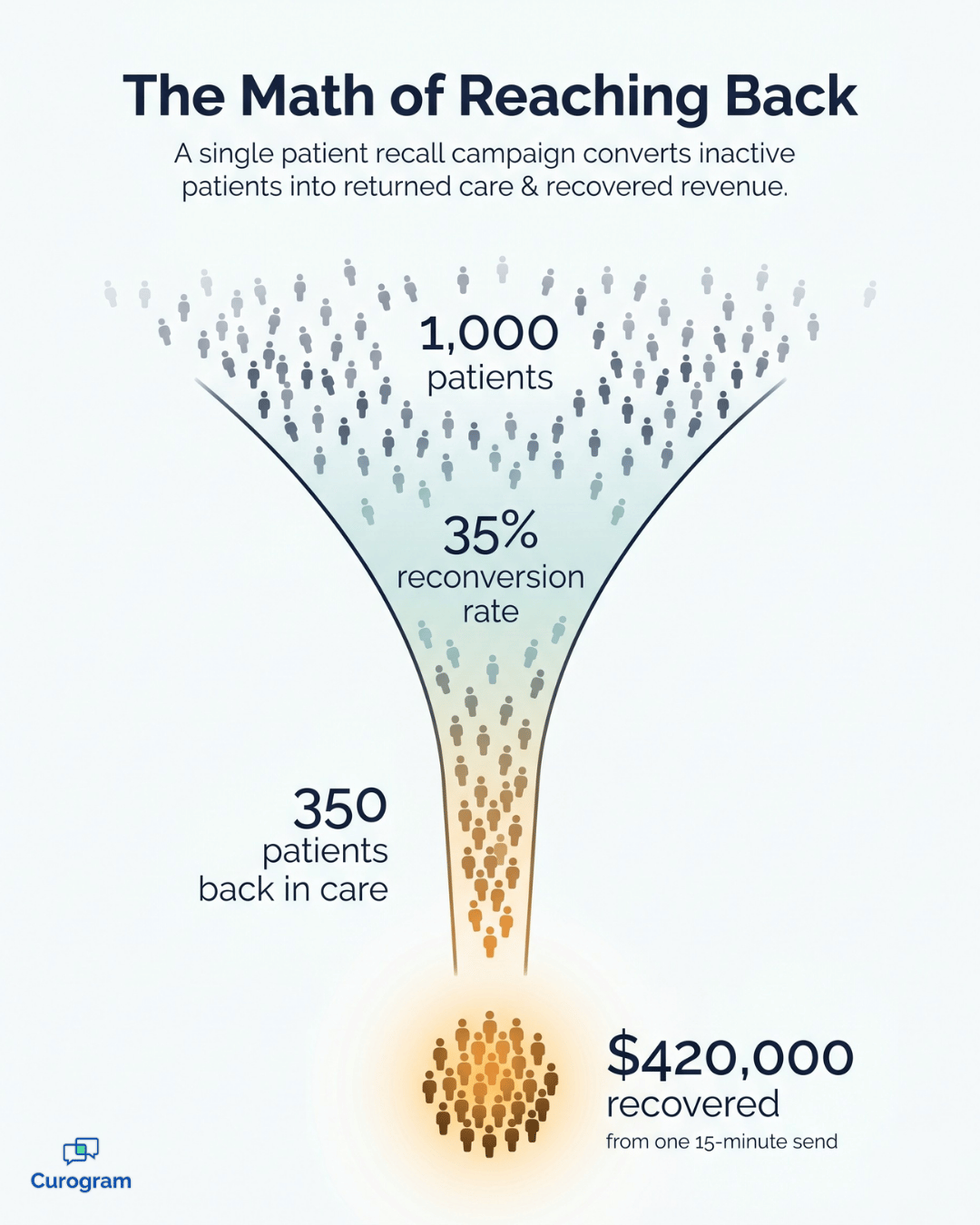
Infographic: SMS patient recall converts 1,000 inactive patients into 350 returned and $420K

How a campaign comes together

The mass texting setup Netsmart practices need is simpler than it sounds.

A full campaign runs in four steps:

  1. Pick your segment. Filter consumers by last visit date, program, provider, or diagnosis category.
  2. Choose your message. Start from a warm template and adjust the wording to fit your voice.
  3. Send. The text goes to your whole segment at once, in minutes.
  4. Route replies. Responses land with your scheduling staff, who book the return visit on the spot.

It sounds simple. That's the point. Work that used to eat days now takes a coffee break.

Words that invite, not scold

Tone is everything in behavioral health. A recall text should feel like an open door, not a citation for a missed appointment.

So the messaging stays warm and human — "We're here when you're ready" instead of "You missed your appointment."

No clinical details ever go into a recall text. For substance use treatment, messages follow 42 CFR Part 2, and every send respects opt-out and TCPA rules.

Built to run alongside Netsmart

You don't need a heavy technical lift to start. This mass texting setup Netsmart practice teams rely on works alongside the EHR without API access, and consumer contact lists import directly.

From there, you can set recurring cadences — 30, 60, and 90 days — so a patient recall campaign Netsmart behavioral health teams launch once keeps re-engaging people on its own.

It gives you a repeatable way to re-engage inactive patients Netsmart can't easily reach by itself, turning a one-time scramble into a standing workflow.

Behavioral health staff warmly welcoming a returning patient back to treatment

What Happens When You Reach Back

Numbers make this real. So let's look at what a recall campaign can actually return.

One multi-location practice ran SMS recall alongside Netsmart and recovered 1,240 consumers. Their reconversion rate hit 35% — meaning more than one in three people who got a text booked a visit.

Days of calls vs. a single send

Compare the two ways to do the same outreach:

  Manual phone calls SMS recall campaign
Time to reach 1,000 consumers Several days Under 15 minutes
Staff needed Multiple, full-time One, part of a shift
Typical response Voicemail, no answer Read within minutes
Record of the effort Scattered notes Tracked in real time

The time gap alone is staggering. Days of phone tag collapse into a single coffee break.

Run the math for your practice

Now translate the result into your own practice. Say you have 1,000 inactive consumers and a 35% reconversion rate.

That's 350 people back in care from one campaign.

If each consumer brings in, say, $1,200 in treatment revenue over their next episode of care, that's $420,000 recovered — from a send that took 15 minutes. Even at a cautious 20% reconversion, you'd recover 200 consumers and $240,000.

Reach every patient in seconds. Use mass messaging for urgent closures, health alerts, or clinic news with a 98% open rate with Curogram.

For your team, the math means something simpler than dollars. Each returned consumer is a person who almost slipped away and didn't. Resumed treatment. An averted crisis. A mission, met.

That's the real shift. You move from losing consumers and hoping they wander back to actively reaching out with a system that works. Recall stops being wishful thinking and becomes a clinical workflow you can count on.

What Separates a Text That Works from One That's Ignored

A recall campaign isn't just a send button. The 35% reconversion rate comes from getting the small things right — the timing, the tone, and the next step you offer. Get those wrong, and even a perfect contact list goes quiet.

The good news is that the pattern is easy to repeat once you see it.

Strong recall texts tend to share a few habits:

  • They lead with warmth, not logistics. "We've been thinking of you and we're here when you're ready" beats a cold "Please call to reschedule."
  • They keep it short. One or two sentences with a single, clear next step gets more replies than a paragraph.
  • They make booking effortless. A reply that routes straight to scheduling removes the friction that made someone drop off in the first place.
  • They respect the moment. No guilt, no clinical detail, no pressure — just an open door.

The texts that get ignored do the opposite. They sound automated. They ask the consumer to do the work of calling back. They read like a billing notice instead of a hand reaching out.

Timing matters too.

A 30-day nudge catches someone before the gap hardens into a habit, while a 90-day message reaches the people who've drifted further but may need that one reminder most. Running both cadences means you meet consumers wherever they are in their drift away from care.

Here's the takeaway for your team. The platform handles the scale, but the message carries the heart. Spend ten minutes shaping a warm, simple template once, and every future campaign inherits that work — and the results that come with it.

Your Roster Is Full of People Waiting to Be Asked

Somewhere in your records is a list of people who started care and quietly fell away. They aren't gone because they got better. They're gone because, on a hard day, no one reached back.

That's the whole problem in one sentence. And it's fixable.

A HIPAA-compliant recall campaign alongside Netsmart lets you reach inactive consumers at scale with outreach that feels warm, not robotic. The results back it up: practices are seeing reconversion rates near 35%, with hundreds of people returning to care from a single send.

Think about what that means in plain terms. Days of phone calls become 15 minutes. A roster of lost names becomes a roster of booked appointments. Guilt becomes action. And the people you'd nearly written off get the one message that tells them the door is still open.

Here's the line worth keeping.

Netsmart documents your consumer's treatment history. A Netsmart mass messaging setup recall workflow helps you write the next chapter.

Because recall isn't marketing. It's care continuity. It's reaching the person who needed one more nudge to return — and giving it to them before a gap becomes a crisis.

Your consumers didn't leave because they stopped needing help. They left because the moment passed and no one followed up. You can change that this week.

The tool is ready. The list already exists. The people are still there. The only missing piece is the message — and that takes minutes to send.

So reach them now.

Schedule a Demo with Curogram and book a recall strategy session. We'll walk your team through how mass messaging works alongside Netsmart, help you map your first consumer segment, and show you what re-engagement looks like at scale.


Frequently Asked Questions

Are mass text messages to inactive consumers HIPAA-compliant?

Yes. Curogram's mass messaging is built to be HIPAA-compliant. A recall text holds no clinical information — just a warm note inviting someone to reconnect. For substance use treatment, messages follow 42 CFR Part 2 confidentiality rules, and every recipient's opt-out is honored.

How much staff time does a recall campaign require?

Just minutes. A staff member picks the consumer segment, tweaks the message, and hits send. Replies route straight to scheduling for booking. A full campaign can launch in under 15 minutes — work that would otherwise mean days of manual phone calls.

What if consumers don't want to be contacted?

They simply reply to opt out, and their choice takes effect right away. Curogram's opt-out management keeps you aligned with TCPA rules and respects each person's autonomy. No one gets a second message they didn't ask for.

Do we need to integrate with Netsmart's API to run recall campaigns?

No. Curogram works alongside Netsmart without API access, so there's no heavy IT project to wait on. You import your consumer contact list, build your segment, and send. Your EHR keeps doing what it does best while recall runs beside it.

How do we know if a recall campaign is actually working?

You watch the numbers in real time. Curogram tracks response rates, reconversion rates, and appointment bookings as replies come in, so you can see exactly how many consumers re-engaged from a given send. That makes it easy to compare segments, refine your message, and prove the impact to leadership without digging through scattered notes.