10 min read

Bring Back Dormant Patients in Elation Health DPC & Primary Care

Bring Back Dormant Patients in Elation Health DPC & Primary Care
💡 Reactivating dormant patients in Elation Health primary care and DPC panels works best through text-based recall campaigns. Patients drift away — they don't quit. A short, personal text brings them back fast.
  • 35% of patients who got an SMS recall booked within a month (based on our internal data)
  • 1,240 patients returned from text recalls alone at one multi-location practice
  • Texts have a 98% open rate, far higher than email or portal alerts
  • Dormant DPC members cost $1,200–$3,600 each year in lost dues
  • Curogram pulls last visit, provider, and overdue services from Elation Health
The fix is not more effort — it is the right channel. A simple text removes the awkwardness of calling back.

A patient sat in your exam chair 14 months ago. She liked her provider. She said she would book her next visit "soon." That visit never happened — and no one at the practice has spoken to her since.

She is not angry. She is not switching practices. She just got busy, missed the portal note, and the next reminder never arrived in a place she actually checks. Multiply her by a few hundred quiet charts, and you have a dormant panel quietly bleeding revenue.

This is the core problem behind reactivating dormant patients Elation Health primary care DPC panels face every quarter. Most "lost" patients are not gone — they are unreachable through the channels your practice still leans on. Voicemail gets skipped. Email gets buried. Portal logins are forgotten.

Text is different. Texts get opened in minutes, not days. They do not require a login or a callback. They feel personal, even when sent to a list of 500. That last point matters more than most practices admit.

This article shows how Elation Health practices use Curogram to bring dormant patients back at scale. We will walk through dormant panel recovery, the friction that keeps patients away, and how a good DPC patient recall sequence rebuilds trust. You will see real numbers from our internal data and clear steps for your own Elation Health patient re-engagement plan.

The goal is not to spam old patients. The goal is to fix the patient reactivation experience so returning feels easy, not awkward. When the path back is one tap on a phone, dormant patients return — often in much greater numbers than practices expect. The chart in Elation Health is still warm. The relationship just needs one gentle nudge.

The Villain: The Drift

Patients rarely fire their primary care doctor. Most just drift — slowly, quietly, and without anyone noticing until the panel report shows the gap. The drift is not one event. It is a pattern of small misses that add up to a lost patient and a lost visit.

The Gradual Fade

A patient leaves the office after a clean annual visit. She tells the front desk, "I'll book my follow-up in about 6 months." Six months become eight. Eight become twelve. By month 14, the practice has sent a portal alert she never saw and made one voicemail she never returned.

The patient did not choose to leave. She just forgot. The fade looks like this in plain numbers:

Months Since Last Visit

Patient Mindset

Reachability

0–6

Still "active" in their mind

High

6–12

Vaguely aware they are due

Medium

12–24

Practice fades from memory

Low

24+

Often searching for new provider

Very low


Without a proactive touchpoint, the relationship does not end — it just gets thinner each month.

The Reachability Gap

Your practice has the patient's phone number, email, and portal account. None of those are the same as a working channel. The phone goes to voicemail she screens. The email sits under 100 newer messages. The portal needs a password she stopped using two years ago.

You have contact info. You do not have a contact channel. That is the gap that kills recall efforts. A text fixes this fast — 98% of texts get opened, and most are read within 3 minutes.

The Return Friction

Even patients who want to come back hit a wall. Calling means business hours, hold music, and a small, awkward speech to a receptionist they do not know. "Hi, I haven't been in for a while…" feels like an apology, and most adults will avoid it.

The phone-only path adds shame to inertia. A short text removes that wall entirely. The patient just taps "YES" — no story to explain, no voice to hear, no judgment to imagine. Patient reactivation experience is mostly about lowering shame and effort, not adding marketing.

The DPC Churn Connection

For DPC practices, the drift is worse. A member who has not booked in 6 months starts asking, "Am I still using this?" The answer is often no, and the cancel email follows. Each lost member is $1,200 to $3,600 in yearly recurring revenue gone.

The math on a 200-member DPC panel is sharp. If 8% drift out each year and half cancel, that is:

  • 8 lost members × $2,400 average annual fee = $19,200 in lost revenue per year

That number compounds. Members who leave rarely come back, and new members cost more to acquire than to keep. Dormant panel recovery is the lowest-cost lever a DPC has — and most practices ignore it.

Why Elation Health Alone Cannot Fix This

Elation Health is a strong chart. It holds the clinical history, the recall flags, and the last visit date. What it does not do is reach the patient on the channel they actually check.

The EHR is the memory. It is not the megaphone. Without a tool that turns that memory into a personal text, the drift continues no matter how good your Elation Health setup is. That is exactly the gap a DPC patient recall workflow needs to fill — and the next section shows how.

The Guide: The Reconnection Bridge

If "The Drift" is the villain, the answer is not louder marketing — it is a bridge. A bridge that uses the data already in Elation Health, lands on the patient's phone, and makes the next step a one-tap reply. That bridge is what Curogram builds.

The Solution in Plain Terms

Curogram reaches dormant patients through SMS — the one channel most people check dozens of times a day. The message is short, personal, and clinically relevant. It is not a coupon. It is a check-in.

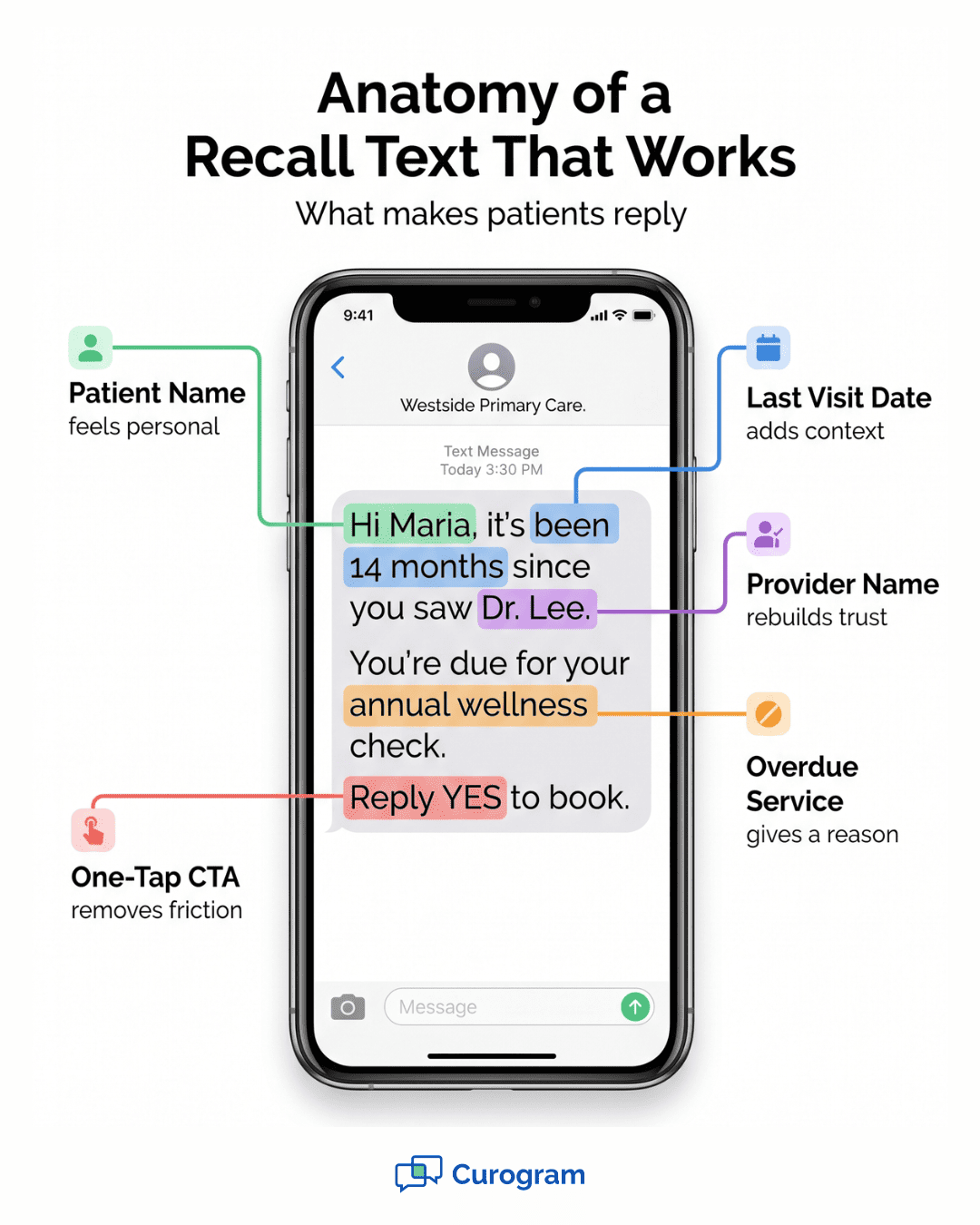
Here is what a real recall text looks like:

Hi Maria, it's been a while since you saw Dr. Lee at Westside Primary Care. You are due for your annual wellness check. Reply YES to book a time that works, or STOP to opt out.

That single text does four things at once. It names the patient, names the provider, names the overdue service, and gives a one-word reply path. No portal. No phone tag. No awkward script.

The Feature: Personalized Recall Outreach at Scale

Curogram's mass messaging lets staff send 500 or 5,000 recall texts in one batch — but each one reads like a one-to-one note. Practices build a list (for example, "patients who have not visited in 12+ months and are due for an annual"), pick a template, and merge in fields from Elation Health.

The result feels personal because it is personal. The merge fields pull:

  • Patient first name
  • Last visit date
  • Assigned provider name
  • Overdue service (annual, lab, screening)
  • A direct booking link

This is the heart of Elation Health patient re-engagement: scale without losing the human touch. A generic blast gets ignored. A note that says "Dr. Lee misses you" gets a reply.

The Integration with Elation Health

Curogram syncs with Elation Health's patient data so staff do not have to build lists from scratch. The flag that says "due for annual" in Elation Health becomes the trigger for a Curogram campaign. When a patient replies "YES," the staff sees the conversation in one inbox and books the visit straight into Elation.

A typical workflow looks like this:

  1. Staff filters Elation Health for patients with no visit in 12+ months.
  2. The list flows into Curogram's mass messaging tool.
  3. Curogram sends a personalized text to each patient.
  4. Replies land in a shared inbox — staff books visits in Elation.
  5. New visit data syncs back, closing the loop.

No spreadsheet juggling. No copy-paste. No tabs lost in the shuffle.

The DPC Retention Tool

For DPC practices, mass messaging is not just for recalls — it is a year-round retention tool. Members need to feel the value of the monthly fee even between visits. Silence breeds cancel emails.

Practical DPC use cases include:

  • Quarterly "how are you doing?" check-ins from the care team
  • New service launches (lab partnerships, home visit options)
  • Seasonal nudges — flu shots in fall, allergy prep in spring
  • Birthday notes from the provider, not the system
  • Wellness challenges and small habit prompts

Engagement prevents drift. Prevention costs far less than reactivation. A $0.02 text every 6 weeks costs about $0.16 a year per member — pennies against a $2,400 yearly fee.

Anatomy of a high-converting patient recall text with labeled fields for primary care and DPC practices

The Success: The Returned Patient

A returned patient is not just a number on a panel report. She is a chart that gets a new note, a slot that does not sit empty, and a relationship that picks up where it left off. The success story of dormant panel recovery is built one text at a time — and the math at scale gets large fast.

The Headline Numbers

Based on our internal data, one multi-location practice ran a focused text-based recall campaign through Curogram. The results stand out because they came from patients who, by every old measure, were "gone":

  • 1,240 patients returned for visits from recall texts alone
  • 35% of contacted patients booked within one month
  • 100% of returners came back with their Elation Health chart intact

At an average visit value of $150 to $250, that single campaign cycle brought in roughly $186,000 to $310,000 in recovered revenue. None of it came from new patient acquisition. All of it came from patients the practice already had.

The Shift: From Forgotten to Reconnected

Numbers tell half the story. The other half is how a recall text feels to the person who gets it. Patients who receive a personalized recall message often describe one specific feeling: being remembered.

A text from "Dr. Lee's office" naming the provider, the patient, and the overdue service signals care, not marketing. It says, we noticed you were gone, and your health still matters to us. That single signal rebuilds trust before the visit even gets booked.

Compare three outreach methods side by side:

Channel

Open Rate

Reply Rate

Feels Like

Generic postcard

~20%

<1%

A bill or ad

Portal message

~10–15%

~2%

A chore

Personalized SMS

98%

25–35%

A friend checking in


The personalized SMS wins not because it is louder, but because it is warmer. The patient reactivation experience hinges on that warmth. A cold blast gets ignored — a warm note gets a reply.

What Happens After the Reply

When a dormant patient texts back "YES," the work is not done — it is just easier. The Curogram inbox routes that reply to a front desk team member who can:

  • Check the Elation Health chart for any updates needed
  • Offer two or three open slots in the next two weeks
  • Send an intake form by text before the visit
  • Confirm with a single reminder 24 hours out

The patient never has to call. The front desk never has to guess. The whole booking happens in a thread, and the visit lands on the calendar with the right provider and the right reason.

The DPC Recovery Angle

For DPC practices, a "returned patient" often means a returned member. A member who was about to cancel reads a text, books a visit, and remembers why they signed up. The monthly fee stays.

The math is sharp here too. Saving even 5 members from cancel in a year on a 200-member panel can mean:

  • 5 saved members × $2,400 average annual fee = $12,000 in saved revenue

Spread across the cost of one text campaign every quarter (under $50 total), the return is extreme. DPC patient recall is one of the highest-leverage tools a small membership practice owns.

Why It Works When Other Channels Fail

Recall campaigns work in text where they fail in email and phone because of three traits SMS uniquely combines:

  • High visibility 98% open rate, read within minutes
  • Low friction reply with one word, no login
  • Personal feel name, provider, reason, all merged in

No other channel hits all three. Email has volume but no urgency. Phone has urgency but high friction. Portal has neither. Text has all three, which is why a 35% reconversion rate is repeatable, not a fluke.


Woman reading a recall SMS from her doctor and replying YES to book an appointment
How Curogram Turns an Elation Health Dormant List Into a Booked Calendar


The hardest part of any recall campaign is not writing the text — it is turning a chart flag into a booked visit without 10 manual steps. Curogram closes that loop.

Here is how the workflow runs from start to finish. Staff opens Elation Health and pulls a list of patients with no visit in 12+ months. That list flows into Curogram with a few clicks — no copy, no paste, no spreadsheet errors.

Inside Curogram, staff picks a recall template. The template auto-merges:

  • Patient first name
  • Last visit date
  • Assigned provider name
  • The overdue service from Elation
  • A simple "Reply YES" call to action

The campaign sends as personalized texts. Each one feels one-to-one, even when the batch is 800 people. Replies stream into a single shared inbox — the same inbox the team already uses for daily two-way texting.

A front desk staffer sees "Maria replied YES" and opens her Elation chart in another tab. She offers two open slots, the patient picks one, and the visit is booked back in Elation. The recall flag is cleared. The chart is current. The slot that was empty is now filled.

The whole loop — from list pull to booked visit — can run in under 5 minutes per patient. At scale, one staffer can rebook 30 to 50 dormant patients in a single afternoon.

For DPC practices, the same flow doubles as a retention tool. Mass messaging on a quarterly cycle keeps members warm between visits.

Engagement stays high, cancel rates drop, and the panel grows instead of shrinks. That is the quiet power of pairing Elation Health with Curogram — clinical memory plus human reach.

Conclusion: Patients Don't Leave — They Drift, Bring Them Back

Dormant patients in Elation Health practices are not lost. They are waiting for one short text that reminds them you are still here. The drift is real, but it is not permanent — and the fix is far cheaper than most practices think.

Curogram's text-based recall campaigns close the gap between a quiet chart and a booked visit. With a 35% reconversion rate and 1,240 returned patients in a single campaign (based on our internal data), the proof is in the numbers — and the numbers come from the channel patients already check 80 times a day.

The split is simple. Elation Health holds the clinical relationship in the chart. Curogram restarts the human relationship in a text. The EHR remembers the patient. The engagement platform reminds the patient that you remember them.

That second part is what brings them back. A patient who feels remembered books. A patient who feels forgotten searches for a new provider. The difference is one well-timed message.

For DPC practices, the stakes are higher and the math is sharper. Each saved member is $1,200 to $3,600 in yearly fees protected. A few texts a quarter can hold a panel together that would otherwise quietly shrink.

Your dormant patients are not gone — they are waiting for one well-timed tex. Book a quick demo and watch how a single recall message turns a quiet chart into a booked appointment.


Frequently Asked Questions

How does Curogram know which Elation Health patients to mark as dormant?

Staff filters Elation Health by last visit date — usually 12+ months out — and pulls that list into Curogram. The two systems share patient data, so flagged "due" services and provider info auto-merge into the text. No manual list building required.

Why do dormant patients respond to texts when they ignored phone calls and emails?

Texts get a 98% open rate and feel personal, not formal. A short note naming the provider and the overdue service removes the awkwardness of a callback. Patients can reply "YES" in one tap — no login, no voicemail, no script to plan.

How quickly can a practice see results from a dormant panel recovery campaign?

Most replies arrive within 24 to 48 hours of the first send. Bookings often fill the next 2 to 4 weeks of open slots. Based on our internal data, one campaign reactivated 1,240 patients across a few weeks of follow-up texts and bookings.

What makes DPC patient recall different from standard primary care recall?

DPC patient recall protects monthly membership revenue, not just visit fees. Silent members cancel. A quarterly text check-in keeps them engaged between visits, lowers cancellation rates, and reminds them why the monthly fee is worth paying for ongoing care.

How does Curogram keep recall texts compliant with HIPAA and patient consent rules?

Curogram is HIPAA-compliant by design, with secure storage and audit logs built in. Each message includes a clear opt-out path — patients reply STOP to leave the list. Consent is tracked per patient, so practices stay within regulatory and patient preference rules.


Personalized DrChrono Patient Recall Texts for Re-Engagement

Personalized DrChrono Patient Recall Texts for Re-Engagement

💡 DrChrono patient recall text messages through Curogram help practices bring back lapsed patients with texts that feel personal, not mass-sent. ...


Read More
Tebra Mass Messaging: Recover Lost Patients with Broadcast SMS

Tebra Mass Messaging: Recover Lost Patients with Broadcast SMS

💡 Tebra does not offer broadcast SMS or mass messaging for patient recall campaigns. Curogram fills this gap with targeted bulk text outreach that...

Read More
Why Patients Respond to Text Recalls, Not Phone | Meditab IMS

Why Patients Respond to Text Recalls, Not Phone | Meditab IMS

💡 Overdue Meditab IMS patients respond to text recalls instead of phone calls because texting matches how patients actually communicate in 2026....

Read More