9 min read
How to Run Patient Recall Campaigns in Your Cerbo EHR Practice
Mira Gwehn Revilla
:
June 3, 2026
- Pull a patient list straight from Cerbo data, with no manual exports.
- Pick a message template and add patient names with merge fields.
- Send to hundreds of lapsed patients all at once.
- Handle replies in the same two-way text inbox staff already use.
- Watch delivery, replies, and booked visits update in real time.
Every few months, the same request lands on the office manager's desk. The physician wants her to reach out to patients who have not been in for a while. She knows it matters. She also knows what it really means.
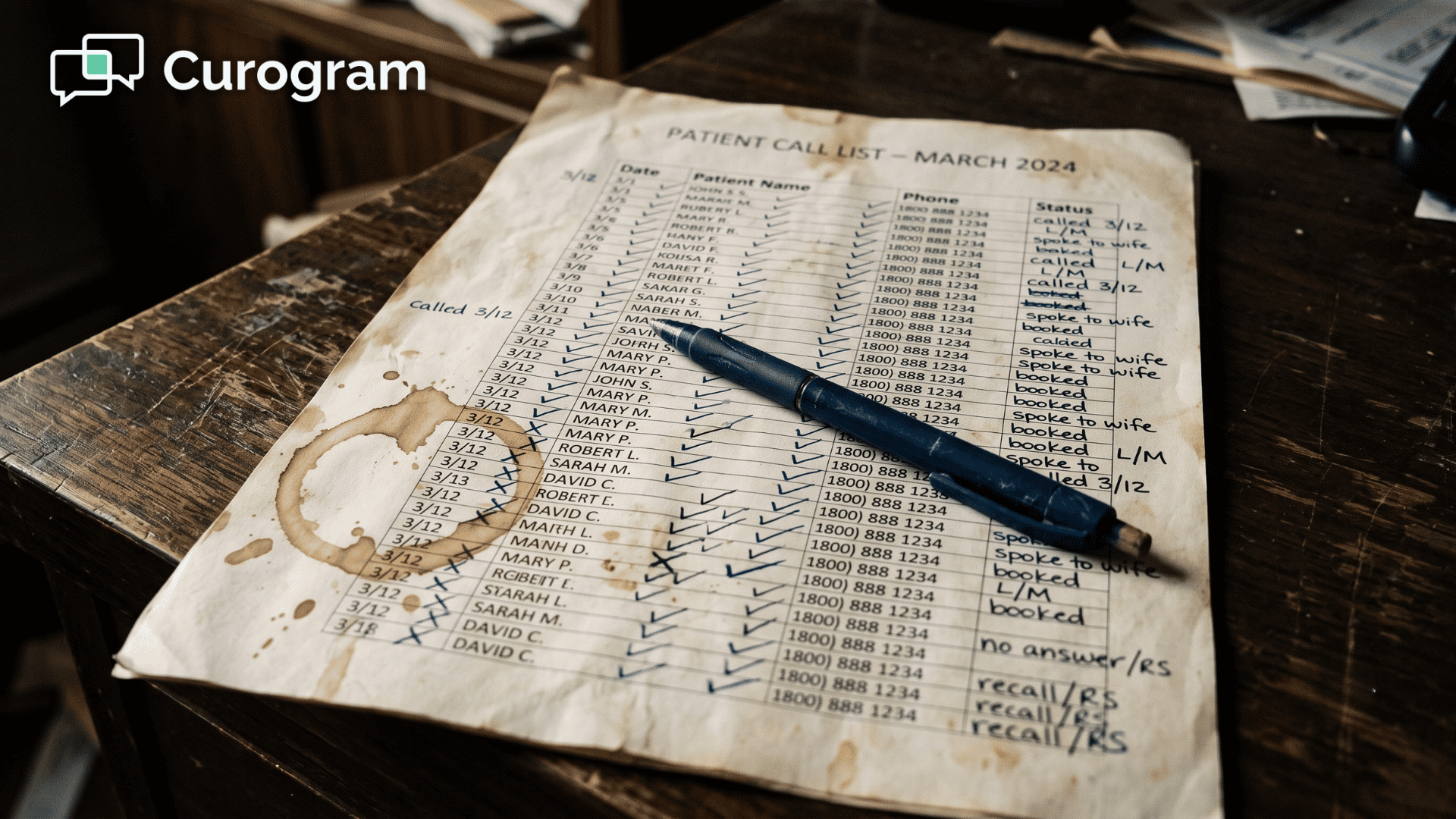
It means hours on the phone. So she prints a list of overdue patients from Cerbo. Maybe 120 names. She splits them between two staff members.
Then the calls begin, one slow dial at a time. By Friday, most names are still uncalled. The list slides into a drawer. Next quarter, the request comes back, and the cycle starts over.
This is the quiet problem in many Cerbo practices. Recall is not ignored. It just never scales. The only tool on hand is the phone.
Learning how to run patient recall campaigns in a Cerbo EHR practice changes that math. Instead of calling patients one by one, you text them all at once. Instead of days of effort, the send takes about 5 minutes.
Cerbo holds the data that shows who is overdue. What it lacks is a way to reach those patients at scale. That gap is where lapsed patients slip away.
Curogram fills the gap. It connects to Cerbo, finds your overdue patients, and sends each one a personal text. Replies land in one simple inbox your team already knows.
The payoff is not small. Based on our internal data, text recall rebooks patients at far higher rates than phone calls. One practice brought back 1,240 patients this way.
This guide breaks down the full workflow, step by step. By the end, recall will feel less like a chore and more like a routine.
The Villain: The Manual Chase
Cerbo practices do care about keeping patients. The physician-owner often asks staff to check in with people who have not visited. The intent is good, but the method is broken.
The only real tool is the phone. The office manager pulls a report of patients not seen in 90+ days. That list might hold 50 to 200 names. Then staff start dialing, one patient at a time.
Each call takes 3 to 5 minutes. Most go straight to voicemail. The same staff member also works the front desk and checks people in. By midweek, the list gets pushed aside.
The Agitation
Walk through one normal week. On Monday, the office manager prints a list of 120 overdue patients. She gives two staff members 30 calls each to make during slow periods.
By Tuesday, they finish only 18 calls. Twelve hit voicemail. Three patients say they will call back. One actually rebooks. Then real life takes over.
Wednesday is packed. Thursday brings a staffing problem. By Friday, 102 patients are still uncalled, and the list goes in a drawer. Next quarter, the physician asks again, and a fresh list prints with 145 names.
The cycle repeats. Staff know it does not work. But Cerbo offers no other option.
The Bottleneck
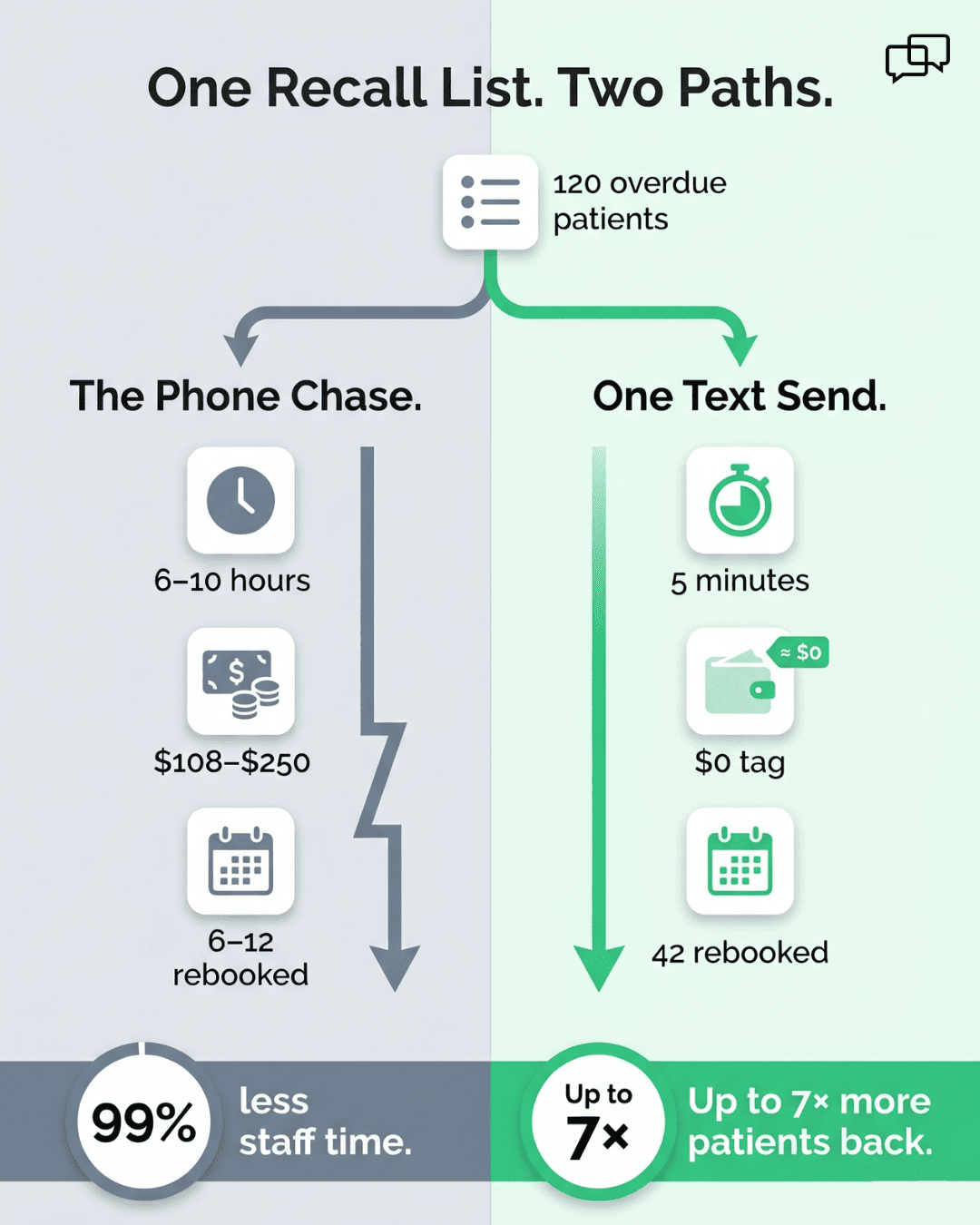
Let's count the cost. At 4 minutes per call, 120 patients eats 6 to 10 hours of staff time. At $18 to $25 an hour, that is $108 to $250 per campaign.
|
Recall method |
Staff time |
Labor cost |
Rebooked from 120 |
|
Phone calls |
6–10 hours |
$108–$250 |
6–12 |
|
Text campaign |
About 5 min |
Near zero |
42 |
Phone recall rebooks just 5 to 10% of the list. That is 6 to 12 visits from 120 calls. A text campaign through Curogram reaches all 120 at once. Based on our internal data, it rebooks about 35%, or 42 visits.
This is not a small edge. It is a 99% cut in labor for many times the results. Better lapsed patient outreach operations for a Cerbo practice start with the right channel, not more dialing.
The Result
The office manager is not lazy. She has tried spreadsheets, color codes, and assigned call blocks. She has even stayed late to dial patients herself.
None of it sticks. The reason is simple. She is calling people one at a time, on a channel they rarely answer. Most calls from unknown numbers go straight to voicemail.
She has looked at software, but most tools target large hospital systems. A 5-provider integrative practice needs something simpler. She wants scale without a second complex system beside Cerbo.
That is the trap. The practice needs recall that scales. The staff cannot scale themselves.
.png?width=2000&height=1125&name=How%20to%20Run%20Patient%20Recall%20Campaigns%20in%20Your%20Cerbo%20EHR%20Practice-inline%20(1).png)
The Guide: The Recall Playbook
Curogram is the Recall Playbook. It is not a heavy marketing tool. It is a simple campaign system for staff who already juggle ten tabs in Cerbo. Think of this as a Cerbo patient recall workflow staff guide you can repeat every quarter.
The workflow has just four steps:
- Find overdue patients using data synced from Cerbo.
- Pick or edit a recall message template.
- Send the campaign to the whole group.
- Handle replies from the Curogram dashboard.
The send itself takes under 5 minutes. Replies arrive as normal text chats. Staff answer them the same way they answer any patient text. There is no new screen to learn.
The Feature
The campaign builder is made for non-tech staff. You build patient groups from simple dropdown filters: last visit date, provider, and visit type. Message templates use merge fields, so each text shows the patient's name, the provider, and your practice name.
Live stats show delivery, replies, and booked visits as they happen. You can run many campaign types from one place: quarterly recalls, seasonal wellness checks, and DPC renewal reminders.
The system also handles opt-outs. Anyone who replies STOP drops off future sends. You can even schedule a campaign for next Tuesday at 10 AM. In short, you can build an SMS recall campaign that links straight to your integrative medicine EHR.
The Integration
Here is how data moves between Cerbo and Curogram. Patient scheduling data syncs through Cerbo's open API. So your recall groups always reflect current Cerbo records.
That means no manual exports, no CSV files, and no data entry. When a patient rebooks, the new visit shows up in Cerbo's schedule. Staff never bounce between two split systems, because the data flows both ways.
For the office manager, recall uses the same patient info that drives every other Cerbo task. This is how Curogram helps a Cerbo practice manager automate patient reactivation, with no second database to keep clean.

The Functional Medicine Fit
Now tie this to staffing. Most integrative and functional medicine offices run with 1 to 3 front-desk staff. They handle intake, supplements, billing, and more.
Adding recall to their plate only works if it costs under 10 minutes per campaign. Curogram fits that limit: 5 minutes to send, zero to maintain. Replies run through the same text inbox they use daily.
Recall campaign setup for a functional medicine or DPC practice on Cerbo takes minutes, not hours. The tool fits because it was built for practices this size.
The Success: The Quarterly Reactivation Rhythm
The proof is in the numbers. Based on our internal data, one multi-location practice recovered 1,240 lapsed patients with Curogram recall campaigns. The rebooking rate was about 35%.
All of that took under 30 minutes of total staff time across every campaign combined. Compare that to phone recall. Phone recall rebooks 5 to 10% and burns 6 to 10 hours per cycle.
|
Measure |
Phone recall |
Text recall (Curogram) |
|
Patients reached |
Fewer than half |
All at once |
|
Staff time |
6–10 hours |
About 5 minutes |
|
Labor cost |
$108–$250 |
Near zero |
|
Rebooking rate |
5–10% |
About 35% |
|
Visits from 120 patients |
6–12 |
42 |
The gap is not small. It is 99% less staff time and 3 to 7 times more patients back on the schedule.
The Shift
Name the change clearly. The old way was the Manual Chase. The new way is the Quarterly Reactivation Rhythm.
Recall stops being a dreaded task squeezed into a full week. It becomes a planned 5-minute ritual each quarter. Pull the overdue group. Send the campaign. Manage replies over a few days. Share results with the physician.
The list that once died in a drawer now drives steady revenue. It works every 90 days. The team that once feared phone outreach now runs fast, clean campaigns.
Why does this rhythm stick when phone recall never did? Three reasons. First, the effort is tiny. Five minutes does not compete with a busy front desk.
Second, results show up fast. Replies start within minutes, and quick wins keep the habit alive. Third, the proof is easy to share. One dashboard screenshot tells the whole story, so the physician sees revenue, not effort.
A simple yearly cadence keeps the rhythm going. Each wave uses the same four steps. Only the patient group and the message change.
|
Quarter |
Patient segment |
Goal |
|
Q1 |
Not seen in 90+ days |
Restart lapsed care |
|
Q2 |
Annual wellness due |
Book yearly visits |
|
Q3 |
DPC renewals coming up |
Keep members active |
|
Q4 |
Year-end lab follow-ups |
Close care gaps |
Over a year, the practice runs four clean recall waves instead of one rushed phone push. The work spreads out and never piles up.
The Outcome
Here is a real quarter, step by step. It is the first week of Q2. The office manager opens Curogram's campaign manager. She selects "patients not seen in 90+ days," and the system shows 94 patients.
She checks the template. It reads: "Hi [Name], it has been a while since your last visit with Dr. [Provider]. We would love to check in on your progress. Tap here to schedule."
She hits send at 10:02 AM. By 10:15, three patients have replied. By the end of the day, 17 have rebooked. By Friday, 33 patients are back on the schedule.
That is over $12,000 in recovered revenue. It came from about 5 minutes of work. She screenshots the dashboard and sends it to the physician-owner.
The only extra time went to a few text chats with patients who had questions before booking. The recall drawer is empty, and the process runs itself.
Look at the math over a year. Say each recovered visit is worth about $375. Bring back 33 patients in one campaign, and that is roughly $12,000.
Run four campaigns a year at similar rates, and you recover tens of thousands in care that would have slipped away.
The cost in staff time stays near zero. There is a human payoff too. Staff stop dreading the recall request. They no longer leave dozens of dead-end voicemails.
Instead, they watch patients reply in real time. The work feels useful, because it is. Morale rises when effort turns into clear results. That is the real shift behind the Quarterly Reactivation Rhythm.
How Curogram Turns Cerbo Data Into Booked Visits
Cerbo is great at one thing: holding your data. It knows who came in, who is overdue, and who is due for a renewal. What it cannot do is reach those patients at scale. That is the missing piece Curogram supplies.
The link starts with a clean data sync. Curogram connects to Cerbo through its open API. So when you build a recall group, you pull live records, not a stale export. Last visit dates, providers, and visit types are always current.
From there, the bridge does the heavy lifting. You filter the patient group with simple dropdowns. You pick a message and add merge fields. Then you send to the whole list at once. No spreadsheets. No copy-paste. No data cleanup.
When a patient taps to book, the new visit flows right back into Cerbo's schedule. Staff never juggle two systems. The same patient record powers both the clinical side and the outreach side.
This is the real value. Cerbo tells you who to reach. Curogram actually reaches them, in a channel patients check. Texts get opened in minutes. Calls go to voicemail.
The result is a tight loop. Cerbo flags the patient. Curogram sends the text. The patient replies and books. Cerbo logs the visit. The loop closes without manual work.
For a small integrative or DPC team, this matters most. There is no IT project and no big training. Staff who already text patients in Curogram run their first recall in minutes.
So the takeaway is simple. Keep your data in Cerbo. Run your outreach in Curogram. Together, they turn a list of overdue names into booked visits, quarter after quarter, with almost no added effort.
Conclusion: Replace the Recall List with a 5-Minute Campaign
Curogram's mass SMS recall replaces the manual phone chase with a 5-minute workflow. It reaches every overdue Cerbo patient through a channel they actually check.
Based on our internal data, that approach rebooks patients at 3 to 7 times the rate of phone calls. And it does so with about 99% less staff labor. The drawer full of forgotten lists finally goes away.
The mindset shift is just as simple. Cerbo is for your clinical data. It holds the records, the histories, and the timelines that show who is overdue.
Curogram is for your outreach. It is the 5-minute campaign that turns that data into action. It is the text that reaches the patients Cerbo can name but cannot contact. One tool knows who. The other tool reaches them.
So stop assigning staff to make 120 calls that yield 6 rebooked visits. Run one text campaign instead. Based on our internal data, the same list can bring back 40 or more patients in days.
The choice is not really about software. It is about where your team spends its time. Phone recall spends hours and recovers little. Text recall spends minutes and recovers far more.
Turn your next recall request into a 5-minute task instead of a week of phone calls. Book a demo and we'll map the full workflow to your practice.
Frequently Asked Questions
Under 10 minutes. The builder uses dropdown filters and ready-made templates. Staff who already text in Curogram will know the dashboard right away. Our team also guides your first live campaign during setup.
It syncs scheduling data straight from Cerbo through the API. When you build a recall group, it reads live records like last visit dates and providers. So there are no CSV files and no list-building by hand.
The reply lands in Curogram's two-way text inbox, the same one staff use daily. Your team answers right there, shares scheduling details, and guides the patient to book. Real-time replies are why texts beat email or portal outreach.
Texts reach the whole list at once and get opened within minutes. Calls reach one person at a time, and most go to voicemail. Patients can tap a link and book on their own schedule, with no phone tag.
Once a quarter works well for most practices. A 90-day rhythm keeps lapsed patients from drifting too far. You can also add seasonal wellness checks or DPC renewal reminders using the same four-step workflow.