9 min read
Text-to-Pay After Vascular Procedures: OBL Medstreaming Billing
Mira Gwehn Revilla
:
May 15, 2026
- 40–50% collection rate within hours of discharge
- Payment resolved in 2–5 days, not 45–60
- $4,000–$5,000/month saved per location on statement costs
- PCI DSS Level 1 and HIPAA compliant from message one
- Plugs into Medstreaming discharge workflows with no IT build
Most billing leaders know the number by heart: 20%. That's the average collection rate on mailed patient statements after a vascular or cardiac procedure. The other 80% sits in A/R, ages past 45 days, and slowly turns into write-offs. The drag is real, and it grows every month.
High-deductible health plans have made this much worse. Patients now owe more out of pocket than ever before. A femoral-distal bypass can leave them on the hook for $1,500. An angioplasty with stent can push that figure past $3,000.
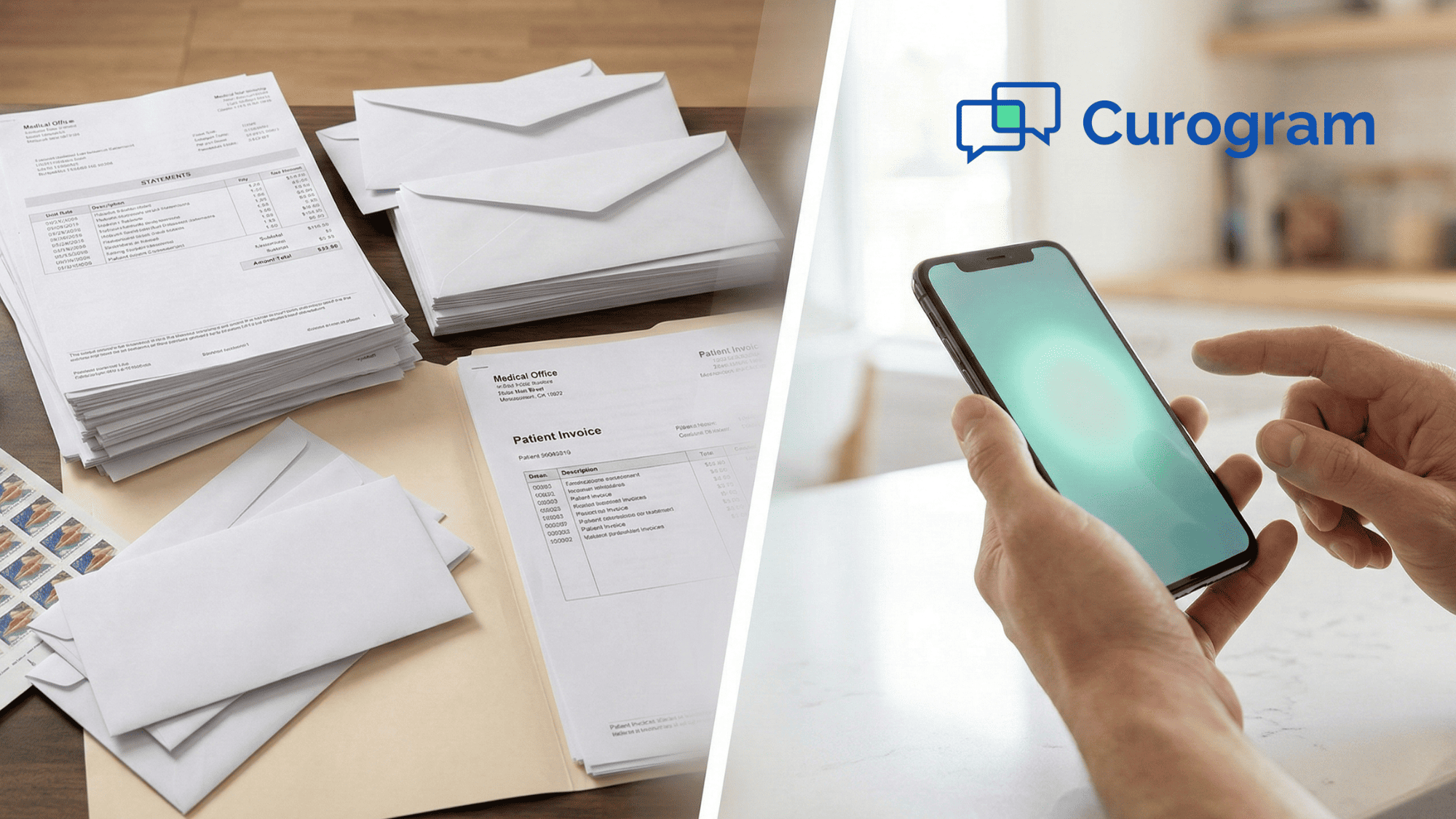
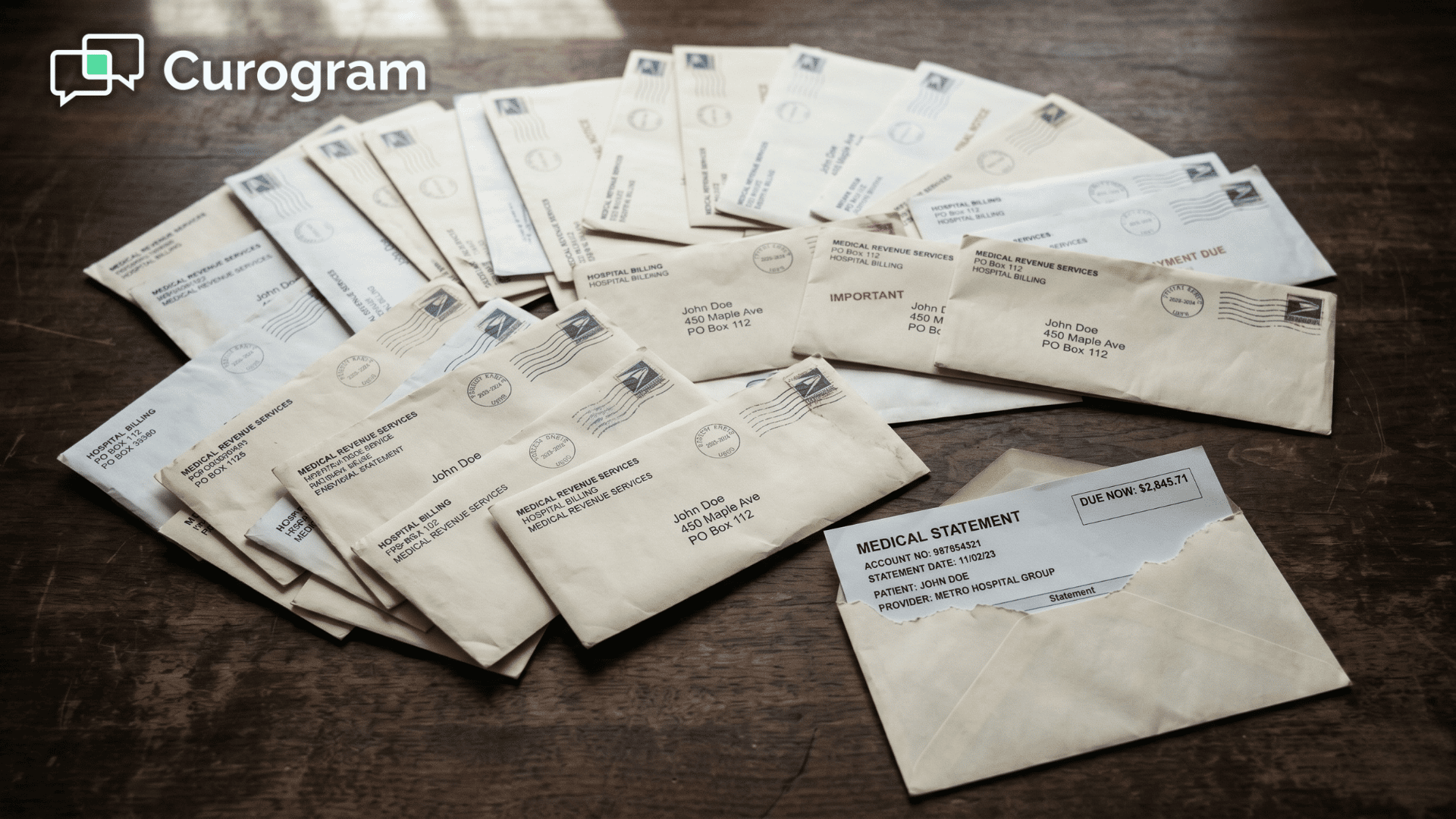
Paper does a poor job of bringing that money back. Statements take two to four weeks to arrive in the mail. They land in the same stack as anesthesia bills, lab bills, and junk ad mail. Most go unopened, and follow-up calls eat hours of staff time each week.
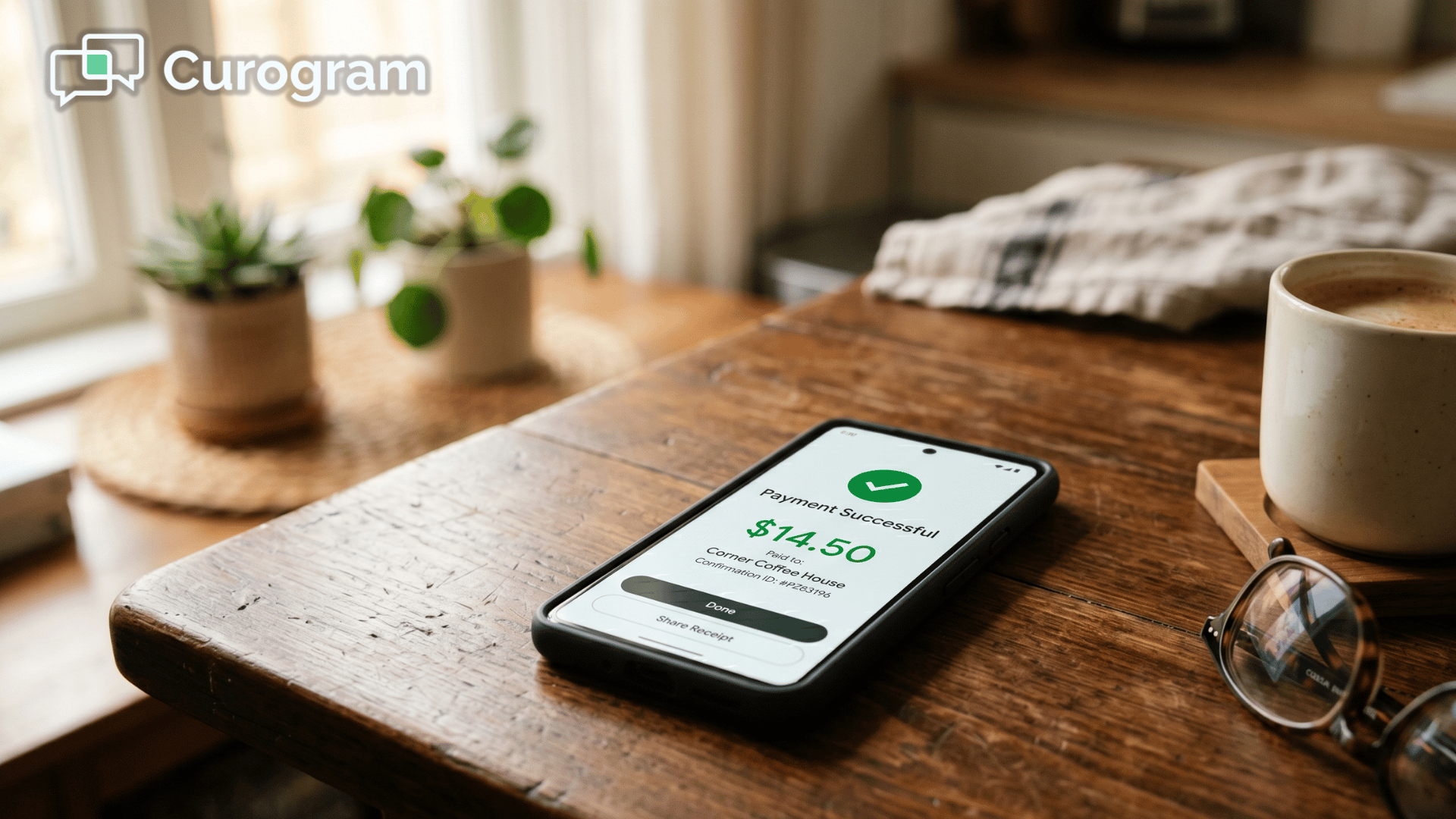
The fix runs on the device every patient already carries. SMS reaches 98% of adults, and texts open within three minutes. When a payment link arrives within hours of discharge, patients pay—often in under 60 seconds. That speed changes everything for cash flow.
This is where text-to-pay after vascular procedure patient billing OBL Medstreaming workflows earn their keep. The platform already holds the data needed to trigger a payment link at discharge. Pair it with Curogram's HIPAA-compliant SMS, and a 45-day chase becomes a same-day event. No portals, no printers, no chase calls.
In the sections ahead, we'll break down the real numbers. You'll see paper versus SMS collection rates side by side. You'll get a cost model for a 5-location OBL handling 150 procedures a month. And you'll see how the security layer holds up to a HIPAA audit.
If your A/R aging report keeps creeping the wrong way, this is the lever to pull. The shift takes days to set up, not quarters.
The High-Deductible Collection Crisis
High-deductible health plans now cover over 40% of commercially insured patients in the U.S. These plans shift more financial risk onto the patient. Annual deductibles run $1,500 to $5,000. Out-of-pocket maxes sit between $2,500 and $8,000.
For vascular and cardiac work, that math hits hard. A femoral-distal bypass costs $5,000 to $8,000 in total. If a patient's deductible is $2,000 and they've only paid $500 toward it, they owe $1,500 the day of discharge. An angioplasty with stent can run $8,000 to $12,000, with $3,000 to $4,000 falling on the patient.
This is patient responsibility at the point of discharge. It has to be collected, and the timing of collection drives both cash flow and A/R aging. The longer it sits, the harder it gets to bring in. Vascular and cardiac OBLs feel this more than most because per-procedure dollars are high.
The Problem with Paper Statements
Paper has four built-in failures. None of them are new, but together they cost OBLs real money each month.
Timing is the first failure. Billing staff usually generate statements two to five business days post-discharge. Printed mail then takes another two to four weeks to arrive. By the time the bill hits the kitchen table, the procedure is a fading memory.
Attention is the second failure. The patient's mail pile that week includes a hospital bill, an anesthesia bill, an imaging bill, a lab bill, and the facility bill. All compete for the same dollar. Most lose.
Third is the collection rate. Industry data puts paper at around 20% for patient responsibility. That means 80% of accounts need a second touch—phone, email, or another mailer.
Fourth is overhead. Print, envelope, postage, follow-up calls, and staff time add up to $30 to $35 per statement. For 150 procedures a month, that's roughly $5,000. And A/R aging quietly stretches to 45 to 60 days, with write-offs after 90.
Financial Impact: Real Numbers
Let's run the math on a real example. Take a 5-location vascular OBL doing 150 procedures a month, with an average patient responsibility of $1,500.
With paper, the practice collects 20% over 45 to 60 days. That's $45,000 a month per location, but slow. Statement costs alone run $4,950 a month per site. Add 1.5 FTEs in collections at $45,000 each, and labor lands at $67,500 a year per location.
Bundle the numbers, and paper billing eats $126,900 a year per location in pure overhead. None of it produces clinical value. None of it builds patient loyalty. It just sits on the P&L as a sunk cost.
How SMS Text-to-Pay Works in Medstreaming
The discharge moment is the highest-leverage moment in the billing cycle. The procedure is done, the patient is alert, and the financial side is fresh in their mind. Capturing payment here is far easier than chasing it later.
Here's how the trigger works in practice:
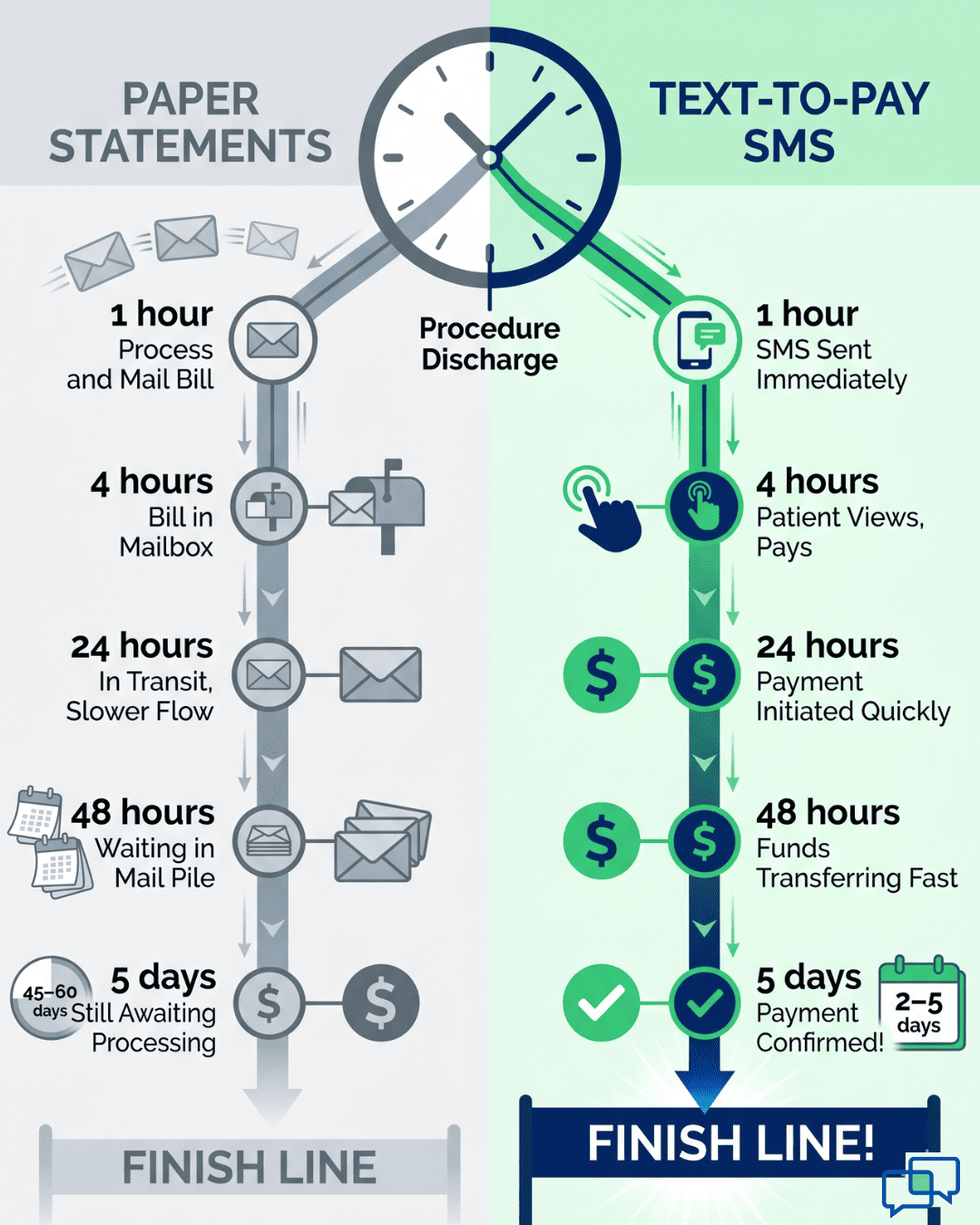
- Discharge is marked in Medstreaming, and the final bill is locked within an hour.
- Curogram's integration auto-generates a patient-specific payment link. It includes the balance, procedure type, facility name, and a one-tap pay button.
- The SMS goes out within four hours of discharge.
- The patient taps the link, enters a card, and pays in under 60 seconds.
There's no app to download. No portal to log into. The same-day procedure payment text reaches the patient at the exact moment they're most willing to resolve the balance.
Open and response data backs this up. Same-day SMS messages open at 98% within three minutes. Response rates run 68 to 78% within two hours. That's a dramatic shift from paper, which sees most opens past 14 days—if at all.
This is what same-day procedure payment text really means in practice: a balance that used to age 45 days now resolves before the patient finishes dinner.
Why SMS Works—Even for Older Patients
A common pushback: "Our patients are older. They don't text." It's a fair concern. Vascular patients skew 65 to 75 in median age. But the data tells a different story.
SMS reaches 98% of adults on any phone, smart or not. For patients 65 and older, SMS opt-in for billing reasons runs 65 to 70%. Portal adoption, by contrast, sits below 15% for the same group. The gap isn't close.
Why? SMS is simple. There's no username, no password, no app. The text shows the facility's name, the procedure date, and a single link. That clarity builds trust where portals create friction.

PCI DSS Level 1 Compliance: Security and Patient Trust
The compliance bar in healthcare is high. Curogram is built to clear it from message one.
- Credit card data is never stored in Medstreaming, on practice servers, or in Curogram logs. It's tokenized through a PCI DSS Level 1 certified payment network.
- Every event has an audit trail. Send, delivery, response, payment attempt, success, failure—each is timestamped.
- Patient consent is captured pre-op in Medstreaming. Opt-out patients route to paper, so no one is surprised.
- The facility can pull audit-ready documentation for HIPAA reviews on demand.
This combination of security and Medstreaming patient billing SMS workflows means compliance is not a separate workstream. It's part of the platform. Billing leaders can stand up text-to-pay without taking on a new audit burden.
Revenue and Operational Impact
The most striking shift is the collection rate itself. Paper averages 20% on patient responsibility for OBL and ASC procedures. SMS payment links, sent within hours of discharge, average 40 to 50%. That's double, sometimes more.
Let's run the same 5-location example side by side.
|
Metric |
Paper Statements |
Text-to-Pay SMS |
|
Procedures per month (per location) |
150 |
150 |
|
Average patient responsibility |
$1,500 |
$1,500 |
|
Collection rate |
20% |
45% |
|
Monthly collections per location |
$45,000 |
$101,250 |
|
Time to collect |
45–60 days |
2–5 days |
That's $56,250 a month in accelerated revenue per location. Across five locations, the total jumps to $281,250 a month system-wide.
Speed matters as much as size. Cash sitting in 45-day A/R has a real cost. Practices borrow against it, pay interest on lines of credit, or simply lose growth dollars they could have reinvested. Shrinking that aging window to 2–5 days frees up working capital with no new debt.
Cost Elimination: Paper to Digital
The savings on the cost side are just as real. Three categories shift when paper drops out of the workflow:
-
Statement costs - At $33 each, 150 statements run $4,950 a month per location. SMS replaces them at about $0.01 per message. Even with two to three attempts per patient, total SMS cost lands at $900 to $1,350 a month.
-
Staff time - Collections teams spend roughly 40 hours a week per FTE on past-due accounts. With SMS, that drops to about 8 hours a week for exception cases only. One full-time role can often be redeployed or eliminated entirely.
-
A/R aging and write-offs - Accounts that age past 90 days have very low recovery rates. By cutting average aging from 45–60 days to 2–5, the volume of accounts that ever reach 90 drops sharply.
|
A note on ASCs and hybrid cath labs: The model scales cleanly. ASC billing automation SMS workflows look almost identical to OBL workflows, with discharge as the trigger and the same compliance stack. Larger volumes drive larger absolute savings. |

How Curogram Turns Medstreaming Discharge Into Same-Day Revenue
Curogram is built for healthcare from the ground up. The Medstreaming integration uses the patient and billing data already in your workflow. There's no double-entry, no separate database, and no IT build to manage.
Setup looks like this. The Curogram team pulls discharge events from Medstreaming through a secure connection. As soon as a final bill is locked, a payment-link SMS goes out under your facility's branded sender ID. The patient sees your name, their procedure, and their balance. They tap, they pay, you're done.
Three things make this work better than generic SMS billing tools:
- Healthcare-native compliance. Curogram is HIPAA compliant and PCI DSS Level 1 certified. Patient consent, audit logs, and PHI handling are built in. No bolt-on tools, no separate vendors.
- Specialty workflows. Vascular and cardiac procedures carry high patient balances, which means the timing window matters more. Curogram triggers payment links at the right moment—within four hours of discharge, not three days later when momentum is gone.
- Real two-way SMS. Patients can reply with questions. Staff see the thread in a shared inbox, just like email. There's no portal, no phone tag, no "leave a message" loop.
Based on our internal data, Curogram's SMS engagement model delivers strong results across multiple use cases. One multi-location practice saw 35% recall reconversion from SMS messages alone, with 1,240 patients booked from those texts. The same engine drives text-to-pay outcomes.
For OBLs and ASCs running Medstreaming, this is the easiest revenue lever to pull this quarter. The platform is ready, the compliance is set, and your billing team doesn't have to learn a new system. They just stop printing.
Conclusion
High-deductible health plans aren't going away. Patient responsibility will keep growing, and paper will keep falling further behind. The OBLs and ASCs that thrive are the ones moving collections to the channel patients actually use.
The numbers are clear. Paper collects 20% and ages accounts to 45 days. SMS collects 40 to 50% and resolves them in two to five days. One method drains the P&L; the other adds to it.
For Medstreaming practices, the path is short. Curogram's integration plugs into existing discharge workflows. There's no IT project, no new platform to learn, and no compliance debt to take on. The first month delivers cost savings on day one and accelerated revenue inside two weeks.
The financial story holds across location counts and procedure mixes. A single OBL doing 150 procedures a month saves roughly $65,000 in combined improvements. A 5-location practice clears more than $324,000 a month system-wide. Those figures reflect what happens when collection rates double and statement costs drop to near zero.
Operationally, the shift is small but meaningful. Front desk and billing staff stop hand-folding statements. Mailroom costs come off the books. Collections labor reallocates to higher-value tasks like patient questions, payment plans, and insurance follow-up.
The harder work is cultural. Some billing leaders worry their patient base "won't text." The data on 65+ year olds and SMS opt-in rates settles that question. Patients prefer the simple option, especially right after a procedure.
Stop losing $65,000 per location every month to paper statements and 45-day A/R aging. Talk to our experts and see exactly how text-to-pay plugs into your Medstreaming discharge workflow.
Frequently Asked Questions
Very secure. Card data never lands in Medstreaming or Curogram logs. It's tokenized through a PCI DSS Level 1 certified network. Patient consent is captured pre-op in Medstreaming, and every event is logged for HIPAA audit.
A second SMS goes out at 24 hours. If there's still no reply by 48 hours, the account routes to an admin dashboard for staff follow-up by phone or paper. About 80% of patients resolve on SMS; the rest get a human touch.
Paper runs $30 to $35 per statement, or about $4,950 a month for 150 procedures. SMS runs roughly $0.01 per message, totaling $900 to $1,350 a month. That's an 80%+ cost cut, plus a doubled collection rate on top.
SMS has no login, no password, and no app. The text shows the facility name, procedure date, and a single tap-to-pay link. For patients 65 and older, SMS opt-in runs 65 to 70%, while portal adoption sits below 15%.
Most OBLs go live in days, not weeks. Curogram handles the integration with Medstreaming on the back end. Staff training takes about 10 minutes. There's no IT build, and the team doesn't have to learn a new system.