

8 min read

Text-to-Pay for Modmed Billing Staff | Collect Without Calling

Text-to-Pay for Modmed Billing Staff | Collect Without Calling
💡 Accelerating patient collections for Modmed billing teams text-to-pay means swapping slow paper statements and collection calls for instant text payment links. Patients tap, pay, and the balance clears in under a minute.       

Curogram text-to-pay for Modmed billing staff productivity lets coordinators send individual or batched links, watch payments arrive in real time, and skip card-over-phone risk entirely.


The result: shorter AR days, fewer voicemails, fewer printed statements, and a billing team that spends time on denials instead of dialing.


Your billing coordinator just hung up on her 18th voicemail of the morning.

She still has 27 calls to go. The AR aging report on her screen shows $127,000 in patient balances over 30 days old, and she knows how this day will end — same as yesterday. A handful of payments. A lot of dial tones. A growing list for tomorrow.

This is the quiet drag inside almost every Modmed specialty practice. Skilled revenue cycle staff, trained in denial management and complex claims, spending their best hours leaving messages no one returns.

The work is necessary. The method is broken.

Paper statements take 2–4 weeks to land. Most patients glance at them, set them aside, and forget. So your team picks up the phone. Around 60–70% of those calls go straight to voicemail.

The ones that connect eat 5–8 minutes each — verifying identity, reading card numbers, posting payments, noting the account. Eight payments in four hours, on a good day.

Meanwhile, the balance keeps aging.

The fix isn’t hiring more callers. It’s removing the call from the workflow entirely.

That’s where Modmed billing staff text payment collection comes in — sending a secure payment link straight to the patient’s phone and letting them pay before the collection call is ever needed.

This article walks through why the phone-and-paper cycle is bleeding revenue, how a text-to-pay billing team workflow Modmed clinic owners can actually deploy in days looks in practice, and what the numbers shift to when you stop chasing payments and start receiving them.

Your billing team is too good for voicemail. Let’s talk about what they could be doing instead.

The Hidden Cost of the Collection Call

Billing coordinators at Modmed specialty practices are not order-takers. They manage denials, reconcile EOBs, handle prior authorizations, and field complex patient billing questions. They are the financial engine of the practice.

And yet, a huge chunk of their day goes to the least leveraged task in revenue cycle:

Dialing patients for money.

The pattern is so familiar it’s almost ritual. Pull the account. Dial. Voicemail. Leave the same scripted message. Move on. For every 30 calls placed, around 20 hit voicemail. Of the 10 that connect, maybe 8 result in a payment. That’s 3–4 hours of phone time for eight transactions.

The math doesn’t improve when calls connect, either. Each phone payment runs 5–8 minutes. The patient repeats their card number twice because they misheard it. The coordinator transposes a digit and has to start over. The system times out. The account note still has to be written.

It is, in a word, exhausting.

What this looks like inside a specialty practice

Imagine the billing coordinator at a Modmed ophthalmology practice. Her AR aging report shows 180 accounts over 30 days totaling $127,000. She prioritizes the over-60-day list — 45 accounts, $38,000.

She starts dialing at 9 AM. By 11 AM:

  • 17 voicemails
  • 5 conversations, yielding 3 payments worth $1,850
  • 2 wrong numbers
  • 1 disputed charge transferred to the billing manager

Then lunch hits. The afternoon brings EOBs to post, three inbound patient billing questions, and a prior auth that has to go out today. The remaining 20 calls? They don’t happen. Tomorrow’s list is longer, and the $38,000 sits where it was.

This isn’t a productivity problem. It’s a workflow problem.

The PCI risk no one talks about

Taking credit card numbers over the phone creates real compliance exposure.

The number gets scribbled on a notepad, typed into the payment terminal, and then has to be securely shredded. Coworkers overhear. If your phone system records calls, the card data may be sitting on a server somewhere it shouldn’t be.

Every phone payment is a small PCI risk. Multiply it across hundreds of calls a month, and the exposure adds up fast.

What paper statements actually cost

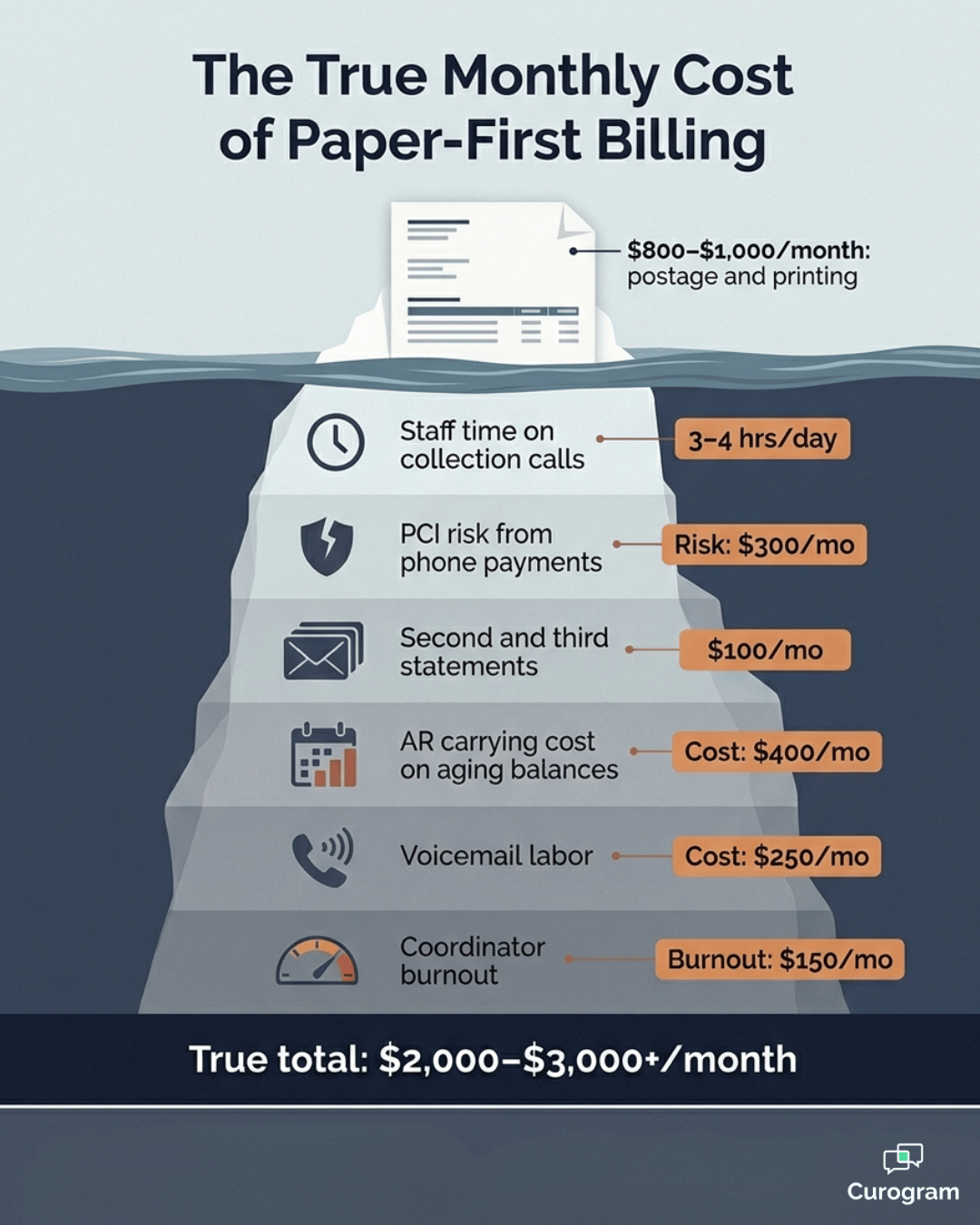
The other half of the cycle is just as expensive. Most practices spend $800–$1,000 per month on printing and postage for first statements.

Add second and third statements for unpaid balances, and the number climbs.

Add staff time for preparing, mailing, and tracking the mail run, and you’re easily at $2,000–$3,000+ per month on patient payment collection.

For what?

A 20% first-cycle collection rate. Four out of five statements don’t convert on the first try.

This is the engine the typical Modmed billing department is running on. It works — barely. And it punishes the staff who run it.

Text Payment Links That Replace the Call

Here is where the workflow flips.

Instead of

Statement → wait → call → voicemail → second statement → call → eventually collect,

Curogram lets your team send a secure payment link by text the moment a balance is ready to collect. The patient receives a personalized message, taps the link, and pays from their phone.

Open rates on SMS sit around 98%. Most are opened within three minutes. Compare that to a paper envelope that takes 11 days to reach the kitchen counter, where it lives for another two weeks.

The Curogram text-to-pay Modmed billing staff productivity story isn’t magic. It’s just removing every step that doesn’t need to exist.

Batch payment requests for the over-30-day list

This is the workflow that changes everything for AR-heavy practices.

Your billing coordinator exports the over-30-day list from Modmed’s practice management system. She uploads it into Curogram. With one action, all 180 patients receive a personalized text containing their balance and a secure payment link.

Then she goes back to denial management.

Payments start arriving within minutes.

By end of day, it’s common to see 30–40% of patients pay. That’s 54–72 payments collected in the time it used to take to make 30 calls. A second batch text a week later picks up another chunk — still faster and cheaper than a second printed statement.

This is what it means to reduce AR days Modmed specialty practice billing teams have lived with for years.

Same-day

collection rate

Baseline → +30–50% lift after switching to text-first billing

Real-time payment dashboard

Paper statements are blind. You drop them in the mail and pray. Curogram replaces that with visibility.

Your coordinator can see, in real time, which patients received the text, which opened it, which clicked the link, and which completed payment. That data is gold. It tells your team exactly where to focus follow-up.

A patient who opened the text and clicked but didn’t finish payment is a warm lead — a quick personal text or call closes it.

A patient who never opened the text may need a different phone number or a different channel.

The blind guesswork is gone.

Infographic showing the hidden monthly costs of paper-first medical billing versus text-to-pay.

Why this fits specialty billing specifically

The text-to-pay billing team workflow Modmed clinic teams adopt looks slightly different by specialty, and that’s a feature, not a bug.

In dermatology, cosmetic balances often run $500–$3,000+.

Those amounts collect far better through an instant link than a 60-day cycle of statements and follow-up calls — patients who said yes to the procedure are far more likely to say yes to a tap-to-pay message while the experience is still recent.

Orthopedics has a different rhythm.

Surgical copays and deductibles tend to be large and predictable, and collecting them at discharge via text prevents those balances from aging into AR in the first place.

The bill never gets a chance to feel like a surprise.

Ophthalmology lives somewhere in the middle.

Premium lens upgrades and elective procedures attract patients who already expect modern payment options.

A text link feels native to how they pay for everything else; a mailed statement feels jarringly out of step.

Pain management is the volume play. Recurring copays collected by text after each visit stop intimidating balances from building over months of repeat care.

Small amounts paid consistently are far easier to collect than one large statement that piles up six visits’ worth of charges.

In every case, the principle is the same:

Collect the balance while the service is fresh in the patient’s mind, not 60 days later when it feels like a surprise.

Paper statement

volume

100% of accounts mailed → Down 50–70% once text-to-pay covers the workflow

The Numbers When You Stop Chasing and Start Collecting

This is the part that gets practice administrators leaning forward.

Medical practice front desk with paper statement tray beside a tablet displaying payment dashboard.

What changes across the board

Across Curogram’s Modmed customers, switching from paper-first to text-first billing produces a consistent pattern:

Faster collections, fewer aging accounts, and dramatically less time on the phone.

You’ve already seen most of the individual numbers in the sections above — the same-day collection lift, the drop in paper statement volume, the recovered staff hours.

The one that ties them together is AR days. Patient responsibility that used to age 45–90 days routinely settles in 10–20 days once text-to-pay is in place.

Translated into plain language: your billing team collects more money, faster, while spending less on paper and less time on the phone.

From revenue chaser to revenue manager

Here is the quieter, longer-term win. Your billing coordinator’s job changes.

The 3–4 hours she used to spend on collection calls drops to 30–45 minutes of dashboard monitoring and edge-case follow-up.

Get paid faster! Strengthen your balance sheet by simplifying patient payments via secure SMS with Curogram.

That recovered time gets redirected to denial management, insurance follow-up, and revenue cycle optimization — work that actually moves the practice’s bottom line.

She stops being a revenue chaser. She becomes a revenue manager.

A Realistic Month-One Scenario

Take a Modmed dermatology practice with $95,000 in monthly patient responsibility. They eliminate paper statements Modmed billing has relied on for years and switch to a text-first model with Curogram.

Month one results:

  • Same-day collections climb from $12,000 to $38,000 — a $26,000 jump
  • Average AR days drop from 58 to 22
  • Paper statement volume falls 55%, saving roughly $520/month
  • The billing coordinator redirects 2.5 hours a day to denial management, recovering an additional $6,200 in previously denied insurance claims

Net revenue impact in month one: roughly $32,000+ in accelerated collections, plus $6,200 in recovered denials, plus $520 in eliminated statement costs.

That’s not a marketing number. That’s what happens when you remove four broken steps from a workflow your team was running 100 times a week.

For your team, the daily change is even more concrete.

Fewer voicemails. Fewer card numbers read aloud across the office. Fewer reasons to dread the AR aging report on Monday morning.

Give Your Billing Team a Better Day

Your billing coordinators didn’t train for revenue cycle work so they could leave 18 voicemails before lunch.

They trained to manage denials, fight for every dollar of legitimate reimbursement, and protect your practice’s financial health. The paper-statement-then-phone-call cycle drags them away from that work and stretches AR days well past what any specialty practice should accept.

Modmed’s practice management system already calculates the balance. The missing piece is a fast, secure, scalable way to collect it — patient payment collection SMS Modmed billing team members can actually run without burning out. That’s the gap text-to-pay fills.

A text payment link replaces a 60-day statement-and-call cycle with a 30-second patient action. Patients prefer it. Staff prefer it. Your balance sheet prefers it.

You don’t need to overhaul your billing department to see results. You don’t need to leave Modmed. You don’t need to retrain your team on a complicated platform — Curogram’s staff training typically takes around 10 minutes, and most practices are live within days.

What you need is to stop running a workflow that punishes the people running it.

Schedule a Demo. Bring your AR aging report to a 15-minute Curogram demo. We’ll show you exactly how text-to-pay would work against your real numbers.


Frequently Asked Questions

Can we send payment links for specific amounts, or does the system pull the balance automatically?

Staff set the payment amount when creating each text payment link. That means full control over what the patient sees — useful for partial payments, copay collection, or a specific procedure balance. The amount in the text matches exactly what your team entered, which keeps things clear for the patient and accurate for your records.

How do we reconcile text-to-pay payments with Modmed’s PM billing records?

Every payment collected through Curogram’s text-to-pay shows up in the Curogram dashboard with patient name, date, amount, and a transaction ID. Your team uses that information to post payments inside Modmed for reconciliation. It works the same way you’d reconcile any third-party payment processor, so your financial records in Modmed stay accurate and complete.

What payment methods do patients have available through text-to-pay?

Patients can pay with credit cards, debit cards, and HSA/FSA cards through Curogram’s secure payment page. The form is mobile-optimized, so entering card details on a phone is quick and frustration-free. No account creation, no saved profiles required — patients tap the link, enter card info, confirm the amount, and submit. Everything is processed with PCI-compliant encryption, so card data never passes through your staff.

What happens if a patient doesn’t respond to the first text payment request?

Your team can send a follow-up text after a few days, just like a second statement — except it costs nothing to send and reaches the patient instantly. The real-time dashboard shows exactly who opened the first text, who clicked but didn’t pay, and who didn’t engage at all. That lets your billing coordinator tailor follow-up by behavior instead of blasting another round of paper. Most practices see a meaningful second-wave collection bump from one additional text, with no extra postage and no extra phone time.

Is text-to-pay HIPAA-compliant, and how is patient data protected?

Curogram is fully HIPAA-compliant, and every text payment link is sent through a secure, encrypted channel. The text itself contains only what the patient needs to act — a balance amount and a payment link — with no exposed clinical information. When the patient taps through, payment is processed on a PCI-compliant page that meets industry standards for card security. Your practice signs a BAA with Curogram during setup, so the compliance side is locked down before the first text ever goes out.