Text-to-Pay for Azalea Health | Collect Patient Balances by Text
💡 Text-to-pay for Azalea Health rural patient balance collection gives rural clinics a faster, cheaper way to collect copays and outstanding...
12 min read
Aubreigh Lee Daculug
:
March 20, 2026
There is a cycle that almost every rural billing team knows well. Monday morning: print the aging report.
Tuesday and Wednesday: call patients about balances from two months ago.
Thursday: re-mail the statements that got no response.
Friday: look at the same list and realize almost nothing has changed. Then do it all over again.
This is the problem that Azalea Health billing staff text-to-pay tools are designed to eliminate — and Curogram is the integration that makes it work.
Instead of chasing paper statements and voicemails, billing teams can send a secure payment link by text and start collecting within hours.
For rural practices where the billing department is often just one or two people, this is not a small improvement. It is a complete shift in how patient collections get done.
The aging report stops being a source of dread and becomes a simple batch-and-send task that takes about 10 minutes on a Monday morning.
This article walks through why the old approach is so expensive, how text-to-pay changes the workflow, and what real billing staff have seen when they make the switch.
Azalea Health does its job well. It calculates patient responsibility accurately, generates clean aging reports, and shows every outstanding balance by how many days it has been sitting.
The data is not the problem. The problem is what happens next.
The billing staffer prints the report, sorts by age, and starts working the list.
Call Mrs. Johnson about her $45 copay from February. Leave a voicemail for Mr. Peters about his $62 deductible from January. Re-mail a statement to Mrs. Garcia whose first two never got a response. Each balance takes 5 to 10 minutes of staff time to work.
Multiply that by 50 to 100 outstanding balances, and the billing staffer's entire week is accounted for before it even starts. There is no margin left for anything else.
Every minute spent on the phone chasing a $30 copay is a minute not spent on a $3,000 denied claim that has a clear path to recovery. The treadmill does not care about priorities — it just keeps running.
That cycle runs every single week without exception. And while it does, the work that actually has a high dollar return — insurance claim denials, prior authorizations, credentialing — sits in a growing pile.
Billing staff are not falling behind because they are slow. They are falling behind because they are spending 15 to 20 hours a week on a collection method with diminishing returns.
What makes it harder is that the patients who are most difficult to reach by phone are often the same ones carrying the oldest balances. Elderly patients on fixed incomes, working adults who screen unfamiliar numbers, and rural households with unreliable mail delivery are not ignoring their bills out of bad faith.
They are simply not being reached by the tools the clinic is using. The mismatch between the collection method and the patient population is where the revenue leak starts — and it widens every month.
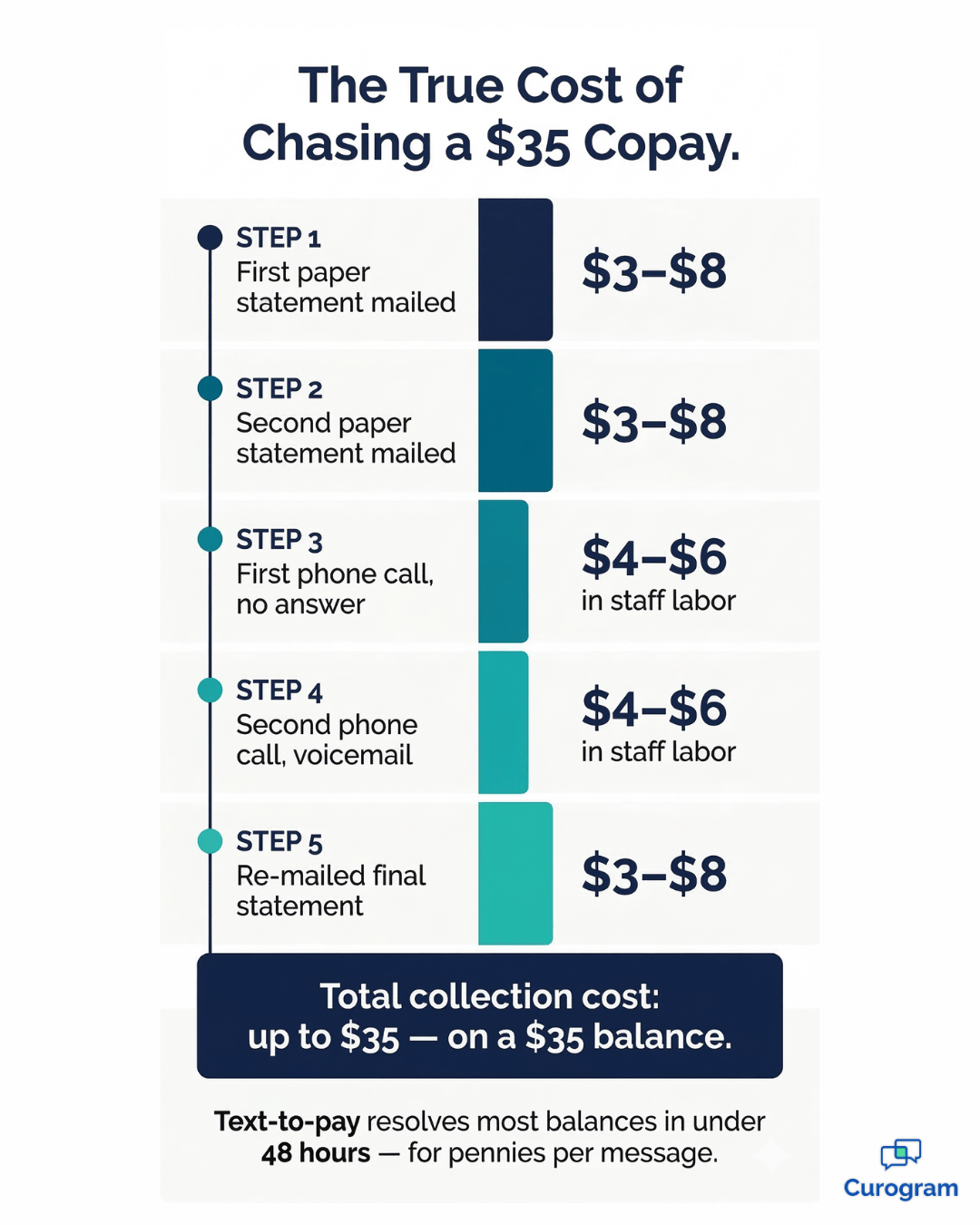
When a billing staffer spends 10 minutes calling a patient about a $35 copay and the patient does not answer, the practice has spent about $4 to $6 in staff labor on a failed attempt — on top of the $3 to $8 already spent printing and mailing the original statement.
That is potentially $14 in overhead for a balance that has not moved. Add a second phone call and a re-mailed statement, and the collection cost can approach or exceed the balance itself.
By the time a balance reaches 90 days, the total cost of collection can exceed 50% of the balance.
For balances under $50, the math often makes it more cost-effective to write them off entirely.
And that is exactly what happens at many practices, creating a steady and invisible revenue leak that rarely shows up cleanly on any single report — but adds up significantly over a quarter.
The cost-per-collection problem compounds every time a balance ages another 30 days. What starts as a $35 copay becomes a $35 copay with $20 in sunk collection costs and still no payment.
At some point the practice has to choose between writing it off or continuing to spend money chasing it. Neither option is good. The table below shows how the cost of each collection method stacks up side by side.
| Collection Method | Average Time per Balance | Estimated Cost per Collection |
|---|---|---|
| Paper statement (1st) | ~5 min (print/mail) | $3–$8 per statement |
| Follow-up phone call | 5–10 min (often voicemail) | $4–$6 in staff labor |
| Re-mailed statement | ~5 min (reprint/resend) | $3–$8 again |
| Text-to-Pay link (Curogram) | <1 min (batch send) | Pennies per message |
Staff labor cost estimates based on industry-standard billing wage rates. Paper statement costs based on print, postage, and handling averages for small practices.
Billing staff at rural clinics are not inefficient. They are fighting with the wrong tools. Paper statements and phone calls are the slowest, most expensive collection methods available.
And they are being used on a patient population — often elderly, working multiple jobs, or simply disorganized with mail — that is least likely to respond to them.
Text-to-pay removes that dilemma by resolving most balances before they ever reach the 60-day mark. When a patient gets a text with their balance and a link to pay, they can act on it in 30 seconds from wherever they are.
That is a fundamentally different dynamic than waiting for a statement to arrive in a mailbox and then remembering to write a check.
Curogram's text-to-pay integration with Azalea Health gives billing staff a completely different tool for the same problem.
Instead of working the aging report one phone call at a time, the billing staffer selects outstanding balances, generates personalized payment links for each patient, and sends them all via text in a single session.
What used to be a two-day phone marathon becomes a 10-minute batch-send workflow.
Payments start coming in within hours. Not 90 days. Not 60 days. The same day.
The reason this works is straightforward:
Text messages get read. Text open rates run as high as 98% compared to far lower rates for email — and unlike a phone call that interrupts whatever the patient is doing, a text sits in their pocket and waits until they are ready to act on it.
For a patient who would never answer an unknown number from a clinic, a text with a clear balance and a tap-to-pay link removes every barrier between them and payment.
There is also no friction on the patient side. They do not need to log into a portal, remember a password, or navigate a website. They tap the link, see their balance, and pay.
The whole interaction takes less than a minute for most patients — and that speed is exactly why the collection rate climbs so quickly after the switch.

Curogram's batch payment link tool is the engine behind this shift. Billing staff select the balances they want to address from the Azalea Health integration, and Curogram generates a unique, secure payment link for each patient.
Every text message includes the patient's specific balance amount and a direct link to pay it.
No login required, no portal navigation, no confusion about what the charge is for.
The billing staffer watches the aging report shrink throughout the day without making a single follow-up call. For the vast majority of balances, the text does all the work.
Because the integration runs through Azalea Health, there is no risk of a patient receiving an outdated balance or paying an amount that has already been adjusted.
The data stays in sync automatically. The billing staffer does not need to double-check anything or manually update records after the fact — the system handles it from the moment the payment is made.
Not every patient will tap the link and pay immediately. Some will have questions about the charge. Some will want to dispute an amount or ask about splitting the balance into a payment plan.
With Curogram, that conversation does not require a phone call or a visit to the office.
The patient can simply reply to the same text message through secure medical messaging, and their response lands directly in Curogram's two-way texting inbox.
The billing staffer can respond, clarify the charge, and work out any arrangement — all from the same tool they used to send the payment link in the first place. Everything stays in one conversation thread, which keeps the interaction organized and documented without any extra steps.
This also means the patient never has to navigate a phone tree or wait on hold just to ask a simple billing question.
The convenience that gets them to open the text in the first place extends through the entire resolution — a key factor in long-term medical practice reputation management for clinics serving rural patient populations.
That is a meaningful difference for patients who might otherwise let the balance sit because calling the office feels like too much effort.
Rural practice billing staff are often one or two people covering the entire revenue cycle — insurance billing, claim denials, patient collections, credentialing, and prior authorizations.
The workload was never designed to fit comfortably inside 40 hours a week. The aging report treadmill makes the gap between the work and the available time even wider by filling the calendar with tasks that have the lowest dollar return of anything on the list.
Every hour spent chasing the aging report by phone is an hour stolen from insurance follow-ups, which often carry a 10 to 50 times higher dollar return per hour.
A denied claim sitting at $1,200 and a $40 copay that went to voicemail are not equivalent problems — but the old workflow treats them as if they are by consuming the same staff time on both. Text-to-pay ends that trade-off.
Text-to-pay does not just collect patient balances faster. It gives the billing team back the time to focus on the work that actually moves the needle.
That is the real value of integrating front desk copay collection via text with Azalea Health — and it scales across every balance on the list, not just the ones that happen to catch a patient on a good day.
.png?width=1920&height=1080&name=Azalea%20Health%20billing%20staff%20text-to-pay%20eliminate%20paper%20statements%20-%20featured%20(1).png)
Billing staff using Curogram's text-to-pay have reduced their weekly patient collection time from 15 to 20 hours down to 2 to 3 hours, based on our internal data. At the same time, they collect a higher percentage of outstanding balances than they did under the old workflow.
The per-collection cost drops from $10 to $20 per balance — once you factor in multiple statements and failed phone calls — down to pennies per text message. That shift makes even a $15 copay worth pursuing instead of writing off.
The transformation is a move away from the aging report treadmill and toward a batch-and-collect workflow.
Monday mornings shift from dreading the report to running a short text-send session and watching payments post throughout the week.
The hours that were tied up in patient balance chasing move directly over to insurance claim follow-ups, denial appeals, and prior authorizations — tasks with dramatically higher revenue impact per hour.
The speed of collection also changes the trajectory of the aging report itself.
Balances that used to reach 60 or 90 days get resolved in the first week after the text goes out. The report does not just shrink — it stays smaller, because new balances are being addressed before they have a chance to age.
Over a quarter, that momentum compounds into a measurably cleaner accounts receivable picture.
Consider a sole billing specialist at a 2-provider rural health clinic running on Azalea Health.
Before Curogram, she spent every Tuesday and Wednesday afternoon calling patients about outstanding balances.
Her 90-day aging report averaged 85 balances, most under $75. She reached maybe 30 patients by phone each week and collected from about 15 of them — a conversion rate just above 17%.
The patients she could not reach stayed on the report. Some received a second statement.
A few got a third call the following week. Many were eventually written off when the collection cost exceeded the balance. It was not a failure of effort on her part. It was a failure of the channel — and there was no better tool available to her at the time.
After implementing Curogram's text-to-pay, she sends batch payment links every Monday morning in about 15 minutes.
By Wednesday, she has typically collected from 40 or more patients without making a single phone call.
Her 90-day aging balance dropped by over 40% in the first quarter, based on our internal research.
She redirected 12 hours a week toward working insurance claim denials, recovering thousands in additional revenue that had been sitting unworked.
The numbers tell the story clearly. Based on our internal research across rural Azalea Health practices using Curogram text-to-pay, weekly collection time dropped from 15 to 20 hours down to just 2 to 3 hours.
Patients collected per week climbed from roughly 15 out of 85 outstanding balances to more than 40 — all without a single phone call.
The 90-day aging balance fell by over 40% in the first quarter, and 12 hours a week shifted directly to insurance denial work that had been sitting untouched.
This is where the story gets even more interesting. Reducing the patient aging report for FQHCs and rural practices is not just about collecting faster — it is about what the billing team does with the recovered time.
Here is where those 12 hours per week tend to go once the aging report treadmill is gone:
Each of these tasks carries a much higher dollar-per-hour return than chasing a $40 copay by phone. A single recovered denial can be worth 30 to 50 times more than the patient balance that would have consumed the same amount of staff time.
When the billing team automates patient balance collection for rural practices through text-to-pay, it frees up capacity for the work that has the biggest impact on the bottom line.
There is also a less obvious benefit: morale. Billing staff who spend their days leaving voicemails that never get returned and mailing statements into the void tend to burn out.
The aging report treadmill is exhausting precisely because it is repetitive, slow, and largely thankless work.
Shifting that to a 10-minute batch process — and spending the rest of the day on work that actually closes — changes the entire character of the job. That matters for retention in a role that is hard to fill and harder to replace.
The aging report treadmill is not a billing staff problem. It is a tools problem. Paper statements and voicemails were never designed to efficiently collect patient balances at the volume and speed that modern rural practices need.
They are slow, expensive, and increasingly ineffective — especially for the patients most clinics serve.
Curogram's text-to-pay changes that equation. Azalea Health handles your billing calculations and your aging reports. Curogram handles the part that comes next — getting the patient to actually pay.
Together, they turn a weekly burden into a 10-minute workflow that clears balances faster and costs far less per collection.
The billing staff time savings from SMS payment links are not marginal. They are the kind of shift that gives a one-person billing team back an entire day every week — time that goes directly toward insurance work with a much higher dollar-per-hour return.
The math is not complicated, and the results speak for themselves across rural practices that have made the switch.
Stop spending 20 hours a week chasing $40 balances by phone. Send the payment link by text and let your billing team focus on the insurance claims that actually move the needle.
Schedule a demo today and see how quickly the workflow changes. Send text-to-pay links to your current 60-plus-day aging balances on Monday morning and track collections by Friday.
Curogram supports batch sending of text-to-pay links. You can select multiple patients from your outstanding balance list and send personalized payment links to all of them in a single session. Each patient receives a text with their specific balance amount and a unique secure link, so it feels personal to the patient while taking only minutes of your time.
Curogram's integration with Azalea Health ensures that payments collected through text-to-pay are recorded and the billing team is notified immediately. You do not need to manually enter the payment or reconcile between systems. The payment posts and the balance updates, keeping your records accurate without additional data entry.
Patients who receive a text-to-pay link and want to discuss a payment arrangement can simply reply to the text message. Their response flows directly into Curogram's two-way texting inbox, where a billing staff member can work out a plan through the same conversation thread. This keeps the interaction in a single channel instead of requiring the patient to call the office and wait on hold.
Yes. Curogram's text-to-pay is built for HIPAA-compliant patient communication. The text message itself does not include sensitive clinical details — it simply notifies the patient that a balance is due and provides a secure link. The actual balance amount and payment details are handled through an encrypted link, keeping protected health information out of the message body. This approach meets HIPAA standards for patient billing communication while still giving patients a fast, frictionless way to pay.
Curogram works with the contact information already stored in Azalea Health. For patients who do not have a mobile number on file, you can continue using your existing collection method for those specific accounts while sending text-to-pay links to everyone else in the same batch. Over time, practices find it worthwhile to collect mobile numbers at check-in, since even a modest increase in text-reachable patients has a measurable impact on collection rates. Most rural practices that start with a partial list see enough results in the first week to make updating contact records a front-desk priority.
💡 Text-to-pay for Azalea Health rural patient balance collection gives rural clinics a faster, cheaper way to collect copays and outstanding...

💡 The fastest way to reduce therapy billing overhead is to replace mailed paper statements with automated SMS payment links. For pediatric therapy...
💡 If you want to reduce patient statement costs in your Prime Clinical practice, the fastest path is switching from printed mail to digital...