
9 min read
Text-to-Pay for Azalea Health | Collect Patient Balances by Text
Aubreigh Lee Daculug
:
March 20, 2026
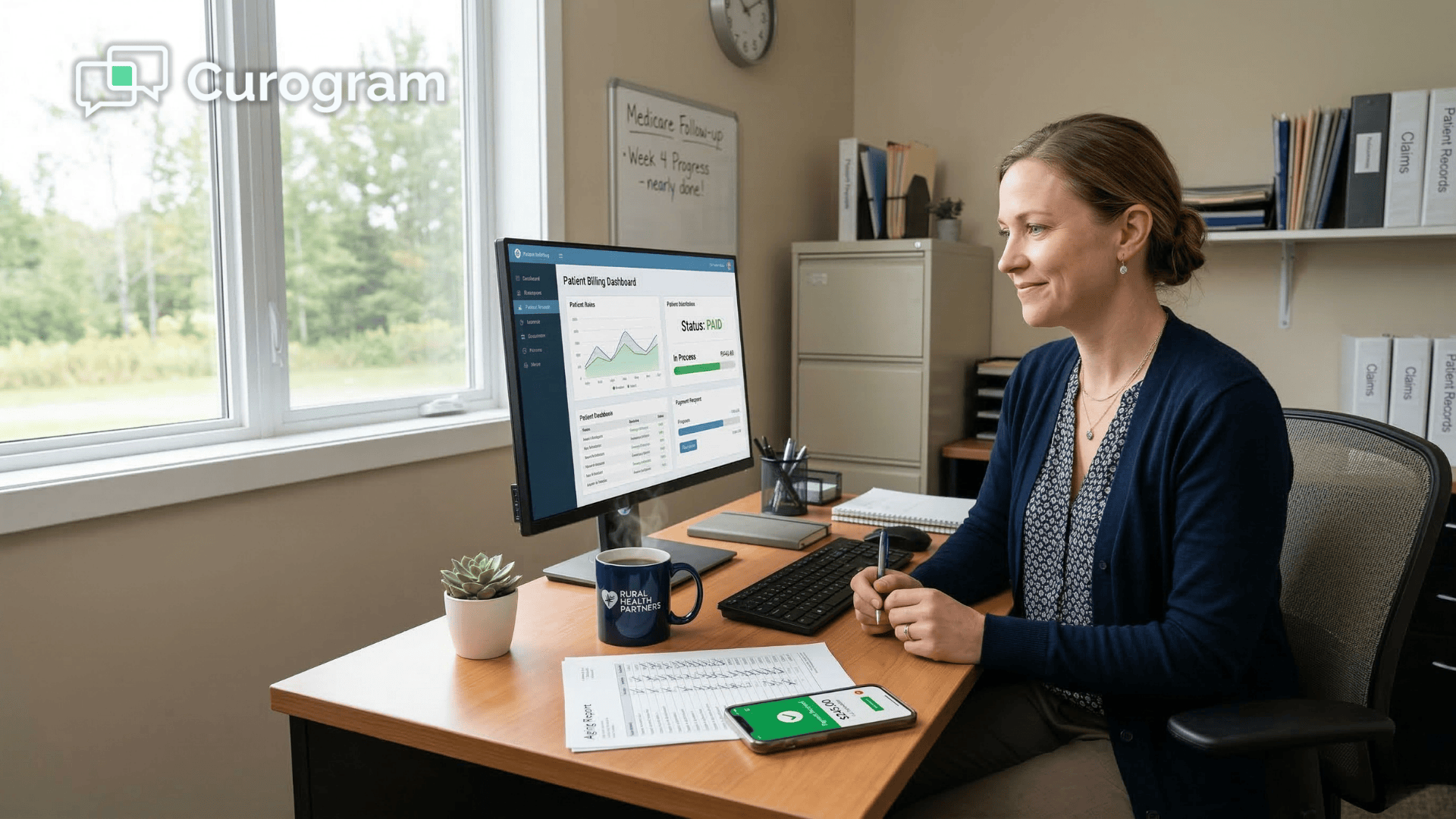
Instead of mailing paper statements, Curogram sends a secure, HIPAA compliant text payment link directly to the patient's phone. No app, no portal login, no check to write.
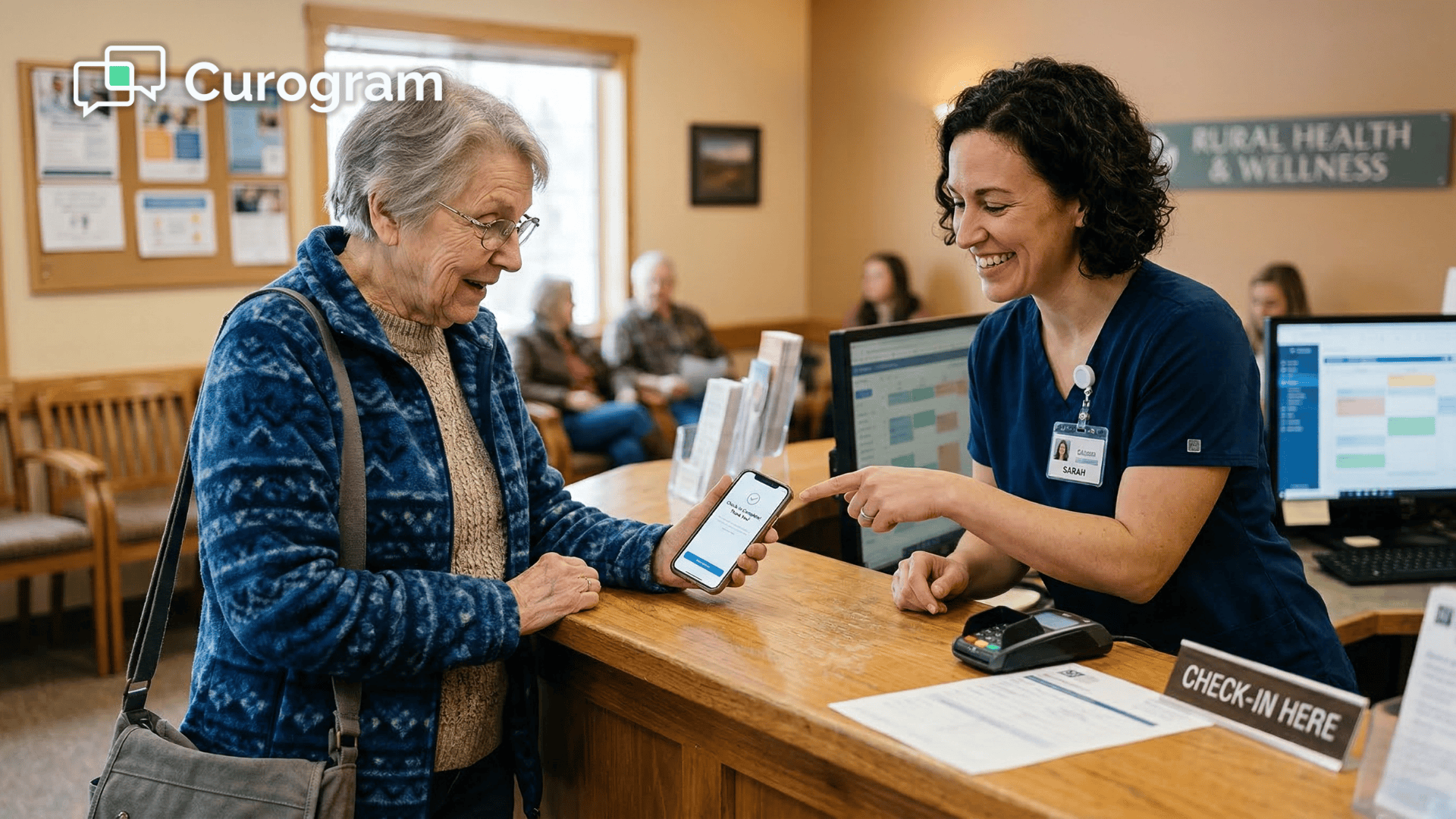
Patients at rural health centers, FQHCs, and Critical Access Hospitals can tap the mobile payment link, see their balance, and pay in about 30 seconds. The payment posts instantly and the billing team is notified right away.
For rural practices running on Azalea Health, this compresses the 90-day paper statement cycle to same-day.
Patient copay collection via text message reduces the cost of collecting from $3–$8 per statement to just pennies per text, making it worthwhile to recover even small balances.
Every rural billing office has a stack of accounts on the aging report that no one wants to touch. The balances are small — $28 here, $40 there — but the cost of chasing them with paper statements can easily exceed what the patient owes.
So the balance sits. Then it ages. Then it gets written off.
Text-to-pay for Azalea Health rural patient balance collection changes that math entirely. With Curogram, rural practices can send patients a secure payment link by text right after their visit.
The patient taps it, enters their card, and the balance is paid. No envelope. No stamp. No 90-day wait.
Rural healthcare has always operated under tighter margins than most. Staffing is lean, resources are stretched, and every dollar of patient revenue matters.
That makes an inefficient collection process more than just a minor inconvenience — it's a direct hit to the practice's ability to stay operational and serve the community it was built to serve.
The good news is that the fix doesn't require a new billing system or months of retraining.
It requires one additional step in your current Azalea Health workflow: a text message with a payment link.
Patients who would never log into a portal will tap a link on their phone. That single behavioral difference is where the revenue recovery happens.
This guide explains how the system works, why rural patients actually use it, and what it means for your practice's revenue cycle. If you're running an RHC, FQHC, or Critical Access Hospital on Azalea Health, this is the collection upgrade your billing team has been waiting for.
Why Mailing Paper Statements Is Costing Your Practice Real Money
Azalea Health does an excellent job of processing claims and calculating what each patient owes.
But once that number is set, most rural practices are stuck using the same collection method they've used for decades: the paper statement. Print it. Stuff it. Stamp it. Mail it. Hope the patient opens it.
The problem isn't that patients don't want to pay. It's that the paper-statement cycle makes paying unnecessarily hard — and unnecessarily expensive for your billing team.
Every statement that goes unanswered is another round of postage, another 30 days of float, and another item to age on the report.
The Infrastructure Gap
Azalea Health handles the billing math.
What it doesn't solve is the last-mile problem:
Actually getting the patient to hand over the money. Portal payment exists in theory, but rural patient adoption of online portals is a fraction of what it is in urban markets.
For many patients, logging in means hunting for a username they set up two years ago and resetting a password they've forgotten. That friction is real, and it costs you collections every month.
The gap isn't a gap in your billing system. It's a gap in the collection channel. Azalea Health gets you to the finish line of knowing what's owed. Curogram gets you the payment.
What the Billing Cycle Actually Costs
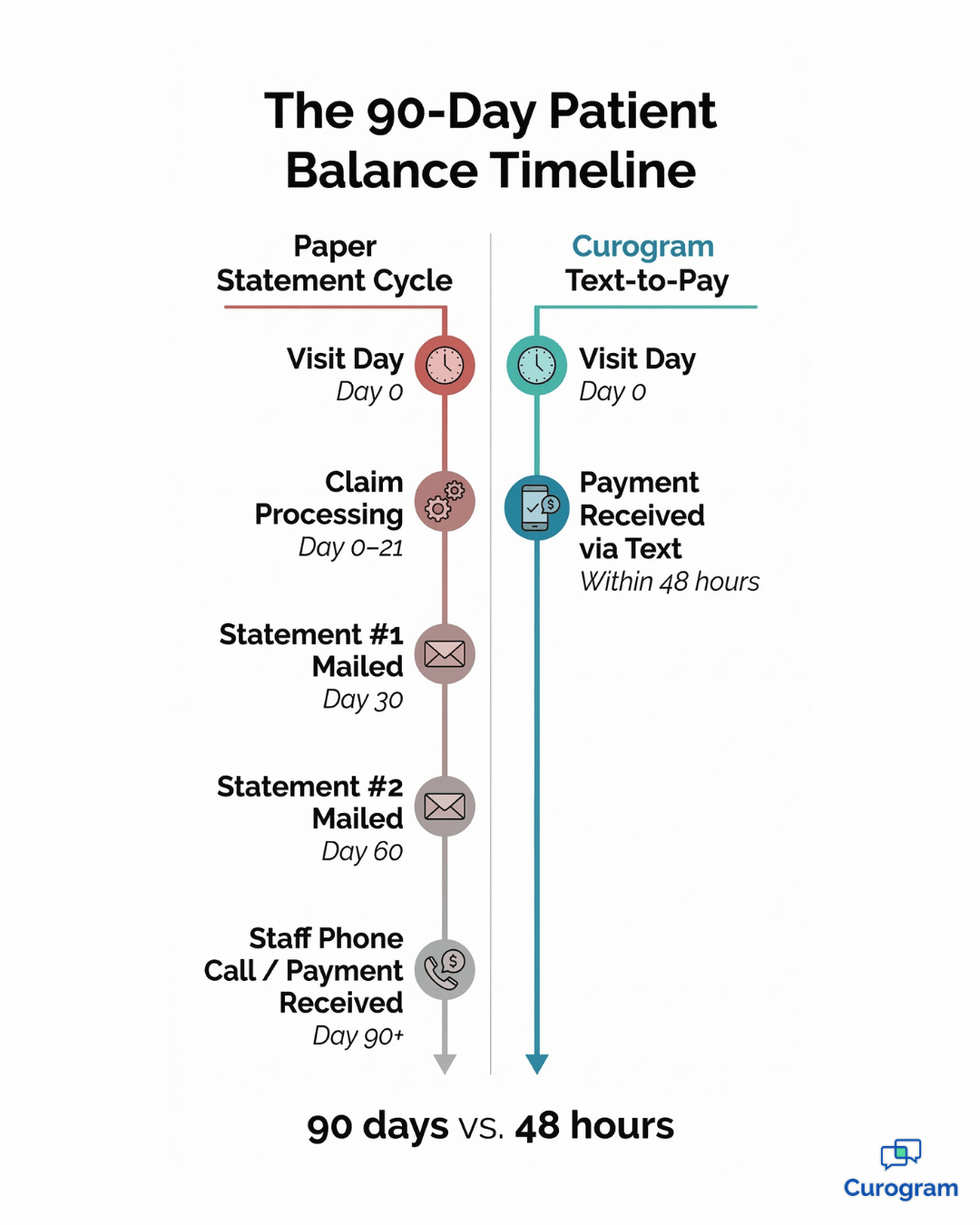
Picture a patient who visits a rural FQHC and leaves without paying a $40 copay. The claim processes over the next two to three weeks.
A statement goes out at day 30 — and gets buried under a pile of envelopes on the kitchen counter.
A second statement follows at day 60. The patient vaguely remembers owing something but isn't sure to whom.
By day 90, a billing staffer is on the phone. The patient apologizes, pays, and everyone moves on. When you add up two rounds of postage and a staff phone call, the cost to collect that $40 often lands somewhere between $18 and $28.
When the cost to collect starts approaching what you're collecting, the math stops working.
For small rural practices, patient responsibility revenue is no longer a rounding error — it's an increasingly critical part of total collections as rising healthcare costs strain health system margins, especially with high-deductible plans becoming more common.
The Revenue Leak No One Talks About
Practices that write off 15 to 20% of patient balances because the collection cost exceeds the balance amount are leaving tens of thousands of dollars on the table each year.
That's revenue that could fund additional staff, equipment upgrades, or extended clinic hours. SMS billing for FQHC patient balances offers a direct, low-effort fix for that leak.
Billing teams at rural clinics know this cycle is broken. They watch the same balances sit on the aging report for 60, 90, and 120 days. They know each statement costs money. They know each phone call burns time that could be spent chasing higher-value insurance denials.
But without a digital collection channel their patient population will actually use, they stay stuck in the loop — not because they haven't tried to fix it, but because nothing easier has been handed to them.

How Curogram Turns a 90-Day Chase Into a 30-Second Payment
Curogram acts as the virtual billing assistant for Azalea Health practices — the layer between "balance owed" and "balance paid" that paper statements were never built to be.
The workflow is simple:
After a visit, the billing team sends the patient a text with their balance and a direct payment link. The patient taps it, pays, and it's done.
No envelope stuffing, no portal navigation, no follow-up call required.
What makes this work isn't just the technology — it's the match between the tool and the behavior. Rural patients already use their phones to pay bills, check balances, and communicate with people they trust. Curogram meets them exactly where they are.
What the Payment Link Actually Does
Curogram's payment engine generates a unique, HIPAA compliant text payment link for every patient balance. The link opens a mobile-optimized page that shows the amount, accepts credit and debit cards, and confirms payment on the spot.
The whole experience is designed around one goal:
Remove every possible reason not to pay right now.
The page is built for plain, everyday use — large text, clear balance amounts, one button to pay. Patients can also save their card for future visits, which cuts down on friction every time they owe a balance. That small detail matters more than it sounds.
When payment becomes a one-tap action, it happens. When it requires setup, it doesn't.
And because the link lives in a text message the patient already received, there's no searching, no navigating, and no waiting for a statement to arrive in the mail.
How It Connects to Azalea Health
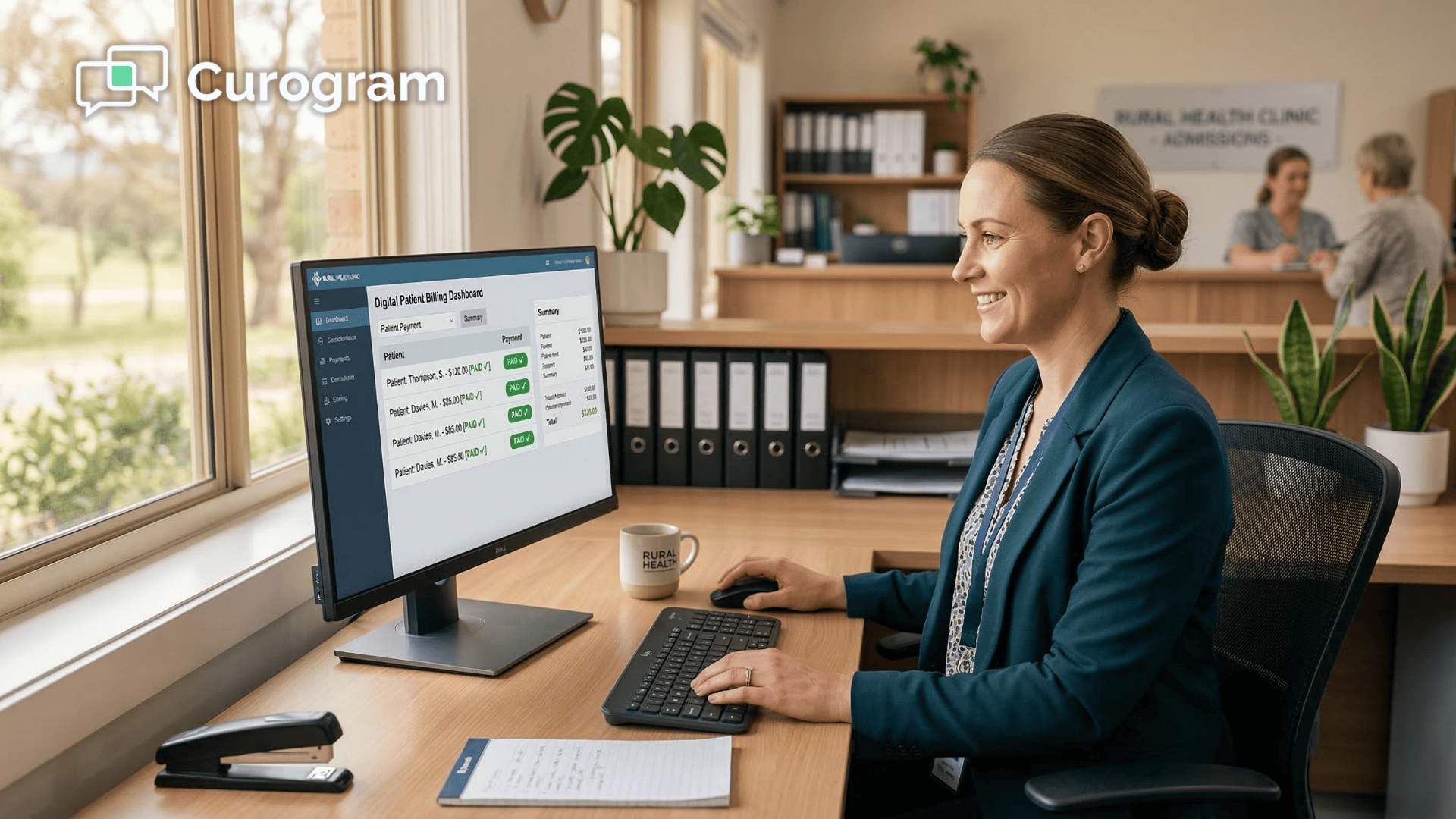
Curogram syncs with Azalea Health's billing data so every mobile payment link reflects the correct, real-time patient balance. When the patient pays through the text link, the payment posts right away and the billing team gets an instant notification.
No manual reconciliation. No double-entry. No switching between platforms.
Your billing workflow in Azalea Health stays exactly the same. Curogram simply adds the fast, frictionless payment channel that closes the loop.
Think of it as the final piece your revenue cycle has always been missing — the one that sits between the bill being generated and the money actually arriving.
Why Rural Patients Actually Use It
Rural patients aren't avoiding their bills — they're avoiding the friction in healthcare payment processes that research shows reduces patient follow-through.
The difference matters, because the fix isn't about chasing patients harder — it's about making payment easier.
Consider what each option actually asks of someone:
- Paper statement: find an envelope, write a check, find a stamp, mail it back
- Patient portal: remember a username, reset a password, navigate to the billing section, enter card details on a form built for desktop
- Curogram text-to-pay: tap the message that's already on your phone
For a 70-year-old Medicare patient who's never logged into a portal, tapping a text link is no different from paying any other bill on their phone. It's familiar. It's fast.
And for patient populations where simplicity determines whether something gets done, it's often the only collection method that actually gets used. That's not an assumption — it's a pattern that plays out in rural practices every day.
Curogram solves unpaid patient AR balances by simplifying the payment process with SMS — increasing the collections rate and reducing the time to collect.
Based on our internal data, practices using text-to-pay collect a significant share of outstanding balances within the first 48 hours of sending the payment text.

What Happens When You Send the Text Instead of the Statement
The shift from paper to text isn't just a convenience upgrade — it's a revenue cycle transformation. Based on our internal data, practices using text-to-pay collect a significant share of patient balances within the first 48 hours of sending the payment text.
Compare that to the 90-plus-day average for paper statement collection, and the impact is hard to ignore.
The per-collection cost drops from $3 to $8 per statement cycle to just pennies per text message. That makes it cost-effective to recover even the smallest balances — the $25 copays and $18 out-of-pocket amounts that used to get written off without a second thought.
Over a full year, those small wins add up to thousands of dollars in recovered revenue that would otherwise be gone.
By the Numbers
| Metric | Paper Statement Cycle | Curogram Text-to-Pay |
|---|---|---|
| Average time to collect | 90+ days | Within 48 hours |
| Cost per collection attempt | $3–$8 | Pennies per text |
| Staff time per balance | 10–15 min (calls + follow-up) | Seconds to send |
| Patient action required | Multiple steps | One tap |
| Reconciliation needed | Manual | Automatic |
The numbers tell one part of the story. The other part is what your billing staff can do with the time they get back.
| 48 hrs |
|---|
| Typical window to collect after sending a payment text — vs. 90+ days by paper |
Every hour not spent on statement cycles and collection calls is an hour that can go toward insurance follow-ups, denial management, and higher-value revenue cycle work. That reallocation adds up just as fast as the recovered balances do.
A Real-World Example
Here's what this looks like for a typical patient. A 74-year-old woman at a rural Critical Access Hospital owes $28 after her quarterly visit.
Under the old paper statement workflow, she'd get a statement at day 30, lose it in the mail pile, get a second one at day 60, and finally pay when the billing office calls at day 90. Total collection cost: over $20 for a $28 balance. The math barely works.
With Curogram's text-to-pay, she gets a text the same afternoon: "Your balance from today's visit is $28.00. Tap here to pay securely." She taps the link while waiting to pick up her grandchildren, enters her card, and pays in 25 seconds.
The billing team sees the payment post before the end of the day. No statement printed. No stamp purchased. No call made.
What Billing Staff Get Back
The gains here go beyond the balance sheet. When patient copay collection via text message handles the bulk of small-balance recovery, billing staff aren't starting every morning with a stack of aging accounts to chase.
The workflow becomes proactive instead of reactive. Texts go out and payments come back. The cycle compresses, and the team's attention shifts to work that actually requires their expertise.
Billing staff reclaim the hours they spent running statement cycles and making collection calls. Those hours get redirected toward higher-value work — insurance follow-ups, claim denials, and tasks with a higher dollar-per-hour return.
That's a better use of the team you already have. And for understaffed rural practices where every hour counts, that shift matters.
Stop Spending $8 to Collect $35: Let's Get You Set Up
The paper-statement chase is not a patient problem. It's a process problem — and it has a straightforward fix. Curogram gives Azalea Health practices the last-mile payment collection tool the billing workflow has always been missing.
Azalea Health handles your billing calculations and claims management. Curogram handles the frictionless payment experience on the patient's side.
Together, they close the loop between "balance owed" and "balance paid" without a single paper statement changing hands.
Think about the 60- and 90-day balances sitting on your aging report right now. Those aren't hopeless accounts — they're patients who simply haven't been given an easy way to pay.
A text message with a direct payment link changes that. Based on our internal research, most practices see meaningful collections come in within the first 48 hours of sending payment texts to aging balances.
You don't need to overhaul your billing workflow. You don't need to retrain your staff. You just need to add the payment channel that matches how your patients already use their phones.
The cost of collecting drops. The speed of collecting improves. And the patient experience gets better in the process.
Schedule a demo today and see how Curogram's text-to-pay works inside your existing Azalea Health setup. Or start your 30-day free trial and send payment links to your current aging balances.
Frequently Asked Questions
Yes. Curogram's text-to-pay operates under a signed Business Associate Agreement (BAA) and follows HIPAA guidelines for electronic communications. The text message itself contains only the balance amount and a secure link — no diagnosis codes, treatment details, or other protected health information. The payment page is encrypted and only accessible through the unique patient link, so financial data stays secure from start to finish.
No. The mobile payment link opens directly in the patient's phone browser — no app, no account, no password required. The patient sees their balance, enters their card details, and confirms payment. The whole process takes about 30 seconds. This is especially important for rural patient populations, where many patients are elderly or have limited experience with smartphones.
Curogram's text-to-pay is built to complement your existing Azalea Health billing workflow, not replace it. It adds a faster, cheaper collection channel for patient responsibility balances. Pricing is based on your practice's volume and typically costs less than the paper statements it replaces. The 30-day free trial lets you test the system on your current aging balances with zero financial risk — and most practices see enough collections during the trial to confirm the ROI right away.
Yes. Curogram can be configured to trigger a payment text automatically once a patient balance is posted in Azalea Health, so your billing team doesn't have to manually send each one. You can also set rules around which balances trigger a text — by amount, visit type, or payer — giving you control over when and how the messages go out. For practices with high visit volumes, automation makes the whole process hands-free after the initial setup.
Because Curogram is a two-way texting platform, patients can reply directly to the payment text with questions. Your billing staff sees the reply in the Curogram inbox and can respond from the same thread — no phone tag, no voicemail. If the patient needs a balance adjustment or has an insurance question, the conversation stays in one place. This is especially useful for rural practices where patients often have a closer relationship with clinic staff and feel more comfortable asking questions before paying.