8 min read

Collect Patient Balances Faster with Meditab IMS | Text-to-Pay

Collect Patient Balances Faster with Meditab IMS | Text-to-Pay
💡 Text-to-pay mobile payment collection helps Meditab IMS practices reduce paper statements by sending patients a secure SMS payment link they can tap and pay in under a minute. No portal login. No envelope. No 90-day wait.

Paper statements cost $1.50 to $3.00 each and convert at just 20%. Text payment links convert 2X to 3X faster and shrink collection timelines from 45–90 days down to 3–7 days.

Curogram sends the link, the patient pays from their phone, and the balance clears before a printed bill would have even arrived in the mailbox.

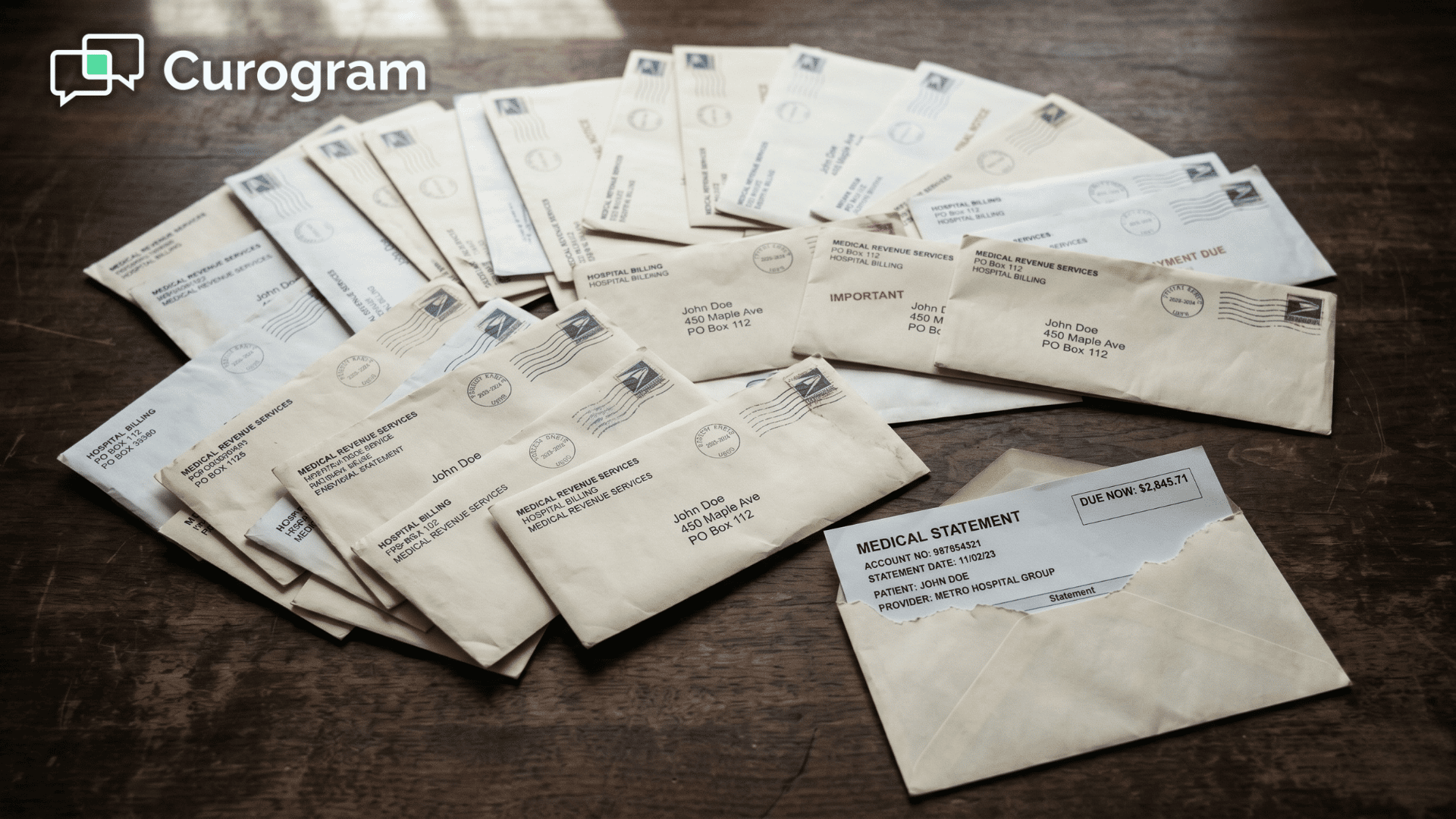
A $75 patient balance sits in your accounts receivable for 87 days. You mailed three paper statements. Each one cost about $2 to send. The patient never opened them.

This is the quiet leak draining cash from most Meditab IMS practices. Balances pile up. More statements go out the next month. Staff time vanishes chasing checks that may never come.

The practice has done everything right — statements, calls, follow-ups — and still waits months to collect money it already earned at the visit.

Here is what makes it worse.

Your patients are not actually refusing to pay you. They are refusing the process. The same patient who ignored your printed bill paid for groceries by phone yesterday, split a dinner check on Venmo, and tapped a parking app on the way into your office.

Paying for healthcare is the only part of their day that still requires an envelope and a stamp.

Meanwhile, CarePortal bill pay sits inside the patient portal, waiting.

The feature technically works. The problem is that fewer than 30% of patients log in regularly. To get around CarePortal bill pay limitations, a text alternative meets patients in the one app they actually open — their text thread.

So most practices fall back on paper. And paper is expensive, slow, and stubbornly ineffective in 2026. The cost-per-collected-dollar climbs every quarter the system stays in place.

This article walks through how to collect patient balances faster. Meditab practice teams using text-to-pay see balances clear in days, not months.

You will see the math behind paper statements, why portals miss most patients, and how a 30-second payment link rewires your entire revenue cycle without replacing your billing system. You will also see what the cash flow shift looks like in practice.

Let's start with exactly what every paper envelope is actually costing you right now.

Why Paper Bills Cost You More Than You Think

Most practices treat paper statements like a fixed cost of doing business. They aren't. They are one of the most expensive ways to chase a dollar in healthcare today.

The True Cost of a Single Statement

A single paper statement runs $1.50 to $3.00.

The number looks small until you break down what is actually inside it:

  • Paper and printing supplies
  • Envelope, insert, and return mailer
  • Postage
  • Staff time to print, stuff, and queue the batch
  • Vendor or mail house fees, if you outsource

Send 500 a month and you are spending $750 to $1,500 just to ask patients for money.

Here is what that math looks like at scale:

Monthly Volume Avg. Cost per Statement Monthly Cost Annual Cost
300 statements $2.00 $600 $7,200
500 statements $2.00 $1,000 $12,000
800 statements $2.00 $1,600 $19,200

For your team, that means spending real money to send mail most patients will never act on.

The 90-Day Aging Cycle You Probably Recognize

A patient walks in for a visit. They pay their copay at checkout. Three weeks later, insurance processes and a $75 balance posts to their account.

Statement 1 goes out. The patient opens their mailbox, sees a stack of credit card offers and one envelope from your practice, and sets it aside.

Day 30: statement 2.

Day 60: statement 3.

Day 90: your billing manager has to choose between writing it off or sending it to collections.

That $75 — which could have been collected the day after insurance adjudication — has now cost you $6 to $9 in statement expenses and three months of cash flow drag.

Conversion Rate

Paper Statements: 20% convert to payment

Text-to-Pay: 40%–60% convert to payment

Translation: 2X to 3X more patients actually pay you.

Why CarePortal Bill Pay Doesn't Close the Gap

Meditab IMS includes CarePortal bill pay through Global Payments Integrated. The technology is there. The problem is the front door.

To use CarePortal bill pay, a patient has to log into the patient portal. That is the same portal fewer than 30% of patients use regularly. The same portal that requires remembering a password, finding the bill pay tab, and navigating menus most patients will never see.

The result is a payment tool that exists in name only. The practice has the feature. The patients have the bill. The two never meet.

This is why so many billing teams quietly search for a CarePortal bill pay limitations text alternative — they need a payment channel that does not depend on portal adoption.

What Your Patients Actually Expect in 2026

Think about how your patients pay for everything else.

They tap a screen to grab an Uber.

They scan a QR code to split brunch.

They send Venmo requests to friends in seconds.

Then they come to your practice and get a paper bill that asks them to write a check.

Patients aren't lazy or unwilling. They are calibrated to digital, mobile-first transactions. A medical bill that requires an envelope feels like a relic from another decade.

They don't refuse to pay you. They refuse to do extra work to pay you.

Infographic showing the true cost breakdown of a single paper patient statement

How Text-to-Pay Turns a Bill Into a 30-Second Transaction

This is the part where the math finally flips. Text-to-pay mobile payment collection helps Meditab IMS practices reduce paper statements dramatically — often by 60% or more inside the first three months.

The 30-Second Payment Flow

Curogram sends an SMS to the patient's phone with a secure payment link. The patient taps the link. They see their balance, enter a payment method (or use a saved one), and confirm.

That is the whole transaction.

No portal login. No app to download. No envelope, stamp, or check.

The Meditab IMS patient payment text message lives in the same thread patients already use for appointment reminders and intake forms.

For a primary care practice running Meditab IMS, that means a patient with a $50 balance can pay before they even leave the parking lot.

Automated Balance Notifications

Curogram can send the SMS payment link automatically after insurance adjudication, triggered by balance thresholds or time-from-visit rules.

A claim posts. A $50 balance lands in your system. The same day, Curogram sends the text. The patient pays before a paper statement ever queues up.

For patients on payment plans or ongoing treatment, automated reminders keep collections moving without staff chasing them. Your billing team works on exceptions, not routine follow-up. That is what real patient payment collection Meditab IMS mobile workflows look like in practice.

Office calendar marking aging patient balance dates before adopting text-to-pay collection

How It Fits Into Your Existing IMS Workflow

Text-to-pay doesn't replace your billing system. It adds a collection channel that runs alongside everything else.

Payments flow through Curogram's secure, PCI-compliant processing. You can reconcile against IMS billing records, so data stays consistent across systems. Patients who prefer to pay in person, by phone, or through CarePortal can still do that.

Think of it as an extra lane on a highway, not a replacement road. The SMS payment link medical practice IMS users send out quickly becomes the most-used lane, simply because it is the easiest one.

Which Specialties Feel the Biggest Lift

Some specialties feel the paper statement trap more than others.

The pattern shows up strongest in practices with high out-of-pocket balances or layered billing:

  • Dermatology — high-value cosmetic procedures with significant patient responsibility
  • Gastroenterology — colonoscopy copays and procedure balances
  • Pain management — multi-session injection series and recurring treatments
  • Multi-specialty groups — complex balance splits across departments

All of them deal with balances that age quickly and convert poorly on paper. Text-to-pay adapts to each one. Large balances get immediate payment links. Smaller balances get batch reminders.

The collection strategy matches your billing complexity instead of fighting it.

From Three-Month Waits to Three-Day Cash

Most practices that adopt text-to-pay see two changes almost immediately. Collections speed up. Conversion rates climb.

The Numbers Behind the Shift

What used to take 45 to 90 days through paper now closes in 3 to 7 days through text. Conversion rates also climb 2X to 3X compared to paper statements.

This means your A/R aging buckets start to look very different in your first quarter. When you combine that with the no-show reduction Curogram brings to scheduling — Atlas Medical Center saw a 53% drop — the compound effect on revenue gets significant.

A Real-Time Revenue Cycle

The traditional collection cycle is slow by design. Visit, wait for insurance, send statement, wait for check, send another statement, wait again.

Text-to-pay collapses that into a same-week cycle. Visit, insurance posts, text goes out, patient pays.

Cash flow becomes predictable. Accounts receivable aging shrinks. Your billing manager spends less time chasing $75 balances and more time on the parts of revenue that actually need a human.

A Sample Month at a Primary Care Practice

A primary care practice running Meditab IMS rolls out text-to-pay. In month one, they send 200 payment links.

Here is what their first 30 days looked like:

  • 130 of 200 patients paid within 72 hours
  • Average balance collected: $65
  • Total collected in three days: $8,450
  • Paper statement volume dropped by 60%
  • Monthly mailing costs fell from $950 to $380

That comes out to roughly $570 a month, or about $6,840 a year, in mailing alone — before you even count the faster collections on receivables.

This is how practices reduce paper statement costs Meditab IMS workflows used to bury in mailing overhead. Lower spend, faster cash, fewer balances aging into collections.

Stop Lending Money to Your Patients for Free

Every day a patient balance sits uncollected is a day you are financing someone else's healthcare for free.

That is not a slogan. That is your bank account.

The $75 balance that ages 90 days is $75 you cannot put toward staffing, equipment, or growth. Multiply that across hundreds of patients each month, and the cost of waiting is bigger than most practices realize.

Paper statements were the only option for a long time. They are not the only option anymore. Patients carry the payment terminal in their pocket. The job is to send the bill where they already are.

That is what text-to-pay does. It replaces the slow, expensive, low-conversion paper system with a fast, cheap, high-conversion text. Your Meditab IMS data tells you what each patient owes. Curogram makes it effortless for them to pay you.

The shift is not small. Collection timelines drop from months to days. Conversion rates jump 2X to 3X. Mailing costs fall by 50% to 70%.

Your billing team stops chasing balances and starts working on the parts of revenue that actually need a human.

You do not need to rip out your billing system. You do not need to retrain your staff for weeks. Most practices are live with text-to-pay inside 48 hours and seeing measurable results within the first month.

If you are tired of waiting for checks that may never come, this is exactly the next step worth taking.

Schedule a Demo with Curogram and see exactly how text-to-pay works inside your Meditab IMS billing workflow. We will walk through your paper statement volume, model the conversion lift, and show you what cash flow looks like when patient balances clear in a week instead of a quarter.


Frequently Asked Questions

Is text-to-pay HIPAA-compliant and secure?

Yes. The text message itself contains only a payment link — no balance amount, diagnosis, or protected health information appears in the SMS. When the patient taps the link, they reach a secure, PCI-compliant payment page. All transaction data is encrypted in transit and at rest. Curogram operates under a Business Associate Agreement and is SOC 2 Type II certified.

Will text-to-pay replace CarePortal bill pay or our existing payment methods?

No. Text-to-pay is an additional collection channel, not a replacement. Patients who prefer CarePortal, in-person payment, or phone payment can keep using those methods. Text-to-pay captures the 70%+ of patients who don't use the portal and would otherwise wait for a paper statement. It adds a high-conversion option alongside everything you already have.

How much does text-to-pay cost compared to paper statements?

A paper statement costs $1.50 to $3.00 per mail piece and converts at 20%. Text-to-pay costs a fraction of that per message and converts at 2X to 3X the rate of paper. The cost-per-collected-dollar drops sharply. Most practices see the text-to-pay cost offset within the first month from reduced paper statement volume alone. We can walk through the specific ROI math for your practice during a quick demo.

How long does it take to set up text-to-pay with our Meditab IMS practice?

Most practices are live with text-to-pay inside 48 hours. Implementation does not require ripping out or reconfiguring your IMS billing system. Curogram layers on top of your existing workflow, so your billing team keeps working the way they already do. Onboarding includes a brief setup call, payment processor connection, and a walkthrough of automated balance triggers tailored to your specialty.

What happens if a patient doesn't pay after receiving the text?

The patient enters an automated reminder sequence. Curogram can send follow-up texts based on rules you set — for example, a gentle nudge at 3 days, another at 7 days, and a final notice at 14 days. Patients who still don't pay can then roll into your standard collection workflow, but most clear during the reminder sequence. The result is fewer balances ever reaching paper statement or collections stages in the first place.