10 min read

Elation Health Mobile Payment: Why Text-to-Pay Beats Paper Bills

Elation Health Mobile Payment: Why Text-to-Pay Beats Paper Bills
💡 Patients at Elation Health practices prefer text-to-pay because it removes the friction of paper bills and portal logins. The payment process takes under 30 seconds on the phone they already use daily.
  • No portal login or password reset needed
  • No app to download or account to create
  • No paper statement delay of 10–14 days
  • Secure SMS link with the practice name and exact balance
  • One-tap payment with a saved card on return visits
This is a patient-friendly text-to-pay Elation Health mobile payment experience that meets people where they already spend their time. It turns a frustrating chore into a quick tap.

The wallet is dead. Or at least, most of us have stopped reaching for it first. We tap our phones to board planes, split dinner bills, and pay for groceries. Yet medical billing often pulls us back into another era.

Patients leave an Elation Health practice feeling cared for. Then a paper bill shows up two weeks later. Or they get an email asking them to log into a portal they haven't visited since their last visit.

This gap between care and billing is wider than most practices realize. A patient who loved the visit can feel annoyed by the bill, not because of the amount, but because of the effort. That shift in feeling shows up in patient reviews, in payment delays, and in the front desk's voicemail.

This article looks at why patients at Elation Health practices are choosing text-to-pay over paper statements and portal billing. It walks through the patient journey, the trust signals patients notice, and the satisfaction effects that follow.

We will cover the current payment experience, what text-to-pay feels like from the patient's side, and how billing shapes practice reputation. You will also see how patient payment preferences have changed across age groups. The shift toward a mobile billing experience Elation users now expect is not a passing trend.

The numbers tell a clear story. Most patients want to pay digitally. SMS open rates beat email by a wide margin. And the SMS payment patient journey is shorter than any other option a practice can offer.

If your team has been asking why some bills sit unpaid for weeks, the answer is rarely about money. It is about friction. And text-to-pay removes most of it.

The Patient's Current Payment Experience

Most patients do not refuse to pay. They get stuck in the process. The bill arrives at the wrong time, on the wrong channel, or asks them to remember things they never wrote down. To see why text-to-pay wins, look at what it replaces.

The Paper Statement Experience

The paper statement is slow by design. The visit happens on Day 1. The statement is generated on Day 3 to Day 5. It is mailed on Day 5 to Day 7. It lands in the mailbox on Day 10 to Day 14.

Then it sits. Mail piles up. The patient may open it on Day 15 to Day 20. If they act right away, payment reaches the practice 20 to 25 days after the visit. If the envelope gets mixed in with junk mail, the cycle starts over from scratch.

There is also a clear age gap. Patients under 45 expect digital payment options. They find paper bills outdated. Older patients are more used to paper, but many still welcome a text-based option when it is offered.

Based on our internal data, paper statement collection rates sit near 20% on the first cycle. That means 80% of patients do not pay on the first try. This is not a money problem. It is a friction problem.

The Portal Payment Experience

Portal billing looks modern, but it adds its own steps. The patient gets an email or alert. They visit the portal. They try to remember their username and password. They reset the password. They log in. They find the billing tab. They review the balance. They enter card details. They submit.

That is six to eight steps on a good day. On a bad day, it ends in a forgotten password and a closed tab.

Most patients visit a practice two to four times per year. That is not often enough to remember portal credentials. So the portal becomes a maze, not a tool. Each step adds drop-off risk.

Portal billing is more current than paper, but it still asks the patient to do the work. They have to find the bill, log in, and complete the task on their own time. Text-to-pay flips this. It brings the bill to the patient instead of asking them to come find it.

What Patients Actually Want

The data on patient payment preferences is clear. Around 79% of consumers say they prefer to pay bills digitally. SMS open rates sit near 98%, while email opens hover around 20%. Portal message engagement is even lower.

Patients can pay for coffee, a ride, or an online order with one tap. Asking them to manage three login screens and a mailbox feels out of step. The contrast is sharp.

This is even more true for Direct Primary Care patients. They chose DPC for a more personal and modern care model. They expect the billing process to match. The portal vs text-to-pay debate often ends here for them.

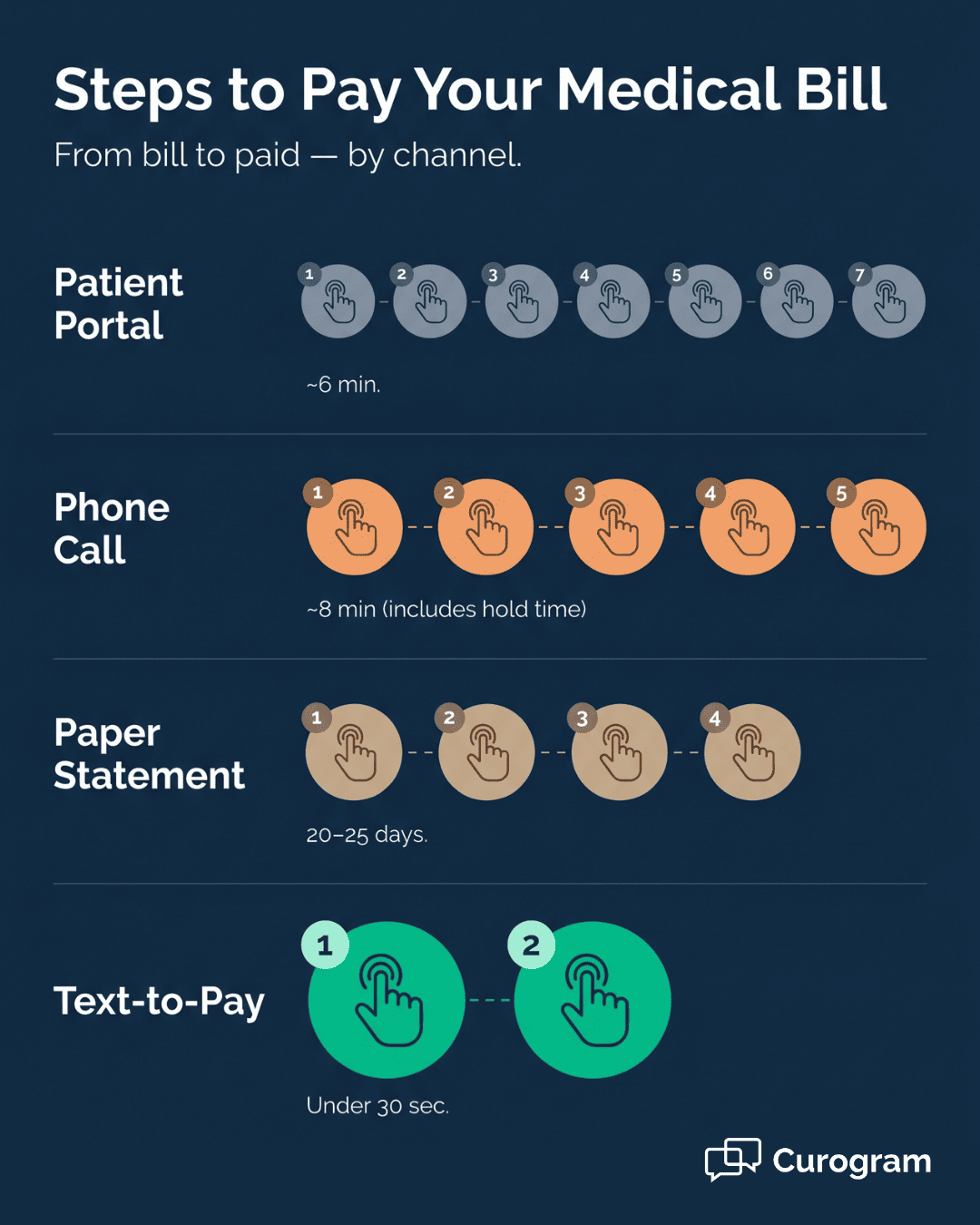
The chart below shows the gap between channels.

Payment Channel

Patient Steps to Pay

First-Cycle Pay Rate

Paper statement

4–6 (open, read, write check, mail)

~20%

Patient portal

6–8 (login, reset, navigate, pay)

30–40%

Phone call to office

3–5 (call, wait, read card, confirm)

Varies widely

Text-to-pay

2–3 (tap link, enter card, confirm)

60%+


The pattern is simple. Fewer steps means more payments collected.

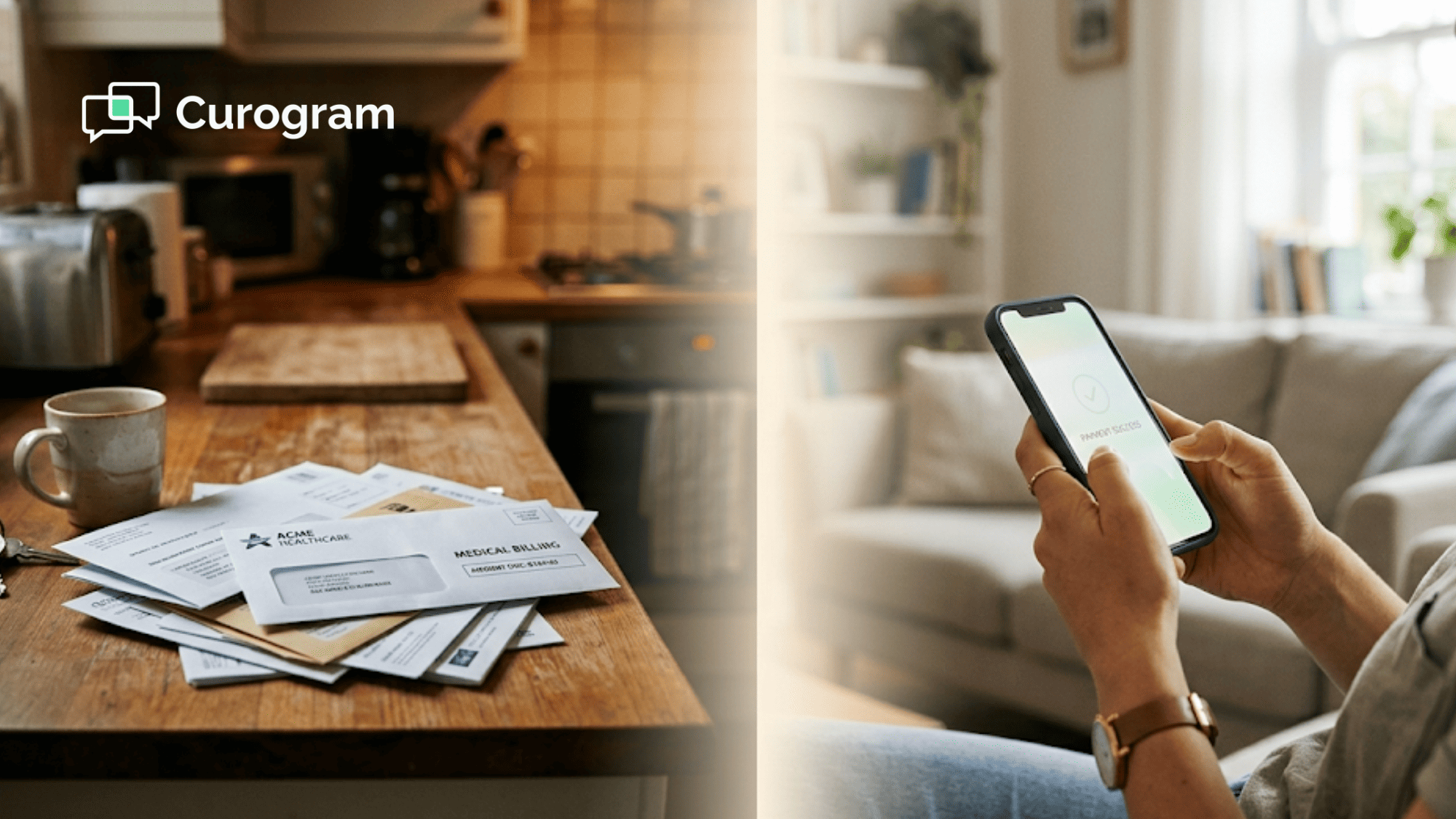
Man paying his medical bill by SMS on his smartphone

The Text-to-Pay Patient Experience

If the old payment paths are mazes, text-to-pay is a straight line. It uses the device the patient already holds, the channel they already check, and a flow that takes less time than ordering a coffee.

The 30-Second Payment Journey

The flow is short and clear. The patient gets an SMS shortly after their visit. The message names the practice, the visit date, and the balance owed. Nothing more.

The patient taps the secure link. A mobile-optimized payment page loads with the balance already filled in. They enter their card details. They tap to pay. A confirmation message arrives by SMS within seconds.

The total time is under 30 seconds for a first-time payer. For returning patients with saved card details, it can drop to a single tap. There is no app to download. There is no account to create. There is no password to recall.

This is what the patient-friendly text-to-pay Elation Health mobile payment experience is meant to feel like. The payment meets the patient where they are.

Trust and Security from the Patient Perspective

A natural question comes up: Is this text really from my doctor's office? Patients have seen enough scam texts to ask.

Curogram messages include details only the practice would know. The practice name appears in the text. The visit date is referenced. The exact balance is shown, down to the cent. None of this matches a generic phishing attempt.

The payment page itself adds more trust signals. Patients see the HTTPS lock icon in the browser bar. The page shows a PCI compliance badge. The practice's name and logo are visible. There is a clear note that no health information is collected during payment.

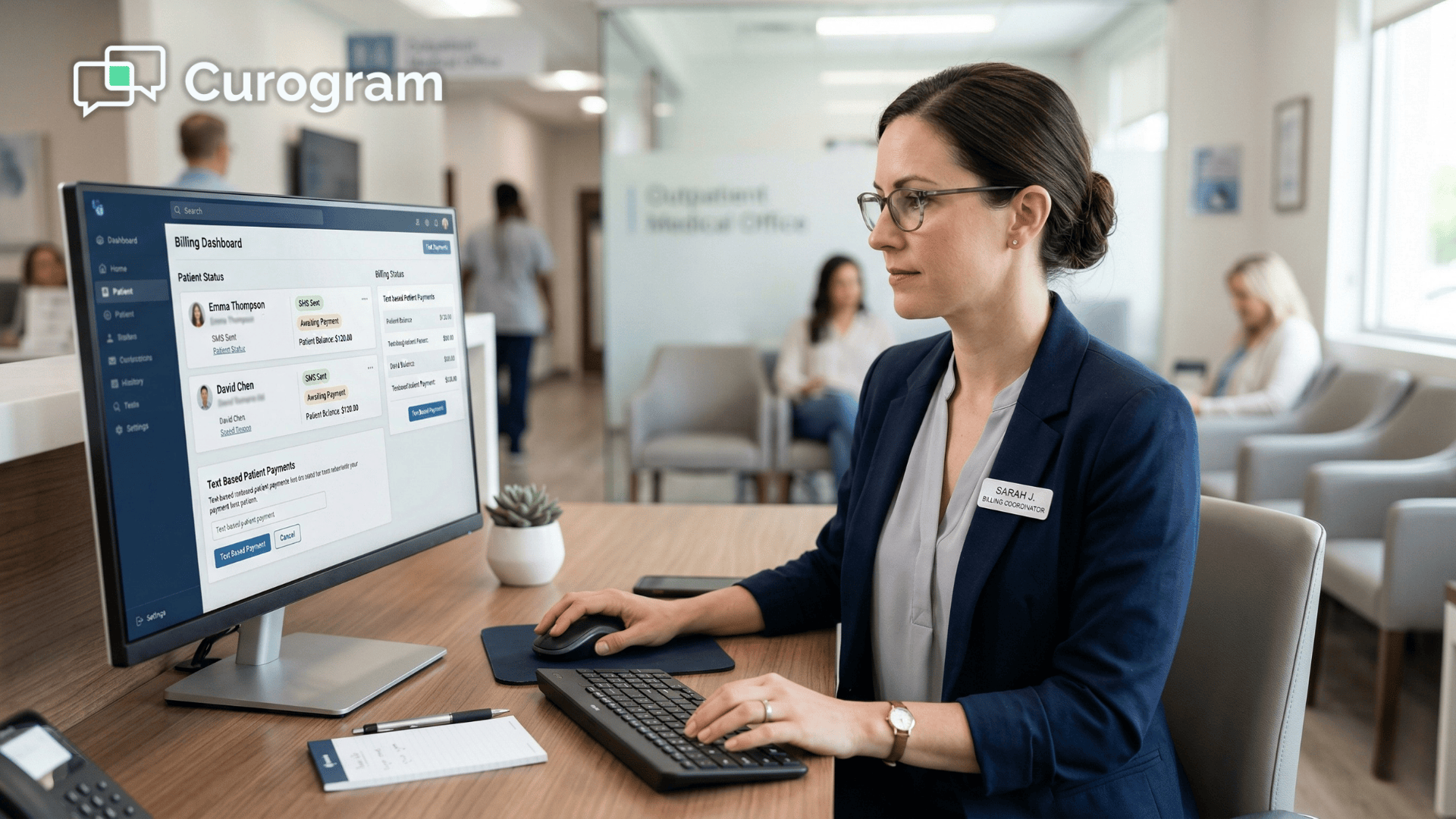
Patients can also reply to the text with a question before paying. The reply goes straight to the practice's billing team in the Curogram dashboard. No separate phone call. No new login. The same SMS thread handles both the payment and the conversation around it.

The Follow-Up Experience

Payment confirmation is instant. The patient gets an SMS receipt with the date, amount, and a thank-you note. If they want a PDF receipt, they can ask for one by email. No further billing texts arrive for that balance.

Contrast this with paper. With paper billing, a second statement often arrives after the patient has already paid. The statements crossed in the mail. The patient now wonders if the first payment went through. They call the office to check. The front desk has to look it up. Time is lost on both sides.

For patients who do not pay right away, the system sends gentle SMS reminders at 24 hours and 72 hours. Each reminder includes a reply option. The patient can ask a question, request a payment plan, or flag a concern about the balance.

This is far less intrusive than a phone call during work hours. It also feels less aggressive than a third paper statement marked PAST DUE. The tone stays neutral. The path to a payment plan stays open.

Here is a side-by-side view of the SMS payment patient journey versus the older paths.

Step

Paper Statement

Patient Portal

Text-to-Pay

Receive notice

Day 10–14

Same day or +1

Same day

Open / access

Manual mail check

Login + reset

One tap

Pay

Check + mail

6–8 clicks

2–3 taps

Confirm

None

Email if lucky

Instant SMS

Receipt

None

Download PDF

SMS + email option


The pattern repeats. Less effort, more completion.

Visual breakdown of how many steps patients take to pay using portal, phone, paper, or text-to-pay

Patient Satisfaction and Practice Reputation

Billing is not just a back-office task. It is the last touchpoint of nearly every visit. A patient who had a great clinical experience can still walk away frustrated if the bill arrives badly. And a patient who paid in seconds tends to remember the whole visit more kindly.

This section looks at how the payment experience shapes patient satisfaction, online reputation, and patient retention for Elation Health practices. The links are tighter than most teams expect.

The Last Touchpoint Effect

Memory is shaped by endings. A movie with a weak final scene gets a lower rating, even if the first 90 minutes were strong. The same rule applies to the patient experience.

A patient may have spent 30 minutes with a kind provider, gotten clear answers, and left feeling cared for. Then a paper bill shows up two weeks later. They miss the due date. They get a second statement marked PAST DUE. They call the office and wait on hold.

Now the memory of the visit shifts. The clinical care fades. The billing frustration moves to the front of mind. When they get asked for a Google review, they hesitate.

Text-to-pay flips this. The last touchpoint becomes a 30-second tap. The patient feels respected. The visit memory stays positive. The review request later that week is much more likely to get a 5-star response.

Patient Satisfaction Scores and Billing

Patient satisfaction surveys often ask about wait times, provider communication, and front desk friendliness. Billing rarely gets a direct question. But it shows up in the open-ended comments.

When billing is easy, patients write things like quick and simple or no hassle. When billing is hard, the comments turn sharp. They mention long holds, confusing statements, and forgotten passwords.

Practices that switch to text-to-pay often see a clear lift in their satisfaction comments. The shift is not always huge in the numeric score. But the tone of the feedback changes. Patients sound calmer. They feel met halfway.

This matters because satisfaction scores roll up into patient retention. Patients who feel respected come back. Patients who feel frustrated quietly drift to another practice.

The Reputation Loop

A frictionless billing experience also feeds online reputation in a direct way. The same SMS channel that delivered the bill can deliver a Google review request a few days later. The patient is already used to texting with the practice. The review request feels like part of the same trusted conversation.

Based on our internal research, practices using Curogram's automated review system have seen up to 90% of surveyed patients leave 5-star reviews.

One multi-location practice gained 1,064 new 5-star reviews in just three months. That kind of growth changes how a practice ranks on local search.

Now connect the dots. A patient pays in 30 seconds. They feel respected. Two days later, they get a review request by SMS. They tap, leave 5 stars, and write a kind comment. The practice's Google profile climbs. New patients find it. They book. The cycle repeats.

Competitive Positioning in a Slow-to-Change Industry

Healthcare billing is one of the slowest spaces to change. Many practices still mail statements. Some still ask patients to pay by phone. Practices that adopt text-to-pay stand out without much effort.

This becomes a quiet retention advantage. Patients who try text-to-pay once rarely want to go back. If they switch practices and the new office still uses paper, the contrast is sharp. They notice.

This is also useful for new patient acquisition. Younger and tech-savvy patients often ask about digital options before they book. A practice that can say yes, you can pay by text clears a real objection.

Here is a quick view of what changes when a practice moves from old billing methods to text-to-pay.

Outcome Area

Before (Paper/Portal)

After (Text-to-Pay)

Time to first payment

20–25 days

Same day to 72 hours

First-cycle collection rate

~20% (paper)

60%+

Patient billing complaints

Common in comments

Sharp drop

Review request response

Mixed

Higher 5-star share

Younger patient retention

At risk

Improved


Patient satisfaction, online reputation, retention, and revenue are not separate goals. They all connect to the same touchpoint. The bill. And text-to-pay turns that touchpoint from a weak link into a strength.


How Curogram Turns Elation Health Billing Into a Frictionless Patient Experience


Curogram pairs with Elation Health to take the payment process out of the maze and onto the patient's phone. It does not replace the EMR. It works alongside it. Elation holds the clinical and billing data. Curogram handles the patient-facing SMS, including the payment link.

The link itself is the key. It is secure, branded, and tied to the exact balance the practice expects. The patient sees the practice name, the visit context, and the amount. They tap once. They pay in seconds.

For Elation Health practices, this matters in three ways. First, it removes the portal login problem. Patients no longer need to remember credentials. Second, it cuts the paper statement cycle. Bills land same-day, not two weeks later. Third, it frees front desk time that was spent chasing balances by phone.

The platform also handles the messaging compliance side. SMS messages contain no protected health information. Payment links route through encrypted, PCI-compliant pages. The practice stays inside HIPAA rules without extra work from staff.

There is more. The same SMS thread that delivers the payment can carry a review request a few days later. Or a recall message a few months later. Or an appointment reminder for the next visit. Patients see one trusted channel. Practices see one clean data flow.

Based on our internal research, practices using Curogram's SMS billing see faster collections, fewer phone calls, and better patient feedback. The numbers vary by practice size, but the direction is steady.

For Elation Health practices that want to keep patients happy, paid up, and engaged, this is the bridge. Curogram does not ask patients to learn a new system. It meets them where they already are.

Conclusion

Patients are not refusing to pay. They are getting stuck in the steps between the visit and the payment screen. Paper bills arrive too late. Portals ask for passwords nobody remembers. Phone calls land at the wrong time.

Text-to-pay removes those steps. The bill arrives on the channel patients already check. The link opens on the device they already hold. The payment finishes in under 30 seconds.

For Elation Health practices, the payoff is wide. Collections speed up. Aging buckets shrink. Front desk staff handle fewer billing calls. Patients feel respected at the last touchpoint of the visit, not frustrated by it.

The reputation effect runs deeper. Patients who pay easily are more likely to leave 5-star reviews. Those reviews drive new patients. New patients book. The cycle keeps building. Billing is no longer a weak link. It becomes a quiet engine of growth.

The patient payment preferences shift is not slowing down. Younger patients expect digital options. Older patients welcome them when offered. The portal vs text-to-pay choice keeps tilting toward SMS for one simple reason: fewer steps win.

Practices that wait to make the change risk losing patients to ones that already have. A patient who tries text-to-pay once rarely wants to go back to paper. That preference becomes part of how they judge every practice they visit.

Step into your patient's shoes and feel the difference text-to-pay makes. Book a quick demo and experience the payment journey from the patient's side.


Frequently Asked Questions

Is it safe for patients to pay medical bills via text message?

Reassure patients and practice managers: Curogram’s text-to-pay uses PCI DSS-compliant payment processing and HIPAA-compliant messaging. The SMS itself contains no protected health information. The payment link opens a secure, encrypted page where card data is tokenized — meaning the actual card numbers are never stored by the practice or by Curogram.

Do patients need to download an app to use text-to-pay?

No app download is required. Curogram’s text-to-pay works through standard SMS and a mobile-optimized web page. Patients receive a text message on their existing phone number, tap the link, and pay through their phone’s web browser.

What if a patient prefers not to pay by text?

Text-to-pay is offered as a convenience, not a requirement. Patients who prefer portal payments, phone payments, or in-person payments can continue using those methods. Text-to-pay simply adds the most convenient option to the billing mix.

Can patients set up payment plans through text-to-pay?

Explain that patients can reply to any payment text with questions about their balance or payment options. The practice’s billing team receives the reply in the Curogram dashboard and can arrange payment plans, clarify balance details, or offer alternative payment arrangements.

How does text-to-pay tie into a practice's broader reputation strategy?

The same SMS thread that delivers a payment can later carry a Google review request. Patients who pay easily are more open to leaving 5-star reviews. The channel becomes one trusted conversation that drives both payments and online reputation.