12 min read
SMS Text-to-Pay Patient Billing for Elation Health Practices
Mira Gwehn Revilla
:
May 27, 2026
- Elation Health does not include native text-to-pay in its EHR
- Spruce Health, a common Elation add-on, has no billing or payment tools at all
- Curogram sends HIPAA-compliant payment links by SMS that work on any phone
- Paper-only billing collects about 20% on the first statement cycle
- Text-to-pay can lift first-cycle collection rates to 60–80%
Mid-market Elation Health practices lose money each month on a quiet problem. The time between sending a bill and getting paid keeps growing. For every $100 mailed on paper, only about $20 comes back on the first try. The rest sits in aging buckets, draining staff hours and shrinking margins.
The cause is simple. Paper statements arrive slowly. Patient portals ask for logins most patients never use.
The average patient, meanwhile, checks their phone more than 100 times a day. That gap between billing tools and patient habits is where revenue leaks.
This is the role of SMS text-to-pay patient billing for Elation Health mid-market practices. A secure payment link arrives by text.
The patient taps it, pays on a mobile page, and the balance clears in seconds. No portal login. No app download. No envelope to open.
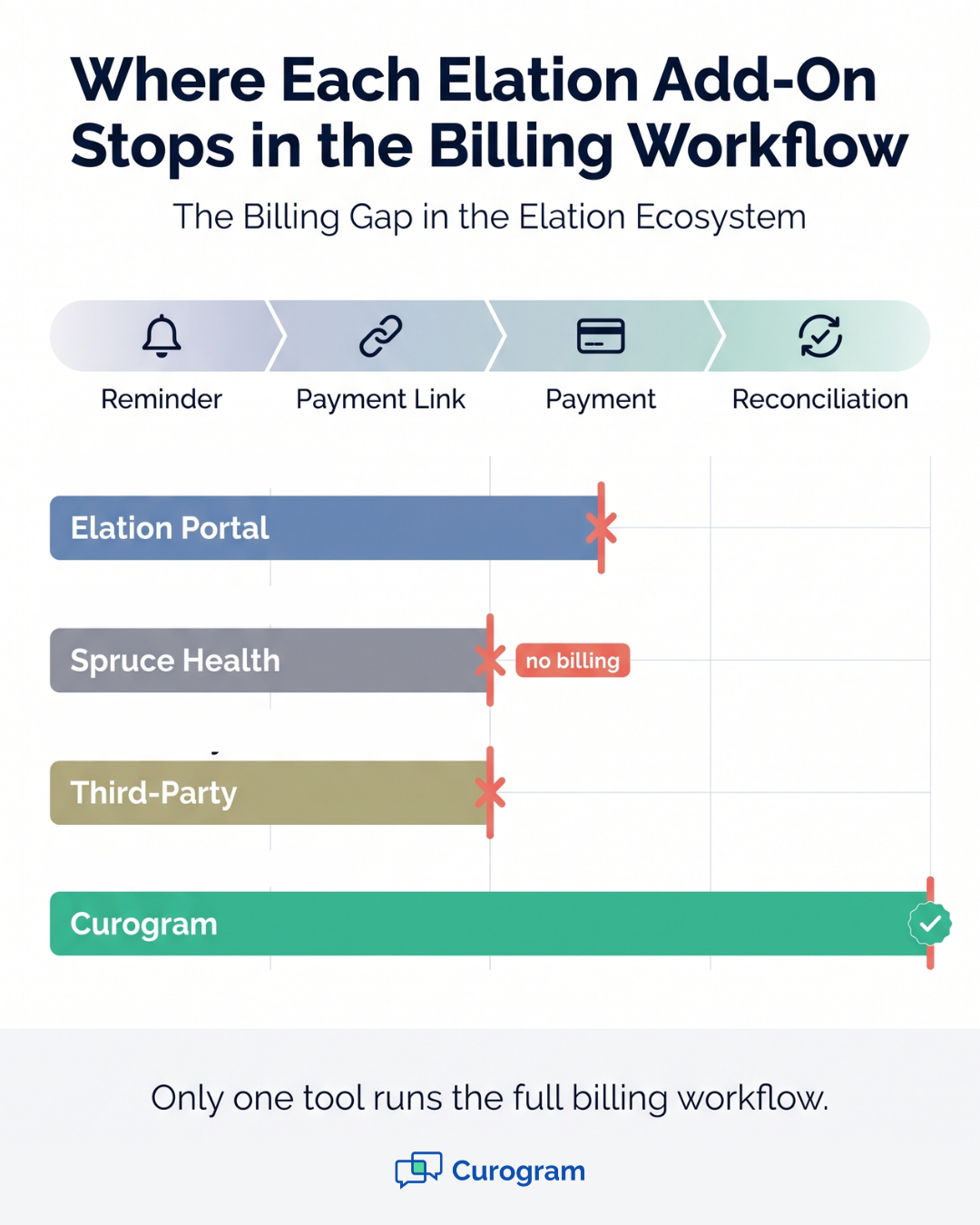
Elation Health does not include native text-to-pay in its EHR. Spruce Health, the most common Elation communication add-on, has no billing tools at all. That leaves a real gap for practice managers and billing leads who want faster collections without adding another login or vendor.
This guide walks through how patient billing SMS works in an Elation Health setup. It covers the workflow, the security model, the cost savings, and the revenue gains. You will see how mobile payment collection in an Elation EHR setup can turn a 90-day collection cycle into a 7-day one.
If you run billing for an Elation practice, this is the playbook to read before your next statement run. Every section ties back to clear numbers and clear next steps you can act on this quarter.
Why Mid-Market Elation Practices Need Text-to-Pay
Most Elation Health practices were built to deliver care, not to chase payments. But the way bills get sent and paid has fallen behind how patients live. Three gaps explain the lost revenue, and each one shows up on the income statement;
The Paper Statement Problem
Paper statements look cheap until you add them up. A mid-market practice spends $800 to $1,000 a month on print, postage, and processing. That is $10,000 to $12,000 a year just to mail bills patients may not open.
The return on that spend is weak. Based on our internal research, paper-only billing collects about 20% on the first statement cycle. For every $100 billed, only $20 comes back before the next round.
The cycle drags on for weeks. First notice, then second notice, then a phone follow-up, then a collections referral.
From start to finish, a single balance can take 90 to 120 days to resolve. Staff burn hours and the practice writes off more bad debt during that time.
Picture the math at scale. A practice mails 1,000 statements at about $1 each, all in. Only 200 of those result in payment in the first round. The other 800 enter a second cycle, then a third, before some are written off as bad debt.
The Portal Payment Gap
Elation Health includes a patient portal that lets people view bills and pay online. On paper, that sounds like a solution. In practice, portals carry too much friction for routine billing.
To pay through a portal, a patient must remember a login, find the billing tab, and finish a multi-step web form. Most never get past step one. Portal login rates for billing alerts often stay in the single digits.
Patients do not treat portals the way they treat texts. They open texts in seconds. They forget portal passwords for months. The result is bills that sit in the portal, unseen and unpaid.
Text-to-pay closes that gap. The link goes straight to the device the patient already uses for everything else. No new login. No new app. Just a tap, a card entry, and a confirmation.
The Spruce Health Payment Gap
Many Elation practices add Spruce Health for messaging, calls, and faxing. Spruce works fine for those tasks. But Spruce Health has no billing, payment, or revenue cycle features at all.
This is the Spruce ceiling for billing. A practice can text a patient through Spruce to remind them about a balance. The text cannot include a working payment link. The patient still has to find the portal or call the office to pay.
The result is a billing process that gets stuck halfway. The reminder goes out. The payment does not come in. Staff still spend time chasing the same balances by phone.
Curogram closes the loop. It pairs patient messaging with patient billing SMS in Elation workflows. One platform sends the reminder, includes the payment link, and logs the result. The practice does not need two tools to do one job.
For mid-market Elation practices, this single-platform model is the point. The Spruce Health no billing gap forces a choice: keep paying for two tools, or move to one that handles both. Most billing leads choose the second path once they see the math.
The three gaps stack on each other. Paper costs eat into margin. Portals leave bills unseen. Spruce stops short of payment. Together, they explain why so many Elation practices feel busy but never see the cash flow they expect on the back end.

How Text-to-Pay Works with Elation Health
Elation Health text-to-pay does not exist as a built-in feature inside the EHR. It runs as a paired layer through a platform like Curogram. The workflow is simple, the data flow is clean, and the security model meets both healthcare and payment rules.
The SMS Payment Workflow
The process moves in a straight line from visit to payment. The appointment finishes. The balance posts in the billing system.
Curogram sends an automated SMS with a secure payment link. The patient taps the link, enters card details on a mobile-friendly page, pays, and gets a receipt.
Timing matters more than most practices think. Payment requests sent within 30 minutes of visit completion see the highest payment rates. The visit is still fresh in the patient's mind, and the wallet is still nearby. Wait two weeks, and the same patient is far less likely to pay.
Patients can use any major credit or debit card. They can pay from any smartphone, on any carrier, with no app to install. The whole flow takes under 30 seconds for most patients. That speed is what drives the higher conversion rates this guide will show in later sections.
Integration Points with Elation Billing
Curogram connects to Elation's data to make the workflow run on its own. Patient contact details sync from Elation. Appointment and billing events trigger payment requests. Payment confirmations are logged for reconciliation by the billing team.
Some pieces work in real time, while others need a quick manual step. Patient names, phone numbers, and visit data move from Elation to Curogram automatically.
Posting the payment back into the patient's Elation ledger is a step that the billing team confirms during daily reconciliation. Deeper write-back is on the roadmap.
This honest split matters for mid-market practices. The platform does not replace the billing system. It works alongside it. A billing manager still sees Elation as the source of truth, with Curogram running the outreach and collection step that Elation does not handle by itself.
|
Step |
System |
Action |
|
Visit completes |
Elation |
Balance posts |
|
Payment trigger |
Curogram |
SMS link sent |
|
Patient pays |
Curogram |
Card processed |
|
Receipt logged |
Curogram |
Patient + staff notified |
|
Reconciliation |
Elation |
Payment recorded in ledger |
Security and Compliance
Patient billing SMS in an Elation setup has to meet two sets of rules at once. It has to be HIPAA-compliant for the messaging side. It also has to be PCI DSS-compliant for the card side. Curogram is built to meet both at the same time.
The SMS itself carries no protected health information. The text shows only the practice name, a generic balance notice, and the secure link. There are no diagnoses, no visit reasons, and no clinical details in the message body.
The payment page is encrypted from end to end. Card data is tokenized so raw card numbers are never stored. The link expires after the payment is made. If someone forwards the text by mistake, the data behind the link is still safe.
Patient trust is built into the design. The text names the practice. The page shows the visit date and balance. The URL uses a branded format that does not look like spam. Patients can see at a glance that the message is real and from a place they know.
This dual-compliance setup is what makes mobile payment collection in an Elation EHR setup work for mid-market practices. Speed alone is not enough. Speed with proven security is what gets billing leads, doctors, and patients to all say yes.

The Financial Impact of Text-to-Pay
This is where the case for change stops being a story and becomes a number. Text-to-pay does three things to the financial side of a practice. It raises collection rates, it cuts hard costs, and it speeds up cash flow. Each one has a dollar figure attached.
Collection Rate Transformation
The single biggest gain shows up in first-cycle collection rates. Paper-only billing collects about 20% on the first statement cycle, based on our internal research. SMS-based payment requests can push that figure into the 60–80% range on patient-responsibility balances.
The reason is friction. A paper statement asks the patient to find a checkbook, write a check, address an envelope, and mail it. A portal asks for a login and three more clicks. A text asks for a tap. Each step you remove lifts the close rate.
The gains keep stacking after the first cycle. Faster payment shrinks accounts receivable aging.
Bad debt write-offs drop. The cost of running second and third statement cycles disappears for the balances that pay in cycle one. Most practices report cleaner AR books within two billing cycles.
Cost Elimination
The direct savings are the easy part to model. Paper statements cost $800 to $1,000 a month for a mid-market practice. SMS payment delivery costs a small fraction of that. Switching to text-to-pay for most of your balances cuts the paper budget by 70–80%.
The indirect savings are bigger but less visible. A billing team typically spends 8 to 12 hours a week on payment follow-up calls. That is one full day of staff time per week, every week, just to chase money that should have been paid already.
Text-to-pay collapses much of that work. Patients pay when the text arrives. They do not need a phone call to remind them, and they do not need a call to take the payment over the phone.
Based on our internal data, two-way SMS workflows already cut phone call volume by as much as 50% across a practice. The billing line picks up much of that gain.
Then there are the downstream costs. Collections agency fees disappear for balances that pay in cycle one. Bad debt write-offs shrink. Postage, paper, and envelopes drop.
None of these line items is huge on its own, but stacked, they often equal another full-time staff salary in saved overhead each year.
ROI on text-to-pay is fast. Most mid-market Elation practices report positive ROI within 30 to 60 days. Payback periods are measured in weeks, not months. Few software investments in a medical practice hit that bar.
The DPC Billing Advantage
Direct Primary Care practices on Elation Health face a slightly different billing mix. They collect monthly or quarterly memberships from most patients. They also collect copays, lab fees, and specialty visit balances on top of that. Most billing tools handle one model well and the other poorly.
Text-to-pay handles both in the same channel. Membership renewal reminders go out by SMS, with a payment link inside. Visit-based balances follow the same pattern. The patient sees one familiar workflow no matter what is being billed.
This matters because DPC patients chose a more personal model on purpose. They expect direct, simple, no-friction contact with their practice.
A paper statement feels off-brand for a DPC clinic. A patient billing SMS in an Elation Health workflow feels exactly like the kind of communication the patient signed up for.
A DPC example helps make this real. A 6-provider DPC clinic with 1,800 active members has roughly 600 membership payments a month at $150 each. That is $90,000 in membership revenue alone. Add another $20,000 in visit-based balances, and the monthly billing base is $110,000.
The DPC angle also lowers churn. Members who get clean, friendly renewal reminders by text are more likely to renew on time.
Members who get a paper invoice, miss it, and then get a past-due notice are more likely to leave. Text-to-pay keeps the relationship smooth at exactly the moment when money changes hands.
Put together, the three financial effects compound:
-
The collection rate goes up.
-
The cost base goes down.
-
The cash cycle gets shorter.
None of this requires a new EHR, a new clinical workflow, or a new staffing model. It only requires closing the gap that Elation and Spruce leave open on the billing side.
For mid-market Elation Health practices, that is the case for SMS text-to-pay patient billing in one sentence: the same patient base, paying faster, for less cost to collect.
Implementation Roadmap
Most mid-market Elation practices can be live with text-to-pay in about four weeks. The work is mostly setup and training, not heavy IT. A clear four-week plan keeps the rollout calm and the staff confident.
Week 1: Setup and Integration
The first week is mostly behind-the-scenes work. The Curogram account gets configured. The Elation integration is set up so patient and visit data flow between systems. The payment processor is connected and tested.
The billing manager maps the practice's current billing workflow during this week as well. Where do balances post today? When are statements sent? Who handles follow-up? These answers shape how text-to-pay is layered in without breaking what already works.
Week 2: Training and Templates
Staff training comes next. The billing team learns the text-to-pay dashboard. They see how to send a one-off payment request, how to read payment status, and how to reconcile a payment back into Elation.
Templates get a quick polish. The default payment request text is edited to match the practice's voice. The practice name, hours, and contact line are added. Test transactions run against staff accounts to confirm that the end-to-end flow works on real phones.
Week 3: Soft Launch
A soft launch limits risk. One provider, or one appointment type, gets the text-to-pay treatment first. The billing manager watches the results in real time. Collection rates, patient questions, and any error messages get logged.
This week also flushes out small issues. Maybe one phone number field needs cleaner data. Maybe one provider wants the message worded differently. Fixes are cheap when only a slice of the practice is involved.
Week 4 and Beyond: Full Rollout
The full rollout follows once the soft launch looks clean. All providers move to text-to-pay. All eligible balances flow through the SMS workflow. The billing team starts to see the collection rate lift in the daily numbers within the first cycle.
Ongoing tuning is light. Message timing, follow-up cadence, and reminder rules get small adjustments based on what patients actually do. The platform takes care of the rest, and the billing team gets back hours of weekly follow-up time.
How Curogram Turns SMS Text-to-Pay Patient Billing into a Single Workflow
Curogram was built for one job: closing the gap between care delivered and money collected. For Elation Health practices, it does this without adding a new EHR, a new portal, or a new login.
The platform sits next to Elation and runs the patient communication and billing outreach that the EHR was never designed to handle.
The product is a one-stop-shop. It sends two-way texts, automated reminders, intake forms, surveys, review requests, and text-to-pay links from the same dashboard.
Practices that try to stitch together two or three vendors end up with three logins, three bills, and three support teams. Curogram replaces that stack with one.
The setup is fast. Based on our internal data, staff training takes as little as 10 minutes for the core workflows. The platform integrates with almost any EHR, including Elation. Front desk and billing staff can be up and running in the same week the contract is signed.
The financial outcomes are direct. Practices report up to a 50% drop in phone call volume, a 30% lift in staff productivity, and no-show rates that run 53% lower than industry averages. On the billing side, text-to-pay drives faster patient balance conversion and a cleaner AR.
Curogram is also the only platform in the Elation ecosystem that pairs patient messaging with text-to-pay in a single tool. Spruce Health no billing means a practice using Spruce still has to find a payment solution elsewhere. Curogram removes that second vendor and that second login.
For a mid-market Elation practice, the result is simple. One platform. Faster payments. Lower costs. More time for clinical care and less time on the phone chasing balances.
Conclusion
Mid-market Elation Health practices have one of the cleanest revenue plays in healthcare sitting in front of them. The clinical work is already happening.
The visits are already complete. The balances are already posted. The only step that breaks down is the one between the bill and the payment.
Paper statements collect about 20% on the first try, based on our internal research. Patient portals see single-digit login rates for billing. Spruce Health does not offer billing at all. That is three different ways the current setup leaks revenue every month.
SMS text-to-pay patient billing in an Elation Health workflow closes all three gaps with one platform. A secure link by text. A tap to pay. A receipt back to the practice.
First-cycle collection rates of 60–80%. Paper budgets cut by most of $10,000 a year. Hours of phone follow-up returned to the billing team.
The math holds at every practice size. A 15-provider practice can recover $300,000 a year in the same patient base. A 6-provider DPC clinic can lift its monthly take by tens of thousands of dollars. The ROI usually shows up inside 30 to 60 days.
The pieces are all in place. Curogram integrates with Elation. The workflow is HIPAA-compliant and PCI-compliant. The setup runs in four weeks. Staff training takes minutes, not days.
The question is not whether to add text-to-pay. The question is how many cycles of paper statements your practice wants to send before making the switch. Each cycle is more cost, more aged AR, and more bad debt that will never come back.
Stop losing $25,000 a month to paper statements and unread portal alerts. Schedule a demo today and see the recovery math on your own patient base.
Frequently Asked Questions
The text itself carries no protected health information. It shows only the practice name, a generic balance notice, and a secure link. All clinical and payment data sit behind the encrypted link, which meets HIPAA rules for the messaging side and PCI DSS rules for the payment side.
Portals ask for a login, a password reset, and a multi-step form. Texts ask for one tap. Removing every step lifts the close rate. Patients open texts in seconds and open portals rarely, so the payment link reaches them at the moment they can act on it.
The same SMS channel sends both membership renewal links and visit-based balance links. Patients see one familiar workflow for every charge. This fits the personal, friction-free style DPC patients expect and helps reduce member churn at the moment of renewal.
Spruce Health is built for messaging, calls, video, and fax. It has no billing, payment, or revenue cycle tools. A practice using Spruce can text a balance reminder but cannot include a working payment link, so the patient still has to find the portal or call the office.
Most practices are fully live in about four weeks. Week one is setup and integration. Week two is staff training and template work. Week three is a soft launch with one provider. Week four onward is the full rollout with light, ongoing tuning.