

NextGen Text-to-Pay | SMS Payment Links That Replace Paper Statements
💡 NextGen Enterprise text-to-pay powered by Curogram sends patients a secure SMS payment link immediately after their visit. There is no portal...

9 min read
Aubreigh Lee Daculug
:
July 2, 2026
Your billing team did everything right. They verified insurance, ran the claim through Modmed's PM, calculated the patient's responsibility, and mailed a clean statement. Then nothing happened.
Three weeks later, you send a second statement. Still nothing.
By week six, your billing coordinator is making calls and leaving voicemails for a $1,200 balance the patient fully intends to pay, just not today, and not on hold.
This is the quiet leak inside most Modmed specialty practices. Not the claims, not the coding, but the last mile. The patient owes the money. They have the means to pay. And the system you're using to collect it was designed in the 1990s.
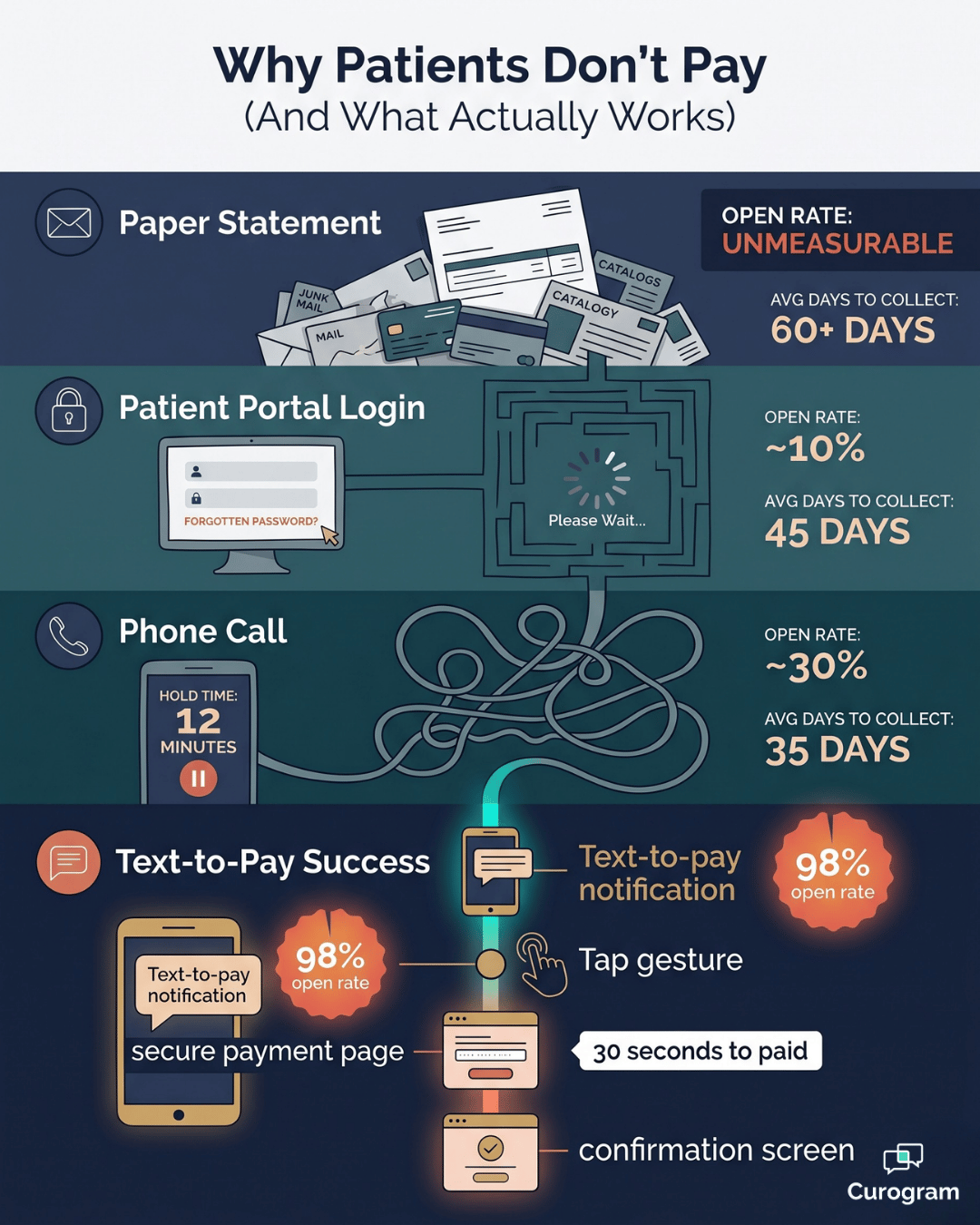
Paper statements collect at roughly 20% on the first cycle.
That means $80,000 of every $100,000 in patient responsibility waits for a second statement, a third statement, a phone call, or eventually, a write-off. Meanwhile, you spend $800 to $1,000 a month producing the very statements that fail 80% of the time.
It sounds like a process problem. It's actually a channel problem.
Your patients are paying everyone else by phone. They Venmo their friends, Zelle their landlord, and tap to pay their coffee. Then your office hands them a paper envelope and expects them to find a stamp.
This article walks through why text-to-pay patient billing for Modmed specialty practices has quietly become the highest-ROI fix in revenue cycle management, why portals and ModMed Pay don't fully solve it, and how a text-based payment link can collapse a 60-day AR cycle into a same-day collection without disrupting your existing Modmed workflow.
If your AR aging report is starting to look more like an obituary than a forecast, the next ten minutes are worth your time.
Paper statements have been the default for so long that most practices stopped questioning them. They shouldn't have. Let's look at what they actually cost when you tally the math.
A 20% first-cycle collection rate sounds like a benchmark. It's actually a warning. For every $100,000 you bill on paper, only $20,000 comes back in the first pass.
The other $80,000 isn't lost yet, but it's now on a slow march through a familiar set of detours:
Each step adds time, cost, or both. Your AR aging stretches to 60 or 90 days, your cash flow tightens, and your billing team keeps doing more work to collect the same money.
Now layer on the production cost. Printing, stuffing, stamping, and mailing statements runs most specialty practices $800 to $1,000 a month. That's $9,600 to $12,000 a year spent on a process that fails four out of five times.
Imagine a dermatology patient who just had a $1,200 cosmetic procedure. After insurance, the full balance is hers.
Here's what happens next under paper statement billing.
The visit ends on Day 1 with a $1,200 balance posted to her account. Five to seven days later, the paper statement arrives in her mailbox. She sets it on the kitchen counter, fully meaning to pay it that weekend.
By Day 14, the statement is buried under junk mail and last week's grocery flyers. On Day 21, your practice prints and mails a second statement at another $2 of postage and materials. She finds it, glances at it, and tells herself she'll call with her card later.
Day 35 rolls around. Your billing coordinator picks up the phone, dials, and leaves a voicemail. That call took five minutes of staff time.
On Day 52, the patient finally calls back, sits through 15 minutes of payment processing, and the balance closes.
Total time to collect:
52 days. Total cost to collect: $8 to $12 in mailing plus 20 minutes of staff time.
Now consider the alternative. The same patient receives a text payment link the moment they leave the parking lot. She pays in 30 seconds while waiting at the stoplight. Done.
Some practices have leaned on the patient portal as their fix. It hasn't worked, and it won't.
Portal payment rates are notoriously low because patients can't remember their login, a challenge that continues to shape modern patient payment experience expectations.
Why would they? They visit the portal once or twice a year, usually only to check a lab result. Now you're asking them to recover a password, navigate a clinical interface, and find the billing tab, all to pay a bill they were willing to pay 90 seconds ago.
The effort doesn't match the task. A patient who will gladly pay $200 right now will abandon the entire process if it takes five minutes.
Text-to-pay reduces that effort to a single tap.
It's a fair question, and it deserves an honest answer. ModMed Pay is Modmed's own payment module, and yes, it works inside the Modmed ecosystem.
But it's another module.
Another contract. Another line item layered on top of an EMA license that already runs $800 to $1,000 per user per month. For practices already feeling the weight of Modmed's module pricing, stacking on another payment-specific tool isn't always the most cost-effective move.
This is where a patient billing SMS Modmed EHR alternative ModMed Pay setup like Curogram becomes worth a serious look. The text-to-pay capability is bundled into the same platform that handles texting, reminders, intake forms, reviews, and recalls.
You're not buying a payment module. You're using the one already included.
After the visit, the patient gets a text from your practice's number. It shows the practice name, the balance amount, and a link. They tap. A secure mobile page opens. They enter their card. They pay. You get a confirmation.
That's the entire workflow. No portal, no app, no paper, no phone call.

The payment page is built for a phone, not a desktop browser shrunken down to fit. That distinction matters more than it sounds.
Patients can pay with credit card, debit card, or HSA/FSA card. There's no account to create, no password to remember, and no app to download. The page shows the practice name, the balance, and a clean payment form, and that's it.
On the backend, payment processing is PCI-compliant with encrypted data transmission. Sensitive financial information never travels through SMS itself, only the secure link does. After payment, the patient gets a confirmation text, closing the loop entirely inside the text channel.
For practices searching for a text payment link Modmed specialty clinic workflow, this is what "frictionless" actually looks like.
One patient at a time is fine. The real efficiency shows up when you do many at once.
Curogram lets you send payment request texts to multiple patients at the same time. End-of-day batch billing, weekly AR follow-ups, or targeted outreach to anyone with a balance above a set threshold can all be done in a few clicks.
This turns patient payment collection from a slow, one-by-one task into a scalable, automated workflow. Your billing coordinator does in 10 minutes what used to take a full afternoon.
3 hours → 45 minutes |
| Daily time spent on collection calls before and after text-to-pay. That's more than two hours a day, or roughly 50 hours a month, given back to your billing coordinator for higher-value work. |
Specialty practices have a particular billing profile. Patient responsibility tends to be higher, more variable, and more time-sensitive than primary care. That's exactly where text-to-pay earns its keep.
Here's how the math plays out by specialty:
Mobile billing dermatology orthopedics ophthalmology Modmed workflows all share one thing in common: the longer you wait to ask for payment, the harder it gets to collect. Text-to-pay flips that timeline.

The shift isn't theoretical. The numbers behind text-based billing are genuinely lopsided in your favor.
Text messages have a 98% open rate. Paper statements have an open rate that's effectively unmeasurable because there's no way to know if the envelope ever got opened, much less acted on.
When you combine a near-universal open rate with single-tap payment, the friction drops to almost zero.
Practices using Curogram text-to-pay Modmed patient engagement workflows commonly see patient responsibility balances clear within 24 to 48 hours, compared to 45 to 90 day cycles on paper.
That isn't a minor improvement. It's a different business.
d to take a full afternoon.
+40% |
| Increase in same-day patient collections in the first month of using text-to-pay. For an $85,000 monthly patient responsibility load, that's a sizable chunk of cash flow moving from "60 days out" to "in the bank today." |
When text becomes your primary collection channel, your billing department's job description quietly changes.
The day-to-day looks different almost immediately:
Second and third statement cycles drop because more patients pay on the first text request. Collection call volume drops because fewer balances sit long enough to require a call.
You don't need to reduce paper statements Modmed practice billing all the way to zero, just enough to free your team to do higher-value work.
Consider a Modmed orthopedic practice billing roughly $85,000 a month in patient responsibility.
They start sending text payment links to every patient after a visit. The shifts above didn't happen in isolation. They happened together, inside the same first month, at the same practice.
Same-day collections jumped 40%. AR days for patient responsibility dropped from 52 to 18. Monthly statement spend fell from $950 to $380.
Collection call time fell from three hours a day to 45 minutes. And paper statement volume dropped by 60%, since practices don't need to eliminate paper entirely to see meaningful gains.
For your team, this means money is moving the right way, faster, with less effort. For your patients, it means paying you is finally easier than writing a check.
This is the practical version of Modmed patient payment collection text message workflows, and it's already happening at practices that made the switch.
Paper statements cost $800 to $1,000 a month and collect 20% on the first try. Portal payments fail because no one remembers their login. Phone collections quietly eat your staff's day.
Your Modmed PM does an excellent job processing claims. The last mile, the part where the patient actually pays, is where most practices are still using tools that don't match the rest of their tech stack.
A text-to-pay patient billing for Modmed specialty practices setup like Curogram closes that gap. Modmed processes your claims. Curogram collects your patient payments through a secure SMS link that turns a 60-day cycle into a same-day deposit, without adding a new payment module to your contract.
The shift is straightforward. You keep your Modmed workflow exactly as it is. You add a text channel for the patient-pay side. Statements drop, AR drops, staff hours drop, and collections rise.
Your patients already prefer paying by text. The only question is whether your practice is ready to let them.
Schedule a demo today and find out what your AR looks like when payment takes 30 seconds instead of 52 days.
Yes. Curogram's text-to-pay uses PCI-compliant payment processing with encrypted data transmission. Patient payment information is entered on a secure payment page, never inside the text message itself. The text contains only the practice name, balance amount, and a secure link. No sensitive financial data is transmitted via SMS. The payment processing meets the same security standards used by major healthcare payment platforms.
Curogram's text-to-pay can be configured to accept the full balance or allow partial payments. For practices that offer payment plans, staff can send multiple payment links at scheduled intervals, each for the installment amount due. The flexibility to handle both full payments and structured installments makes text-to-pay adaptable to any billing scenario, from $50 copays to $5,000 procedure balances.
Text-to-pay complements Modmed's PM billing workflow. PM handles claims processing, insurance billing, and balance calculation. Once the patient's responsibility is determined, staff send a text payment link through Curogram for the patient-owed amount. Payments received through Curogram are recorded and can be reconciled with PM's billing records. The two systems work in parallel, PM for insurance, Curogram for patient collections.
Curogram lets you configure automated follow-up texts at intervals that match your practice's collection policy. A typical setup sends a reminder 3 days after the initial text, then another at 7 days, and a final reminder at 14 days. Each message contains the same secure payment link, so the patient can tap and pay at any point. This automated sequence replaces the manual work of second statements and collection calls, and most balances clear well before the final reminder is needed.
If a patient can receive a text message and tap a link, they can pay. The mobile payment page is designed for the simplest possible flow, with large buttons, clear labels, and no account creation. Older patients and non-tech-savvy users handle it without issue because there's no portal to navigate or app to install. For the small percentage of patients who still prefer paper or a phone call, those options remain available, and most practices find text-to-pay covers 70% to 80% of their patient base comfortably.
💡 NextGen Enterprise text-to-pay powered by Curogram sends patients a secure SMS payment link immediately after their visit. There is no portal...
💡 NextGen patient pay bill text message powered by Curogram's Two-Tap Payment lets patients settle their balance from a single text — no portal...
💡 Modmed patients can pay their balance via text in about 30 seconds — statement to payment with one tap. The practice sends a secure SMS with the...