
Secure Online Forms for eClinicalWorks | Structured Data Intake
💡 eClinicalWorks secure online forms with structured data intake for enterprise networks replace clipboard-based check-in with text-delivered...
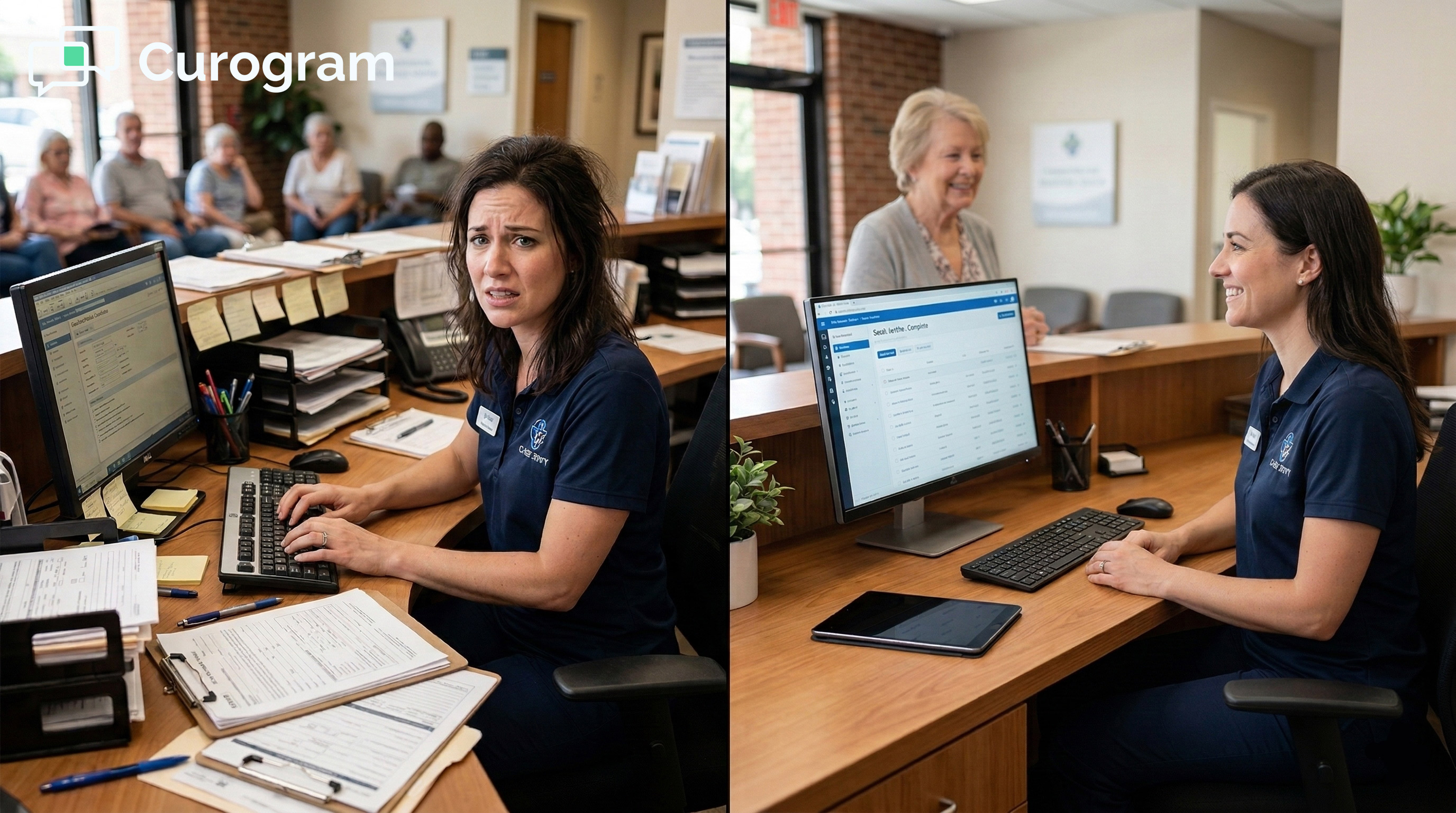
It's 8:50 AM. Four patients are checking in at once. One needs a pen. One can't understand a form question. One is a new patient with a six-page intake packet. And the phone is ringing.
This is the reality for front-desk staff at most eClinicalWorks practices every single morning. The clipboard system isn't just slow. It's a daily sprint that eats hours of staff time and produces errors no one catches until weeks later.
eClinicalWorks front desk digital intake forms that eliminate transcription and manual data entry give check-in teams a real way out.
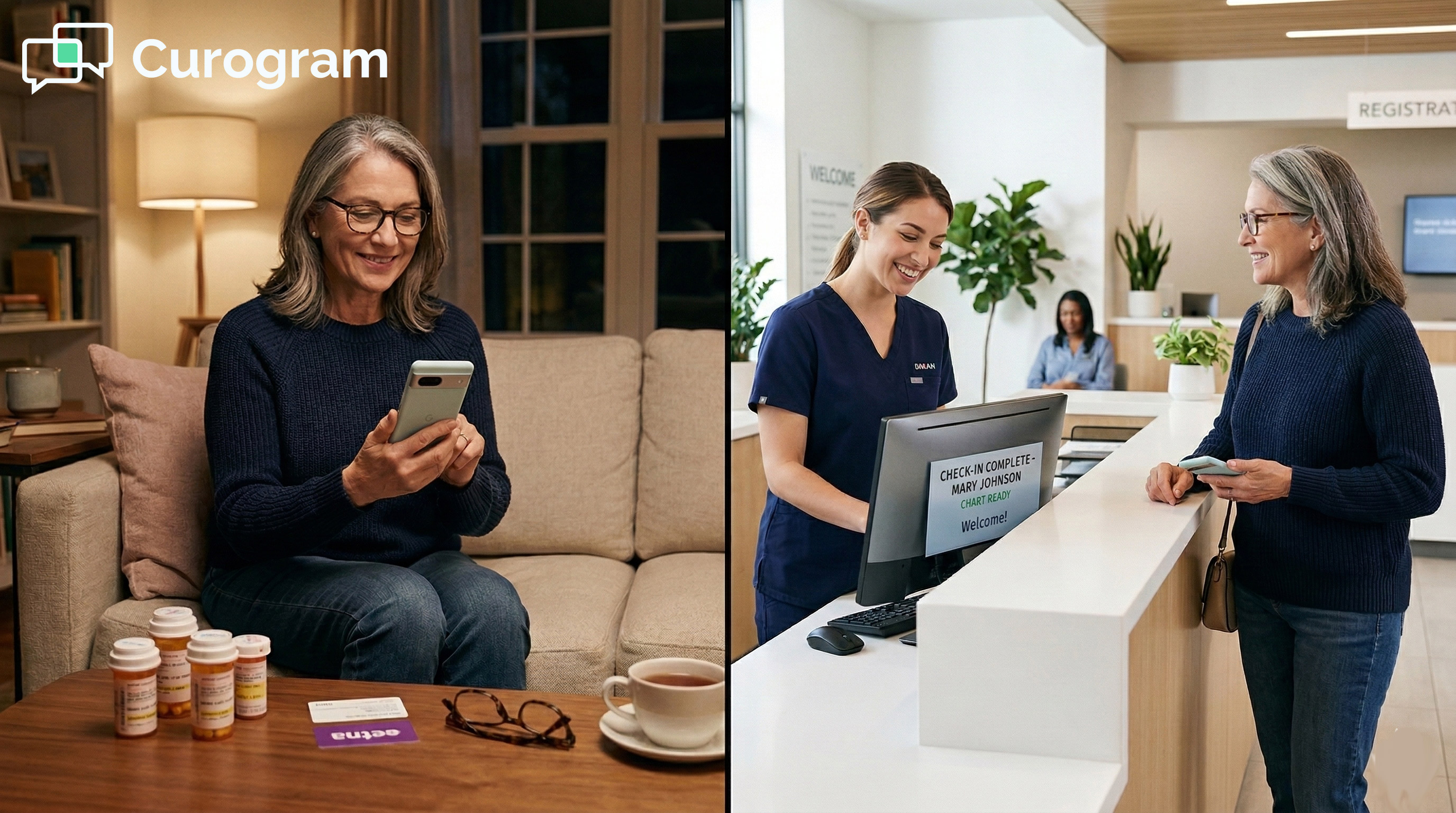
Instead of handing clipboards to patients in the lobby, Curogram sends a text link before the appointment. Patients fill it out on their phones. Every answer flows to the right eCW field automatically.
No typing. No scanning. No deciphering handwriting under pressure.
For practices running on eCW, this shift turns check-in from a data entry marathon into a quick, friendly greeting.
It frees staff to focus on patients who need real help — not on transcribing insurance IDs from a clipboard.
This article breaks down why the old clipboard workflow fails, how digital intake automation works, and what front-desk teams actually experience when they make the switch.
Every eCW practice has a version of the same morning problem. Patients arrive. Clipboards go out. Clipboards come back.
Then the real work begins — for staff, not the system. This section breaks down where that process breaks down, and why it keeps getting worse.
eCW handles complex, multi-specialty scheduling with ease. But when patients walk through the door, most practices still rely on paper. Each morning, a wave of patients arrives carrying clipboards or needing one.
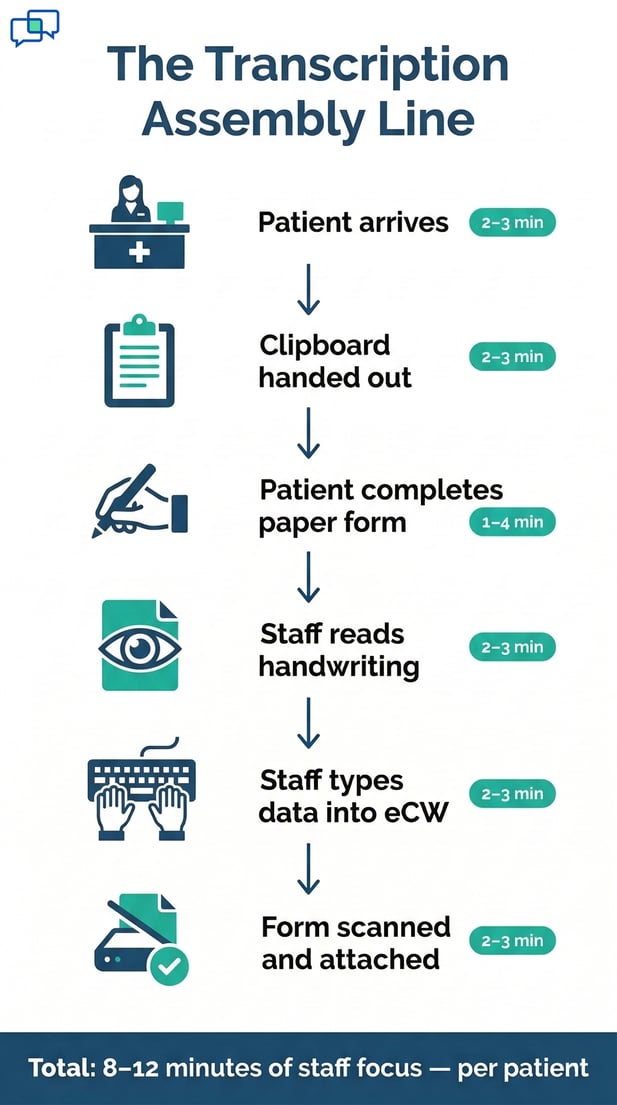
Every completed form triggers the same chain: read the handwriting, type it into eCW, verify the insurance card, scan consent forms, attach documents.
That sequence takes 8–12 minutes of focus per patient. During peak check-in, nothing else gets done.
Picture a five-provider cardiology clinic. At 8:50, four patients show up at once.
One is handing back a clipboard. One ran out of ink. One needs help with a question. One is a new patient who needs the full packet.
While one staff member starts transcribing patient one's data, the phone rings. A provider has a scheduling question. By 9:10, only one patient has been fully checked in. Three others are still waiting.
The first provider hasn't seen a patient yet. The cascade has begun and it won't stop until the lobby clears, which could be hours away.
This kind of morning doesn't improve on its own. Adding a provider at any location means 15–20 more check-ins per day.
Each one demands the same 8–12 minute transcription sequence. The front desk simply cannot absorb that load without hiring more staff or letting wait times grow.
For expanding eCW networks, clipboard intake becomes a ceiling that limits how fast new providers can reach full capacity.
The problem isn't the staff — it's the process. Fixing it means removing the transcription step, not adding more people to manage it.
Transcription errors are quiet. They don't announce themselves during check-in. A wrong digit in an insurance member ID looks fine on a clipboard. It only becomes a problem when a claim comes back denied weeks later.
A missed allergy slips through when no one catches the handwriting. An outdated medication list causes a drug interaction flag to fail silently.
These aren't rare exceptions. They're the predictable result of rushing through handwriting while a lobby fills up.
For enterprise eCW networks, data accuracy isn't just an operational concern. It touches billing, clinical decisions, and compliance.
A transposed insurance ID can trigger a claim denial. An incomplete allergy record can affect prescribing. An outdated medication list can break automated safety checks.
Front-desk coordinators aren't making careless mistakes. They're working fast under pressure, doing a task that was never a good fit for humans in the first place.
Every transcription error is a downstream event waiting to happen and it's entirely preventable.
The front-desk data entry reduction challenge isn't isolated to busy mornings. It compounds over time. As practices grow, the gap between what the clipboard system can handle and what the practice needs widens.
Practices hit a wall: hire more check-in staff, or accept that the lobby will always back up. Neither option solves the real problem.
The transcription step is the bottleneck, and no amount of staffing fully removes it until the process itself changes.

Removing the transcription step doesn't mean doing less. It means doing it smarter. Curogram's digital intake tools integrate directly with eCW to automate the parts of check-in that were never a good use of staff time.
Here's how the system works, and what it actually changes for front-desk teams.
Curogram's intake workflow automation starts before the patient ever arrives. The system pulls from the eCW appointment schedule and sends the right form via text — 48 hours before the visit, or at a timing you configure. Patients complete the form on their phones, with no app required.
For new patients, the full intake packet goes out. For returning patients, the form pre-fills with existing eCW data and asks them to confirm or update.
When the patient submits, every field writes to the corresponding eCW record via API in real time, with no staff involvement.
This isn't a one-size-fits-all form. Specialty-specific sections activate based on appointment type.
Custom fields can write to progress note sections or eCW custom data elements. Here's what flows to eCW without any staff input:
|
Form Field |
eCW Destination |
|
Demographics |
Patient record |
|
Insurance information |
Coverage details |
|
Medications |
Medication list |
|
Allergies |
Allergy record |
|
Consent signatures |
Chart (with timestamps) |
|
Custom fields |
Progress notes / custom data elements |
Every submission is validated before it's accepted. Required fields, phone formats, date formats, and insurance IDs are all checked for accuracy before the patient can complete the form.
One concern practices have is whether patients will actually complete forms before arriving. In practice, the time commitment is low. New patients average 6–8 minutes. Returning patients who are reviewing and updating existing data average just 2–3 minutes.
For same-day appointments, the form link can be sent right at booking, so the patient completes it in the waiting room on their phone instead of on a clipboard. Either way, the transcription step is gone.
When most patients arrive with forms already done, the entire check-in experience changes. The front-desk intake workflow automation means that Priya, our cardiology clinic coordinator from earlier, isn't racing to transcribe before providers fall behind.
She's greeting patients, confirming IDs, and rooming people — tasks that actually require a human.
The eCW front office digital form write-back means the chart is already up to date before the appointment begins. Staff morale shifts too.
The most repetitive, error-prone task in the front-office workflow — copying handwriting into fields — no longer exists. That's not a small change. For many front-desk teams, it's transformative.
For eCW networks, data security isn't optional. Curogram is SOC 2 Type II certified and operates under a signed Business Associate Agreement (BAA), making it fully HIPAA-compliant for patient health information.
Form links are delivered via encrypted text. Submitted data flows through a secure API. Consent signatures include timestamps and attach directly to the eCW chart.
The system meets the compliance standards that enterprise healthcare networks require without placing the burden of verification on front-desk staff.
Real change shows up in real numbers. When front-desk teams switch from clipboard intake to digital forms, the results aren't subtle.
This section covers what practices actually measure and what it feels like for the people doing the work.
Based on our internal data, front-desk teams at eCW practices using Curogram's digital intake recover 5–8 hours per day, per location, that were previously spent on intake transcription.
That's not a rounding error; it's the equivalent of a full shift's worth of manual data entry, returned to the practice every day.
Check-in time per patient drops from 12–18 minutes to 2–3 minutes for patients who completed their forms before arriving.
Patient check-in time reduction at eCW practices using digital forms is one of the most consistent results we see across locations and specialties.
|
Metric |
Paper Clipboard |
Curogram Digital Forms |
|
Check-in time (new patient) |
12–18 minutes |
2–3 minutes |
|
Check-in time (returning patient) |
8–12 minutes |
2–3 minutes |
|
Staff time spent on transcription per day |
5–8+ hours |
Near zero |
|
Transcription-related data errors |
Common |
Effectively eliminated for digital submissions |
|
Provider start time impact |
Frequent delays |
Patients roomed on time |
The billing team notices too. Transcription-related claim denials drop when insurance IDs, member numbers, and coverage details are entered by the patient rather than typed from a clipboard under pressure. Fewer denials mean less rework and faster reimbursement cycles.
Based on our internal research, practices that move to digital intake see a measurable reduction in insurance-related claim errors within the first month. That's a direct return on the workflow change, beyond the staff hours recovered.
The transformation from "The Transcription Assembly Line" to a front desk that greets instead of transcribes isn't just operational. It changes what the job feels like.
Priya's cardiology clinic deployed Curogram's digital intake forms. Within four weeks, the majority of new patients were completing intake before arrival.
Returning patients verified their data in under three minutes via text. The 8:50 AM crunch — the simultaneous arrivals, the clipboards, the cascading delays — was gone.
The IT director confirmed that structured data was flowing accurately to eCW fields. The billing team saw fewer insurance-related denials.
And Priya said it simply: "I used to be a typist. Now I'm actually helping patients. This should have been how it worked all along."
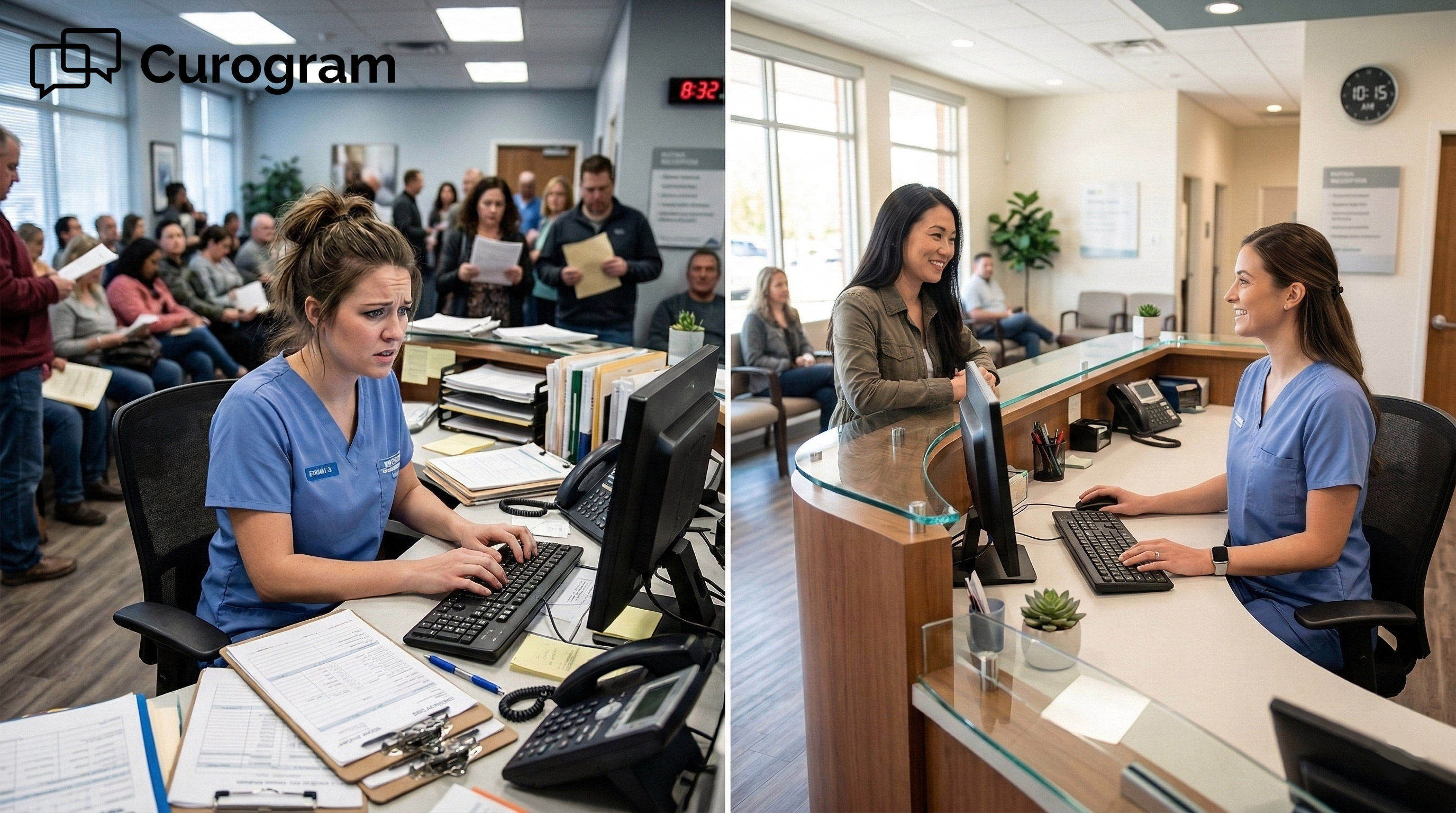
When check-in moves faster, the entire practice runs smoother. Patients get roomed on time. Providers start their first appointment without delay.
The lobby clears instead of backing up. Staff have time to handle the things that actually require human judgment.
For multi-location eCW networks, the intake workflow automation at eClinicalWorks level also scales cleanly. Adding a new provider doesn't mean adding new transcription burden. The digital form system absorbs the volume increase without adding headcount.
As our internal data shows, combined with communication and reminder automation, the total labor savings across intake and communication workflows can reach approximately one full-time equivalent per five providers.

Curogram's digital intake forms eliminate the transcription workflow at eCW front desks, recovering 5–8 daily staff hours per location. Structured data goes directly to eCW fields with zero manual entry from staff.
eCW is built for your structured data and clinical workflows. Curogram is built to free your front desk from the clipboard-to-keyboard pipeline that was never a good use of their skills.
Together, they create a practice where data enters the system correctly the first time, because the patient entered it themselves.
Stop paying your best front-desk coordinators to interpret handwriting. Give patients a digital form and let the data flow directly to eCW.
Schedule a demo today and then ask your front-desk team if they want to go back to clipboards. They won't.
Frequently Asked Questions
Very little. The system handles form delivery and data write-back automatically, so staff don't manage the intake workflow — they review the pre-populated eCW chart at check-in.
Training covers the new check-in flow: verify identity, confirm data, room the patient. Most practices report that staff feel fully comfortable with the new process within the first week.
Curogram's forms include required-field checks, format validation for phone numbers, dates, and insurance IDs, and completeness review before submission. If a patient skips a required field or enters an invalid format, the form prompts them to fix it before they can submit.
For the rare cases where corrections are needed at check-in, staff can update the record directly in eCW — the same process they'd follow today, just for far fewer patients.
Form links can be sent at booking, at a set pre-visit interval (48h, 72h, or custom), or bundled with appointment reminders.
For same-day bookings, the form goes out immediately so the patient can complete it in the waiting room on their phone. Either way, the transcription step is eliminated — staff never need to type from a clipboard.
Paper intake relies on staff reading handwriting quickly under pressure — which leads to transposed digits in insurance IDs, missed fields, and outdated information that slips through.
Digital forms require patients to enter their own data in validated fields, catching format errors before submission. The result is cleaner data flowing to eCW from the start, which reduces claim denials and rework downstream.
Patients who don't complete forms before arriving can do so in the waiting room using their phones — no app required. The form link can be resent via text on the spot.
For patients who aren't able to use a phone, staff can handle check-in in eCW as usual. The system is built to handle exceptions without disrupting the majority of patients who do complete forms in advance.
💡 eClinicalWorks secure online forms with structured data intake for enterprise networks replace clipboard-based check-in with text-delivered...
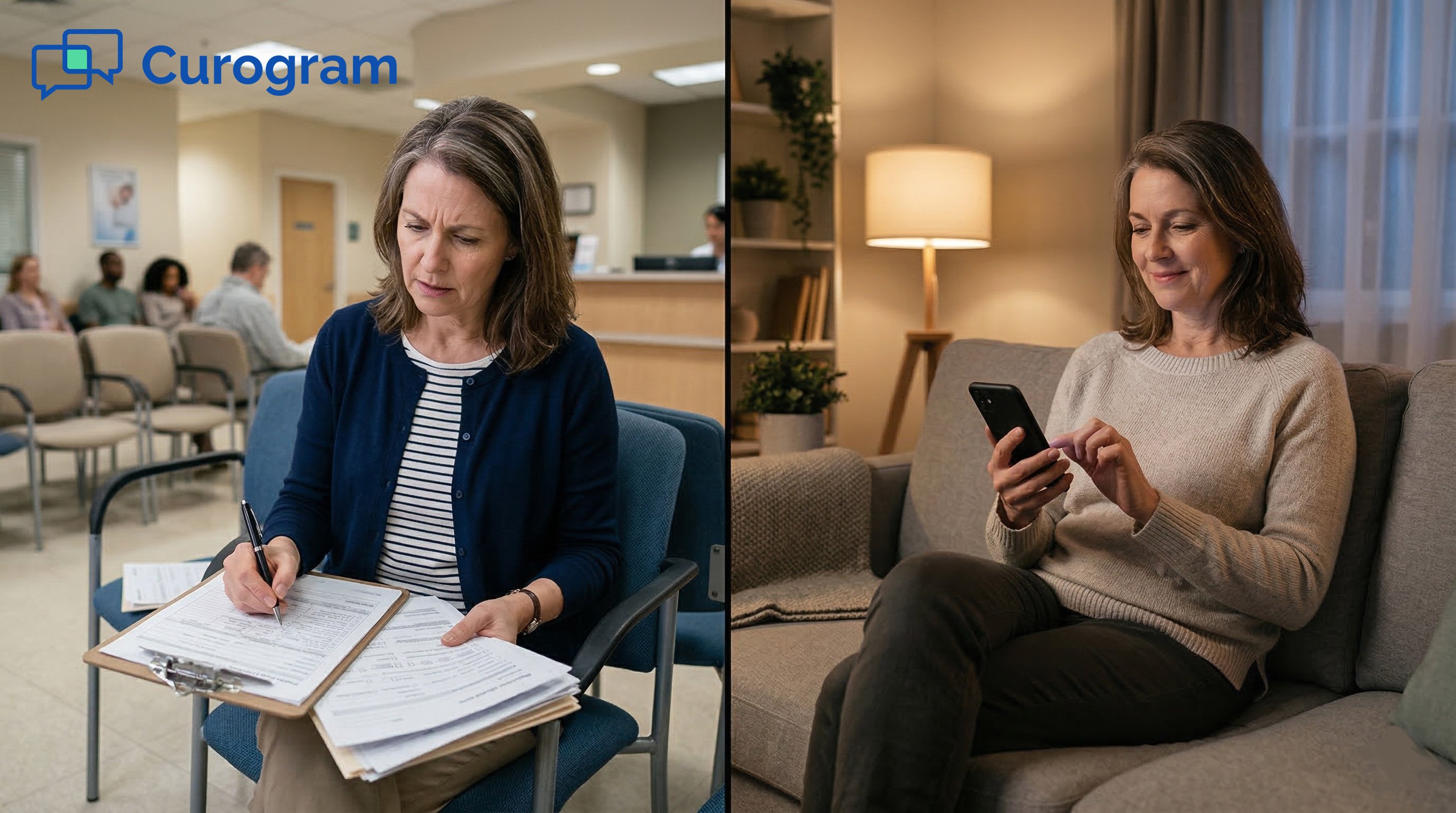
💡 Curogram delivers the eClinicalWorks patient digital form experience through text — with no app download, no clipboard, and no lobby wait....
💡 Digital intake workflow, along with Veradigm solutions, helps imaging centers eliminate delays and errors from paper-based processes. Patients...