Why eCW Patients Review by Text | Post-Visit Timing That Works
💡 When a patient leaves a good visit, that positive feeling fades fast. An eClinicalWorks patient text review request sent 1–2 hours after the...
10 min read
Mira Gwehn Revilla
:
April 21, 2026
The braces come off. The patient stares into the mirror. Two years of tightening and waiting just paid off. That smile is perfect — and that family is about to walk out the door.
Here's the problem. Your Dolphin software captured every X-ray and treatment step. But it didn't capture that smile on Google. It didn't text the family a review link.
Most Dolphin practices face this gap every day. You treat 40 to 50 patients per schedule. Each one finishes thrilled. Yet your Google Business Profile sits at 47 reviews while a newer practice across town has 380.
Staff try to ask at the front desk. They forget. Patients say "sure" and forget too. The ask feels awkward right after a clinical visit. By the time families reach their car, the good intention is gone.
That gap has a real cost. About 90% of new patient leads check your Google Business Profile before your website. Review count and star rating drive who gets the click. Clinical quality does not show up in search rankings — review volume does.
This is where Dolphin orthodontic Google reviews through automated text requests change the math. A post-visit text with a direct Google link arrives when satisfaction peaks. One tap, and the review is live. No searching. No friction.
This article walks through how to use automated text requests to build five-star reputation management at scale. You'll see how one multi-location practice added 1,064 new five-star reviews in just three months, based on our internal data.
You'll also see why Dolphin plus Curogram beats the Weave bundle for pure review growth — without replacing the clinical tools your team already loves.
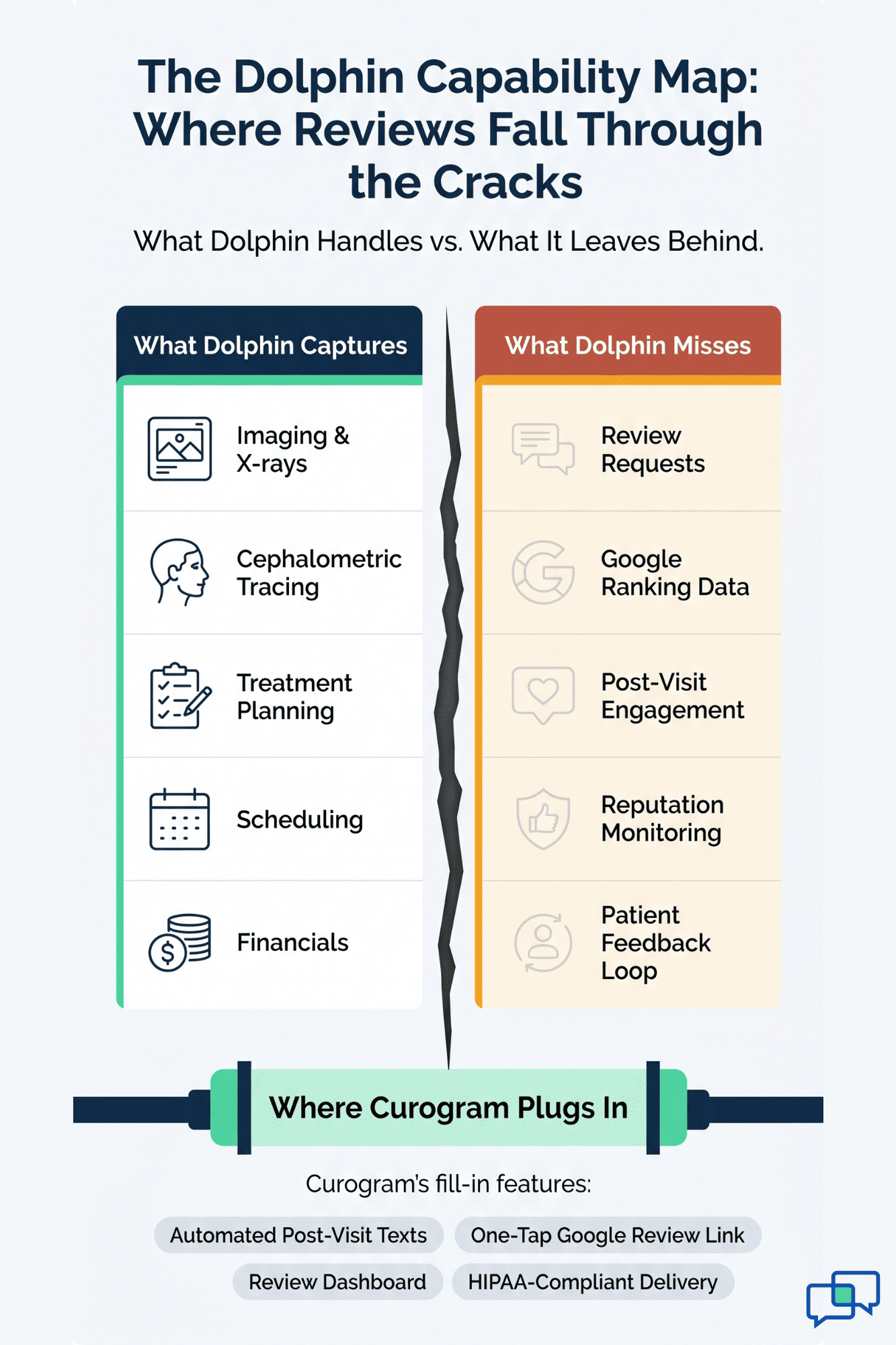
Dolphin built its reputation on clinical tools. Imaging, cephalometric tracing, treatment planning, and scheduling — it does all of that well. About 97% of U.S. orthodontic residency programs train on Dolphin. That means the next wave of orthodontists starts their careers inside this system.
But Dolphin stops where the clinical record stops. It does not send review requests. It does not track your Google rating. It does not flag a happy patient and nudge them to leave a public review. A two-year case ends, and Dolphin simply saves the final scan.
Many practices try to close this gap by hand. A front desk staffer says, "If you had a great visit, we'd love a Google review!" It works once in a while. It does not work at scale.
At 40 to 50 visits per day, staff cannot ask every patient. They forget during busy mornings. A cancellation throws off the rhythm. The ask gets skipped for the rest of the day.
Patients forget too. They nod, smile, and walk out. By the time they reach the parking lot, the review plan is gone. The small bit of friction — finding your listing, tapping through menus, typing something — is enough to lose them.
Consider the math. A Dolphin practice sees roughly 200 debanding patients per year. Each one is a peak-satisfaction review chance. If only 5% leave reviews, that's just 10 per year from the happiest moment.
Now imagine 50% of those patients leave reviews with a simple automated text. That's 100 new reviews — a 10x jump from the same patient base. Add in adjustments, consults, and retainer checks, and the gap between manual and automated becomes huge.
Here's what makes this urgent. Parents searching "orthodontist near me" scroll the map pack first. They see your star count, your review total, and quotes from recent patients. They decide in seconds.
A practice with 47 reviews loses to a practice with 470 reviews. Review volume builds search trust. Search trust drives clicks. Clicks drive consults — regardless of who's actually better clinically.
This is the gap. Dolphin produces the clinical excellence. Patients feel it every visit. But Google shows almost none of it.
Some Dolphin practices turn to Weave. Weave does offer review collection. The catch is the bundle — phones, payments, analytics, texting, and more — priced at $300 to $500+ per month.
You buy a full stack just to solve a review problem. If you already like your phone system, that is a lot of spend for reputation management. Many Dolphin offices want the review engine without the rip-and-replace project.
Here is how many owners describe it in plain words:
"We debanded 200 kids this year. Every family loved it. But our Google profile is stuck, and the general dentist down the street outranks us. Our clinical skill does not show up in search."
That feeling — clinical pride without digital proof — is the real villain. It is the review gap you cannot close by asking louder at the front desk. The Dolphin ortho Google reviews problem is a system problem, not a staff problem.
The fix is not a bigger platform. The fix is a focused, automated text request that fires after every visit, at the exact moment patients feel best about their care.

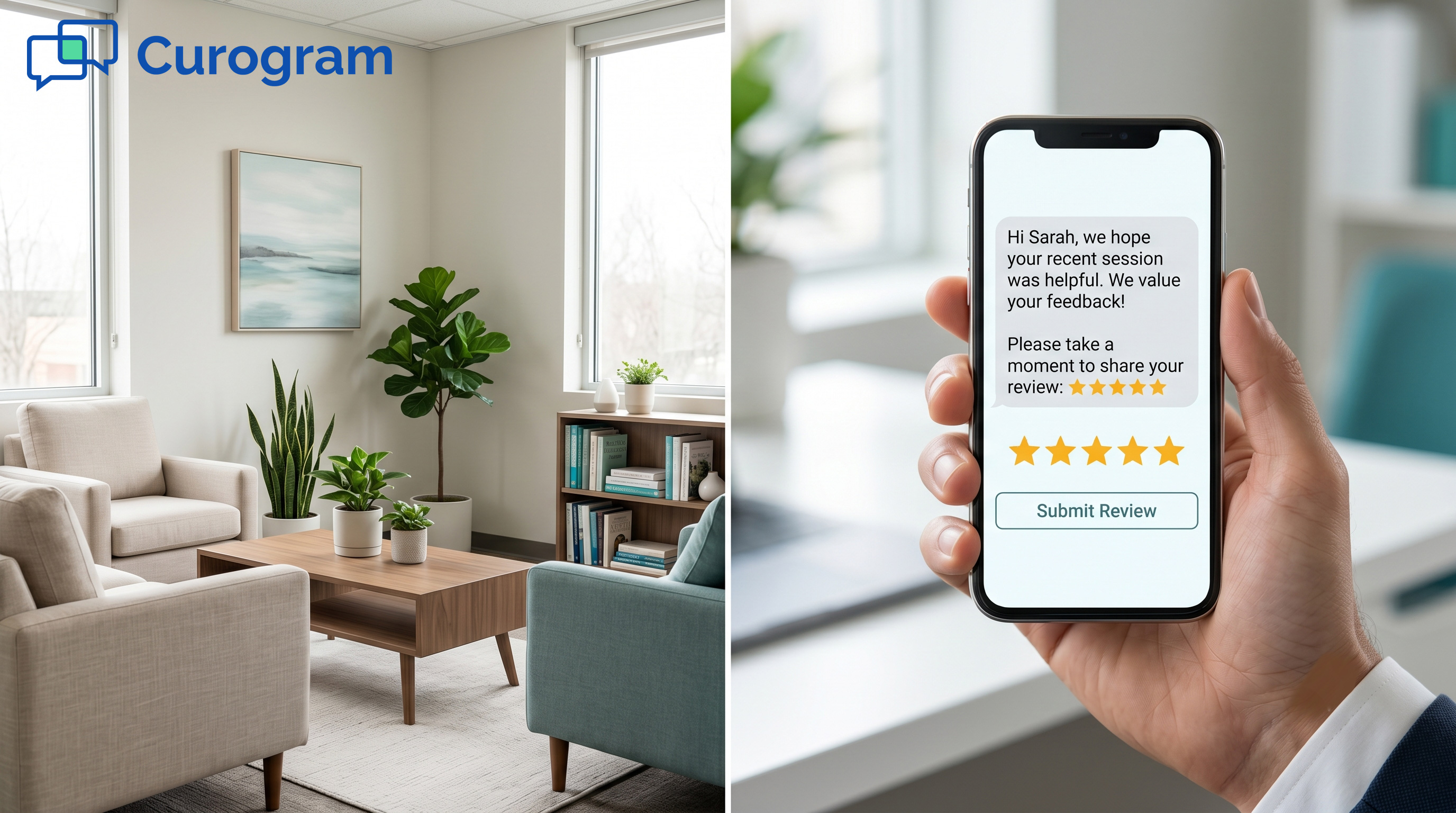
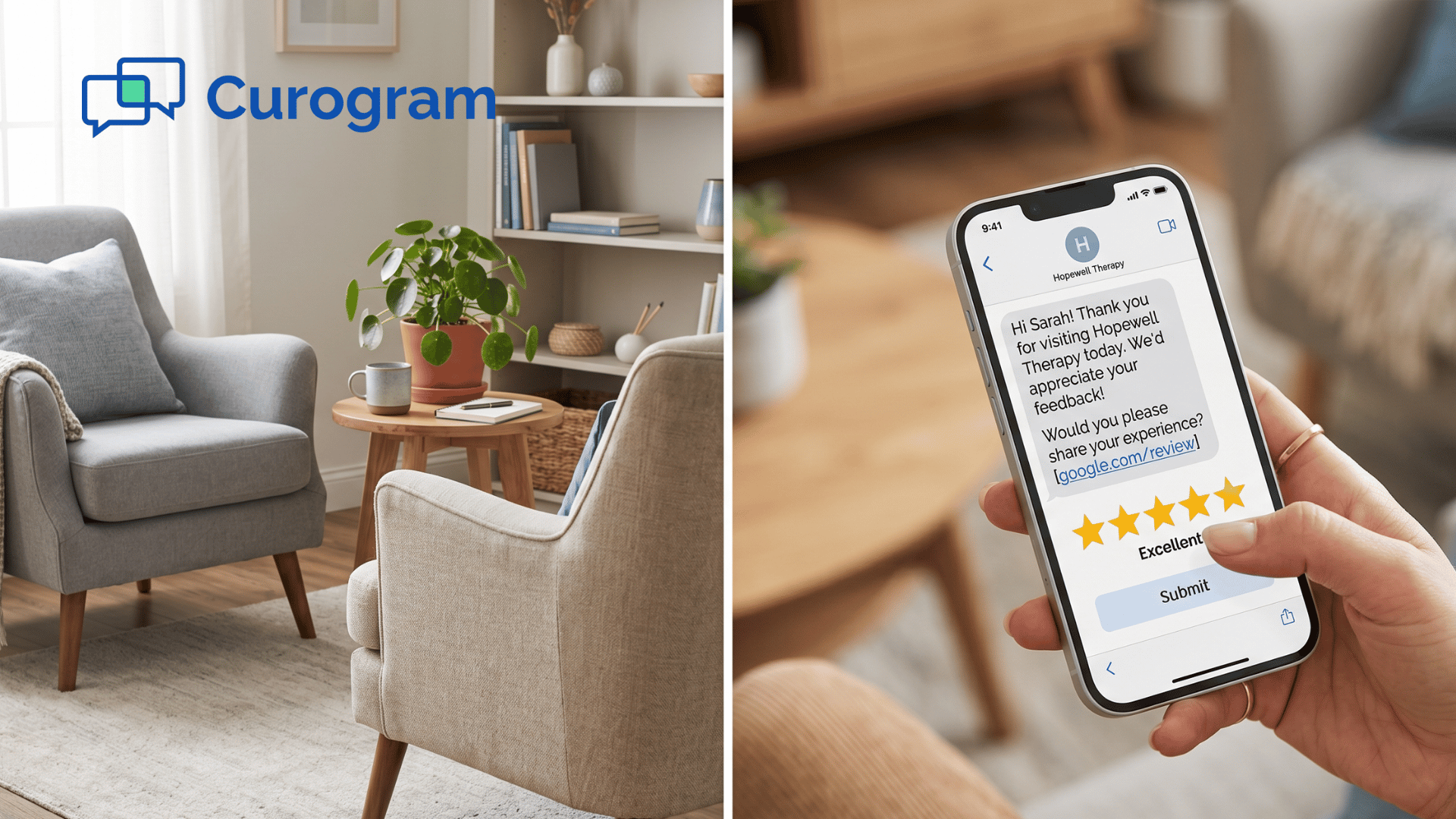
Curogram closes the gap with one focused tool: an automated text that goes out right after each visit. The message includes a direct tap-to-review link for your Google Business Profile. No searching. No typing the practice name. No menu trees.
The timing is the trick. A patient reads the text while still happy, still smiling, often still in the car. That window is short. Curogram hits it every time, without staff input.
You set the rules once. Pick your send time — right after checkout, that evening, or the next morning. Choose which visit types trigger a request: all visits, debandings only, new consults, or a mix. Curogram handles the rest.
When a patient checks out, the system queues the message. At the scheduled time, the text fires with a one-tap link. The patient lands straight on your Google review page. Writing a review takes seconds.
For orthodontic Google reviews, Dolphin automated text request workflows finally scale. Every chair turnover becomes a review chance. The system does not forget, get busy, or skip a shift.
You keep full control. If a patient had a rough visit, your team can flag the chart to skip the request. If a child is under a parent's phone, the request still reaches the decision-maker. If weekend visits should wait until Monday morning, set it and move on.
This is five-star reputation management built for a real front desk. The staff does nothing extra. The software does the work.
Curogram's dashboard turns review data into practice insight. You see delivery rates, open rates, and reviews earned per visit type. Office managers can spot trends fast.
Here's how that data might read for a busy ortho practice in a single week:
|
Visit Type |
Texts Sent |
Reviews Earned |
Conversion Rate |
|
Debanding |
15 |
9 |
60% |
|
Initial consult |
22 |
5 |
23% |
|
Adjustment |
180 |
20 |
11% |
|
Retainer check |
18 |
3 |
17% |
The table above is a sample pattern, not a fixed promise. It shows how debanding — the peak emotion moment — can carry the highest conversion. With that insight, a practice can tune its ask even further.
Ortho has a unique edge in review generation. A typical case runs 18 to 30 months with 15 to 25 visits. Each visit is a review chance, not just the final one. That is a patient touch map most specialties do not have.
Pediatric dentistry gets one visit every six months. General dentistry gets two per year. Orthodontics gets monthly contact, plus the once-in-a-lifetime debanding moment. Curogram turns that entire arc into steady review flow.
Based on our internal data, one multi-location practice deployed Curogram's automated post-appointment surveys tied to Google reviews. Over three months, they added 1,064 new five-star reviews. Their total review count moved from around 993 to over 8,000 as the system kept running.
That's what scale looks like. Not hoping staff remember. Not offering gift cards. Just a simple post-visit text, sent at the right moment, to every patient.
Dolphin handles the clinical work. Curogram handles the post-visit review loop. The two live in different lanes and never step on each other.
You keep your Dolphin workflow. You add a review engine that runs in the background. The result: clinical excellence finally shows up where parents are looking.
Here's where the results hit. A Dolphin practice that adds automated review requests can change its Google profile in under a year. Based on our internal data, the numbers speak for themselves: 1,064 new five-star reviews in three months, with total reviews climbing from 993 to 8,159 as the system kept running.
Those numbers are not magic. They come from simple math: more appointments plus automated text requests equal more reviews per week, every week.
Let's walk through a realistic Dolphin practice. Picture a two-location office with 2,500 active patients. Each patient averages 10 visits per year during active treatment. That's 25,000 visits — and 25,000 possible review requests.
If just 10% convert — a very modest rate given the debanding spikes — that is 2,500 new reviews in a year. Even at 5% conversion, you earn 1,250 reviews. Compare that to 40 to 60 reviews per year from manual asking.
This is why Google reviews Dolphin orthodontic automated text request workflows change the math at scale. You are not trying to push harder. You are just removing friction and letting patient goodwill show up in public.
Six to twelve months in, the profile looks different. Your review count climbs past 300 or 400. Your average star rating settles above 4.8. Recent reviews show up every week, so the profile looks active and trusted.
Google's local ranking system rewards that pattern. Fresh reviews, high volume, and strong star averages all push your listing higher in the map pack. A higher spot means more clicks — and more clicks mean more consultations.
Here is how the flywheel turns in a Dolphin office:
Each step feeds the next. The flywheel does not need ads, coupons, or extra staff time. It just needs the text to fire after every visit.
To make this concrete, here is how a typical Dolphin ortho practice might look before and after deploying the system:
|
Metric |
Before Curogram |
After 6 Months |
|
Total Google reviews |
47 |
320 |
|
Average star rating |
4.3 |
4.9 |
|
Reviews added per month |
2 |
45 |
|
Map pack visibility |
Low |
Top 3 |
|
New patient consults |
Baseline |
+25% |
These figures show a practical pattern, not a locked guarantee. The shift comes from one habit change — sending a text after every visit instead of hoping patients remember.
Nothing in dentistry beats a debanding moment. Two years of effort meet a brand-new smile. Patients cry. Parents cry. Photos get posted on Instagram.
That is when the review request should land. Most practices let this moment slip away. With Curogram, debanding days drive review spikes that lift the monthly average on their own.
Think about it this way. If your practice completes 200 debandings per year at 60% review conversion, that is 120 high-emotion five-star reviews from one visit type alone. That single number can beat the total review count many practices have today.
This is what five-star reputation management looks like at scale. Not ad spend. Not manual campaigns. Not another platform to log into.
Just a silent, automated post-visit text after each visit, sent at the exact moment patients feel best. The habit becomes part of how your practice operates. The reviews become part of how Google ranks you.
For Dolphin ortho offices, this is the missing layer. Dolphin runs the chair. Curogram runs the afterparty — the moment that turns clinical care into public proof.

How Curogram Turns Every Dolphin Visit Into a Review Opportunity
Curogram runs alongside Dolphin, not on top of it. Dolphin keeps its place as the clinical core for imaging, treatment planning, and scheduling. Curogram plugs into your visit flow and handles the post-visit layer.
Here is how it works in practice. A patient checks out of their appointment in Dolphin. Curogram picks up the visit completion signal through a light integration. A few minutes or hours later — your call — a personalized text goes out with a direct Google review link.
The text is short, warm, and written in your voice. No long forms. No login walls. One tap and the patient is inside Google's review screen.
Behind the scenes, Curogram works the way your office already does. HIPAA-compliant 2-way texting keeps every message secure. Automation rules let you tune delivery by visit type, location, and provider. Your front desk sees it all on one dashboard.
The business case is simple. Weave asks you to replace your phone system, switch payments, and rebuild workflows just to unlock reviews. Curogram charges a fraction of that price for focused post-visit review automation that works from day one.
For orthodontic Google reviews, the Dolphin plus Curogram combo targets the exact gap. Dolphin does not need to add reputation tools. Curogram does not try to replace Dolphin. Each does one job well.
You also get two more wins for free. The same platform that sends review requests can send appointment reminders, recalls, and intake forms. That is one tool replacing several, with one monthly bill instead of many.
The goal is steady, natural five-star growth — driven by happy patients, automated requests, and zero extra lift from your staff.
Dolphin runs the clinical side of orthodontics better than almost any tool on the market. That is why 97% of U.S. ortho residency programs train on it. But Dolphin was never built to handle reviews.
That gap shows up every day. Your team delivers great care. Parents walk out thrilled. Then the moment slips past — and Google never hears about it.
Manual asking at the front desk cannot solve this. At 40 to 50 visits per day, staff run out of time. Patients forget by the time they reach the car. Good intentions don't move the needle on your star rating.
Automated text requests fix the problem at the source. The text goes out when patients feel best. One tap sends them to Google. The review gets posted while the smile is still fresh.
Over months, the pattern compounds. Your profile moves from 47 reviews to 300+. Your star rating climbs above 4.8. New parents searching at 10 p.m. see you first in the map pack.
That is what five-star reputation management looks like at scale. No bundled platform. No rip-and-replace project. Just a simple, automated post-visit text that runs while your team focuses on patients.
For Dolphin orthodontic offices, this is the cleanest path to growth. Dolphin handles the treatment. Curogram handles the review engine. Neither steps on the other.
The competitive math is clear. A practice with 400 reviews and a 4.9 rating wins clicks over a practice with 50 reviews — every single time. Review volume is the biggest lever in local search right now.
The fix takes one decision. Start your 30-day free trial with Curogram. Send your first automated review request after today's appointments. Watch the ratings climb.
Stop letting your happiest debanding moments disappear into the parking lot. Book a demo and see how one automated text turns every Dolphin visit into a five-star review opportunity.
Satisfaction peaks right after a visit, especially after debandings. A text reaches patients during that window, on the device they already hold. One tap opens the review page. Front desk asks lose that moment within minutes of checkout.
You set the rules in Curogram once. Pick visit types, send windows, and locations. Skip flags let staff pause requests for specific patients. The system runs automatically after setup, and your front desk does zero extra daily work.
Based on our internal data, one multi-location practice added 1,064 new five-star reviews in just three months. Growth depends on visit volume, debanding count, and how consistently the automated text system runs across every appointment type.
💡 When a patient leaves a good visit, that positive feeling fades fast. An eClinicalWorks patient text review request sent 1–2 hours after the...
💡 Practice Fusion automated Google review requests, powered by Curogram's Review Engine, send a post-visit text to every patient after each...
💡 Most Office Ally practices have tried review cards, emails, and portal messages. None of them work well. Patients skip them, forget them, or...