Athenahealth Reputation Management: The Review Engine Guide
💡 Athenahealth reputation management powered by Curogram's Review Engine turns every patient visit into a Google review — with zero staff effort.
11 min read
Mira Gwehn Revilla
:
April 21, 2026
Your front desk staff are too busy to ask for Google reviews. Even when they remember, patients forget the moment they reach the parking lot. That is why most Dolphin practices stay stuck at 40 to 50 lifetime reviews. Meanwhile, the practice down the street hits 500 and climbs.
The fix is not training staff harder. The fix is removing staff from the ask entirely. That is where most practices get it wrong year after year.
Curogram's Dolphin orthodontic review management dashboard sends Google review requests right after each visit. No staff member needs to remember. No patient gets put on the spot at checkout. Every appointment becomes a review chance, and the dashboard shows you how the system is working in real time.
Dolphin has no built-in reputation tools. Weave bundles reviews inside a $300-$500+ per month suite. Curogram gives you focused Google review tracking automation without forcing you to buy a full platform you do not need. You get what you need and skip what you do not.
The results speak loudly. One multi-location practice using Curogram went from about 993 reviews to 8,159 in three months. That is 1,064 new five-star reviews, and 90% of patients left five stars, based on our internal data. The front desk did not ask even once.
This guide walks you through why manual asks fail. It also shows how the Review Automation Dashboard fixes the problem fast. You will see how front desk review generation performance shifts from a staff task to a system task.
You will learn how office managers track reviews by location, appointment type, and time of day. Stop asking. Start automating. Let the system catch patients at peak joy every time.
Every orthodontist wants more Google reviews. Every practice owner has told staff: "Please ask patients to leave a review." Every office manager has watched the same pattern play out within weeks.
Let's look at why manual asking breaks down and why more training will not fix it.
Staff ask for reviews the first week after a new push. By week three, the asks drop off. By week six, nobody asks at all.
This is not a staff failure. It is a math problem. Your treatment coordinator handles 40 to 50 appointments a day. She tracks confirmations, insurance checks, intake forms, and the next appointment slot.
Adding "ask for a Google review" to that list sets her up to miss it. Humans forget small tasks when bigger ones crowd them out. That is how The Ask That Never Happens happens inside a busy Dolphin ortho practice.
Even when staff do ask, the timing is wrong. The patient stands at the front desk, digging for a credit card. They are wrangling a child's coat and scheduling the next adjustment.
In that moment, "please leave us a Google review" sounds like noise. The patient nods, walks to the car, and checks email. The review never happens.
Peak happiness after an ortho visit lasts about 15 to 30 minutes. That window closes fast. By dinner, the good feeling has faded. Without a system, you lose that window every single time.
Do the math on manual asks. A solo orthodontist with 40 daily adjustments needs 40 asks per day. That is 200 asks per week and 800 per month.
For a group with four offices, the number climbs to 3,200 monthly asks. No front desk team keeps that up. Even if 10% of patients actually left a review, you would need 100% of asks to land first. They never do.
Here is how the gap grows by practice size:
|
Practice Size |
Daily Visits |
Monthly Manual Asks Needed |
Realistic Ask Rate |
|
Solo (1 doctor) |
40 |
~800 |
5-10% |
|
Small group (2-3 offices) |
90 |
~1,800 |
3-5% |
|
Multi-location (4+ offices) |
160+ |
3,200+ |
1-3% |
The practices that rank high on Google either started years ago or run a review management dashboard. Manual asking cannot close that gap. It is not built for the speed modern ortho requires.
"I have asked my staff to ask for reviews for three years. We get two or three new reviews a month. The practice down the street gets 20. I have no clue what they are doing, but it is not asking at the front desk."
If that sounds familiar, you are not alone. Most Dolphin orthodontic practices live in this loop. They believe more training will fix the problem. It will not.
The problem is not staff effort or staff skill. The problem is that the ask relies on a human brain at the busiest moment of the day. You need a layer that does not forget, does not get tired, and does not feel awkward.
That layer is a review management dashboard Dolphin orthodontic Google tracking automation front desk generation performance setup — built to run while your team runs the office. It quietly turns each appointment into a review chance, with zero added load on the front desk. The next section shows exactly how this plays out day to day.
Curogram's Dolphin orthodontic review management dashboard removes staff from the review workflow. After each visit, the system texts the patient with a direct Google Business Profile link. No one at the front desk has to say a word.
The system runs the same way for every patient, every day, across every office. That is the heart of Google review tracking automation.
Picture your office manager opening the dashboard on Monday morning. One screen shows the full review pipeline. She sees everything in one view, with no spreadsheets.
Here is what the dashboard surfaces in real time:
When debanding appointments produce the most reviews, the dashboard shows it. When Tuesday afternoons beat Monday mornings, the data makes it clear. The office manager can act on what the numbers say.
The setup is simple. Your Dolphin system marks an appointment complete. Curogram picks up that signal and sends a text to the patient within a set window, often 30 to 60 minutes after the visit.
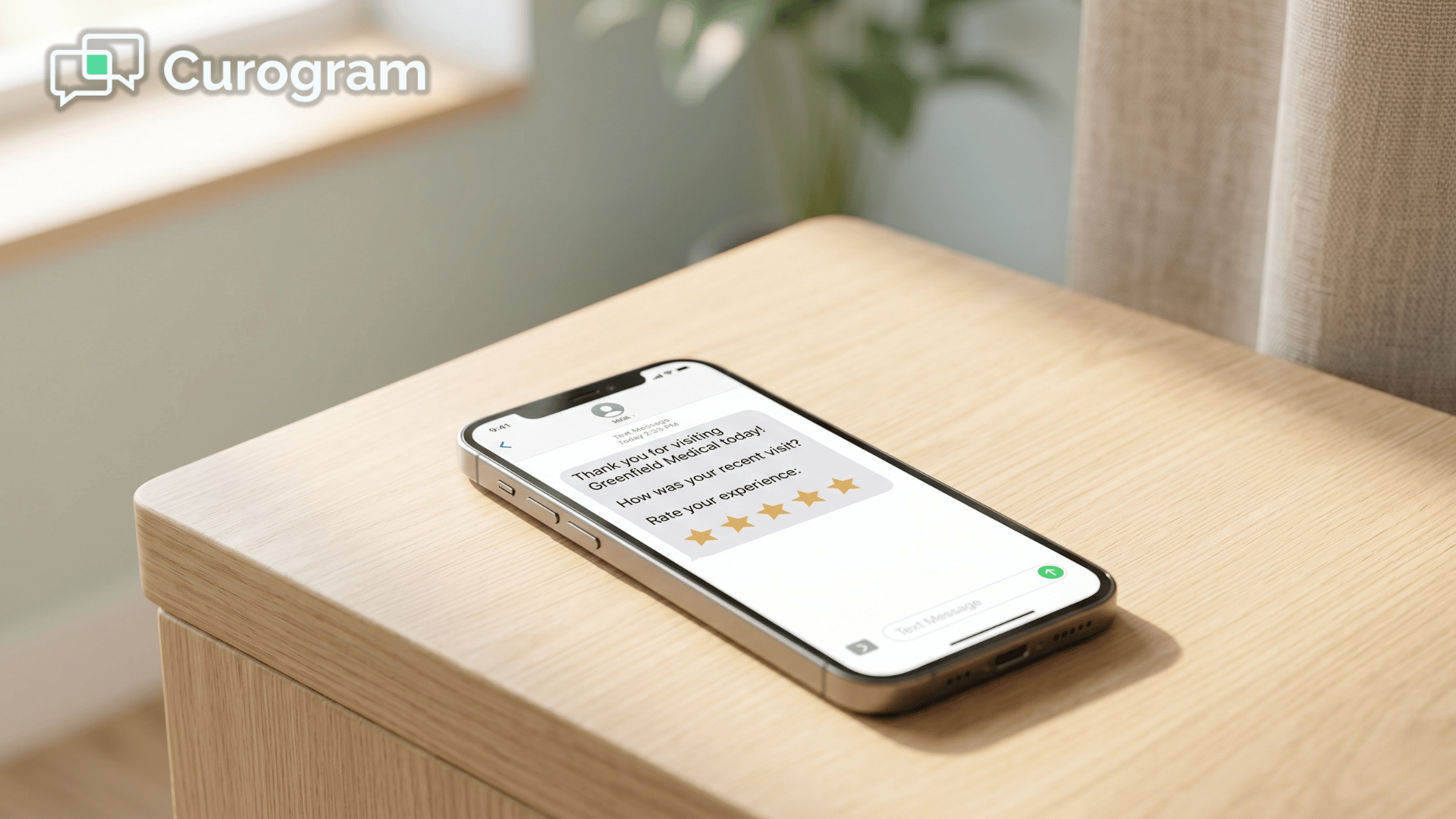
The text is short and warm. It thanks the patient and links straight to your Google Business Profile. The patient taps the link, rates the practice, and the review posts live.
That full flow takes under 30 seconds for the patient. It takes zero minutes for your staff. Front desk review generation performance stops depending on human memory.

One multi-location practice rolled out Curogram's review automation. In three months, they generated 1,064 new five-star reviews. Total review count grew from about 993 to 8,159, based on our internal research.
Around 90% of patients who responded left a five-star review. No contest. No social media push. Just automated post-visit texts that caught patients while they still felt good about their visit.
Compare that to typical manual asking, which yields 2 to 3 reviews per month. The multi-location client was generating roughly 355 per month through automation. That is more than a 100X jump.
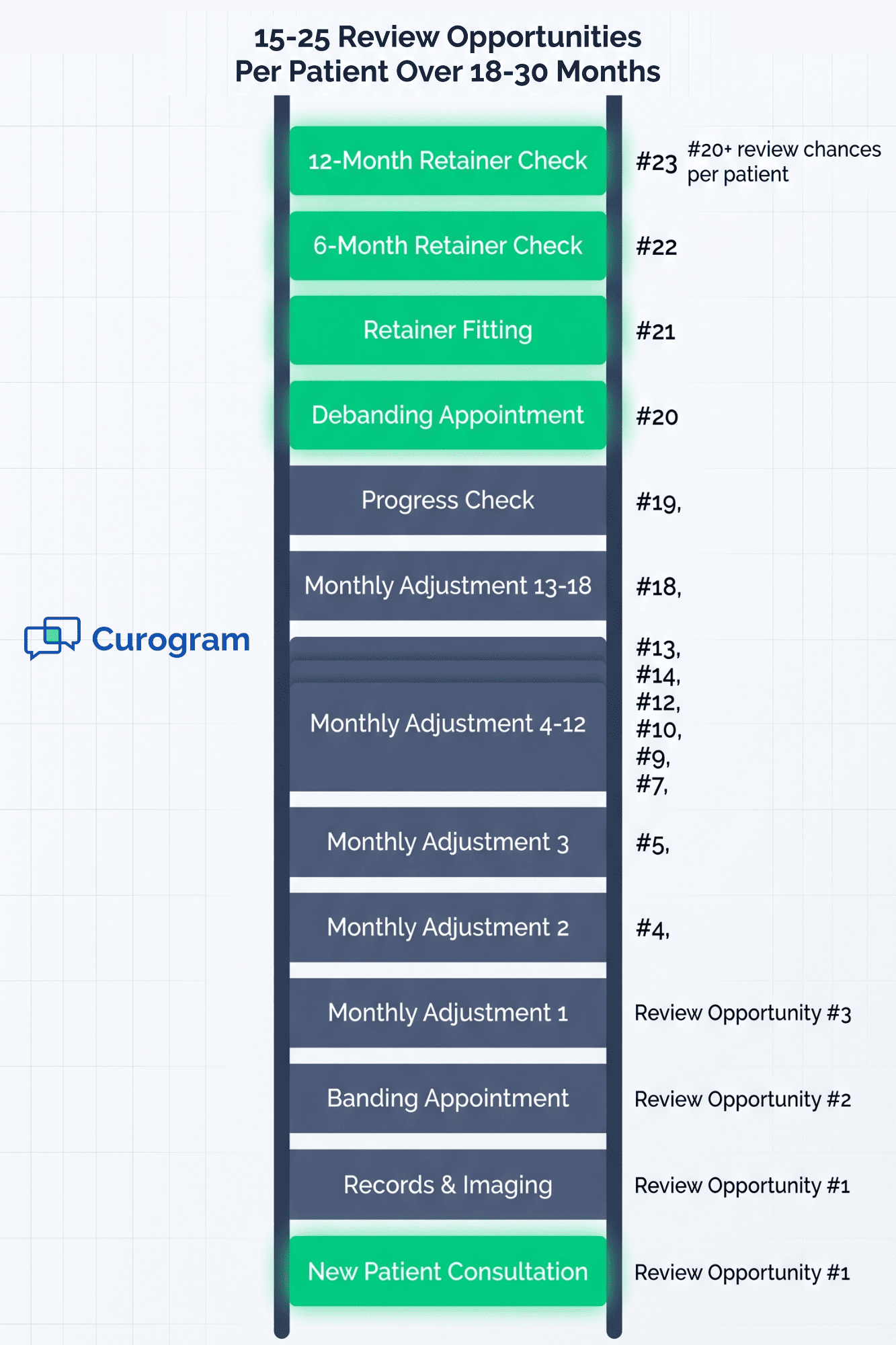
Orthodontic practices have a hidden edge. Each patient gets 15 to 25 appointments over 18 to 30 months. That is 15 to 25 chances to ask for a review per patient, without feeling pushy.
No other specialty offers that volume. A family doctor sees a patient once a year. An orthodontic review management setup inside Dolphin sees the same family every 6 to 8 weeks.
Curogram captures each of those chances automatically. Even if only 1 in 10 patients leaves a review per appointment, the math stacks up fast across a full treatment cycle.
Debanding visits carry special weight. They are emotional high points. The patient just saw their final result.
Reviews written at that moment mention specific outcomes like "straight teeth," "great smile," and "kind staff." Those are the exact phrases future parents search for on Google. The orthodontic review management Dolphin dashboard Google tracking automation front desk generation system converts that emotion into public proof.
Your future patients read those words before they even visit your site. The next section walks through what success looks like once the dashboard has run for 90 days. You will see the shift in numbers, workflow, and team mindset.
If you want to see the math for your own practice, you can project your potential ROI for boosting your reputation based on your monthly appointment volume and realistic conversion rates.
Imagine it is Monday morning, 90 days after you turned on review automation. Your office manager opens the Dolphin review management orthodontic dashboard Google tracking automation front desk performance view. The numbers on that screen tell a very different story from three months ago.
A typical Dolphin practice using manual asks generates 2 to 3 Google reviews per month. Switching to Curogram's automated system shifts that number sharply. Most practices hit 20 to 40 new reviews per month within 90 days.
For the multi-location client in our records, the jump was even larger. They moved from roughly 993 total reviews to 8,159 in three months. That is 1,064 new five-star reviews, based on our internal data.
Here is what those numbers look like side by side:
|
Metric |
Before Automation |
After 90 Days |
|
Monthly new reviews |
2-3 |
20-40+ |
|
Response rate to review asks |
2-5% |
30-40% |
|
Five-star share of responses |
70-80% |
~90% |
|
Staff time spent asking |
1-2 hours/week |
0 hours |
|
Google rating visibility |
Low |
High (top local pack) |
These numbers are not magic. They come from one simple shift: the ask happens every time, on time, without a human needing to remember.
The mindset change inside the office is the most valuable part. It touches every role.
The office manager stops sending staff Slack messages about reviews. The morning huddle drops the "please ask for reviews" reminder. That mental load is gone for good.
Staff stop feeling awkward. Asking for reviews at checkout has always felt a little forced. Now they just smile, check out the patient, and move on. The review ask happens later, by text, without any awkward pause.
Patients stop feeling pressured. No one is put on the spot at the front desk. They get a friendly text at home, read it when they want, and tap a link if they feel like it.
This is what front desk review generation performance looks like when the system carries the weight. The humans do what humans do best, which is care for the patient. The software does what software does best, which is repeat a task flawlessly.
Let's walk through a real example. Your office manager, Sarah, opens the dashboard at 8:45 AM on a Monday.
She sees that 32 review requests went out last week. Of those, 18 patients clicked the link. 14 left a five-star Google review. Two left four-star reviews with small notes about wait time.
She opens the location comparison tab. The Pasadena office is crushing it with 22 new reviews this month. The Glendale office has 11. She sends the Glendale team a quick note to check if any recent appointments triggered issues.
She clicks the appointment-type filter. Debanding visits produced 41% of new reviews. Retainer checks produced 23%. New patient consults produced 18%. She now knows which appointment types drive the most reviews per 100 visits.
That entire review takes her 6 minutes. No staff meeting. No review drive. No new training. Just data she can act on before lunch.
Month 1: Your practice adds about 25 new Google reviews. The dashboard shows you which days and appointment types are performing best. You start to see small improvements in local search.
Month 3: You hit 75 to 100 new reviews. Your Google Business Profile jumps from 47 reviews to roughly 140. You begin showing up more often in the top three local map results.
Month 6: Your review count sits at 260 or so. Your average star rating climbs to 4.8 or 4.9. Local search visibility doubles. New patient calls start to mention "I saw your reviews."
Month 12: You are at 470+ total reviews. You rank in the top map pack for "orthodontist near me" in your area. Competing practices with 60 to 80 reviews look less credible next to you.
You stop asking three questions that used to consume your week:
In their place, one new habit forms. You check the dashboard once a week. You look at the trend. You note which location needs a small nudge and which is flying high.
The review engine runs whether you are in the office or not. It runs on weekends. It runs during staff turnover. It does not take vacation or sick days.

How Curogram Turns Every Dolphin Appointment Into a Review Machine
Curogram sits beside your Dolphin practice management system as the patient communication layer. It does not replace Dolphin. It fills the gap Dolphin leaves open around Google reviews and patient messaging.
Here is the basic loop. Dolphin marks an appointment complete. Curogram picks up that signal and texts the patient a thank-you with your Google Business Profile link. The patient taps the link, rates the visit, and the review posts live. The dashboard logs every step.
That loop runs 100% automated. You do not need to touch it. It works for debanding visits, new patient exams, adjustments, and retainer checks across every location you run.
What makes Curogram different from bolt-on review tools:
Pricing stays focused. You pay for the review automation and text features you actually use. You do not pay for a bundled phone system or POS that you already have from another vendor.
Our results show what this looks like at scale. One multi-location client generated 1,064 new five-star reviews in three months. About 90% of patient responses were five stars, based on our internal research.
For Dolphin practices tired of manual asks and flat review counts, Curogram offers a direct path. The system does the asking. Your team focuses on care.
Manual asks do not scale. Every practice that tries to build Google reviews through front desk effort alone hits the same wall. Two or three reviews a month, no matter how hard staff push.
Automated post-visit review requests do scale. They run 40 to 50 times per day without ever getting tired. They catch patients at peak joy, right after the visit. They do not forget, and they do not feel awkward at checkout.
Curogram's review management dashboard puts that automation to work for Dolphin practices. Every appointment becomes a review chance. Every location gets tracked in one view. Every office manager sees progress without chasing staff around the office.
The results speak for themselves. 1,064 new five-star reviews in three months for one client. Around 90% of responses at five stars, based on our internal data. All with zero front desk asks.
Dolphin handles your clinical workflow. It keeps records, treatment plans, and imaging in one place. Curogram handles your reputation workflow. The two systems together give you full coverage, from chair to Google rating.
Your team stops feeling pressured to ask. Patients stop feeling put on the spot. Office managers stop nagging staff. Reviews just appear on the dashboard, week after week.
If your Google Business Profile is stuck at 47 reviews, you do not need more training or a bigger review drive. You need a system that takes the ask out of the human workflow. That shift is the single biggest lever in local search today.
Find out how your Dolphin practice can climb from 47 reviews to 470 without adding a single task to your team's plate. Schedule a demo and map the exact 90-day plan for your office.
Your office manager can exclude that patient from the automated workflow. The system sends review texts by default, but human override always wins. You control which patients receive a review ask and which do not.
The dashboard shows review counts, star ratings, request volume, and trends per location in one view. Office managers spot lagging offices fast. They act before a location slips behind on Google rankings.
Most practices see 20 to 40 new reviews in the first 30 days. Within 90 days, many hit 100 or more new reviews. Based on our internal research, growth compounds as local search visibility rises.
💡 Athenahealth reputation management powered by Curogram's Review Engine turns every patient visit into a Google review — with zero staff effort.
💡 Many practices want to boost Google reviews Office Ally but find that ratings change slowly without a clear plan. Patients share feedback more...
💡 Reputation drives revenue for radiology, vascular, and IR practices using StreamlineMD. Automated review workflows help boost Google reviews...