14 min read

Athenahealth Reputation Management: The Review Engine Guide

Athenahealth Reputation Management: The Review Engine Guide
💡 Athenahealth reputation management powered by Curogram's Review Engine turns every patient visit into a Google review — with zero staff effort.
  • Sends a post-visit SMS review request with a single-tap Google link within 1–2 hours of the visit
  • Routes unhappy patients to a private feedback form before they post on Google
  • Builds steady review volume that boosts local search map pack ranking
  • Based on our internal data, 90% of patients left 5-star reviews after setup
  • Available as an Athena Marketplace review partner with same-day setup
For high-volume Athena practices losing ground to hospital systems in local search, the Review Engine levels the field. It captures the happy majority at the peak of their visit, building the star rating and review count that control where you rank on Google.

Your best patients never leave a review. That's the problem.

A patient walks in with knee pain. Your team checks them in fast, the provider gives great care, and the patient walks out feeling better. But they never tell Google about it. The patient who waited 40 minutes because of a scheduling glitch? That one goes straight to your review page.

This pattern quietly wrecks your online image. And for practices on Athenahealth, it's a growth killer. Your Google profile — the first thing new patients see — ends up shaped by your worst days, not your best. You deliver 4.8-star care but show a 3.8-star rating. The gap between reality and your online profile costs you new patients every single day.

Hospital-owned urgent care chains don't have this problem. They have full marketing teams that send review emails, hand out tablets at checkout, and run follow-up calls. Their Google profiles show 4.5+ stars with hundreds of reviews. Your practice, which may deliver equal or better care, sits below them in the search results.

Athenahealth reputation management doesn't have to feel this broken. Curogram's Review Engine fixes this gap by sending every patient an automated text after their visit. One tap, and they're on your Google review page. No login. No searching. No friction.

As a result, our internal data reveals that 90% of patients left 5-star reviews — with over 1,000 new reviews added in just three months at one multi-site practice. That's the kind of volume that changes your map pack ranking and puts you ahead of hospital chains.

This guide breaks down how the Review Engine works, why local search is the #1 growth channel for Athena practices, and what happens when you stop losing to marketing — and start winning with patient volume.

The Silent Majority: Why Your Best Patients Never Speak Up on Google

Online reviews are skewed by design. Happy people don't feel the urge to speak up. Angry people do. This is true in every field — but in health care, it's worse.

Think about it this way:

A patient who had a smooth, quick 20-minute visit goes home and moves on with their day. A patient who sat in the lobby for 45 minutes stews about it. Then they open Google and leave a one-star review.


The math is simple: negative reviews pile up faster than positive ones because frustration is a stronger trigger than relief.

For high-volume Athena practices seeing hundreds of patients each week, this creates a silent gap. The practice delivers strong care to the vast majority of its patients.

But the Google profile tells a different story. It gets shaped by the small group of people who had a bad day — not by the large group who had a great one.

Here's what that looks like in real terms:

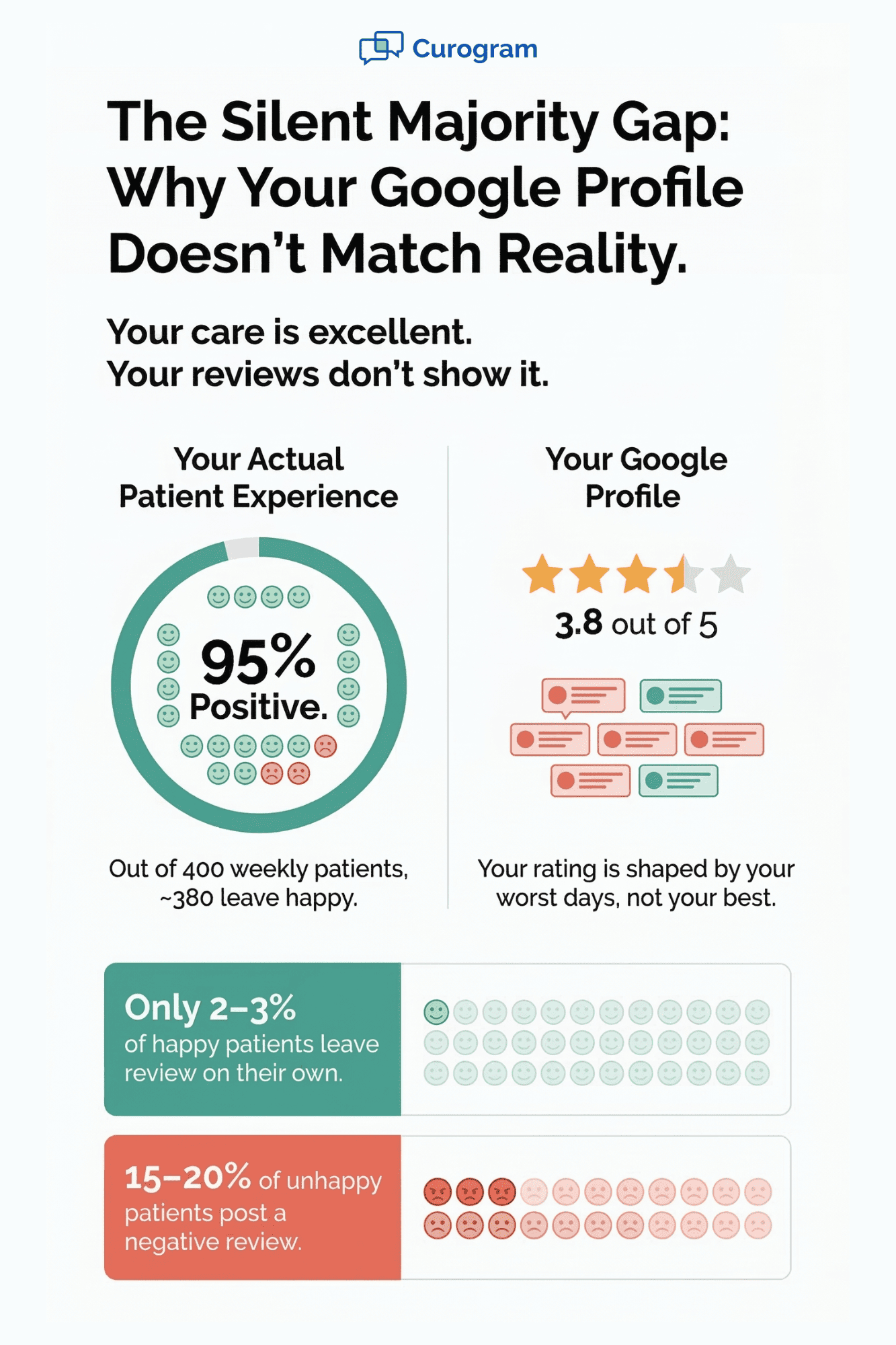
Say, your practice sees 400 patients a week. Maybe 380 of them leave happy. But only 2 or 3 of those 380 will leave a positive review on their own. Meanwhile, 3 or 4 of the 20 who had a less-than-perfect visit will post about it.

Over a few months, your star rating drifts down — not because your care got worse, but because the wrong group is doing all the talking.


This is a massive problem for reputation management at urgent care clinics. Patients who search "urgent care near me" make fast choices. They look at three things:

  • How close the clinic is

  • Whether it's open

  • What the star rating looks like

If your Google profile shows 3.8 stars and 90 reviews while a hospital chain down the road shows 4.6 stars and 350 reviews, they pick the hospital chain every time.

And that's where the real damage happens. It's not just about pride — it's about patient volume and revenue.

Hospital systems invest in marketing teams whose entire job is to push review volume. They send email blasts. They use discharge tablets. They make follow-up calls. Their Google profiles are the product of a full system built to collect reviews at scale.

The typical Athena practice has no such system. The front desk is too busy handling calls and check-ins. Nobody has time to ask every patient to leave a review. And even when they do ask, the patient forgets by the time they get to their car.

Here's a quick look at how this gap plays out:

Factor

Hospital Chain

Typical Athena Practice

Review system

Dedicated marketing team

None or manual

Monthly new reviews

30–50 per site

5–10 per site

Average star rating

4.5+

3.7–4.0

Map pack ranking

Top 3

Below the fold

New patients from Google

High and growing

Flat or declining


The table makes it clear. The hospital chain doesn't win because of better care. It wins because of better review flow. And review flow is what Google uses to decide who shows up first when someone types "urgent care near me" into their phone.

This is why the silent majority isn't just a branding issue. It's a patient leak. Every week that passes without a system to capture positive reviews is a week where your best patients stay silent — and your competitors pull further ahead in local search.

The good news? You don't need a marketing team to fix this. You need a system that does it for you, with no added work for your staff.

Visual breakdown of why satisfied patients stay silent on Google while unhappy patients leave negative reviews

The Review Engine: How Curogram Turns Every Visit into a Local Search Asset

Curogram's Review Engine creates a direct line from a patient visit to a Google review. It runs on its own, with no staff work needed. Here's how each piece works.

Post-Visit Trigger

After a patient's visit ends, the system sends a text message to their phone. The message thanks them for their visit and includes a link to the practice's Google review page.

The timing is set up to send within 1–2 hours of the visit — the window when the patient still feels good about the care they just got. You can adjust this timing to fit your workflow, but the sweet spot is right after checkout when the visit is still fresh.

Single-Tap Review Link

The link in the text opens the Google review page right on the patient's phone. There's no login needed. The patient doesn't have to search for your practice on Google. They don't have to find the review button.

They just tap the link, see the star rating screen, and write a few words. The whole thing takes under two minutes. This kind of low-friction design is what makes the post-visit SMS review request so effective. Every extra step you add cuts your review rate in half.

Sentiment Pre-Screen (Optional)

Practices can add a step before the review link goes out. The text first asks, "How was your visit today?" with a simple rating scale.

Patients who respond with a high rating get the Google review link. Patients who respond with a low rating get routed to a private feedback form instead. That form goes straight to the practice admin — not to Google.

This is a big deal. It means you catch complaints before they go public. The admin can reach out, fix the issue, and often turn a bad experience into a saved one. Meanwhile, only your happiest patients land on your Google profile.

Steady Flow, Not Spikes

Because this system sends a text after every visit, reviews come in at a steady pace. A practice seeing 50 patients a day might get 5–10 new reviews per week. Over a month, that's 20–40 new reviews — every month, like clockwork.

This matters for your local search map pack ranking. Google's search system favors practices that get reviews on a regular basis.

A burst of 50 reviews in one week followed by silence for three months looks odd. A steady stream of 8–10 reviews per week looks natural and active. Google rewards that pattern with higher ranking in the map pack.

Here's what the flow looks like from start to finish:

Step

What Happens

Who Does It

1. Visit ends

Patient checks out

Staff (normal flow)

2. SMS sent

Text with review link goes out (1–2 hrs)

Automated

3. Patient taps

Opens Google review page in one tap

Patient

4. Review posted

Star rating + text review goes live

Patient

5. Negative catch

Unhappy patients route to private form

Automated


With Athena automated Google reviews powered by the Review Engine, a practice doesn't have to choose between great care and great reviews. It gets both at the same time.

And because Curogram is an Athena Marketplace review partner, the setup plugs right into your current system. There's no need to switch EHR platforms or add new hardware.

You turn it on through the Marketplace, set your timing, and let the engine run. Based on our internal data, one multi-site practice saw 1,064 new 5-star reviews in just three months after going live.

That kind of volume changes the game. It shifts your Google profile from a weak point to your strongest growth tool.

The Urgent Care Edge: Why Local Search Ranking Is the #1 Growth Channe

For urgent care practices running on Athena, local search isn't one growth tool among many. It is the growth tool. Patients don't plan urgent care visits weeks in advance.

They don't ask friends for referrals. They grab their phone and search "urgent care near me." What they see in the first few seconds drives their choice.

That's why the local search map pack for Athenahealth practices matters more than any ad budget or printed flyer. Let's break down why — and how to use it.

Map Pack Ranking: The Top 3 Is All That Matters

When someone searches for a local health care service, Google shows a small map at the top of the page with three results pinned on it.

This is the map pack. It shows the practice name, star rating, review count, hours, and distance. Below the map pack, there's a link to see "more places," but most people never click it.

Based on our internal research, 90% of new patient leads see your Google Business Profile before they even visit your website. That means your map pack listing is often the first — and only — thing a new patient looks at before picking a clinic.

If your practice shows up in the top 3, you get seen. If you're in spot 4 or lower, you're almost invisible. It's that simple.

So what decides who lands in the top 3? Google looks at three main signals:

  • How close the practice is to the person searching

  • How relevant the listing is to the search query

  • How strong the practice's online profile is.

That third signal — profile strength — is driven by two things: review volume and star rating.

A practice with 400 reviews and a 4.7-star rating will almost always rank above a practice with 80 reviews and a 4.0-star rating, even if the second practice is a bit closer. Reviews are that powerful in the ranking formula.

The Hospital System Edge (And How to Beat It)

Hospital-owned urgent care chains have a built-in advantage here. They have full marketing teams whose job is to push review volume.

They use email drip campaigns, discharge tablet surveys, and phone follow-ups. Each location might add 30–50 new reviews per month through these efforts.

For an independent Athena practice with no dedicated marketing staff, that's hard to match by hand. But here's the thing — high-volume Athena practices often see more patients per day than a hospital urgent care site. A busy practice seeing 60–80 patients a day has more review chances in a single week than a hospital chain site sees in a month.

The missing piece isn't patient volume. It's a system to capture reviews from those patients. That's exactly what the Review Engine provides. It turns your higher visit count into a higher review count — with zero extra work for your team.

Let's say your practice sees 300 patients per week:

With the Review Engine, even a modest 10% conversion rate means 30 new reviews per week. That's 120 per month. Most hospital chain sites don't come close to that pace.

Within a few months, you can dominate hospital search results in your zip code — not by outspending them on marketing, but by using your patient volume more effectively.


"Book, Text, Treat" Extends to "Review"

Urgent care runs on speed. Patients want to get in, get care, and get out. When that process works well, patients leave happy. The problem is that their happiness fades fast once they're back in their car and onto the next task of the day.

The Review Engine captures that moment of peak joy right after the visit. The patient's phone buzzes with a friendly text. One tap, and they're on your Google page. They rate five stars, type a few words, and move on. It adds about 90 seconds to their day. That's it.

This is why the Book-Text-Treat-Review cycle works so well for urgent care. The same speed-first model that keeps patients happy also creates the perfect window for a review request. The faster and smoother the visit, the more likely the patient is to tap that link and leave a good review.

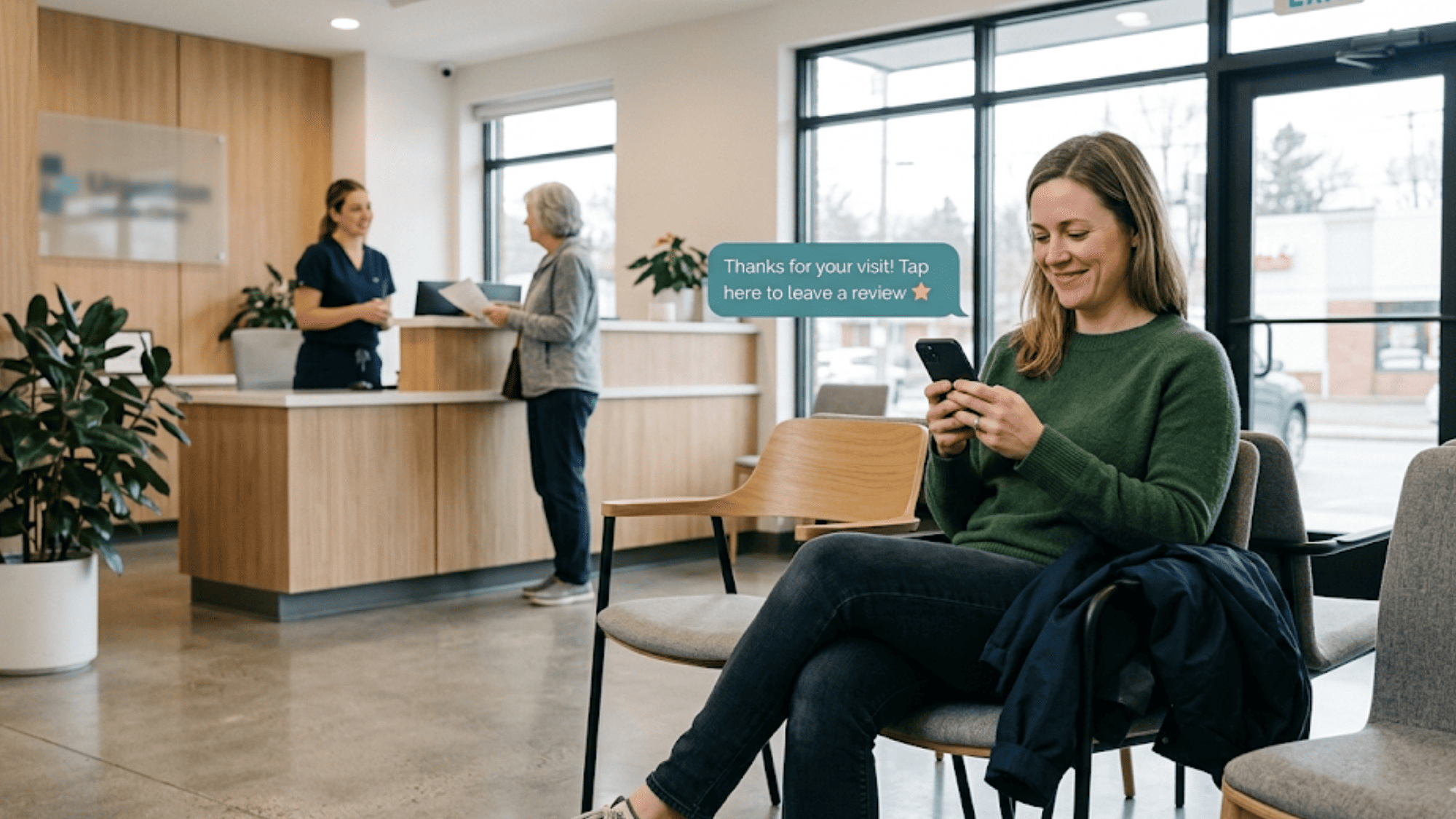
Patient sitting in urgent care lobby looking at phone with floating post-visit SMS review request notification

What This Means for Your Practice — A Simple Math Example

Let's run some basic numbers. Say you have two urgent care locations, each seeing 250 patients per week. Before the Review Engine, each location gets about 5 organic reviews per month. Your star rating sits at 3.9. You're not in the top 3 map pack for any of your key zip codes.

After turning on the Review Engine:

Metric

Before

After (Month 4)

New reviews per month (per site)

5

80–100

Total Google reviews (per site)

120

400+

Average star rating

3.9

4.6

Map pack position (key zip codes)

Not in top 3

Top 3 at both sites

New patients from Google (monthly)

~40

~90+


The jump in review volume is what makes the shift happen. Google sees a practice with strong, steady review flow and a rising star rating.

It bumps you up in the local search map pack. New patients find you first. They book. They visit. They leave a review. The cycle keeps going.

Why This Matters More for Urgent Care Than Any Other Specialty

Primary care practices grow through referrals and insurance networks. Specialists get patients from PCP referrals.

But urgent care is almost entirely driven by what shows up when someone types a search into their phone. There's no referral chain. There's no long-term loyalty in many cases. The patient picks whoever looks best on Google at that moment.

That's why reputation management for urgent care clinics is not a "nice to have." It's the core of the growth engine. If your Google profile doesn't reflect the quality of your care, you are losing patients to clinics that may not be as good — but look better online.

The Review Engine closes that gap. It makes sure the patients who love your care are the ones who shape your Google profile. And it does it at the scale and speed that urgent care demands.

The Narrative: How a 12-Provider Urgent Care Group Outranked the Hospital

A 12-provider urgent care and orthopedic group ran four locations in the Tampa Bay metro, all on Athenahealth. For a decade, they were the market leader. Then a hospital chain opened three urgent care sites in the same area — and the tide started turning.

The hospital's locations had Google profiles with 4.6 stars and 300+ reviews each. The independent group's four sites averaged 3.9 stars with around 120–180 reviews each.

Their own patient surveys showed high marks, but Google told a different story. Searches for "urgent care near me" in their zip codes showed the hospital chain in the top 3 map pack. The independent group sat below the fold.

New patient volume had been dropping for 18 months. The practice admin, Kevin, knew the issue wasn't care quality. It was online visibility.

Kevin turned on Curogram's Review Engine through the Athena Marketplace. Post-visit SMS texts went out to every patient within 90 minutes of their visit, with the option for a pre-screen filter.

Within four months, review volume at each site grew well past the hospital's monthly pace. Star ratings climbed above 4.5. Two of the four locations broke into the top 3 map pack for their target zip codes. New patient volume from Google search bounced back and passed the old trend line.

Kevin's take? His practice was losing to a marketing team, not to better care. Once the Review Engine gave his patient base a voice, the numbers flipped.

Beyond Reviews: The Reputation Feedback Loop

The Review Engine's value goes beyond star ratings. It creates a loop that feeds back into the whole practice.

Catching Complaints Early

The pre-screen filter routes unhappy patients to a private form instead of Google. This gives the practice admin a chance to reach out, fix the problem, and save the relationship. Complaints become data for the team to learn from — not public damage.

Spotting What Patients Love

Positive reviews often name specific staff, mention short wait times, or praise easy check-in. Over time, these patterns show you what's working. Double down on those strengths. If patients keep praising your front desk team, that's a sign your training is paying off.

Staff Morale and Retention

When a nurse or front desk worker gets called out by name in a 5-star review, it matters. It builds pride and lowers burnout. Practices can share review highlights in team meetings to keep morale high — which is critical at enterprise-level groups where burnout is a real concern.

Measuring the Review Engine Effect

You can't manage what you don't track. For practice admins and medical directors looking at Curogram's reputation management system, here are the key numbers to watch.

  • Monthly Review Volume - Compare your new Google reviews per month before and after going live with the Review Engine. The goal is a steady, rising flow that outpaces your local competitors.

  • Star Rating Trend - Track your rolling average star rating over time. As the positive majority starts leaving reviews, your rating should trend upward and settle at a level that reflects real patient joy.

  • Map Pack Position - Check where your practice ranks in Google's local map pack for key search terms in each zip code. Any climb in map pack position ties directly to higher visibility and more clicks.

  • New Patient Volume from Search - Measure how many new patients come through Google search or Google Maps each month. Connect the dots from review growth to search ranking to new patient bookings. That's the full ROI chain — reviews drive ranking, ranking drives clicks, clicks drive bookings, bookings drive revenue.

For enterprise practices with multiple sites, track each location on its own. One site might need more review volume while another needs to improve its star rating. The data tells you where to focus.


Why Curogram's Review Engine Is the Smartest Reputation Tool for Athena Practices


Curogram's Review Engine was built for one thing: turning patient visits into Google reviews without adding work for your team. It's made for Athenahealth. As an Athena Marketplace partner, Curogram plugs into your current setup with no extra hardware or software.

You can go live the same day you sign up. The system reads visit data from Athena and sends the post-visit SMS at the right time — no manual triggers, no staff input needed.

It also works at scale. Whether you run one clinic or twenty, the Review Engine handles volume without slowing down.

Based on our internal data, one multi-site practice pulled in 1,064 new 5-star reviews in just three months. That's not a one-time spike. It's a steady stream that compounds over time.

Curogram protects your brand. The optional pre-screen filter catches unhappy patients before they reach Google. Those patients get routed to a private form so you can fix the issue.

Only your happiest patients land on your public profile. This is how you build a Google presence that truly reflects the quality of your care.

Our platform drives real revenue. More reviews mean a higher star rating. A higher star rating means better map pack ranking. Better ranking means more new patients.

Based on our internal research, 90% of new patient leads see your Google Business Profile before your website. If your profile looks strong, those leads turn into booked visits.

For practices that want to dominate hospital search results in their area, the Review Engine is the most direct path. No marketing team required. No ad spend. Just your own patients telling Google how good your care really is.

Next Step: Take Control of Your Google Profile Before Your Competitors Do

Your practice delivers great care every single day. But if your Google profile doesn't show it, new patients will never know. They'll pick the clinic that looks best online — even if your care is better.

That's the cost of the silent majority. Happy patients move on. Unhappy ones leave reviews. And your star rating drifts lower than it should.

Athenahealth reputation management with Curogram's Review Engine breaks that pattern. It texts every patient a one-tap review link right after their visit. It catches complaints before they hit Google. And it builds the steady review flow that pushes your practice to the top of the local search map pack.

The numbers speak for themselves. Based on our internal data, practices using the Review Engine saw 90% of patients leave 5-star reviews. One group added over 1,000 new reviews in three months. Locations that were invisible in Google's map pack moved into the top 3.

You don't need a marketing team to make this happen. You don't need an ad budget. You need the system that turns the patients you already see into your most powerful marketing tool.

Curogram is ready for a demo with any Athenahealth practice that wants to stop losing patients to clinics with better Google profiles. Activate through the Athena Marketplace, and start seeing results in weeks — not months.

Your best marketing team is your patient base. Give them the easiest way to speak up.

Stop losing new patients to clinics with better Google profiles. Schedule a quick demo today and find out how fast the Review Engine can move your practice into the top 3 map pack results in your zip code.


Frequently Asked Questions

How does the Review Engine send texts without adding work for my front desk staff?
The system triggers on its own after each visit ends in Athenahealth. Your staff doesn't need to press any buttons, send any messages, or follow up. It's fully hands-free from start to finish.
Why does a steady review flow matter more than getting a lot of reviews at once?
Google's search system favors practices that receive reviews on a regular basis. A sudden burst followed by silence looks unnatural. Steady weekly reviews signal an active, trusted practice — which helps your map pack ranking stay strong over time.
How does the sentiment pre-screen prevent bad reviews from reaching Google?

The system sends a quick "How was your visit?" text first. Patients who rate their visit low get a private feedback form instead of the Google link. This lets your admin resolve the issue before it becomes a public review.

How quickly can an Athena practice expect to see results after turning on the Review Engine?

Most practices see a clear increase in review volume within the first two to four weeks. Map pack ranking shifts typically follow within two to four months as Google processes the rising volume and star rating.

Why is the Review Engine more effective than asking patients to leave reviews at the front desk?

Front desk staff are busy and can't ask every patient. Even when they do, patients forget by the time they get to their car. The Review Engine sends the link at the right moment — when the patient is still feeling good about their visit — and makes it a single-tap action.


Reputation Management in Veradigm with Curogram

Reputation Management in Veradigm with Curogram

💡 Imaging centers face unique trust issues. A single bad review can damage referral flow and hurt revenue across multi-site networks.Reputation...

Read More
Reviews & SEO for Prime Clinical | Rank #1 on Google

Reviews & SEO for Prime Clinical | Rank #1 on Google

💡 Improving local SEO for Prime Clinical practices depends on the volume, frequency, and recency of Google Reviews. Reviews make up roughly 15–20%...

Read More
The Mom-Group Referral: How Reviews Drive Pediatric Therapy Growth

1 min read

The Mom-Group Referral: How Reviews Drive Pediatric Therapy Growth

💡 The most effective pediatric therapy marketing strategy is building a steady stream of 5-star Google reviews. When parents search for a therapist...

Read More