
11 min read
Cloud 9 Ortho Reviews | Turn Every Appointment into a 5-Star Review
Aubreigh Lee Daculug
:
April 4, 2026
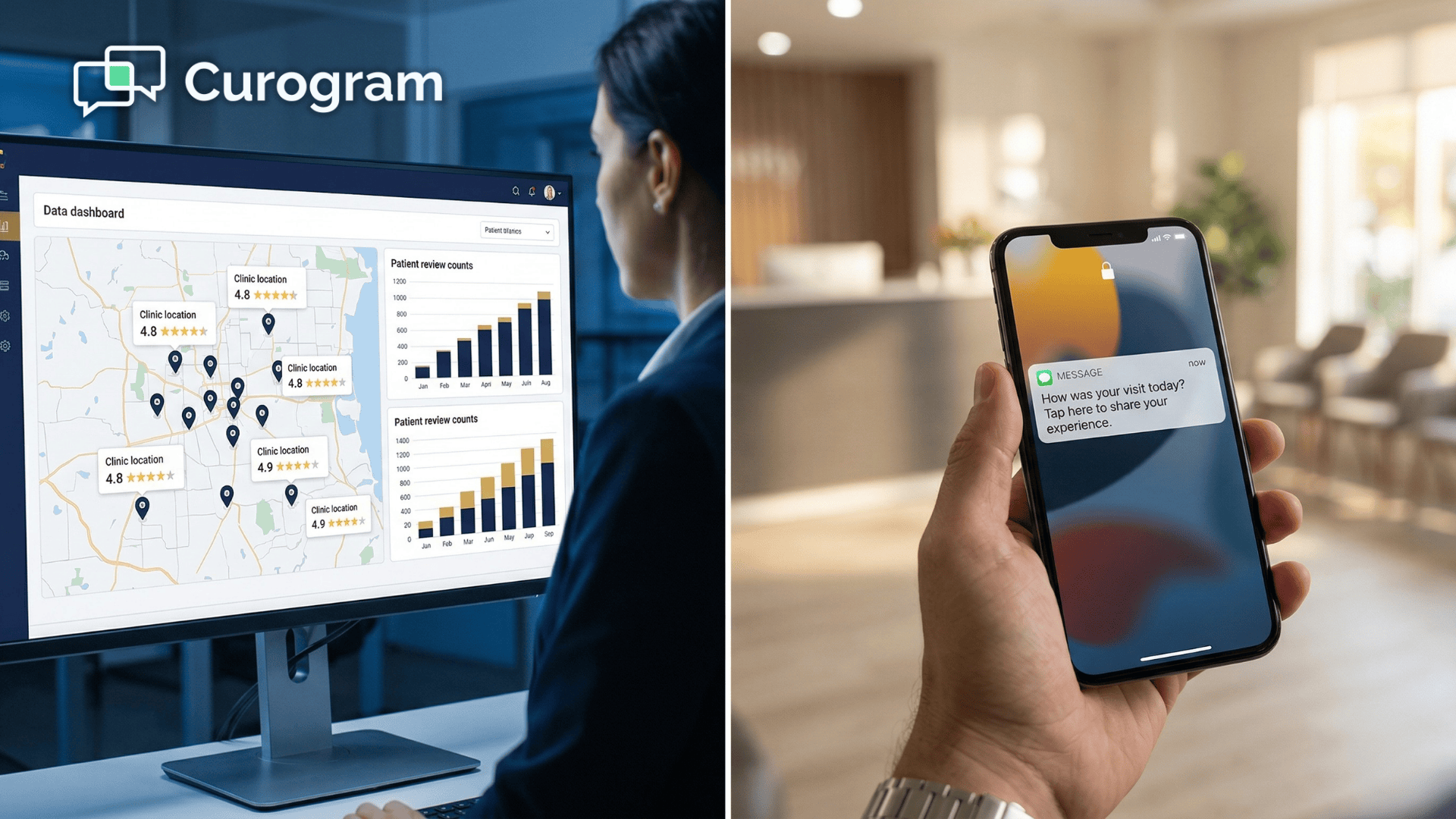
After every completed appointment, Curogram sends patients or parents a text with a direct link to your Google Business Profile review form.
Text carries a 98% open rate. The parent taps the link, writes a few sentences while the experience is still fresh, and submits in under 60 seconds.
No feedback forms. No redirects. One appointment, one text, one review.
One multi-location practice using Curogram generated 1,064 new five-star reviews in just three months — growing from 993 to 8,159 total reviews across all locations.
Two Cloud 9 orthodontic practices sit two miles apart. Same board-certified orthodontists. Same modern equipment. Same excellent outcomes. One has 47 Google reviews. The other has 512.
When a parent searches "orthodontist near me," Google's local pack shows three results.
The practice with 512 reviews looks established, trusted, and in demand. The one with 47 looks new at best, invisible at worst. The parent clicks the listing with 512 reviews, reads a few posted just this week, and calls to schedule a consultation.
The practice with 47 reviews never gets the call.
Here's the frustrating part: the 47-review practice might be the better one clinically. Parents rave about it at school pickup and in neighborhood Facebook groups.
But none of that enthusiasm transfers to Google — because enthusiasm without a system is not a strategy.
Most Cloud 9 practices don't have a review strategy. They have a hope.
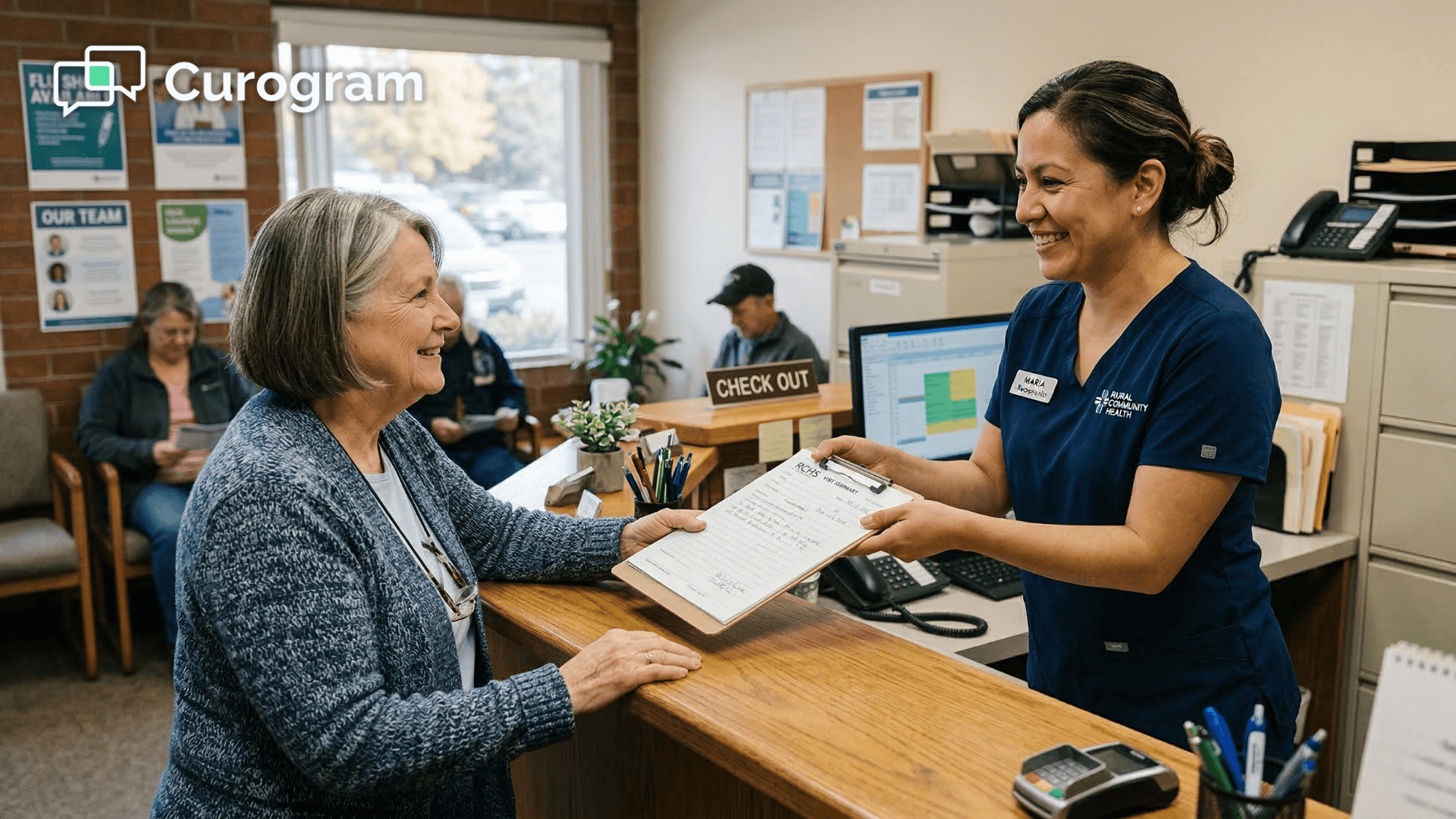
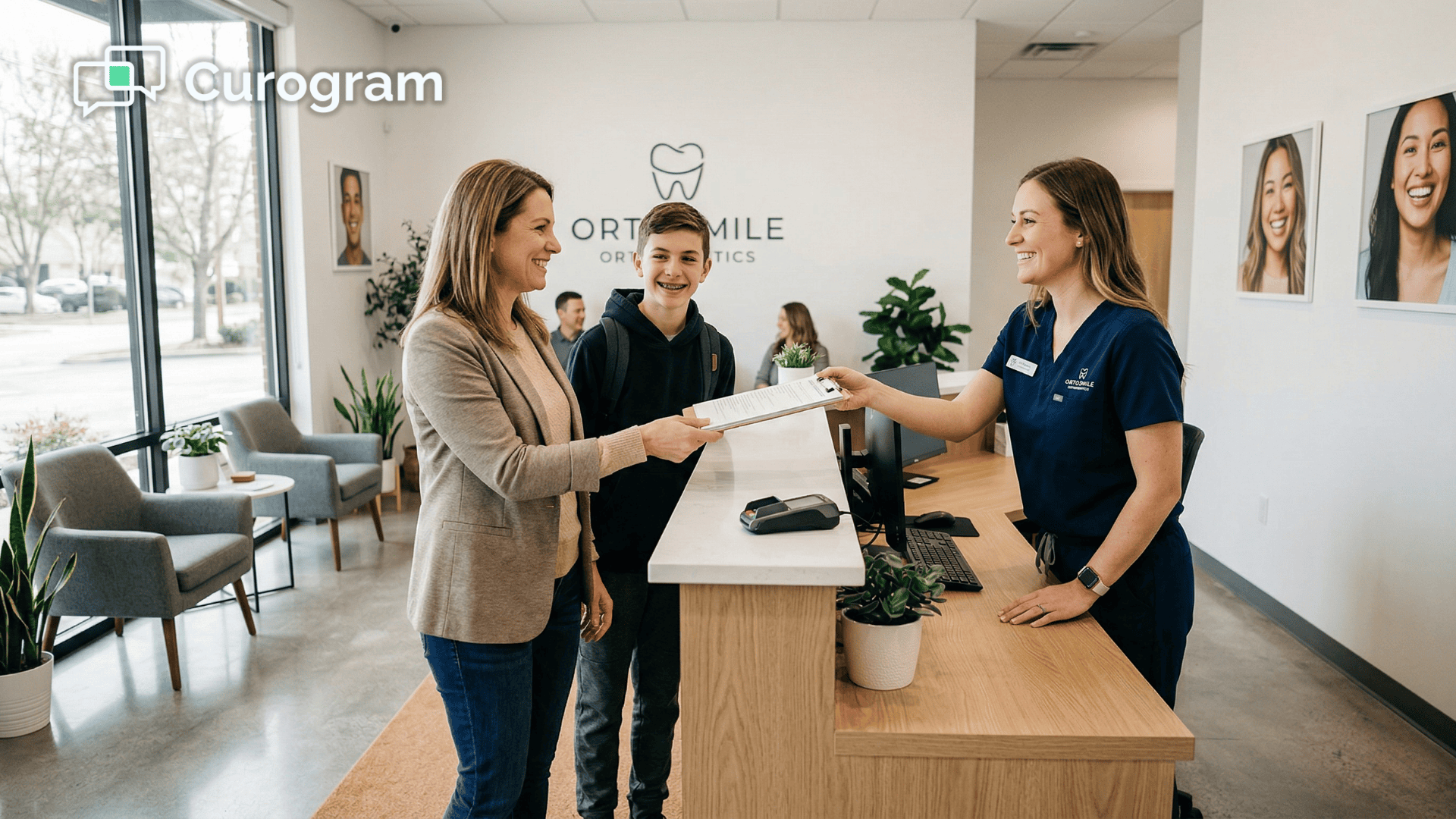
Your front desk is juggling check-ins, payments, and a ringing phone all at the same time. The verbal review ask happens maybe 20% of the time. Even when a parent says yes at checkout, they still have to open Google, find your listing, navigate to reviews, and write something.
The motivation that existed at the front desk evaporates before they reach their car.
Email requests don't solve it. They land in inboxes crowded with 80 to 100 other messages. Even if a parent opens yours, most link to a satisfaction survey first — not directly to Google.
Every extra step is another place the review disappears.
The result: you see 30 patients on a Tuesday and your review count stays exactly the same.
This isn't a quality problem. It's a system problem.
Curogram's Post-Visit Review Engine solves it. After every completed appointment, an automated text goes to the patient or parent with a direct link to your Google Business Profile.
No surveys. No friction. Just one tap, a few sentences typed while the visit is fresh, and a new review posted in under 60 seconds.
Every appointment. Every day. Without the front desk lifting a finger.
The Review Gap That's Already Costing You Patients
You already know your patients are happy. You feel it in the conversations at checkout, in the referrals that come through word of mouth, in the parents who bring a second child in without you ever asking.
The problem is not satisfaction. It's conversion.
Happy patients don't automatically become Google reviewers. There's a gap between how much they love your practice and how often they tell Google about it.
That gap is costing you new patients right now.
The Myth of the Organic Review
Most Cloud 9 practices assume that if the experience is good enough, reviews will follow on their own. Some do. Most don't.
A patient who genuinely loves your practice has roughly a 5–10% chance of leaving a Google review without any kind of ask.
The parent who recommends your practice at every youth soccer game has simply never thought to open Google Maps and write something — the impulse strikes in conversation, not when they're staring at their phone's home screen.
A practice seeing 30 patients per day generates about 1–3 organic reviews per month at that rate.
At that pace, reaching 500 reviews takes somewhere between 15 and 40 years.
The practice down the street that started automated review requests 18 months ago already has 500. Organic reviews are real. They are not a system.
5–10% |
| The average chance a happy patient leaves a Google review without being asked. |
Why the Front Desk Ask Doesn't Scale
Some practices train their teams to ask for reviews at checkout. The intent is excellent. The execution almost always breaks down.
Picture the front desk at 3:00 PM on a busy Wednesday:
One staff member is processing a payment, another is confirming tomorrow's schedule, the phone is ringing, and a new patient just walked in.
The review ask happens when there's a spare moment — which is not consistently.
When it does happen, the parent nods, says "of course," and walks to their car, where they have 14 unread texts and three missed calls waiting.
The manual ask creates intention. It does not create reviews.
The Email Problem
Email-based review requests are better than nothing. They are also not particularly effective for building volume and velocity.
The average professional's inbox holds 80 to 120 new messages each day. A review request email from your practice competes with a Costco promotion, a school newsletter, and a LinkedIn notification.
Healthcare email open rates typically sit around 30–50%.
Even among those who open it, most dental engagement tools route patients through a satisfaction form before ever reaching Google — collecting platform data rather than sending your patient directly where you need them.
Even if a parent opens the email and clicks through, here is what typically stands between them and a posted review:
- Complete an NPS or satisfaction survey
- Wait to be redirected based on their score
- Navigate to the Google review form — if they're routed there at all
- Write a review, after already filling out a form
Each of those steps is a moment where the parent closes the tab and moves on.
Every additional step between "I had a great visit" and "I posted a review" is a dropout point. And dropout is exactly what happens.
Feedback-First Platforms Prioritize Their Data Over Your Reviews
Some orthodontic platforms — Legwork being a well-known example — use Net Promoter Score surveys as the entry point for reputation management. Patients rate their experience on a scale of 0 to 10, and those who score nine or ten are encouraged to leave a Google review.
The internal data is valuable for practice improvement. But that added step is a conversion killer.
For Cloud 9 ortho practices focused on growing Google reviews through automated text post-visit requests and building a five-star reputation at scale, a feedback-first approach creates real friction between the appointment and the Google review.
There's no dental platform tax worth absorbing when your primary goal is maximizing the reviews that actually make it to your public Google listing.
Every redirect, every form, every extra screen is another place your patient quietly drops off.
How Curogram's Post-Visit Review Engine Fills the Gap
The fix is straightforward. After every appointment, your patient or their parent receives a text message. That text contains a direct link to your Google Business Profile review form.
They tap it, write a few sentences, and hit submit. New review posted.
That's the whole system. It works because it meets patients where they already are — their phones — and removes every obstacle between the appointment and the review.
One Text. One Tap. One Review.
Curogram sends the message automatically after each completed appointment.
The timing is configurable:
30 minutes after checkout, one hour, or at end of day — whichever generates the best response rate for your practice.
The message is personal and simple:
"Thank you for bringing Tyler to his appointment with Dr. [Name] today! If you had a great experience, we'd appreciate a quick Google review: [Direct Link]."
The parent taps the link. It opens directly to the Google Business Profile review form — already loaded, no searching required. They write two or three sentences while the visit is still fresh: the office was welcoming, the team was friendly,
Tyler's adjustment was quick. They hit submit. A new five-star review is posted. Total time from text to review: under 60 seconds. Total effort from your practice: zero.
The system runs after every appointment, every day, automatically.
98% |
| Text open rate, compared to 30–50% for email review requests |
The Direct-to-Google Difference
This is where Curogram separates clearly from other options.
Most review generation tools insert a survey or NPS prompt before the patient ever sees Google. The goal is to capture internal feedback and filter potential negatives before they reach your public listing. T
he trade-off is that each additional screen reduces the number of patients who follow through.
Curogram sends patients directly to Google. No intermediate form. No satisfaction rating screen.
The parent taps the link and immediately sees the review form. That direct path from text received to review posted maximizes conversion — and the difference in review volume over time is substantial.

Smart Timing by Appointment Type
Not every appointment creates the same emotional energy. Curogram's system can be configured by appointment type so the timing and messaging match the moment.
Here is how the key visit types break down:
- Debond (braces removal): The emotional peak of the entire treatment arc. The patient sees their new smile; the parent is genuinely moved. Personalized milestone messaging here captures the most detailed, heartfelt reviews.
- Routine adjustment: Lower emotional intensity, but it happens 20 or more times per treatment arc. The consistency is the advantage — steady requests build serious review velocity over months.
- New patient consultation: First-impression reviews from families still evaluating your practice. Strong social proof for parents just beginning their search.
- Retainer check: A post-treatment loyalty touchpoint that reminds parents of the full journey and the outcome they are happy with.
The right message at the right moment significantly improves conversion from text received to review posted.
A generic "thank you for your visit" works. A message that references Tyler's new smile works better.
Multi-Location Scale for Cloud 9 DSOs and OSOs
For DSOs and OSOs managing 50 to 200+ Cloud 9 locations, manual review generation is not just inefficient — it is structurally impossible.
No central operations team can ensure consistent review asks across hundreds of practices simultaneously.
Curogram runs independently at each location. Each practice's Google Business Profile receives reviews from its own patients, directed to that location's specific listing.
The central operations team gains a clear, real-time view across the entire network:
- Which locations are generating the strongest review velocity
- Which have slowed down and may need a configuration or workflow check
- Where review gaps may signal a patient experience issue worth investigating proactively
Cloud 9 automated Google reviews across an orthodontic text request post-visit five-star scale program like Curogram's transforms review generation from a location-level hope into a measurable, manageable operational metric — tracked and improved like any other performance KPI across the network.
The Review Velocity Flywheel
Here's what most practices miss:
Google's local search algorithm weights review recency and velocity, not just total count.
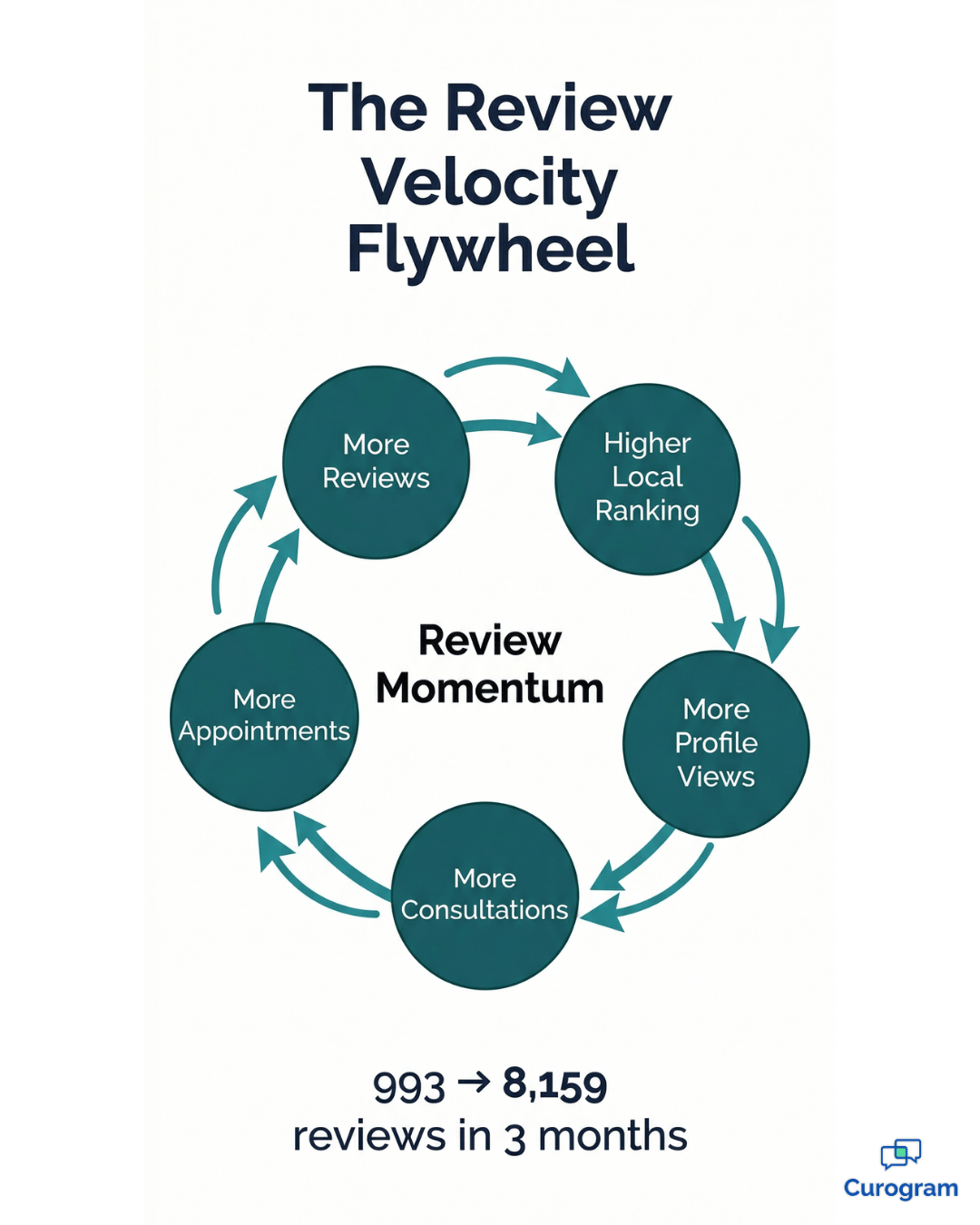
A practice that receives 20 new reviews this month ranks higher than a practice with the same total count but only two new reviews this month. Google reads consistent, recent reviews as a signal of an active, trusted business — and rewards it with visibility.
|
The flywheel then runs like this: More recent reviews → higher local ranking → more profile views → more new patient consultations → more appointments → more review opportunities. The longer the system runs, the faster it spins. |
Orthodontic Google reviews via Cloud 9 automated text post-visit request systems like Curogram don't just build a static review count.
They build ongoing review momentum that signals activity and trust to both the algorithm and the parents who find you.
What Happens When Every Appointment Works for Your Reputation
The numbers tell the story clearly. Let's look at what automated review generation actually produces — and what it means for your patient pipeline and practice revenue.

Real Results at Scale
A multi-location practice using Curogram generated 1,064 new five-star reviews in just three months.
Three numbers from that case study tell the story quickly:
- Total reviews grew from 993 to 8,159 — nearly a 10x increase
- 90% of patients who received the text left a five-star review
- The entire growth came from appointments the practice was already running every day
These results translate especially well to orthodontic practices, where the emotional peaks of treatment — the debond, the first adjustment, the new smile reveal — create stronger review motivation than routine medical visits typically produce.
For a Cloud 9 DSO with 100 locations, similar automation could generate thousands of new reviews per quarter across the entire network.
The math at a single practice is compelling on its own.
A practice seeing 25 patients per day, five days a week, runs roughly 500 appointments per month. If just 10% result in a posted review, that's 50 new reviews every month — 600 per year. A practice at 47 reviews today reaches 500+ within a single year.
The review gap closes. The ranking gap closes with it.
From Invisible to Top Three in Local Search
Think about what that does for your local search position.
The practice that was buried below competitors with 300 to 500 reviews now appears in the top three results for "orthodontist near me."
The review count is competitive. The reviews are recent — posted this week, not last year. The star rating finally reflects the clinical quality your team delivers every day.
Prospective parents click through, read recent five-star reviews from other parents in the same situation, and call to schedule.
Google reviews Cloud 9 orthodontic automated text post-visit reputation management five-star scale.
That's what your Google Business Profile becomes:
The most productive new patient acquisition channel you own, generating more consultations than your website, social media, or paid advertising combined.
90% of new patient leads see your Google Business Profile before they ever visit your website. That profile is either working for you or working against you.
The Revenue Math Behind More Reviews
Let's put numbers to this.
Each orthodontic new start is worth approximately $5,000 to $7,000 in production.
If stronger Google visibility generates just two to four additional consultation calls per month — a conservative estimate for a practice moving from 47 to 500+ reviews in a competitive market — the revenue impact is real and compounding.
Over a full year, that compounds in both directions: more reviews → higher ranking → more consultations → more new starts → more appointments → more reviews.
The cost of automated review generation through Curogram is a fraction of the revenue from a single additional new start per month.
A Review Moat Your Competitors Can't Easily Cross
Review advantages compound over time and are difficult for competitors to reverse.
A practice that builds to 500+ reviews over the next 12 to 18 months creates a gap that competitors relying on organic reviews or inconsistent front desk asks simply cannot close at the same speed.
The first Cloud 9 practice in a competitive market to deploy systematic, appointment-driven review generation sets the benchmark that everyone else chases.
For practices in markets with multiple orthodontists competing for the same local search results, review velocity is the single most controllable factor in ranking — and the one most directly tied to new patient volume.
Start today. The lead you build over the next 12 months is the competitive advantage you carry for years.
Your Next Five-Star Review Is One Appointment Away
Your Cloud 9 practice is already doing the hard work. The clinical outcomes are there. The patient experience is excellent. Parents leave happy after every single appointment.
The only thing missing is the system that captures that satisfaction and turns it into a Google review before the moment fades.
Here's the reality: the difference between 47 reviews and 500 isn't clinical skill. It's infrastructure. A text after every appointment. A link directly to Google.
Sixty seconds from the parent's phone to a posted review. That's the system — and it runs in the background while your team focuses entirely on patient care.
Stop losing reviews to manual asks that happen only 20% of the time. Stop losing them to email requests competing with 100 other messages in a crowded inbox.
Stop paying the dental platform overhead for tools built around internal data collection rather than your actual Google review count.
Every appointment is a review opportunity. Right now, most of those opportunities are quietly disappearing.
Curogram's Post-Visit Review Engine captures them. After every completed appointment — adjustments, debonds, consultations, retainer checks, records appointments — an automated text reaches your patient or parent with a direct path to your Google Business Profile.
No NPS survey. No feedback form. No manual step from the front desk.
Just a consistent, scalable system that builds your five-star reputation while your team does what they do best.
The practices winning local search in your market are not necessarily the best. They are the most visible. And visibility in orthodontics is built one review at a time.
Schedule a demo to see exactly how Curogram's automated review generation transforms your Cloud 9 practice's Google presence — and start turning every appointment into a five-star review today.
Frequently Asked Questions
Yes. Curogram's review request system is fully configurable for Cloud 9 practices. You can send requests after all appointment types or limit them to specific ones — debonds, new patient consultations, or key adjustment milestones where satisfaction is typically highest. You can also exclude specific patients when needed. For practices concerned about soliciting reviews after a difficult visit, configuring requests by appointment type ensures messages only go out when conditions are right.
Negative reviews are a reality for every practice, and no system eliminates them entirely. Curogram helps manage their impact in two meaningful ways. First, high review volume dilutes the effect of an occasional negative — one poor rating among 500 genuine positives barely moves your overall star average. Second, consistent review velocity means recent five-star reviews always populate at the top of your Google listing, pushing older negatives further down. The most effective response to negative reviews isn't preventing them. It's making sure they are surrounded by hundreds of recent, authentic positives.
Legwork's reputation management uses NPS surveys as the entry point. Patients rate their experience on a 0–10 scale, and those who score nine or ten are then encouraged to leave a Google review. That internal data has value — but it adds a step between the appointment and the actual review. Curogram sends patients directly to the Google review form via text, with no intermediate survey, no additional screen, and no extra friction. The result is a measurably higher conversion rate from request received to review posted. If your priority is maximizing Google review volume and velocity for your Cloud 9 practice without adding dental platform overhead, the direct-to-Google text approach consistently generates more reviews with less effort.
Yes. Curogram integrates with almost any EMR or practice management system, which means your appointment data flows directly into the review request workflow without any manual input or double data entry. When a completed appointment is recorded in your system, Curogram picks it up and triggers the post-visit text automatically. There is no separate platform to manage, no import process, and no extra step for your team. The setup is straightforward, and most practices are up and running in under 10 minutes.
Yes. Curogram is a HIPAA-compliant texting platform. Review request messages are designed to contain only generic, non-identifying information — the patient's first name, the appointment date, and the direct Google review link. No clinical details, diagnoses, or treatment information are included in the message. This keeps the text compliant while still feeling personal and timely. For DSOs and OSOs managing multiple Cloud 9 locations, Curogram's compliance framework applies uniformly across every location, so your entire network operates from the same standard.