9 min read
Rural Patients Leave Reviews by Text | Azalea Health + Curogram
Aubreigh Lee Daculug
:
March 18, 2026
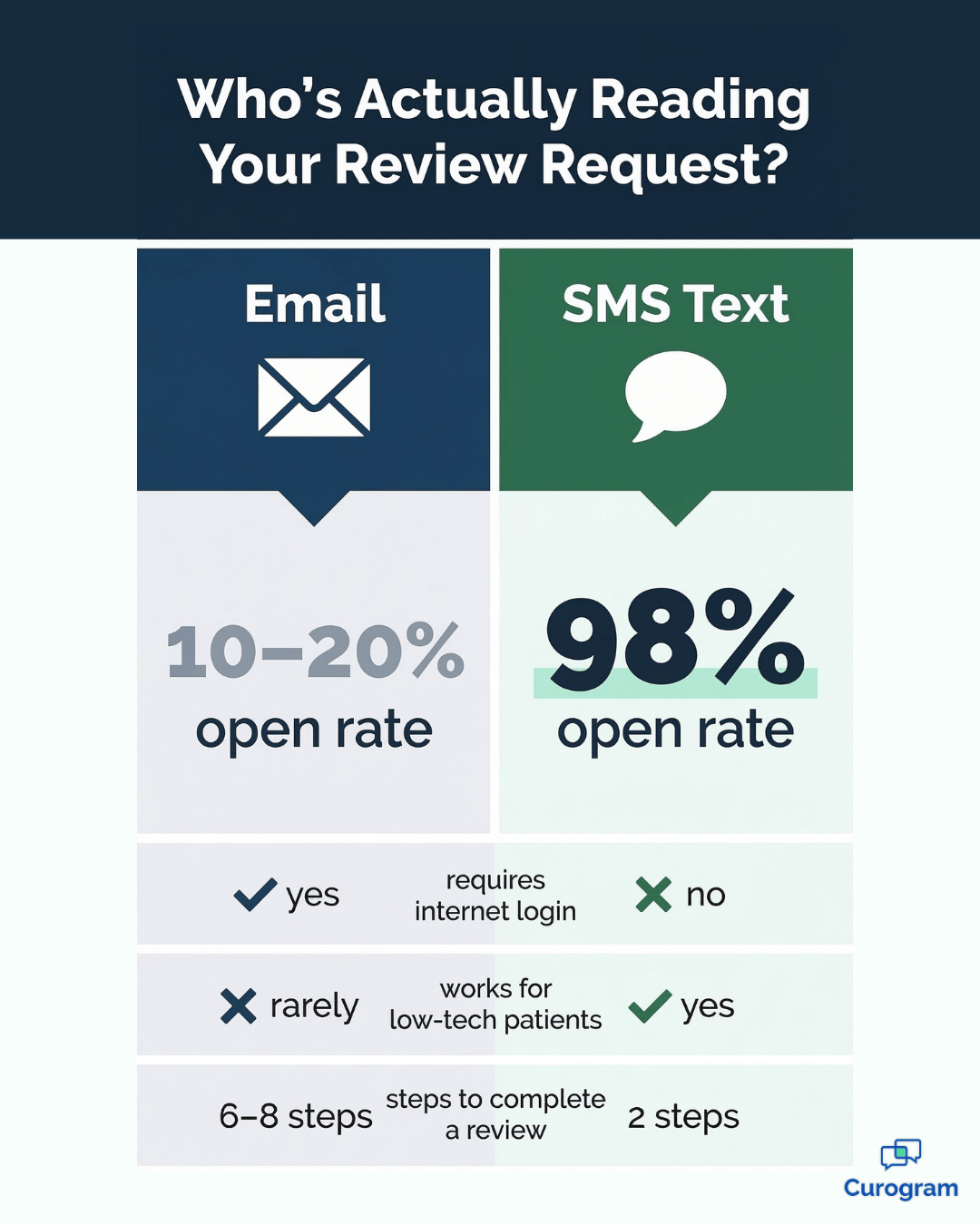
Text messages reach a 98% open rate — compared to 10–20% for email — and arrive on a device the patient is already holding.
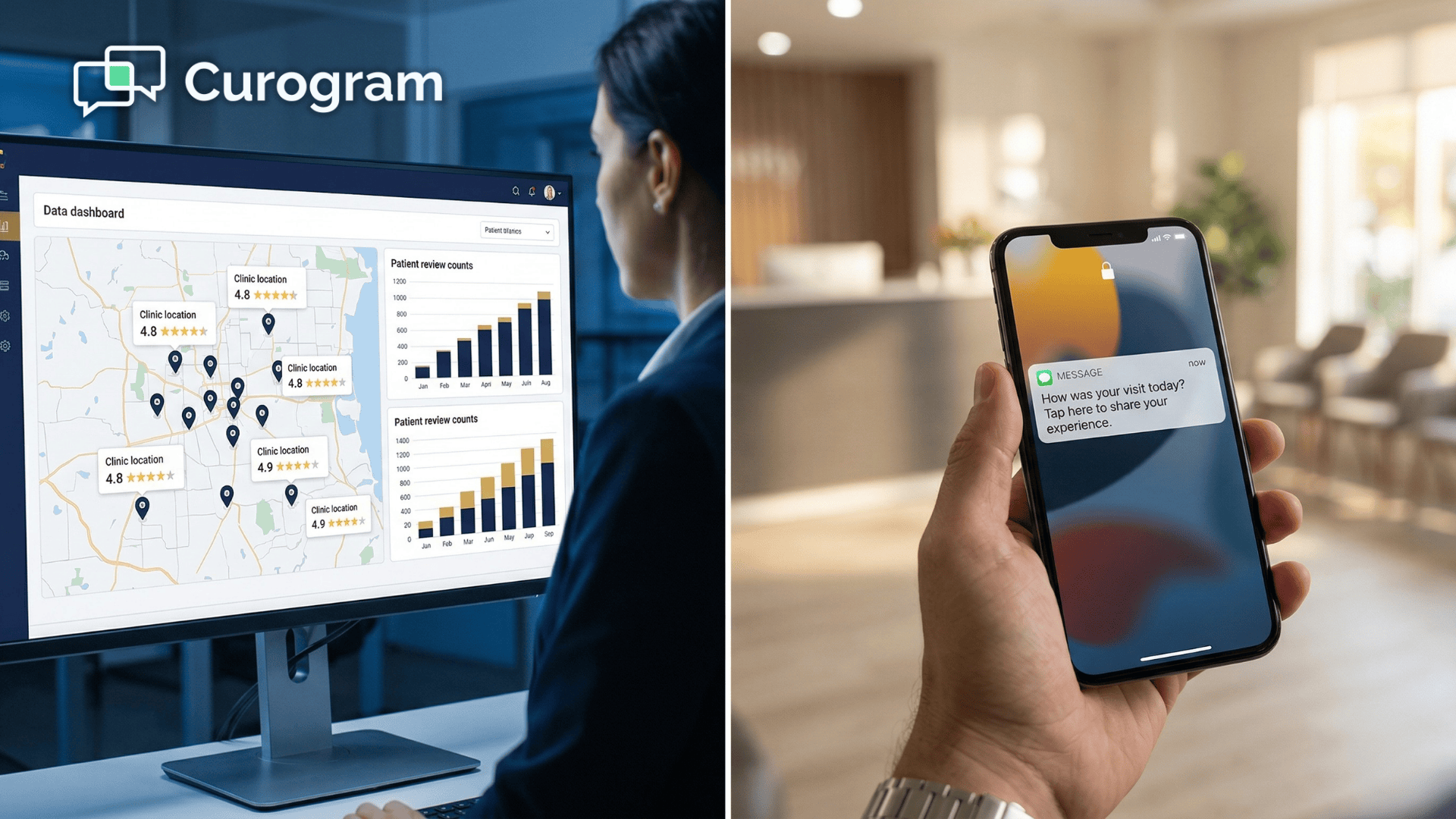
Curogram sends an automated post-visit text with a one-tap link directly to the Google review form. No searching, no logging in, no navigating. Just one tap and a few words.
Practices using this approach see review volume grow 5–10x. For elderly and rural patients — many of whom have never left an online review — the text-first format is the first time leaving a review has ever felt easy.
The barrier was never willingness. It was access.
Most of your satisfied patients are already recommending you. They tell their neighbors, mention you at church, and share your name at family gatherings. But none of that word-of-mouth shows up on Google.
And for a rural clinic, what shows up on Google can decide whether a new family picks up the phone or keeps scrolling.
Online reputation has become one of the most powerful drivers of new patient volume — especially in rural areas where there are fewer providers to choose from and people rely heavily on community trust.
A strong Google profile does not just attract patients; it reassures them before they ever walk through your door.
The good news? Rural patients leave reviews when asked by text message after Azalea Health visits at a rate that surprises most practice administrators. They are not unwilling — they were just never given a way to act on it.
The channel matters more than most clinics realize. Reaching a patient through the right medium — at the right moment — is what turns a satisfied visit into a posted review.
And for rural patient populations, that channel is almost always their text inbox.
This article breaks down why the text message review request works so well for rural and FQHC patients, what Curogram's system actually does behind the scenes, and what happens to your online reputation when your quietest supporters finally get a voice.
The Invisible Wall Between Happy Patients and Public Reviews
Here is a reality most clinics already sense but rarely talk about: the patients most willing to advocate for their practice are often the least likely to leave a Google review. Not because they don't care — but because the path to leaving a review was designed for someone else.
To post a Google review, a patient needs to open a browser, search for the practice name, scroll to the review section, log into their Google account — or create one — type a comment, and hit submit.
For a connected urban patient, that takes about two minutes.
For a 70-year-old rural patient who uses her phone mainly for calls and texts, it might as well be a different language.
This is not a problem unique to one clinic or one region. It is a structural gap that affects rural healthcare providers everywhere. The patients who show up consistently, follow their care plans, and refer their neighbors are the very ones whose voices are missing from your online profile.
Meet Mrs. Thompson
Think about Mrs. Thompson. She has been a patient at her local FQHC for over a decade. She loves her doctor and talks about the clinic to anyone who will listen. But she has never left an online review.
The clinic sent an email survey once — she does not use email much.
There is a
"Review us on Google!" poster in the lobby, but she is not sure how to find it on her phone.
Meanwhile, a younger patient who had a frustrating billing issue posted a 1-star review six months ago, and it is still sitting at the top of the practice's Google profile.
Mrs. Thompson's story is not unusual. In rural communities, a large share of patients are older, less connected to digital platforms, and simply unfamiliar with the concept of leaving an online review.
Their satisfaction is real — the pathway just was not built for them.
That is the problem. It is not a motivation gap. It is a friction gap — and it runs deepest for the very patients who have the most positive things to say.
Why Traditional Review Collection Falls Short for Rural Patients
Every standard review collection method assumes a baseline of digital comfort that does not match the reality of rural patient populations — creating a major blind spot in healthcare reputation management for rural clinics.
Here is where each one breaks down:
- Email survey links reach open rates of 10–20% under ideal conditions — and often far less in rural areas where many older patients check email infrequently.
- Patient portal surveys require a separate login, adding a step most low-tech users will not take.
- Verbal requests from staff are inconsistent by nature — a busy front desk forgets, the wording changes, and there is no follow-up.
- QR code cards assume patients know how to use a camera scan and trust an unfamiliar link.
The Azalea Health patient review experience, when built around these tools, produces limited results — not because patients dislike the clinic, but because the method never reaches them where they are.
What rural practices need is not a better version of any of these channels.
They need a completely different approach — one that meets patients on a device they already use, in a format they already understand, without asking them to do anything they have never done before.
| Review Request Method | Typical Open Rate | Requires Internet Login? | Works for Low-Tech Patients? |
|---|---|---|---|
| Email survey link | 10–20% | Often yes | Rarely |
| Patient portal survey | Low | Yes | No |
| Verbal request (staff) | Inconsistent | No | Somewhat |
| QR code card | Low | Sometimes | No |
| SMS text with one-tap link | 98% | No | Yes |
One Text, One Tap: How Curogram Removes the Friction
Curogram works as a post-visit communication layer on top of Azalea Health. After a visit is logged as complete, Curogram automatically sends a short text to the patient's mobile number.
It reads something like:
"Thank you for visiting Mountain Valley Clinic today. How was your experience? Reply 1–5." The patient types a single number. That's it.
The design is intentional. Every element of the message is stripped down to the minimum needed to get a response.
There is no login, no link to click yet, no form to fill out. The first message just asks one question in a language every patient understands.

How the Two-Message Flow Works
If the patient replies with a 4 or a 5,
A second text arrives right away:
"Thank you! Would you share your experience on Google? Tap here: [link]."
That link opens directly to the review submission form for that specific practice — no searching, no navigating to find the right business, no guessing.
For patients who already have a Google account on their phone (most smartphone users do, even if they do not think about it), the process is genuinely one tap and a few words.
Curogram sends the message within a few hours of the completed visit, while the experience is still fresh. The patient is in the car, at home, or already settled in — and the visit is top of mind. The text comes from the practice's own number, so it feels personal rather than promotional.
If a patient replies with a 1, 2, or 3, the system takes a different path. Instead of sending a public review link, it routes the feedback internally — giving the practice a chance to follow up privately before any dissatisfaction reaches a public platform.
This built-in triage is one of the less obvious but most valuable features of the workflow.
What Mrs. Thompson's First Review Looked Like
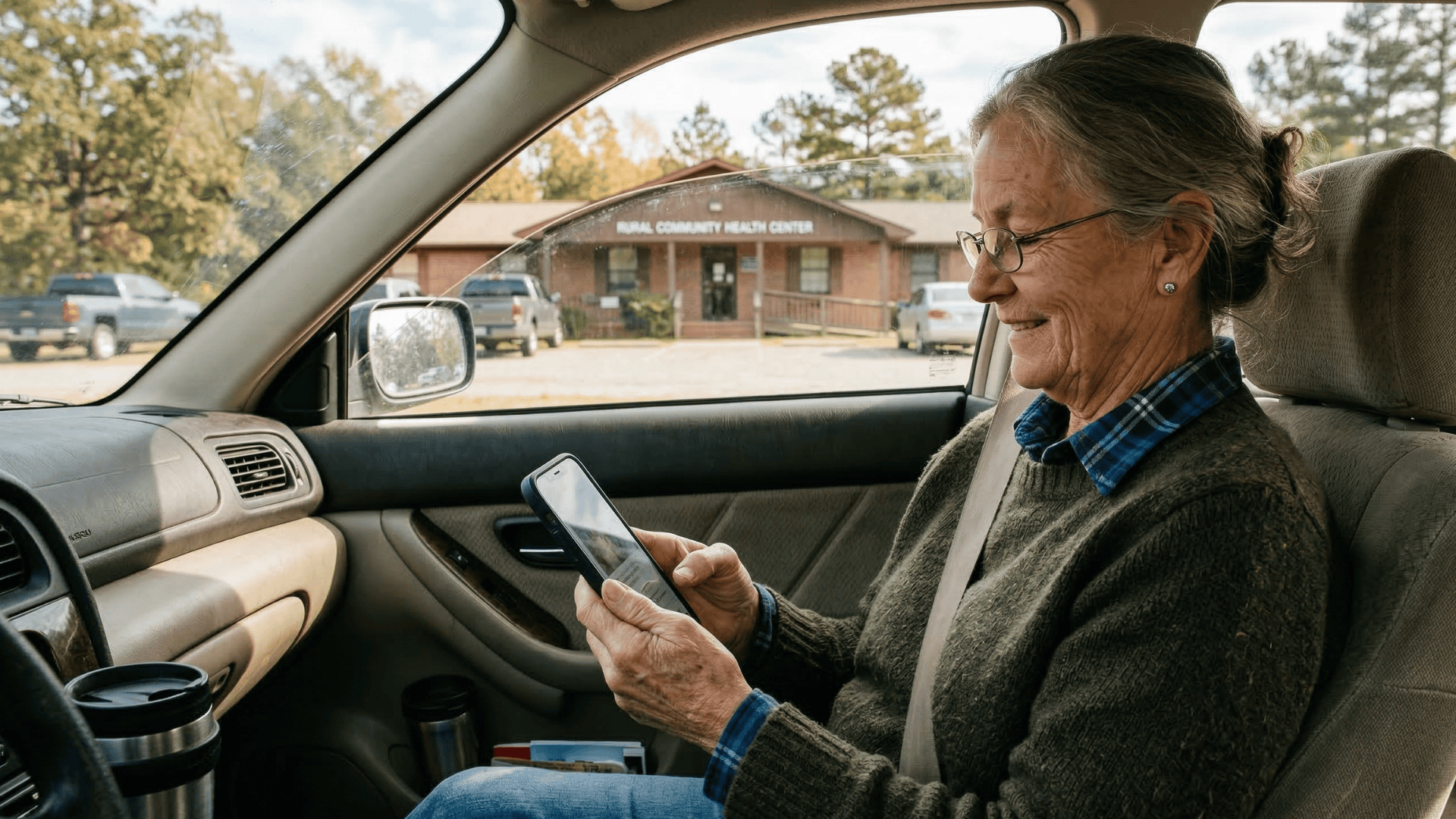
The text arrives while she is sitting in the parking lot after her visit.
She reads:
"How was your visit? Reply 1–5." She types "5."
A second message appears:
"Thank you! Would you share on Google? Tap here." She taps the link. A page opens.
She types:
"Dr. Chen is wonderful. Very caring. Recommended." She hits submit.
For the first time in twelve years, her advocacy is visible to every person searching "doctor near me" in her county. It took about 45 seconds.
And she is not alone. Every patient who walks out of the clinic satisfied is a potential reviewer — they just needed a pathway that matched how they actually use their phone. The text-first format makes that pathway available to everyone, regardless of their comfort with technology.

HIPAA Compliance and Patient Consent
Curogram's SMS review requests are sent through HIPAA-compliant infrastructure and contain no protected health information.
The message is simply a thank-you and a satisfaction rating prompt. Patients who have opted out of text communications are automatically excluded from the system.
This matters especially for federally qualified health centers and rural clinics that serve vulnerable populations.
Patient trust is foundational to care in these communities, and every communication tool used in that environment needs to respect both privacy and consent without exception.
The entire workflow is built for the healthcare environment from the ground up — and when paired with a secure Azalea Health integration, FQHC patient engagement and review collection work reliably and safely on this platform.
98% |
| SMS open rate (vs. 10–20% for email) |
What Happens When Quiet Patients Start Speaking Up
When you remove the friction, the numbers change fast. Text messages reach a 98% open rate — a figure consistent with our internal data and reflected in how practices using Curogram see results.
Compare that to the 10–20% open rate of email-based review requests, and the gap becomes hard to ignore.
Based on our internal research, practices using Curogram's text-based review system see review volume increase 5–10x.
One multi-location practice saw 90% of surveyed patients leave 5-star reviews, resulting in over 1,000 new 5-star Google reviews in just three months. That is not a slow build — that is a reputation shift.
The ripple effect goes beyond raw review count. A higher volume of recent, genuine reviews also signals to Google's algorithm that your practice is active and trusted — which improves your visibility in local search results.
For rural clinics competing for patients across a wide geographic area, that visibility can be the difference between a full schedule and an empty one.
From Silent Fans to Public Advocates
The shift that happens is straightforward: patients who would have praised your clinic at dinner are now praising it to every person in your community who searches for a doctor online.
The word-of-mouth network your practice already has gains a permanent, searchable presence.
And the downstream effect is real. New patients searching for an FQHC near them see the rating.
They call. They schedule.
They show up and mention the reviews when they check in.
Your Google profile stops being a liability and becomes one of your strongest referral sources — and it happens without adding a single task to your staff's day.
There is also a quieter benefit that often goes unnoticed. When long-term patients like Mrs. Thompson finally leave a review, it anchors the practice's profile with the kind of authentic, community-based voice that no marketing campaign can replicate.
New visitors to your Google listing do not just see a star rating — they see the real story of your clinic told by the people who know it best.
1,064 |
| New 5-star reviews (In just 3 months — internal data) |
Why Patients Who Are Asked by Text Actually Follow Through
SMS review requests work for rural and elderly patients because the ask arrives in the same place where they already feel comfortable — their text inbox.
They read it. They understand it. There is no need to navigate anywhere unfamiliar. Patient experience behavior text vs email rural health data makes the contrast clear:
- Email asks patients to open a different app and follow a multi-step process most low-tech users are not familiar with.
- Text asks them to do something they already do a dozen times a day — reply to a message and tap a link.
For practices wondering why patients leave Google reviews after a text request, the answer is simple: it is the first time they were asked in a way they could actually act on.
The system is not tricking anyone or pressuring anyone — it is just removing the steps that got in the way.
Over time, this consistency compounds. Every post-visit text is another opportunity for a satisfied patient to add their voice.
The practice does not need a campaign or a push — it just needs the system running in the background, doing the same thing after every appointment.
Give Your Patients 45 Seconds to Recommend You Online
Your rural patients already believe in your clinic. They talk about you. They refer family members. They come back year after year. The only thing missing was a simple, accessible way to put that loyalty where it can be seen.
Azalea Health manages your patient care. Curogram patient review text for Azalea Health handles their voice.
When you connect the two, your Google profile starts to reflect the reality of who you are — not the occasional frustrated outlier, but the full weight of a community that trusts you.
SMS review requests elderly rural patients can actually use are not a workaround. They are the right channel, built for the way your patients communicate. The barrier was never motivation. It was always access — and now you can remove it in a single automated message.
Think about what your Google profile could look like six months from now if every satisfied patient had a 45-second way to say so publicly.
The reviews would reflect what your community already knows — that your clinic shows up, does the work, and earns that trust every single day.
Schedule a demo today and see how Curogram integrates with Azalea Health to start collecting reviews after every visit. Your patients will speak up. You just need to make it easy.
Frequently Asked Questions
Many can — especially when the process is reduced to replying to a text and tapping a single link. The direct review link skips the most confusing steps: searching for the practice and navigating Google's interface. Some patients may still need a little help from a family member or staff, and that is perfectly fine.
This can still happen, and that is not a failure of the system. The goal is not to prevent negative public reviews — it is to give unhappy patients an alternative channel they are more likely to use. When a negative review does appear, Curogram's dashboard flags it so the practice can respond quickly and professionally.
Yes. Review requests are sent through Curogram's HIPAA-compliant infrastructure and contain no protected health information — just a thank-you message and a satisfaction rating prompt. Patients who have opted out of text communications are automatically excluded. The text comes from the practice's existing Curogram number, so every message is consistent with the communication patients already recognize.
Curogram sends the post-visit text within a few hours of the appointment being marked complete in Azalea Health. This timing is deliberate. The patient is still close to the experience — they remember how the visit felt, who they saw, and whether they left satisfied. A same-day message catches that window before the memory fades and the moment passes.
Yes — and this is often where the impact is most visible. A low rating typically reflects a small number of reviews, which means a handful of negative posts have an outsized effect on the average. When Curogram starts bringing in a steady stream of positive reviews from satisfied patients, that average climbs quickly. The new reviews do not erase the old ones, but they provide far more accurate context.