
10 min read

NextGen Review Automation | Network-Wide Google Reputation at Scale

NextGen Review Automation | Network-Wide Google Reputation at Scale
💡 For large NextGen Enterprise networks, Google reviews remain untapped.  

Neither NextGen nor Luma sends automated post-visit review texts or manages reputations centrally, leaving location profiles thin, inconsistent, and hard to find in local search. 

Curogram's Review Generation Engine closes this gap. It sends automated post-visit texts across every NextGen location, routes satisfied patients to that location's Google page, and captures negative feedback internally before it goes public.

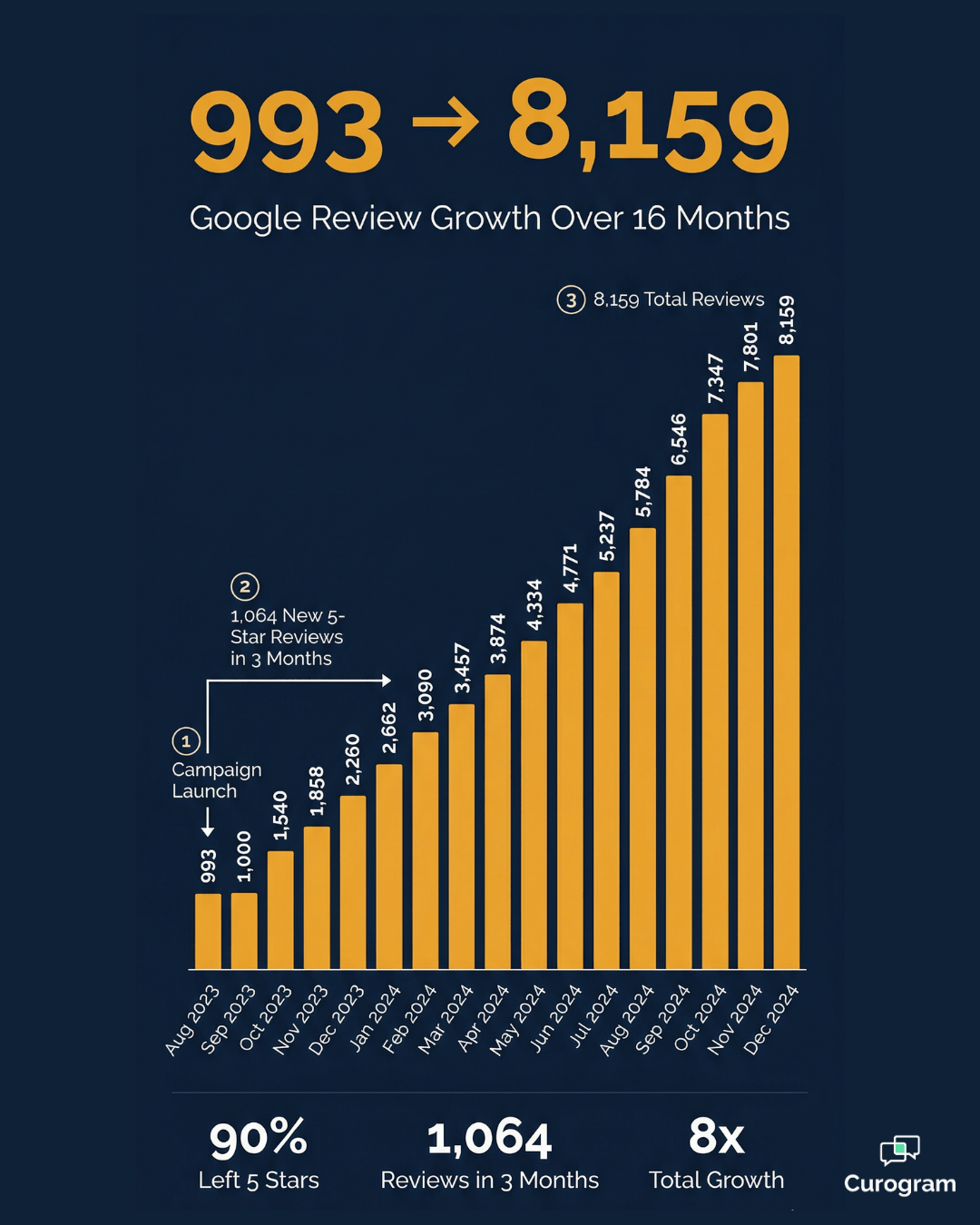
One multi-location practice earned 1,064 new 5-star Google reviews in just three months — growing total review volume from 993 to 8,159. That's network-wide reputation management at scale, without adding another vendor.

Think about this:

A prospective patient just got a referral from their primary care doctor. They need an orthopedic specialist.

They open Google, type in a search, and three practices appear on their screen. Two have hundreds of reviews, a 4.8-star rating, and recent posts from satisfied patients. The third has 18 reviews, a 3.9-star average, and the most recent post is two years old.

They call the first two. They never make it to the third.

Now imagine the third option is one of your locations.

This isn't a hypothetical. It's what happens every day at large ambulatory networks running on NextGen Enterprise — organizations that deliver excellent clinical care but have Google Business Profiles that look like no one's home.

Research shows that 90% of new patients check a Google Business Profile before they ever visit a practice's website.

For most of those patients, a sparse or outdated profile doesn't raise a yellow flag. It ends the search entirely.

The problem isn't clinical. Your providers are skilled. Your outcomes are strong. Your patient satisfaction is almost certainly far higher than your ratings reflect.

The problem is structural:

There's no mechanism inside the NextGen ecosystem for generating Google reviews at scale, across every location, after every visit.

Some office managers ask patients before they walk out the door. A few locations have a QR code taped to the counter. Most do nothing consistent at all.

The result is wildly uneven review counts across a network that should be presenting a unified, compelling online presence — with no way to see the full picture from a single place.

Your network is delivering 5-star care. Google doesn't know that yet.

The gap between what you deliver and what patients see online isn't a quality problem. It's an automation gap.

And for organizations managing 20 to 100+ providers on NextGen Enterprise, that gap is also a patient acquisition problem — one that's been quietly building for years.

Your Google Profiles Are Costing You Patients

Imagine you're a VP of Operations at a 50-location ambulatory network. Your NextGen PM system is humming. Appointments are confirmed. Reminders go out on schedule.

No-show rates are down. You've made serious investments in the patient experience at every level.

Then you search your own network on Google Maps.

Location A has 12 reviews. Location B has 7. Two locations have zero. Star ratings range from 3.6 to 4.5 — not because care quality varies, but because review volume is completely random. The locations with better ratings don't necessarily deliver better experiences.

They just happen to have a front desk coordinator who occasionally asks patients to leave a review on their way out.

This is what the reputation gap looks like in practice. And it's invisible until you go looking for it.

The Core Problem Is Scale

A 50-location network sees thousands of patient encounters every week. But the vast majority of those encounters produce no Google review at all. Patients don't typically post unless something went very wrong — or very right.

Every satisfied patient who walks out without leaving a word online is a missed opportunity for patient acquisition, compounding across every location, every single day.

This isn't a criticism of your team. Soliciting reviews isn't part of a clinical workflow.

It's an awkward ask during a checkout process that's already busy enough. Without an automated system that does it consistently after every visit, the results will always be sparse and inconsistent — regardless of how good the care actually is.

The NextGen Ecosystem Has a Blind Spot Here

If you've invested in the NextGen patient engagement stack, you've likely explored Luma Patient Engage, the PxP portal, and Navigator AI. These tools handle scheduling, reminders, and patient communication well.

None of them generate Google reviews.

This NextGen Enterprise reputation gap — the one Luma and no native review generation feature in the ecosystem addresses — is the function that was simply left out.

Luma doesn't send post-visit review request texts. PxP doesn't prompt patients to leave a Google review after their appointment. Navigator AI doesn't include review solicitation in any of its voice or messaging workflows.

For organizations that built their engagement stack around NextGen and assumed comprehensive coverage, this is the gap they find out about the hard way.

What It Costs to Be Invisible in Local Search

In local search, review volume and recency are ranking signals. A competitor with 300 reviews and a 4.9-star rating will outrank a NextGen location with 18 reviews and a 4.5-star average — regardless of which practice delivers better medicine.

That's not fair. But it's how the algorithm works.

Here's what that means in practical terms. If your network has 50 locations and each loses just 5 new patients per month to a competitor with stronger Google visibility, that's 250 missed patient opportunities every month.

At an average revenue of $350 per visit, that's $87,500 in potential monthly revenue walking out the door — not because of care quality, but because of an unoptimized profile.

Scenario Locations Patients Lost/Month Per Location Monthly Revenue Impact Annual Revenue Impact
Conservative (5 patients lost) 50 5 ~$87,500 ~$1,050,000
Moderate (10 patients lost) 50 10 ~$175,000 ~$2,100,000

These are illustrative estimates based on typical ambulatory visit revenue.

What Happens When Your Whole Network Gets Reviews

The results from live Curogram deployments aren't projections. They're documented outcomes from organizations that made the decision to automate.

One multi-location practice deployed automated Google review requests across their ambulatory network, covering all locations, and grew their total Google review count from 993 to 8,159 over the course of the campaign.

The early results were remarkable:

90% of patients who received a post-visit review request left a 5-star review.

In a single three-month stretch, the practice added 1,064 new 5-star reviews to their Google profiles.

To put that in context:

1,064 reviews in 90 days works out to roughly 355 new reviews per month, or about 11 new reviews every single day.

For most large ambulatory networks, that's more Google review activity in one quarter than they've accumulated in their entire history.

Multi-location practice Google review growth from 993 to 8,159 over 16 months

The Shift From Passive Artifact to Active Asset

Before automation, a Google Business Profile is essentially whatever patients happen to post on their own. That's a passive artifact — slow to grow, hard to influence, and invisible to prospective patients doing a local search.

After automation, a Google Business Profile becomes an active patient acquisition asset. New reviews arrive consistently after every visit. Ratings reflect actual care quality, not just the occasional unhappy patient who took the time to post.

Review recency tells Google — and prospective patients — that this practice is active, trusted, and seeing real people regularly.

This is where NextGen patient acquisition through Google Business Profile review volume automation converts into real, measurable outcomes.

Higher review volume and recency improve local search rankings.

Higher rankings generate more inbound calls from prospective patients.

More calls mean more scheduled appointments. And more appointments mean revenue that can be directly attributed to an improved online reputation.

Modeling the Impact for Your Network

Here's a simple projection based on the documented results above, scaled to a 50-location network with 10,000 monthly patient visits:

Metric Without Automation With Curogram Automation
Monthly review requests sent ~100 (manual, inconsistent) ~10,000 (automated, all visits)
Review conversion rate ~0.2% ~10%
New reviews per month ~20 ~1,000
Total reviews after 12 months ~240 added ~12,000 added
Estimated new patients from improved ranking Baseline +100–200/month*

Estimated based on industry benchmarks for local search conversion improvement with higher review volume.

At $350 per new patient visit, 100 additional monthly patients from improved Google visibility equals $35,000 in monthly revenue — or roughly $420,000 per year.

That's the downstream math of taking reputation management seriously.

From Invisible to Inevitable — At Every Location

The most important shift isn't numerical. It's structural. When automated

Google review requests run across your ambulatory network covering all locations, every location gets the same systematic treatment — not just the ones with an enthusiastic office manager or a well-placed QR code.

Your network's Google presence transforms from a scattered, inconsistent collection of sparse profiles into a coordinated, growing asset that reflects clinical excellence at every service area.

The locations that were invisible in local search start climbing. Prospective patients researching options in your area encounter profiles with hundreds of recent reviews, strong ratings, and consistent activity.

The reputation your network built through years of clinical outcomes finally becomes visible — exactly where new patients are looking.

That's the shift. And it happens automatically, every day, from one dashboard.

Patient leaving medical clinic reading post-visit review request text on smartphone

The Automation That Fixes What NextGen Was Never Built to Solve

Curogram's Review Generation Engine is built for exactly this problem.

It automates the entire review collection workflow — after every appointment, at every location — so your network stops relying on chance and starts generating Google reviews the same way it manages everything else: systematically.

The engine handles three things at once. It sends the request, routes the response, and captures the data.

No staff prompting required. No QR codes. No asking patients to find your Google profile on their own.

How the Workflow Actually Runs

The process is straightforward by design:

  • A patient completes a visit at any location in your network.
  • A post-visit text goes out automatically, asking about their experience.
  • Patients who report a positive experience are routed directly to the Google review page for their specific location.
  • Patients who report a negative experience are routed to an internal feedback channel — where your team can address the concern before it ever becomes a public review.

Every step is automated. Every location is covered. The workflow runs the same way whether you have 5 locations or 100.

Your front desk staff doesn't lift a finger, and patients get a frictionless, one-tap path to leaving a review on the right profile.

This is what NextGen Google review generation through automated post-visit text request at the enterprise level actually looks like in practice — not a manual process dressed up with a QR code, but a true automation layer that operates in the background after every visit.

One Dashboard for Every Location

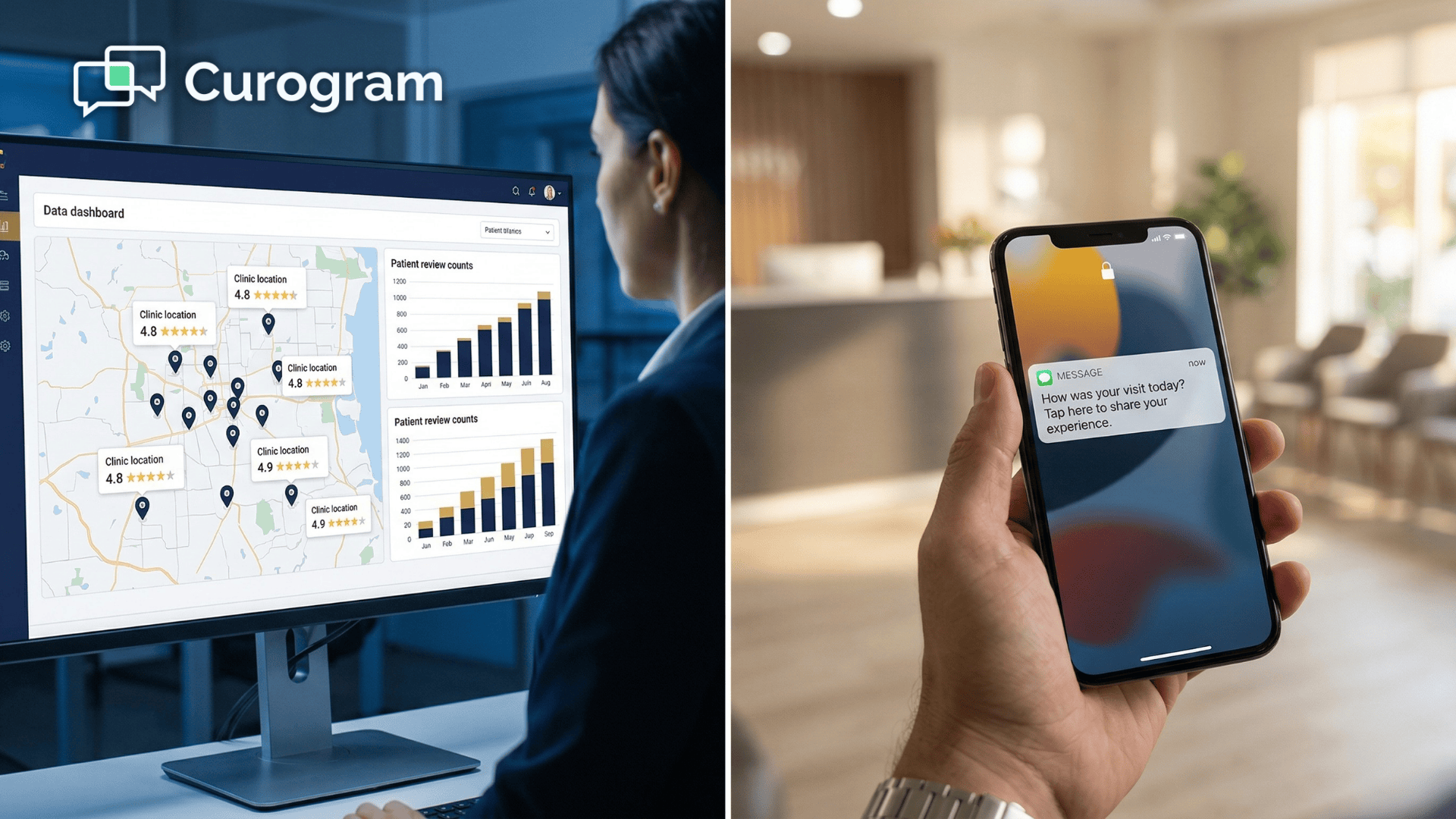
For multi-location organizations, the centralized Network Reputation Dashboard is where the operational value really shows up.

This is the command center for network-wide reputation management in a NextGen multi-location environment, bringing centralized reporting into a space that previously had none.

From a single screen, marketing and patient experience leaders can see:

  • Google star ratings and review counts per location
  • Review velocity — how many new reviews each location is generating per week
  • Sentiment trends and patient feedback themes across the network
  • Which locations are falling behind and where intervention is needed

This replaces the tedious manual process of checking individual Google Business Profile pages across 50 locations.

Location-level drill-downs show individual reviews, response rates, and recurring themes in patient feedback. If one location is quietly losing ground in local search, you'll know about it — before it becomes a competitive problem.

One Platform, Not Two

The integration between Curogram and NextGen PM is worth understanding because it matters for your IT team. Review request texts are triggered by visit completion data from the NextGen PM schedule.

That means every text goes to a real patient who completed a real appointment — not a blanket outreach message sent to your full contact list.

The integration uses the same infrastructure that already powers Curogram's two-way texting and appointment reminder workflows. There's no separate module to license, no additional implementation project, and no new vendor to manage.

Your IT director oversees one platform for texting, reminders, digital forms, payments, and now reputation management — instead of adding another tool to an already crowded stack.

Timing is configurable, too. Behavioral health practices may prefer to delay post-visit texts.

Surgical practices might wait until after a follow-up appointment before asking for a review. Each location or specialty can be configured to match the clinical context, while the dashboard keeps all of it visible from the center.

Stop Letting Your Profiles Underrepresent the Care You Deliver

Your network has earned its reputation the hard way — through outcomes, experienced providers, and years of patient relationships built one visit at a time. That reputation is real. The problem is that Google can't see it.

NextGen Enterprise manages the clinical workflow with precision. Scheduling, reminders, patient communication — all of it runs smoothly.

But when it comes to generating Google reviews at scale, across every location, after every visit, the native ecosystem has never had an answer. That's not a design flaw. It's a gap. And for organizations competing for new patients in local search every day, that gap has a measurable cost.

Curogram fills it. Automated post-visit texts go to real patients after real visits. Satisfied patients are one tap from leaving a review on the right Google profile. Negative feedback is captured privately so your team can resolve it first.

Your IT team manages one platform.

Your marketing team sees the whole network in one place.

And your patient experience leaders can finally close the gap between the care you deliver and the story your Google profiles tell.

One practice went from 993 Google reviews to 8,159. Ninety % of their patients who received a post-visit review request left 5 stars.

Applied to your network, that kind of momentum means hundreds of new reviews every month — building local search dominance that drives new patient calls without a dollar spent on paid advertising.

You've already built a 5-star network. It's time for Google to prove it at every location, every week, automatically.

Schedule a demo today. See how the Review Generation Engine maps to your specific patient volume across every NextGen location — and what that means for your network's patient acquisition in the next 90 days.

Frequently Asked Questions

Is automated review solicitation compliant with Google's review policies?

Yes. Curogram's review generation workflow complies fully with Google's review policies. Every review request goes to a real patient who completed a real visit. Patients choose freely whether to leave a review — there's no incentive, no coercion, and no manufactured feedback. The text simply asks about their experience and provides a direct link to the Google review page for their specific location. Google explicitly allows businesses to ask customers for reviews, and this workflow does exactly that.

What happens with negative patient feedback?

Curogram's workflow includes a built-in satisfaction filter. Patients who report a negative experience are routed to an internal feedback channel rather than the public Google review page. This gives your team the opportunity to address concerns directly before they become visible online. Feedback is captured, documented, and routed to the appropriate staff for follow-up. The result: your public profile is protected, and every patient concern still gets heard and resolved.

Does this require a separate reputation management vendor or an additional module?

No. Review generation is built directly into Curogram's platform alongside two-way texting, appointment reminders, digital forms, payments, and telemedicine. Your IT team manages one vendor, one integration, and one dashboard — not a separate reputation tool layered on top. For organizations already using Curogram for patient communication, the Review Generation Engine is an added capability on the same platform. There's nothing new to license, implement, or support beyond what you've already deployed.

Can review request timing and messaging be customized per location or specialty?

Yes. Curogram's Review Generation Engine is configurable at the location and specialty level. A behavioral health practice may want to delay the post-visit text by several days to allow for appropriate emotional distance after a session. A surgical practice might hold the request until after a follow-up visit, when the patient has a fuller picture of their recovery. Primary care locations may prefer to send the text within a few hours of checkout. Each configuration runs independently while the Network Reputation Dashboard keeps all location activity visible from one place. You get the flexibility of location-specific workflows without losing centralized oversight.

How does the Review Generation Engine affect a network's local search rankings over time?

Google's local search algorithm weighs review volume, star rating, and recency as part of how it ranks businesses in Google Maps and local search results. A location with 15 reviews from three years ago ranks significantly lower than a competitor with 300 recent reviews — even if both practices deliver equivalent care. When automated review requests run consistently across every location after every visit, review velocity increases steadily across the network. More recent, high-volume reviews signal to Google that each location is active and trusted, which improves rankings over time. The compounding effect is meaningful: organizations that commit to automated review generation typically see measurable ranking improvements within the first 60 to 90 days of deployment.


Automate Google Reviews via Text | Staff Workflow on Azalea Health

Automate Google Reviews via Text | Staff Workflow on Azalea Health

💡 Azalea Health practices can automate Google review collection via text by connecting Curogram's post-visit workflow to their scheduling data. ...

Read More
Rural Patients Leave Reviews by Text | Azalea Health + Curogram

Rural Patients Leave Reviews by Text | Azalea Health + Curogram

💡 Rural patients leave reviews when asked by text message after Azalea Health visits because SMS is the one channel that fits how they already...

Read More
Reputation Management in Veradigm with Curogram

Reputation Management in Veradigm with Curogram

💡 Imaging centers face unique trust issues. A single bad review can damage referral flow and hurt revenue across multi-site networks.Reputation...

Read More