9 min read

NextGen Review Automation Workflow | End Manual Solicitation

NextGen Review Automation Workflow | End Manual Solicitation
💡 Curogram's automated review workflow helps NextGen Enterprise organizations eliminate manual review solicitation entirely.   

After each appointment, patients receive a post-visit text asking about their experience — no staff involvement needed. 

Patients who respond positively are automatically routed to their location's Google review page. Those who flag a concern are redirected to an internal feedback channel, protecting the network's public profile from unmanaged negative sentiment.

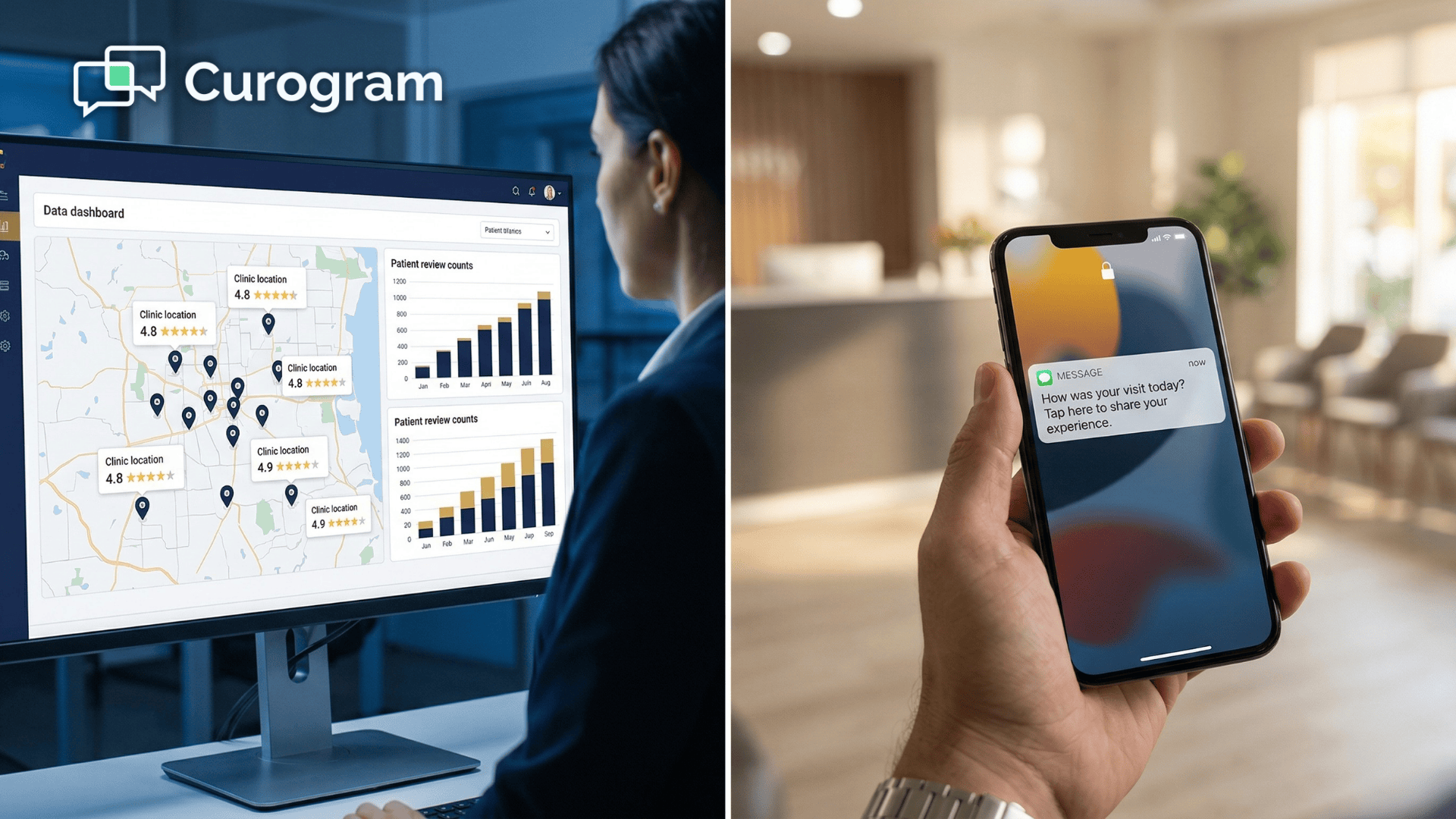
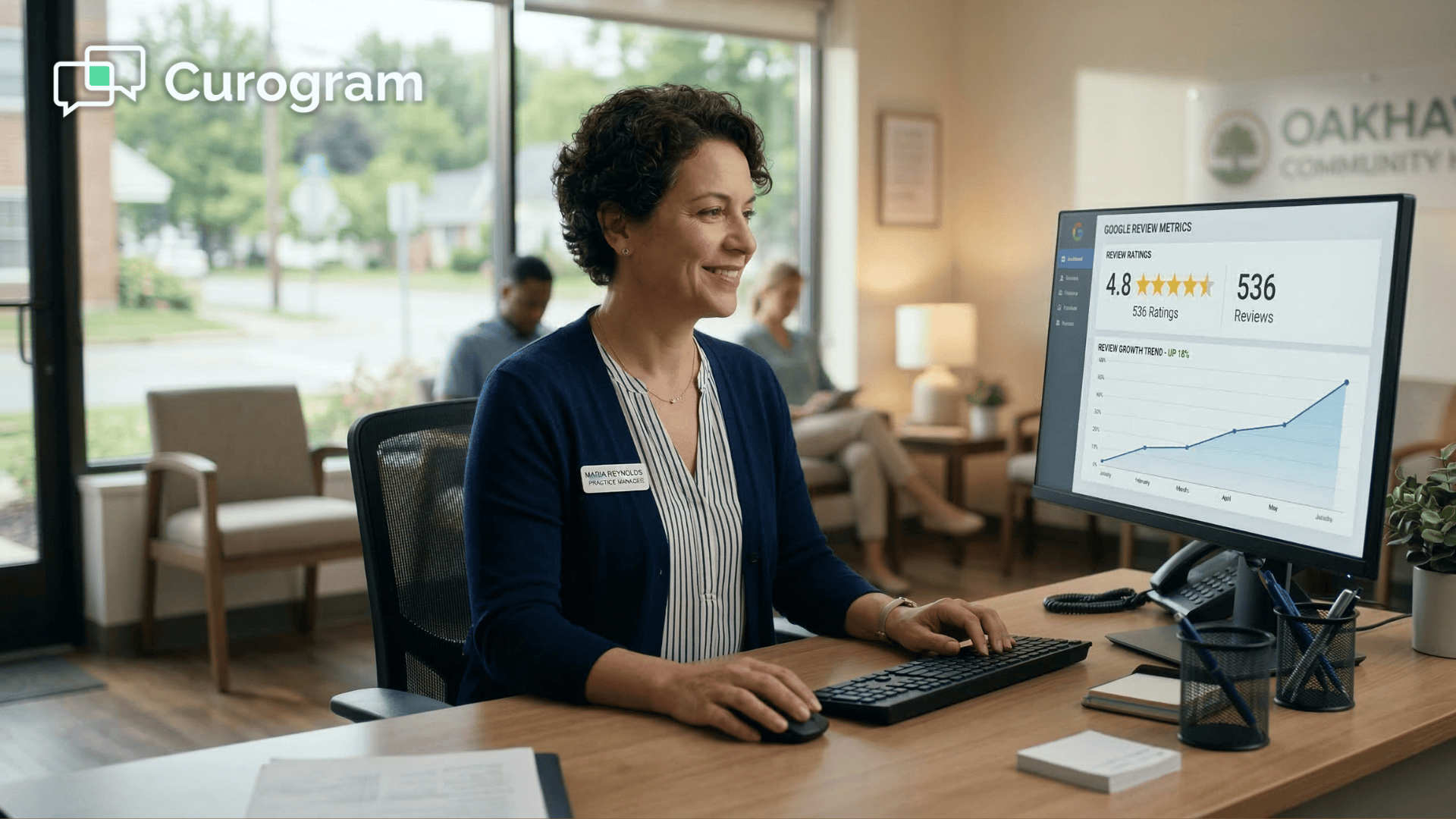
Operations and marketing leaders can track Google review growth across every NextGen location from a single centralized dashboard.

One multi-location practice generated 1,064 new 5-star reviews in just three months — without a single staff member making a single ask.

Think about the last time your front desk staff asked a patient for a Google review.

Did it happen? Did it feel natural? Did anyone actually follow through?

For most multi-location NextGen Enterprise organizations, the checkout ask is one of the most inconsistently handled moments in the patient journey.

Some staff do it. Most don't. Some locations have a loose process. Most have none. And nobody is tracking what happens either way.

Here's why this matters more than you might think. Studies show 7 in 10 patients check online reviews before choosing a healthcare provider. For a 20- or 50-location network, your Google profile isn't just a marketing asset — it's often the first thing a prospective patient sees.

And right now, it's being shaped — or quietly neglected — by whoever at the front desk happens to feel comfortable asking.

That's not a strategy. It's a gamble.

Imagine Location A has an enthusiastic office manager who asks every patient. Result: 280 reviews, 4.8 stars.

Location B had front desk turnover last quarter and the process stopped. Result: 14 reviews, 3.9 stars — skewed by a handful of complaints that don't reflect the actual care quality.

Location C has no process at all. Result: 6 reviews from 2021. Same network. Entirely different reputations.

This is what happens when reputation management depends on individual behavior instead of a consistent system. The fix isn't more staff training. It's removing the ask from their hands entirely.

That's exactly what Curogram's automated review workflow does. It sends a post-visit text to every patient, at every location, after every appointment — automatically.

No awkward checkout conversations. No inconsistency. No guessing who asked and who didn't.

One Curogram client proved what that looks like at scale: 1,064 new 5-star Google reviews in three months.

Not one staff member made a single ask.

Why Asking Patients for Reviews Is Everyone's Least Favorite Job

The Problem With a Human Variable

Review generation that depends on a staff member remembering — and feeling willing — to ask is not a process. It's a coin flip.

Front desk staff are juggling phones, insurance questions, paperwork, and a lobby full of patients. Asking for a Google review at checkout isn't top of mind.

And even when it is, many staff members find it uncomfortable — it feels transactional, it feels like selling, and patients who just received a diagnosis or are rushing back to work don't always respond warmly to the ask.

So the few staff members who are willing carry the reputation burden for everyone else, while the ones who avoid it are never called out because there is no way to measure who's asking and who isn't.

The result is review generation that varies by person, by shift, by location, and by day.

That's not a staff performance problem. It's a system design problem.

No Process Means No Visibility

Even when staff do manage to ask, there's no way to measure the effort. The data simply doesn't exist.

That leaves operations and marketing leaders unable to answer some of the most basic questions about their own network's performance:

  • How many patients were asked for a review this week — and at which locations?
  • How many followed through, and how long after the visit?
  • Which locations have gone quiet, and when did the drop happen?
  • Is a low review count a patient satisfaction problem or a solicitation problem?

Without an automated workflow, those questions don't have answers.

When the NextGen staff manual review solicitation process is entirely informal, you are flying blind on one of your most important brand signals — and the gap between a dissatisfied patient and a disorganized front desk is completely invisible.

What This Looks Like Across a 50-Location Network

Here's what inconsistency at scale actually costs.

Picture three locations delivering comparable care — with very different Google profiles.

Location A has a passionate office manager who asks every patient: 310 reviews, 4.9 stars.

Location B went through front desk turnover and the informal process collapsed: 18 reviews, 4.1 stars, with a handful of old complaints doing most of the talking.

Location C never had a process at all: 4 reviews, 3.5 stars, last updated in 2021.

Three locations. Same network. Three entirely different stories on Google.

For marketing leaders managing brand consistency, that gap quietly undermines every campaign dollar and every new patient trying to decide which location to trust.

Multiply this across 50 locations and the inconsistency becomes a measurable liability — not just an operational inconvenience.

The Dependency That Nobody Plans For

When you make reputation dependent on manual solicitation, you're also creating a dependency on specific individuals.

The moment your most review-generating employee transfers, resigns, or changes shifts, the review pipeline at that location stops — with no visible warning, no handoff, and no data to show you when the drop happened.

No VP of Operations should accept that kind of fragility in a core marketing function.

How Automation Takes the Ask Off Your Staff's Plate

Curogram's automated review workflow removes staff from the solicitation process entirely.

The moment a visit is completed in the NextGen PM schedule, the system triggers a post-visit text to the patient:

"How was your visit today?"

No staff action required. No process to remember or reinforce.

It sounds simple. That's by design.

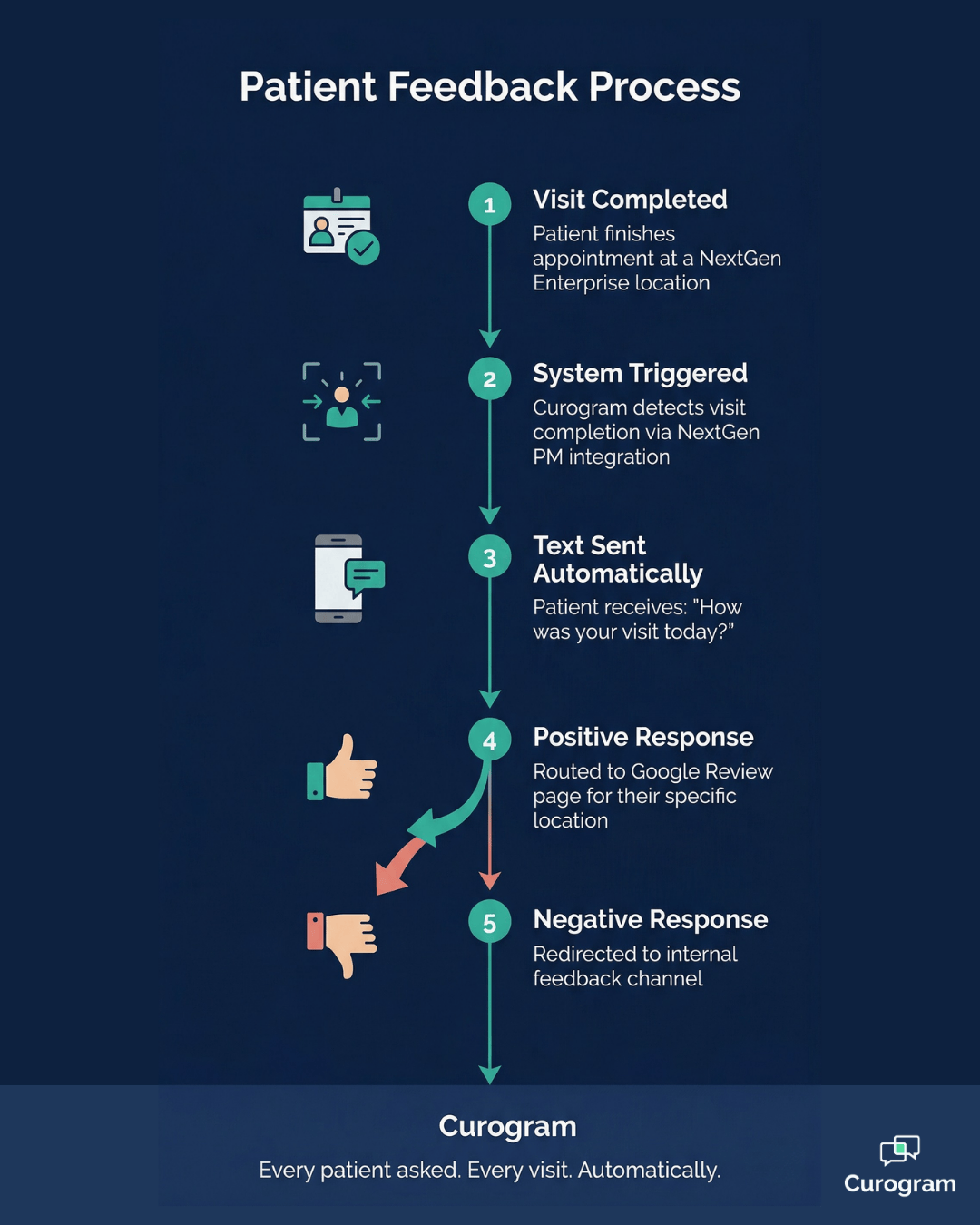
Curogram's 5-step automated review workflow for NextGen Enterprise post-visit Google requests

The Workflow, Step by Step

The automated Google review request text works through the NextGen Enterprise PM integration — the same infrastructure already powering your appointment reminders, two-way texting, and digital intake forms.

Here's how it runs:

  1. Patient completes their appointment at any NextGen Enterprise location.
  2. Curogram detects visit completion through the NextGen PM integration.
  3. A post-visit text is automatically sent to the patient.
  4. Patients who respond positively are routed to the Google review page for their specific location.
  5. Patients who flag a concern are redirected to an internal feedback channel — keeping negative sentiment off your public profile before it has a chance to post.

No new vendor. No extra module. No separate IT implementation project.

For organizations already running Curogram for patient communication, review generation is simply an additional capability on the same platform — one vendor, one integration, one dashboard.

Reputation Intelligence Reporting: Every Location, One View

Manual solicitation never came with a dashboard. This does.

Curogram's centralized reporting gives marketing and operations leaders a real-time view of reputation performance across the entire NextGen network.

The dashboard surfaces:

  • Review volume by location
  • Star rating trends over time
  • Review velocity — new reviews generated per week
  • Location comparison charts
  • Provider-level sentiment data

For the first time, reputation becomes a measurable KPI you can report on, act on, and continuously improve.

Marketing leaders can see which locations need attention. Operations leaders can identify which locations are outperforming and study what's driving the results.

This is what it means to have NextGen multi-location review generation tracked in a centralized dashboard instead of scattered, untracked conversations at checkout.

Configurable for Every Location's Operational Reality

Not every location operates the same way, and Curogram's workflow doesn't force them to. Review request timing, message language, and routing logic are all configurable per location, per specialty, and per provider.

A surgical practice can delay the review request until after a post-operative follow-up. A behavioral health location can use more discreet messaging. A high-volume primary care site can send requests after every single visit.

For organizations running standardized quality programs across a large network, this configurability delivers consistency where it matters while respecting each location's specific clinical and operational context.

Patient reading an automated post-visit review request text after a clinic appointment

What Happens When Every Patient Gets Asked 

The results from real-world deployment are hard to ignore.

One multi-location Curogram client generated 1,064 new 5-star Google reviews in just three months.

90% of patients who received the automated post-visit text left a 5-star review.

The difference between those numbers and what a manual process produces isn't about the quality of care — it's entirely about consistency of the ask and timing of delivery.

Think about what that means in practice. If your network sees 400 patients per day across all locations and just 20% of them respond to the post-visit text, that's 80 new reviews every single day.

Over 90 days, that's more than 7,200 new reviews — the kind of volume that reshapes your Google presence across every market your network operates in.

Consider what separates the two approaches side by side. With a manual process, request consistency varies entirely by staff — there's no tracking, no reporting, and no control over which patient complaints make it to Google. Staff spend two to five minutes per patient on a task that may or may not result in a review.

With an automated workflow, every patient is asked after every visit, negative responses are captured internally before going public, and the whole system runs without a single minute of staff time.

Estimated review output over 90 days shifts from unpredictable to 500 to 1,000 or more, depending on patient volume.

Appear at the top of Google. Automate 5-star reviews and build a pervasive online reputation today with Curogram.  

The advantage isn't only volume. It's timing. The optimal moment to ask for a review is immediately after the visit, when the experience is freshest and the patient is most likely to respond positively.

An automated workflow delivers that ask at exactly the right time, every time, without fail.

Why Timing Is the Variable That Manual Processes Always Miss

Staff don't ask at the optimal moment — they ask when they remember, when the lobby is calm enough, and when they feel comfortable doing it. That window is often hours after the visit, or not at all.

By contrast, the automated post-visit text goes out right after the appointment closes in the system. The patient's experience is fresh. The response rate reflects that.

That 90% 5-star response rate isn't a coincidence.

It's what happens when the right message reaches the right patient at the right moment — consistently, every time, without depending on anyone at the front desk having a good day.

What Your Team Walks Away With

When NextGen operations review automation is running at enterprise scale, the dynamics across your team shift in ways that go beyond the review count. Each stakeholder group experiences the change differently:

  • Staff lose an uncomfortable task and gain time back for patient-facing work.
  • Operations leaders replace guesswork with a live, location-by-location performance metric.
  • Marketing teams see Google profiles strengthen across the network without adding headcount.

And the patients who had a genuinely great experience but never thought to leave a review? They finally have a simple, timely path to share it — which means the network's online reputation starts reflecting the care quality it actually delivers.

Build Reputation Without the Awkward Ask.

Manual review solicitation was never a sustainable model. Asking staff to carry your network's reputation — one uncomfortable checkout conversation at a time — places an unfair burden on people already managing too much.

At enterprise scale, that inconsistency compounds into a measurable liability that affects patient acquisition, brand equity, and location-level performance.

Curogram's automated review workflow fixes this at the root. It removes staff from the solicitation loop entirely, replacing a fragile, human-dependent process with a systematic, trackable, always-on workflow.

Every patient asked. Every visit covered. Every location represented equally on Google — without anyone at the front desk lifting a finger.

Think about what that means over a full year. If your network runs 30 locations and each one generates just 10 new reviews per week through automation, that's 300 new reviews every week.

Over 12 months, that's more than 15,000 new pieces of social proof — each one visible to a prospective patient before they ever call your office.

That's the compounding power of a system that never forgets, never feels awkward, and never takes a day off.

For your operations leaders, reputation becomes a measurable KPI for the first time. For your marketing team, Google profiles finally reflect the care quality your network actually delivers. For your staff, the uncomfortable solicitation task is simply gone.

The best time to ask for a review is right after the visit.

The best way to ask is a text message. And the best person to ask is nobody — because an automated workflow asks every patient, every time, at every location, without variation or fatigue.

Stop relying on whoever remembered to ask this shift. Stop guessing which locations are generating reviews and which have gone silent. Stop accepting reputation inconsistency as a fixed cost of running a large network.

Schedule a demo today with Curogram today and see exactly how automated review generation performs across your specific NextGen locations — every site, every specialty, tracked in one dashboard.

Frequently Asked Questions

Can we control which patients receive review requests?

Yes. The review request logic in Curogram is fully configurable. You can send requests to all patients after every visit, or filter by appointment type, provider, location, or other criteria. Behavioral health visits can be excluded entirely or handled with different messaging. Post-surgical patients can receive requests after their follow-up appointment rather than immediately after the procedure. The workflow adapts to your clinical and operational policies at every level.

What if we already use a separate reputation management platform?

Curogram can replace or complement your existing tool. For organizations using a standalone reputation vendor, consolidating to Curogram eliminates an extra vendor relationship and integrates reputation management into the same platform already handling patient texting, reminders, intake forms, and payments. For organizations that prefer to keep their current tool for review response management, Curogram handles the solicitation and volume-building side of the workflow — the part that manual processes consistently fail to deliver.

How quickly will we see review volume increase?

Most organizations see measurable increases in review volume within the first two to four weeks of deployment. The case study result of 1,064 new 5-star reviews in three months reflects sustained automation across a multi-location practice running the workflow at full scale. Your results will vary based on patient volume, but the upward trend is typically visible within the first month — as the automated workflow reaches every patient at every visit, consistently, from day one.

Is the review request text HIPAA-compliant?

Yes. Curogram is a HIPAA-compliant platform, and review request messages are designed to avoid including any protected health information. The post-visit text is a simple, neutral message — "How was your visit today?" — that does not reference the patient's condition, diagnosis, provider, or appointment details. Your compliance and legal teams can review the message templates before deployment, and Curogram's team can walk you through how the workflow handles patient data at every step.

Can the workflow run across different specialties within the same network?

Yes, and this is one of the more practical advantages for large ambulatory organizations managing multiple service lines under one network. Workflow settings are configurable at the location, specialty, and provider level. That means a primary care location can send review requests after every visit while a behavioral health clinic uses a more discreet message cadence and a surgical specialty delays outreach until the post-operative follow-up window. Each specialty gets a workflow that fits its patient experience — without needing a separate platform or integration for each one.