
12 min read

Patient Reviews That Reflect Reality | RamSoft

Patient Reviews That Reflect Reality | RamSoft
💡 Positive patient reviews at imaging centers on Google ratings are skewed by a structural problem: satisfied patients leave without saying a word online, while frustrated ones post 1-star reviews that stick.                          
Most imaging centers deliver excellent care but carry a 3-point-something star rating that doesn't reflect it.      

Text-based review requests sent immediately after a study — before the moment fades — prompt satisfied patients to share their experience.           

Smart sentiment routing sends happy patients to Google and catches negative feedback privately before it goes public.

One multi-location RamSoft practice grew from 993 Google reviews to 8,159 in 90 days, with an average rating jump from 3.2 to 4.7 stars. The clinical quality didn't change. The visibility did.

Your imaging center invested in top-tier equipment. Your staff is trained, your turnaround times are fast, and your patients leave satisfied. You know it. Your team knows it.

Google doesn't.

Think about what happens the moment a patient walks out after a smooth, well-run imaging visit.

They got in on time. The technologist was kind. Their results came back quickly through RamSoft's Blume app, complete with a clear summary. The experience was genuinely good — and that patient has no reason to think about your center ever again.

They don't leave a review. They don't tell Google. They just go home.

Now picture a different patient.

One who waited 25 minutes past their scheduled time because a prior scan ran long. That patient opens Google that evening and leaves a 1-star review. It takes them three minutes. It lives on your profile forever.

This is the reputation trap every imaging center falls into. It isn't about the quality of care you deliver. It's about who bothers to speak up — and right now, only the unhappy ones do.

Frustrated patients are motivated. Satisfied patients are silent.

The result is a Google rating that looks like a complaint board. Referring physicians see it.

New patients see it. And your competitors — who may not deliver care as well as you do — benefit from it simply because they figured out how to ask for feedback at the right time.

This article breaks down exactly why that imbalance happens, what it costs your practice, and how a simple text-based approach to capturing positive patient reviews from your imaging center patients can finally make your Google ratings match your clinical reality.

Why Your Google Rating Is a Distorted Mirror

Most imaging center administrators assume a low rating means poor care. That assumption is wrong.

What it usually means is that your unhappy patients are more motivated than your happy ones.

Research shows that 72% of patients are willing to leave a review if someone simply asks them — but only 8% ever volunteer one on their own.

That gap is where your reputation is being lost.

Every day your satisfied patients walk out without leaving feedback, and every day that silence accumulates into a star rating that doesn't represent your center.

Imaging patients are different from primary care patients.

They don't have an ongoing relationship with your facility. They come in for one study, receive their results, and move on.

There's no recurring appointment to remind them you exist. There's no newsletter, no follow-up call from a familiar doctor. The connection is brief — and unless you capture that moment, it disappears entirely.

The Math Behind the Imbalance

To understand how this plays out in practice, consider a simple scenario:

Month Patients Served Positive Experiences 1-Star Reviews Posted 5-Star Reviews Posted
Jan 400 360 (90%) 4 2
Feb 400 368 (92%) 3 1
Mar 400 372 (93%) 5 3
Q1 Total 1,200 1,100 12 6

After one quarter, you've served 1,100 patients who had a positive experience.

Six of them left a review. Twelve frustrated patients did. Your overall rating skews negative — not because you failed your patients, but because satisfied patients had no easy path to speak up.

This means your rating is being written by roughly 1.5% of your actual patient experience. That's the gap Curogram and RamSoft partners are designed to close.

What a Low Rating Actually Costs You

A 3.4-star rating isn't just a bruised ego. It's lost revenue.

According to BrightLocal's research on healthcare consumer behavior, 75% of patients check online reviews before selecting a healthcare provider.

Among those, patients are far more likely to choose a practice rated 4.0 stars or above, and many won't even consider providers rated below 3.5 stars.

For an imaging center processing 400 patients per month, losing even 10% of prospective new patients to a competitor with a stronger Google profile represents roughly 40 lost studies per month.

At an average imaging study value of $250, that's $10,000 in monthly revenue — or $120,000 per year — slipping away quietly, never tracked to a root cause.

And it compounds. Referring physicians notice ratings too.

When your center sits at 3.2 stars and a competitor sits at 4.6, the referral decision isn't purely clinical.

Reputation matters.

The Real Reason Satisfied Patients Stay Silent

It's tempting to think your satisfied patients just don't care enough. That's not it.

The problem is friction. Most patients have no idea how easy it is to leave a review — and even when they do, the moment passes. Patients who had a great first-time imaging experience are busy people.

They return to work. They pick up kids. The glow of a smooth appointment fades within hours, and with it, the impulse to say something publicly.

The Psychology of Who Actually Leaves Reviews

There's a clear behavioral pattern at work here. Leaving a positive review feels optional. Leaving a negative one feels necessary — like a warning to protect others from a bad experience.

That emotional urgency is what drives the unhappy minority to act while the satisfied majority does nothing.

Two factors explain why the gap persists:

  • Satisfied patients feel no obligation to act. The experience was good — their needs were met. There's no unresolved tension pushing them toward a keyboard.
  • Frustrated patients feel a social duty to warn others. That sense of urgency creates immediate action, while satisfaction creates none.

Understanding this asymmetry is the first step to correcting it. You can't change human psychology. But you can remove the friction that keeps willing patients from following through.

RamSoft's Blume app solves one piece of this challenge well. It gives patients access to their imaging results with AI-powered report summaries and clear image annotation — removing confusion and anxiety from what can be a stressful experience.

But Blume has no built-in mechanism to capture patient satisfaction or generate reviews. The patient's experience is better understood, but it still evaporates once they close the app.

More importantly, not every patient uses Blume.

RamSoft sites report that 30–40% of imaging patients never download it at all.

That's a significant portion of your patient population whose experience — good or bad — leaves no trace at all.

Why Apps Aren't the Answer for Review Generation

App-based feedback tools sound logical. In practice, they face a fundamental adoption barrier: getting patients to download something for a one-time visit.

Unlike primary care patients who see their doctor quarterly, imaging patients typically visit once or twice a year, often for a specific diagnostic study. The motivation to download an app for a single interaction is low.

Adoption rates for healthcare apps among one-time imaging visitors often hover around 60–70%, meaning a large segment of your satisfied patients is completely unreachable through app-only feedback tools.

Text messages, by contrast, reach nearly everyone. Response rates for SMS in healthcare regularly exceed 90%.

The channel meets patients where they already are — no login, no download, no barrier.

How Smart Text-Based Feedback Changes the Equation

The solution isn't complicated. But timing makes all the difference.

A post-study text review request is sent to a patient immediately after their study is complete — at the peak of their satisfaction, when the experience is fresh and the positive feeling is still active. The message is brief, warm, and direct. It includes a one-tap link to your Google review page.

No app to download. No account to create. One tap.

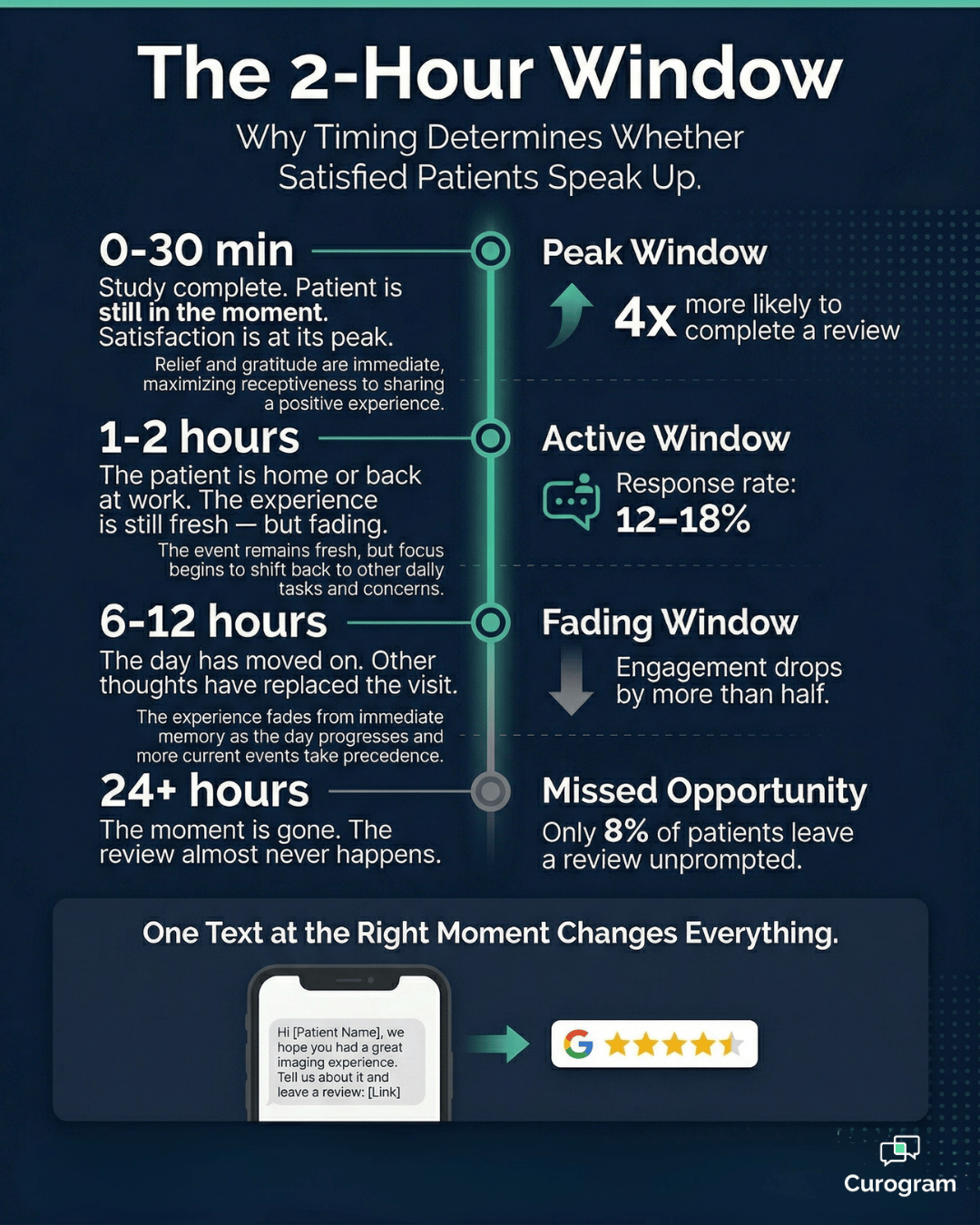
Research shows patients are 4x more likely to complete a review request within 2 hours of a positive experience than if contacted 24 hours later.

The window is short. Miss it, and the moment is gone.

How the Automation Actually Works

Curogram's integration with RamSoft makes this hands-off for your team.

Here's what the process looks like from start to finish:

  • A patient completes their imaging study and is discharged.
  • Curogram detects the completed study through the RamSoft integration and automatically triggers an SMS review request.
  • The patient receives a brief, warm message with a one-tap Google review link — no login, no app, no friction.
  • The system routes responses based on sentiment: positive feedback goes to Google, concerns go to your team privately.

No staff member manually sends anything. No follow-up is required.

The system runs in the background while your team focuses on the next patient.

Infographic showing how review request timing affects patient response rates after imaging

Smart Sentiment Routing: Catching Problems Before They Go Public

Not every patient response will be positive. And that's actually an advantage.

Curogram's approach includes a smart sentiment routing layer.

When a patient responds to the review request text, the system analyzes whether the response indicates satisfaction or concern.

Patients who indicate a positive experience — or agree to share their feedback — are directed straight to Google Reviews with a pre-filled link.

Patients who flag a concern are routed to a private feedback form instead.

This is where the real value lies. Rather than letting a frustrated patient's first outlet be a public 1-star review, your team receives that feedback internally — with time to call, apologize, and resolve the issue.

Service recovery within hours is possible. The patient feels heard. The public review is often never posted.

Response Type What Happens Outcome
Positive / Neutral Directed to Google Review with one-tap link Public 5-star review posted
Negative / Concern flagged Routed to private feedback form Internal issue captured, service recovery triggered
No response No further action (prevents annoyance) No harm done

This dual-path design means your Google profile fills with authentic positive feedback while negative sentiment gets caught privately — giving your operations team a chance to improve before problems become permanent.

What the Patient Actually Receives

It's worth being specific about what this looks like from the patient's point of view. The message isn't a cold survey request. It's a brief, personalized thank-you that acknowledges their visit and makes sharing easy.

Something like:

"Thank you for visiting us today. We hope your experience was a positive one. If you have a moment, we'd love to hear your feedback." Followed by a direct link.

That's it. No pressure. No multiple-question survey. No login prompt.

The patient who had a good experience feels the invitation is genuine — because it is.

And the data backs this up.

Multi-location practices using this approach report engagement rates of 12–18% among patients who receive the text, with 40–50% of those engaged patients completing a review.

For an imaging center seeing 400 patients per month, that translates to 50–75 new reviews per month — which compounds dramatically over a quarter.

What Happens When Satisfied Patients Finally Have a Voice

Numbers tell the story best here.

One multi-location RamSoft practice came to Curogram with 993 total Google reviews spread across all its locations. The average rating sat at 3.2 stars. Clinical quality wasn't the problem — visibility of that quality was. Satisfied patients had never been given a simple, timely way to speak up.

Within 90 days of implementing text-based review requests, that practice had grown to 8,159 reviews.

The average rating climbed to 4.7 stars. They added 1,064 new 5-star reviews in the first quarter alone.

Nothing changed clinically. The same technologists, the same equipment, the same turnaround times. What changed was whether satisfied patients had a frictionless pathway to share their imaging experience feedback in a way that reached Google.

Radiology technologist walking patient out after a positive imaging experience

What a Shift From 3.2 to 4.7 Stars Actually Means

It's easy to see those numbers and think "nice result." But the downstream effects go well beyond aesthetics.

A rating above 4.5 stars on Google significantly increases the likelihood that a practice appears in the local search results patients and referring physicians see first.

More visibility means more first-time imaging patients choosing your center. More reviews mean your rating is statistically stable — one bad review doesn't tank you anymore.

Here's what that shift looks like in real terms for a mid-sized imaging center:

At 3.2 stars, a center fielding around 80 new patient inquiries per month might realistically grow that number to 120 once the rating climbs to 4.7 — a 50% increase simply from stronger visibility.

At $250 per imaging study, those 40 additional monthly patients translate to $10,000 more in monthly revenue, or $120,000 over a year.

Referral physician confidence shifts too:

A rating that was once flagged as a concern becomes one they cite positively when recommending a location.

And internally, staff morale changes when patient appreciation starts showing up publicly instead of only complaints.

In practice, this means the investment in clinical quality — the RIS/PACS infrastructure, the 3D reconstruction tools, the training — finally becomes visible to the patients who are deciding where to go next.

Beyond the Rating: Three Compounding Effects

The benefits of a stronger Google profile don't stop at new patient volume.

They compound across your entire operation over time:

  • Referral stability: Physicians who already send patients your way feel reassured — and less likely to experiment with a competitor — when your rating is publicly strong.
  • Review resilience: A profile with 8,000+ reviews absorbs the occasional negative post without a rating swing. A profile with 50 reviews gets knocked around by a single bad week.
  • Staff recognition: When positive patient feedback shows up publicly, your technologists and front desk staff see it. That visibility has a real effect on retention and team morale.

None of these show up in a single month's revenue report.

But over time, they shape the competitive position of your practice in ways that are hard to reverse once a competitor establishes them first.

Referring Physicians Notice, Too

It's not just prospective patients who read Google ratings.

When a referring physician's office is choosing between two imaging centers of similar proximity and clinical capability, online reputation is a real tiebreaker.

A 4.7-star rating with 8,000+ reviews tells a referring physician that hundreds of real patients had a great experience at that facility.

A 3.2-star rating with 50 reviews tells a different story — even if it's not the true one.

Positive patient reviews for your imaging center on Google ratings don't just attract new patients directly. They influence the physician referral patterns that drive the majority of your volume.

This is one of the most overlooked downstream effects of reputation management in radiology.

Your Reputation Should Match Your Reality

Here's the clearest way to think about what's been described above.

RamSoft's Blume gives your patients clarity about their imaging results. It helps them understand what was found, how to interpret the report, and what comes next. It handles the clinical communication layer with precision.

Curogram handles the reputation layer — the part where patients share their experience with everyone else who hasn't visited yet.

Together, they close the loop. Blume for records. Texts for everything else.

Imaging patient experiences are fragile. They're brief, they're one-time, and they vanish the moment a patient drives out of your parking lot. Positive experiences evaporate unless you capture them immediately.

Negative experiences harden into public posts that stay live for years.

Without a deliberate system to capture post-imaging patient satisfaction feedback — a system that reaches patients in the right channel, at the right moment, with zero friction — your Google profile will always be written by the loudest 10% rather than the representative 90%.

The imaging centers winning the reputation game right now aren't necessarily delivering better care. They've simply made it easier for the patients who love their experience to say so out loud.

That's not manipulation. It's making sure your clinical reality is visible.

Start Building the Reputation Your Patients Already Know You Deserve

You've done the hard part. You've invested in the equipment, the staff, the workflows. Your patients are leaving satisfied — they just aren't leaving reviews.

That gap is fixable. Not with a reputation management agency or a costly PR campaign. With a well-timed text.

Curogram's text-based review system works alongside your existing RamSoft infrastructure to automatically reach patients at peak satisfaction — right after their study — and give them a one-tap path to share their experience on Google.

Positive responses go public. Concerns come to you privately. Your ratings compound month over month.

The math is simple. If your imaging center sees 400 patients per month and you convert just 10% into Google reviews, you're adding 40 reviews per month — nearly 500 per year.

At that pace, your rating stabilizes, your visibility grows, and your referral volume follows.

More than that, your team gets to see the appreciation that already exists. Staff morale improves when patient testimonials from your medical imaging practice start showing up publicly. Your Google profile starts telling the story you already know is true.

From 993 reviews to 8,159 in 90 days. From 3.2 stars to 4.7.

That result didn't require a single clinical change. It required a system that let satisfied patients speak.

If you're ready to see how text-based review requests fill the reputation gap that Blume and other tools can't reach, the next step is simple.

Schedule a demo today and see how Curogram turns patient satisfaction into your most powerful marketing asset.


Frequently Asked Questions

Do patients need to opt in before receiving a review request text? What about HIPAA?

Yes, and the compliance piece is straightforward. Review request texts follow the same standard SMS consent workflow as appointment reminders. The message doesn't contain any protected health information — it's simply a thank-you prompt with a review link. That makes it equivalent to the appointment reminder texts your practice likely already sends. Patients can opt out at any time, and Curogram handles unsubscribe management automatically.

Will patients find it annoying to receive a text asking for a review?

Timing is everything, and when done right, most patients don't find it intrusive at all. Research shows 68% of patients are more likely to leave a review when asked directly, and 74% say they appreciate the follow-up. The key factors are timing — sent immediately after a positive experience, not days later — tone (a genuine thank-you rather than a transactional request), and brevity (one text, one link, no survey). Multi-location practices using this approach consistently report 12–18% engagement rates, which reflects willing participation rather than reluctant compliance.

What if a patient responds with a complaint? Can you stop a negative review from posting?

This is actually one of the most valuable parts of the system. Smart sentiment routing catches negative feedback before it reaches Google. When a patient's text response indicates a concern, Curogram routes them to a private feedback form instead of a public review link — giving your team the opportunity to follow up, address the issue, and resolve it before it becomes a permanent 1-star post. For reviews that do appear publicly despite best efforts, timely and empathetic responses from your center demonstrate to future patients that concerns are handled seriously.

How does this work for imaging centers with multiple locations?

It scales cleanly. Each location operates as its own Google Business Profile, and Curogram sends review requests tied to the specific facility the patient visited. That means reviews land on the right location's profile — building accurate, location-specific ratings rather than pooling feedback in a way that blurs performance differences between sites. For a multi-location radiology group, this matters: a high-performing location shouldn't have its rating diluted by a struggling one, and vice versa. The practice-level view also gives administrators a clear picture of which locations are converting patient satisfaction into reviews most effectively.

Does the system work if we already have a low rating? Can we realistically recover?

Yes — and the case study data shows just how fast recovery can happen. The RamSoft practice that grew from 993 to 8,159 reviews started at 3.2 stars. Within 90 days, they were at 4.7. The reason recovery is possible is that Google's rating algorithm is volume-sensitive: a flood of authentic 5-star reviews from satisfied patients mathematically outweighs a small pool of old negative ones. The key is consistency. One month of review requests won't move the needle dramatically, but three to six months of steady, post-study outreach compounds quickly. Your existing patients — the ones who already had great experiences — are the foundation of that recovery. They just need to be asked.