

9 min read

Imaging Center Reputation Management | Automated Reviews

Imaging Center Reputation Management | Automated Reviews
💡 Imaging center staff reputation management workflow with automated review requests requires a systematic approach — not sporadic Google checks.               
When a patient completes a study, an automated SMS review request is sent within minutes, capturing feedback before they leave the parking lot.      

Smart sentiment routing directs satisfied patients (scores 4–5) to public Google review platforms.         

Dissatisfied patients (scores 1–3) are routed to a private recovery channel so your team can respond before damage goes public.

A centralized multi-location reputation dashboard gives operations managers and VPs real-time visibility into ratings, review volume, and trending sentiment across every location — all from a single login.

Your scanner cost $2 million. Your AI reporting tools are state-of-the-art. Your radiologists are excellent.

And yet, three of your referring physicians quietly redirected imaging orders to a competitor last quarter. Not because your clinical outcomes changed.

Because your Google rating dropped to 3.2 stars — and nobody on your team noticed until the referral numbers did.

That's the reputation gap that no one talks about. Your RamSoft infrastructure handles every study with precision.

Every workflow is tracked. Every report is optimized.

But the moment a patient walks out of your center, the system goes silent. There are no automated review prompts.

No alerts when a negative review appears online. No dashboard showing you what 1,000 patients a month are actually saying about your front desk, your wait times, or your check-in process.

So what happens instead? Your administrator checks Google Reviews when they remember to — maybe once a month.

They find a 1-star review posted three weeks ago. They write a hasty response and move on. Two weeks later, another review appears. They don't see it until a referring physician brings it up.

By then, four more patients have already read both reviews and chosen a different imaging center.

This is not a clinical problem. It's an operational one. And it's costing you more than you think.

Think about this: a radiology center performing 1,000 studies per month might generate just 2 organic reviews in that same period — and both are often from dissatisfied patients.

The satisfied patients?

They go home and say nothing. That imbalance shapes your entire online presence. It shapes what Google shows when someone searches for imaging centers in your area. It shapes whether a referring physician recommends you — or doesn't.

The good news is that this is a solvable problem.

Not with more staff hours. Not with a new hire.

With a systematic, staff-driven reputation workflow that runs automatically, in the background, every single day.

The Reputation Nobody Manages

Imaging center staff reputation management workflow — automated review requests included — is rarely owned by anyone.

That's the core problem.

RamSoft's ecosystem is built for clinical excellence. RADPAIR, Maverick AI, iCAD, Therapixel — every AI partner in your stack handles reporting, coding, or clinical workflows.

None of them touch patient communication. None of them generate review requests, monitor sentiment, or provide a centralized response management tool. That's not a criticism of those platforms. That's just not what they're built to do.

But the gap they leave is wide open.

The Typical Reputation Workflow (And Why It Breaks Down)

Walk through what actually happens at most imaging centers:

Your center performs 40 studies per day. That's 200 per week, roughly 1,000 per month.

Of those 1,000 patients, maybe 2 leave an unprompted review — and dissatisfied patients are statistically far more likely to do so than satisfied ones.

That means your Google profile is being shaped almost entirely by your vocal detractors, while your happy patients say nothing.

No one on your staff owns this. Your front desk manager doesn't see review data, so she doesn't know patients are complaining about checkout wait times. Your practice operations manager can't connect a scheduling backlog to your declining star rating.

There's no workflow to request reviews, no alert system, and no HIPAA-compliant response process.

What This Looks Like at Scale

If you operate 10 or 15 imaging centers across multiple markets, the picture gets worse. You're manually checking Google for each location — if you remember to check at all.

And one location's 2.9-star rating may have been silently eroding referral volume for months before anyone notices.

The gaps compound quickly across a network:

  • No centralized view means each location's reputation is only as visible as whoever last thought to check it.
  • A single underperforming location sitting at 2.9 stars can quietly drag down referral volume for an entire market without ever triggering an internal alert.
  • When a VP finally notices the numbers slipping, the root cause is often weeks or months old.

These aren't hypothetical edge cases. They're what happens when imaging center review monitoring automation is absent — and when reputation is treated as an afterthought rather than an operational function.

Your center invested in new equipment, but reputation is eroding referral flow before that equipment can pay for itself.

It sounds like a fixable problem. And it is. But not the way most imaging centers try to fix it.

Where Current Approaches Fall Short

Most imaging centers try to manage reputation one of two ways: manually checking Google every few weeks, or delegating it informally to whoever has a spare moment. Neither works.

The Manual Checking Trap

Manual checking is reactive by definition. By the time you see a negative review, the damage has already started.

A 1-star review sitting unresponded for three weeks sends two signals to prospective patients:

That your team doesn't pay attention, and that nobody cares enough to respond.

That perception sticks — and it compounds every day the review sits there unanswered.

Informal delegation is worse. When no one truly owns a task, it doesn't get done consistently. Your front desk staff are managing check-in queues, phone calls, and intake forms.

Asking them to also monitor online reviews — without a tool, a workflow, or a system — is setting the task up to fail.

The Review Generation Gap

And then there's the deeper structural problem that manual effort can't fix:

Satisfied patients simply don't leave reviews on their own. Patients leave imaging centers and move on with their day.

They're not thinking about leaving a review. The only patients motivated enough to find your Google listing and write something are often the ones who had a frustrating experience. That's not a character flaw — it's just human behavior.

Without a systematic prompt sent at exactly the right moment, your online profile will always skew negative, no matter how good your care actually is.

The fix isn't manual effort. It's automation with the right structure behind it.

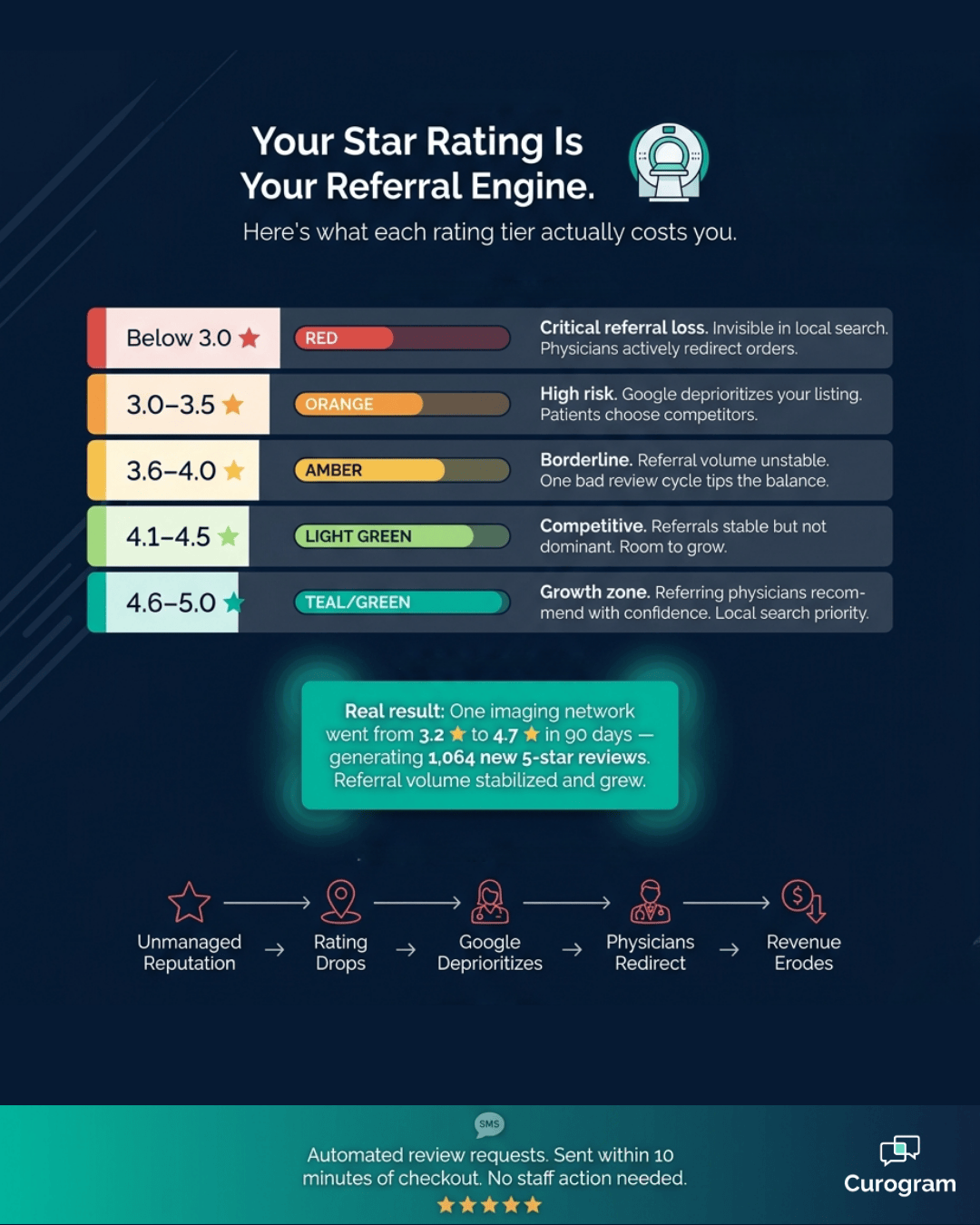
Star rating tiers and their impact on imaging center referral volume

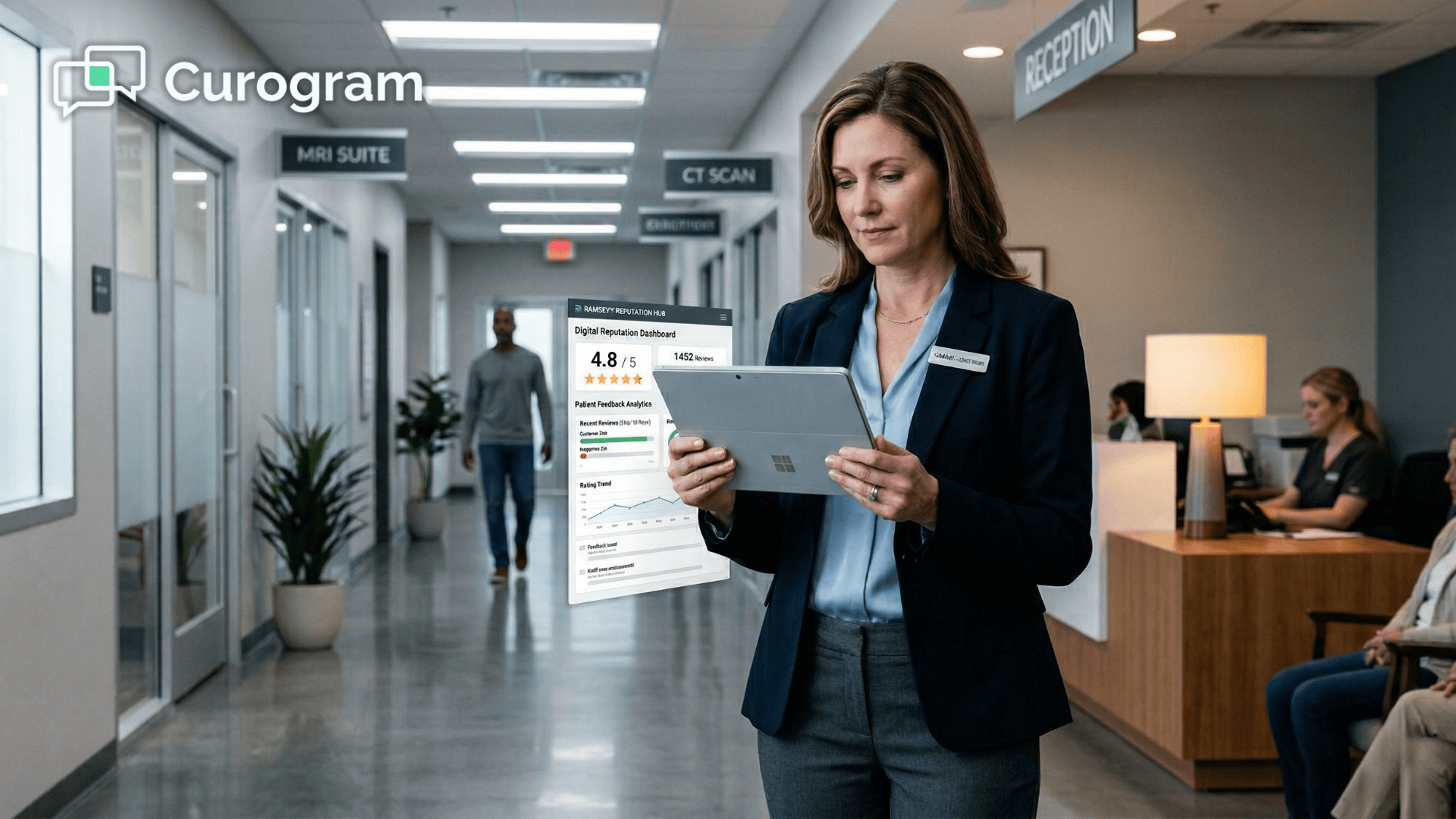
Your Imaging Center's Reputation Dashboard, Built for Operations

This is where the shift happens.

Curogram's reputation platform automates what your staff can't consistently manage on their own.

Post-study review requests are delivered via SMS to patients within minutes of exam completion — before they've left the parking lot.

No staff action required. No manual follow-up. Just a simple, well-timed message asking for feedback.

But the real power is in what happens next.

Smart Sentiment Routing: The Feature That Changes Everything

Not every piece of patient feedback should go straight to Google. That's the insight behind Curogram's smart sentiment routing.

Here's how it works:

  • Patients who rate their experience 4 or 5 are directed to your public Google review profile, amplifying authentic positive voices.
  • Patients who score 1, 2, or 3 are routed to a private feedback form and sent directly to your operations team for service recovery — before that frustration becomes a public review.

This is the difference between proactive and reactive practice reputation metrics tracking. Instead of discovering a problem through a bad Google review, your team hears about it first, privately, and has a chance to make it right.

That's not spin — that's good operations.

No IT Headaches, No RamSoft Reconfiguration

One of the real concerns for imaging center administrators is integration complexity. Here's the short answer: there is none.

Curogram works independently alongside RamSoft. No PACS or RIS system integration is required. Reputation data flows through Curogram's own HIPAA-compliant infrastructure.

Your IT team doesn't need to touch RamSoft configurations, and your staff logs into a separate dashboard that has no overlap with your clinical systems.

The two environments never touch — which also means no HIPAA concerns about mixing clinical and reputation data.

Multi-Location Visibility from One Login

For VPs of Operations and network directors overseeing 10 or more imaging centers, the multi-location reputation dashboard is where the value compounds.

A single enterprise login shows you every location's ratings, review volume, response status, and sentiment trends — simultaneously.

You can see which centers are generating the most organic reviews, which ones are responding fastest, and where radiology center sentiment analysis is flagging a decline before it becomes a referral problem.

The dashboard answers the questions that network leaders actually need answered:

  • Which locations have the highest organic review rates?
  • Where is response time lagging?
  • Which markets are showing early signs of sentiment decline?

Alerts trigger automatically when any location drops below a 4.0-star threshold or when negative keyword clusters — like "wait time," "front desk," or "cleanliness" — start appearing in volume.

You don't have to go looking for problems. The system surfaces them.

This is what online review response management looks like when it's built into operations rather than bolted on as an afterthought.

Patient reading automated review request SMS in imaging center waiting room

From Reactive Scramble to Proactive Workflow: Real Results

Here's what happens when imaging centers actually deploy a systematic reputation workflow.

One multi-location imaging network went from 993 total reviews to 8,159 reviews across all centers in just three months. In that same period, they generated 1,064 new 5-star reviews — more than doubling the volume of positive voices on their public profiles.

Let that settle in. In 90 days.

What the Workflow Shift Actually Looked Like

The staff reputation workflow transformation was just as significant as the numbers.

Before Curogram, reputation management was sporadic — a monthly panic triggered by a new negative review. After implementation, it became a defined daily task.

Before Curogram After Curogram
Monthly Google checks (when remembered) Real-time alerts, every new review flagged immediately
No review generation system Automated SMS sent within 10 minutes of checkout
Reactive, uncoordinated responses Templated HIPAA-compliant responses, approved in 15 min/day
No multi-location visibility Single dashboard, all 15 centers, real-time
Negative reviews shape profile Positive reviews dominate, balanced feedback captured privately

The network ultimately reached a 4.7-star average rating across all locations.

Referring physician confidence was restored. Online review response management became a staff-owned workflow with clear accountability — not a crisis response triggered by a bad review.

The Referral Math

If an 8% referral volume drop — the kind that happens when your rating slides below 4.0 — costs your center even $50,000 per quarter in lost studies, that's $200,000 per year in revenue erosion tied directly to an unmanaged reputation.

Recovering that referral volume with a 4.7-star profile isn't just a vanity metric. It's a revenue protection strategy.

For your team: every satisfied patient who completes a post-study SMS review request is a micro-investment in your long-term referral pipeline.

The system runs automatically. The results compound monthly.

Your Next Step Toward a Stronger Online Presence 

Reputation management is not optional for imaging centers competing for referral volume in saturated markets.

RamSoft powers your clinical excellence — every study read accurately, every algorithm deployed.

Curogram powers your operational excellence — every satisfied patient amplified, every operational issue surfaced before it becomes a public problem.

Think about the gap between what your center actually delivers and how it looks online.

Your radiologists are precise. Your equipment is cutting-edge.

But if a referring physician searches your center name and sees 3.2 stars with two unanswered complaints from last month, none of that clinical excellence is visible to them. The reputation is the first impression. It's the deciding factor before a single order is placed.

RamSoft's AI ensures every study is read accurately. Curogram ensures every satisfied patient is heard publicly.

That's the combination that turns clinical quality into competitive positioning.

Every study matters. Every patient experience matters.

And with the right staff-driven reputation workflow in place, every positive interaction finally gets the platform it deserves — automatically, consistently, and at scale.

Your imaging center doesn't need more people to manage this. It needs the right system. And the system can be running, generating reviews and monitoring sentiment across every location, without a single additional hire or workflow disruption.

Ready to see what your reputation could look like six months from now?

Schedule a demo today and see how Curogram transforms reputation from a reactive scramble into your imaging center's most consistent growth engine.


Frequently Asked Questions

How does Curogram handle HIPAA compliance with automated review requests and responses?

Review requests are triggered only after patient checkout — no protected health information is disclosed. The SMS simply invites feedback and directs patients to a secure form. Automated responses to public reviews use templated language that acknowledges concern without referencing any clinical details — for example: "We appreciate your feedback and would like to understand your experience better. Please contact our manager at [phone]." All data is encrypted, audit-logged, and stored in HIPAA-compliant infrastructure. Review requests also include opt-out language so patients can remove themselves from future requests at any time.

Does implementing Curogram add burden to front desk staff, or is it truly automated?

There is zero additional burden for front desk staff. Review requests are fully automated — no staff action is required to trigger or send them. Dashboard alerts and notifications are designed for operations managers, not front desk teams. If your center adopts templated response management, a front desk manager typically spends about 15 minutes per day reviewing alerts and approving responses. Many centers treat this as a once-daily task for a single manager rather than an ongoing real-time workflow.

How does centralized reputation management work across 10 or more imaging centers in different markets?

A single enterprise dashboard shows all locations simultaneously. Role-based access allows VP-level users to see aggregate metrics across the entire network, while location managers see data specific to their center. Comparative trending identifies which markets are strongest and which need intervention. Multi-location automation ensures consistent review requests and templated responses are deployed across all sites, eliminating workflow variation that could lead to inconsistent patient experiences or uneven response quality. National networks can set brand-wide response standards while still allowing location-specific customization where needed.

How quickly do patients typically receive a review request after completing a study?

Review requests are sent via SMS within minutes of exam checkout — usually before the patient has left the parking lot. That timing matters. Patients are most likely to leave feedback when the experience is still fresh. A message that arrives hours later gets ignored. One that arrives within 10 minutes feels like a natural follow-up. Curogram's automation handles the timing automatically, so your staff never has to think about it.

What happens if a patient leaves a negative public review before the private feedback system captures their concern?

It happens — and Curogram is built for it. When a negative review appears on Google, the system sends an immediate alert to your operations team so no review goes unnoticed. Your team can then respond using pre-approved, HIPAA-compliant response templates that acknowledge the concern professionally without disclosing any patient details. The goal is always speed and tone: a prompt, thoughtful response signals to other prospective patients that your center listens and takes feedback seriously, which mitigates much of the damage a single negative review can cause.