

Pediatric Reputation Management with Fusion Web Clinic
💡 The most effective pediatric reputation management for Fusion Web Clinic uses Curogram's automated SMS review platform. It integrates directly...
11 min read
Aubreigh Lee Daculug
:
March 12, 2026
Table of Contents
A single 1-star review can undo months of hard work. For pediatric therapy clinics, the stakes are even higher — parents are protective, emotional, and highly connected to one another through local mom groups, school networks, and social media.
One public complaint about a billing mix-up or a long wait time can spread faster than any marketing campaign can counter it.
Here's the uncomfortable truth: most negative reviews are not really about the therapy. They are about the experience around it.
A confused parent who couldn't figure out the patient portal. A tired mom who got put on hold for 20 minutes just to confirm an appointment. A dad who felt blindsided by a charge he didn't expect.
These are fixable problems — but only if you hear about them before they end up on Google.
That's where review gating for healthcare comes in. When done correctly, it doesn't suppress honest feedback — it redirects it. Instead of asking every patient to leave a public review and hoping for the best, a gating system first asks parents how their experience went.
Happy parents are invited to share on Google. Frustrated ones are guided to a private channel where someone from your team can actually help them.
Curogram's reputation management tool connects directly with Fusion Web Clinic to automate this process.
The result is a steadily growing library of 5-star reviews, a reliable system for catching problems early, and a clinic reputation that reflects the quality of care you actually deliver.
This article walks through how the system works, why it matters for pediatric practices specifically, and how to use it to turn even your most frustrated parents into loyal, long-term supporters.
Parents of children in therapy are not your average healthcare consumer. They are exhausted, under pressure, and fiercely invested in their child's progress. When something goes wrong — even something small — emotions run high fast.
A misunderstood co-pay or a scheduling mix-up that costs them a session can feel like a much bigger deal than it actually is.
The problem is that Google is always just a few taps away. A frustrated parent sitting in their car after a difficult appointment can leave a 1-star review in under 60 seconds. And that review will be seen by every prospective family who searches for your clinic going forward.
Based on our internal research, 90% of new patient leads check a clinic's Google Business Profile before ever visiting the website.
Unlike a complaint sent directly to the front desk, a public Google review cannot be taken back.
Once it is posted, it becomes a permanent part of how your clinic appears in search results. Other parents read it, weigh it, and sometimes make their decision based on it alone — without ever picking up the phone to hear your side of things.
The financial impact is real. One visible 1-star review on the first page of search results can deter dozens of prospective families.
Over the course of a year, that kind of reputational damage can translate into five-figure revenue losses for a practice that relies on word-of-mouth and local search to grow.
In most cases,
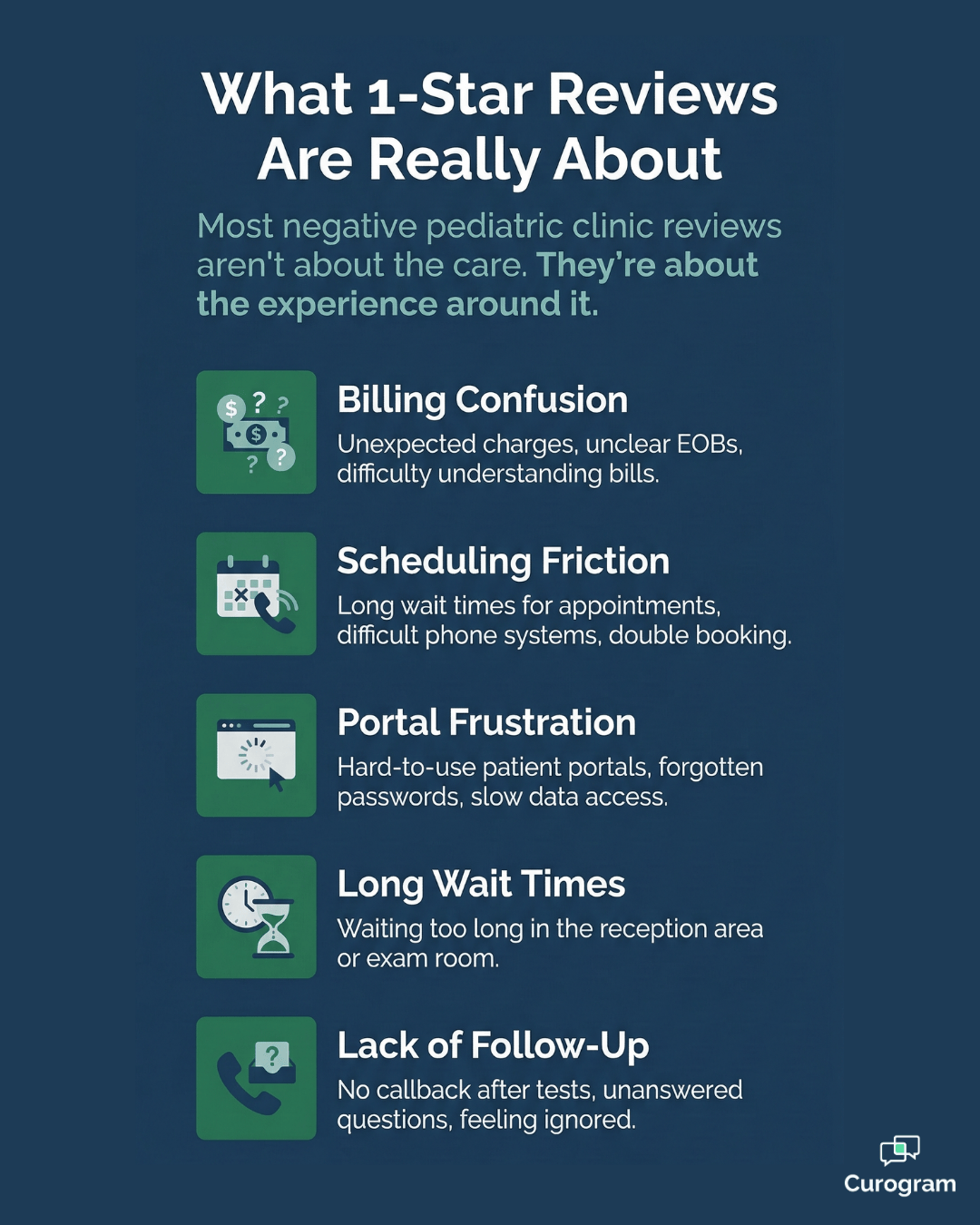
The complaint is not about the quality of the care at all. It's about the experience around it.
The phone tag that never got resolved. The confusing patient portal. The billing statement that arrived without any context. These are communication problems, and every one of them is fixable — but only if you hear about them before they end up on Google.
The most common triggers for negative pediatric clinic reviews include:
None of these are clinical failures. They are operational ones — and that means they are well within your power to address, once you have a system that surfaces them before they go public.
The challenge is that most clinics do not find out about these frustrations until long after the damage is done. A parent might stew on a billing issue for days before venting online.
By then, the moment for a simple fix has passed. Getting ahead of that window is exactly what a well-built feedback system is designed to do.
Curogram's reputation management feature works by creating a private checkpoint between the patient's experience and their Google review. It is not about hiding bad feedback.
It is about giving your team a chance to hear about problems first and respond to them before a frustrated parent reaches for their phone.
The process is simple and fully automated. After an appointment, a text message goes out to the parent asking them to rate their child's session on a 1-to-5 scale.
That one step — a simple SMS — makes all the difference in what happens next.
What makes this approach different from a standard post-visit survey is the logic built into the second step. Most survey tools collect feedback and store it. Curogram acts on it — routing each response toward the outcome that best serves both the parent and the practice.

Step 1: The Private Ask.
The parent receives a text message shortly after their appointment:
"How was your child's session today? Rate us 1–5." It is fast, low-pressure, and requires no app or login.
Because it arrives as a standard SMS, most parents respond without a second thought.
Step 2: The Logic Bridge.
A rating of 4 or 5 triggers a follow-up message inviting the parent to share their experience on Google, with a direct link included. A rating of 1 to 3 takes a different path entirely — the parent is guided to a private manager form where they can describe what happened.
No public review is prompted until there is a chance to make things right.
Step 3: Real-Time Intervention.
The moment a low rating is submitted, the practice manager receives an SMS alert. This is not a daily digest or a weekly report — it is an immediate notification, designed to enable a service recovery call within minutes of the parent leaving the building.
Speed matters here more than most clinic managers realize. A parent who hears from your team within the hour is in a very different emotional state than one who gets a follow-up call two days later.
The sooner the conversation happens, the more likely it ends well — for the family and for your reputation.
When a low rating comes in, the manager's alert already includes everything needed to make an informed follow-up call. Because Curogram pulls data integrate from Fusion Web Clinic,
The notification arrives with:
That level of detail means the person making the recovery call is prepared before they pick up the phone — not scrambling to look up records while the parent is already frustrated.
This is what makes the system genuinely useful rather than just another notification tool.
And because every part of this process runs on Curogram's secure HIPAA compliant review collection platform, you never have to worry about protected health information being exposed anywhere in the feedback chain.
Over time, this system does more than protect your public profile. It builds a culture of accountability inside your clinic — one where problems get named early, addressed quickly, and learned from.
That shift alone can meaningfully improve both staff performance and patient retention.
There is a concept in customer service called the "Service Recovery Paradox."
It sounds counterintuitive, but research backs it up:
A customer who has a problem that gets resolved quickly and well often becomes more loyal than a customer who never had a problem at all. The same holds true in pediatric healthcare.
When a practice manager calls a frustrated parent within minutes of receiving a low rating, something powerful happens. The parent realizes they were heard.
They realize the clinic actually cares. That emotional shift can turn a potential 1-star review into a 5-star story about how well the practice handled a difficult situation.
Think about what that call communicates. It tells the parent that their experience mattered enough for someone to pick up the phone. It signals that the clinic takes its own quality seriously. And it gives the family a reason to come back, even after a rough visit.
That kind of recovery is nearly impossible without a real-time alert system in place.
It is also worth noting that this works in both directions.
When positive feedback comes in, managers can use it just as productively — passing compliments along to specific therapists, recognizing staff who are consistently praised, and reinforcing the behaviors that parents value most.
The feedback system becomes a two-way mirror into your clinic's culture.

The private feedback data is more than a crisis tool — it is a window into how your clinic actually runs. Over time, patterns in the responses will point directly to the bottlenecks causing friction in your Fusion Web Clinic workflow.
Some of the most common fixes practices discover through this data include:
This is the kind of intelligence that most practices never get — because they only hear from patients who bother to call back or post a public complaint.
A steady private patient feedback loop changes that. It surfaces honest input from real families in a protected, actionable way, so your team can keep improving without waiting for something to go wrong publicly.
Over a few months, this data starts to look less like individual complaints and more like a clear picture of where your operations need attention.
That picture is far more valuable than any patient satisfaction score, because it is specific, timely, and tied directly to real appointments rather than anonymous surveys.
Even the best-run clinic will occasionally receive an unfair review.
A competitor might leave a fake 1-star rating. A family who had a bad day might post something that does not fairly reflect the care their child received. In some cases, a single disgruntled person will leave multiple reviews across different platforms.
This is what people in the industry call review bombing, and it can feel completely outside your control.
The good news is that context matters on Google. When a reviewer has only ever left one review — and it happens to be a scathing 1-star post targeting your clinic — most readers are savvy enough to question it.
Suspicious patterns, vague complaints, and reviewer profiles with no history all signal that something may not be legitimate. But that skepticism only protects you if there are enough genuine reviews surrounding the outlier to put it in perspective.
The best defense against review bombing is not to fight every unfair post — it is to have so many genuine 5-star reviews that the outliers simply fade into the background. When your clinic has 200 honest, detailed reviews averaging 4.9 stars,
A handful of suspicious 1-star posts looks exactly like what it is:
Noise. Curogram gives you the volume needed to make outliers irrelevant by keeping a steady flow of post-visit review requests going out after every appointment.
Beyond volume, staying on top of your reviews is essential. Curogram's monitoring feature keeps you informed of every new review across all your locations without requiring you to manually check Google every day.
When a new review appears, you know about it right away — whether it is a glowing 5-star post or something that needs a thoughtful response.
There is also the option to flag clearly fake or policy-violating reviews for removal through Google's own process.
While removal is not guaranteed, Google does take action on reviews that violate its terms — including those from people who were never actually patients. Staying informed means you can act quickly when a suspicious review appears, rather than discovering it weeks later.
Responding publicly to a negative review — even an unfair one — is one of the most visible things your clinic can do. Future patients are watching how you handle criticism.
A calm, professional reply tells them just as much about your practice as the original complaint does.
Keep these principles in mind:
A short, empathetic public reply paired with a genuine private follow-up is almost always more effective than trying to get a review removed. It shows the community that your team takes feedback seriously — and that matters more than a perfect star rating.
The practices that handle negative reviews best are the ones that treat each public response as a marketing moment.
A thoughtful reply to a 1-star post can actually build trust with prospective parents — because it shows them exactly how your clinic behaves when things get hard. That is a more powerful endorsement than any 5-star review on its own.
Your clinic's Google reputation is one of the most valuable assets you have. For pediatric practices in particular, it is often the first thing a searching parent sees before deciding whether to call.
A strong, consistent rating tells that parent what your staff already knows: this is a place that cares.
But building that reputation — and protecting it — takes more than just good intentions. It takes a system. One that catches problems early, amplifies the positive, and gives your team the information they need to keep improving.
That's exactly what Curogram's reputation management feature was built to do.
When paired with Fusion Web Clinic, Curogram automates the entire feedback cycle. Parents get a quick, easy way to share how they felt about a session. Managers get instant alerts when something needs attention.
And Google gets a steady stream of genuine 5-star reviews from families who genuinely love what your clinic does for their child. Based on our internal data, practices using this approach have generated over 1,000 new 5-star reviews in as little as three months.
The clinics that grow fastest are not necessarily the ones with the most staff or the biggest advertising budgets.
They are the ones that listen well, respond quickly, and make every parent feel like they matter. A strong private patient feedback loop makes that possible at scale — without adding extra work to your front desk.
The 1-star review you never get is just as valuable as the 5-star review you earn. Curogram helps you get both outcomes working in your favor at the same time.
Schedule a demo today and see how the Fusion Web Clinic integration can transform the way your practice handles patient feedback — privately, efficiently, and in full compliance with HIPAA.
Google discourages "selective solicitation," which means asking only your happiest patients to leave reviews while ignoring the rest. Curogram's approach is different. Every patient receives the same initial rating request after their appointment. What changes is the second step: patients who rate the experience highly are invited to share that on Google, while those who had a less positive experience are guided to a private channel where a manager can help. The goal is better service, not score manipulation. The result is a more accurate reflection of what your clinic actually delivers.
Yes. Because Curogram pulls appointment data directly from Fusion Web Clinic, every internal alert includes the provider's name alongside the rating and any written feedback. This makes targeted staff coaching much easier. If one therapist's appointments consistently generate low ratings tied to scheduling or communication concerns, your manager can address that directly without having to guess where the friction is coming from.
Nothing. The system is designed to be hands-off and low-pressure. If a parent does not respond to the initial rating request, no follow-up is triggered and no review is prompted. Because it's a simple SMS rather than an email survey or an in-app prompt, response rates tend to be significantly higher. Most parents will tap a single number to rate their session without a second thought. But for those who don't, there is no awkward follow-up and no pressure to respond.
All feedback collected through Curogram's system stays within the platform's secure, HIPAA-compliant environment. Patient information is never exposed in the review process itself, and public responses to Google reviews should always stay general — never referencing specific visits, diagnoses, or treatment details. Curogram's platform is built specifically for healthcare practices, so the compliance guardrails are built in from the ground up.
Results vary depending on your appointment volume and how consistently the system is used, but the growth tends to be visible within the first few weeks. Based on our internal research, one multi-location practice generated over 1,000 new 5-star Google reviews in just three months after implementing Curogram's automated post-appointment feedback system. The more appointments you run through the system, the faster the review count grows.
💡 The most effective pediatric reputation management for Fusion Web Clinic uses Curogram's automated SMS review platform. It integrates directly...
1 min read
💡 The most effective pediatric therapy marketing strategy is building a steady stream of 5-star Google reviews. When parents search for a therapist...
💡Automated review requests in DrChrono help practices collect more balanced and honest patient feedback. Send automated SMS or email review...