
10 min read
NextGen 5-Star First Impression | Win Patients on Google
Aubreigh Lee Daculug
:
April 1, 2026
A profile sitting at 12 reviews and a 4.2-star rating will lose new patients to a competitor with 400 reviews and a 4.9 rating, every time.
Curogram's Review Generation Engine rebuilds that first impression. Triggered automatically by visit completion in NextGen PM, post-visit texts route satisfied patients directly to your location-specific Google page — no staff effort required.
One multi-location client generated 1,064 new 5-star reviews in just three months, with 90% of patients leaving top ratings.
Across every NextGen location, Curogram turns invisible profiles into active patient acquisition channels that win new patients before the first call is ever made.
Think about this.
A patient gets a referral to your orthopedic practice. She's been dealing with knee pain for months and is finally ready to act on it. The provider her PCP sent her to is board-certified, highly experienced, and well-regarded in the community.
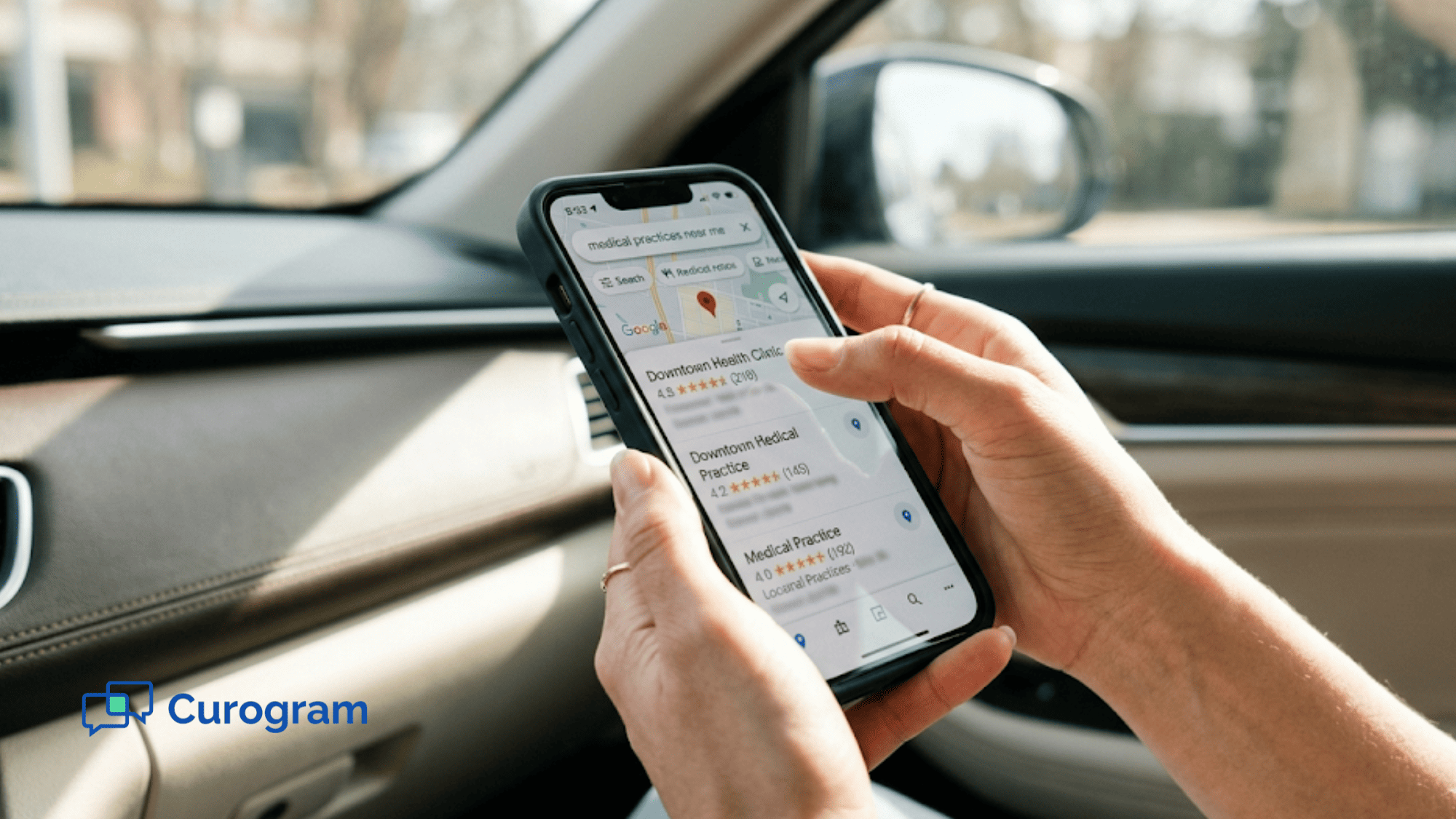
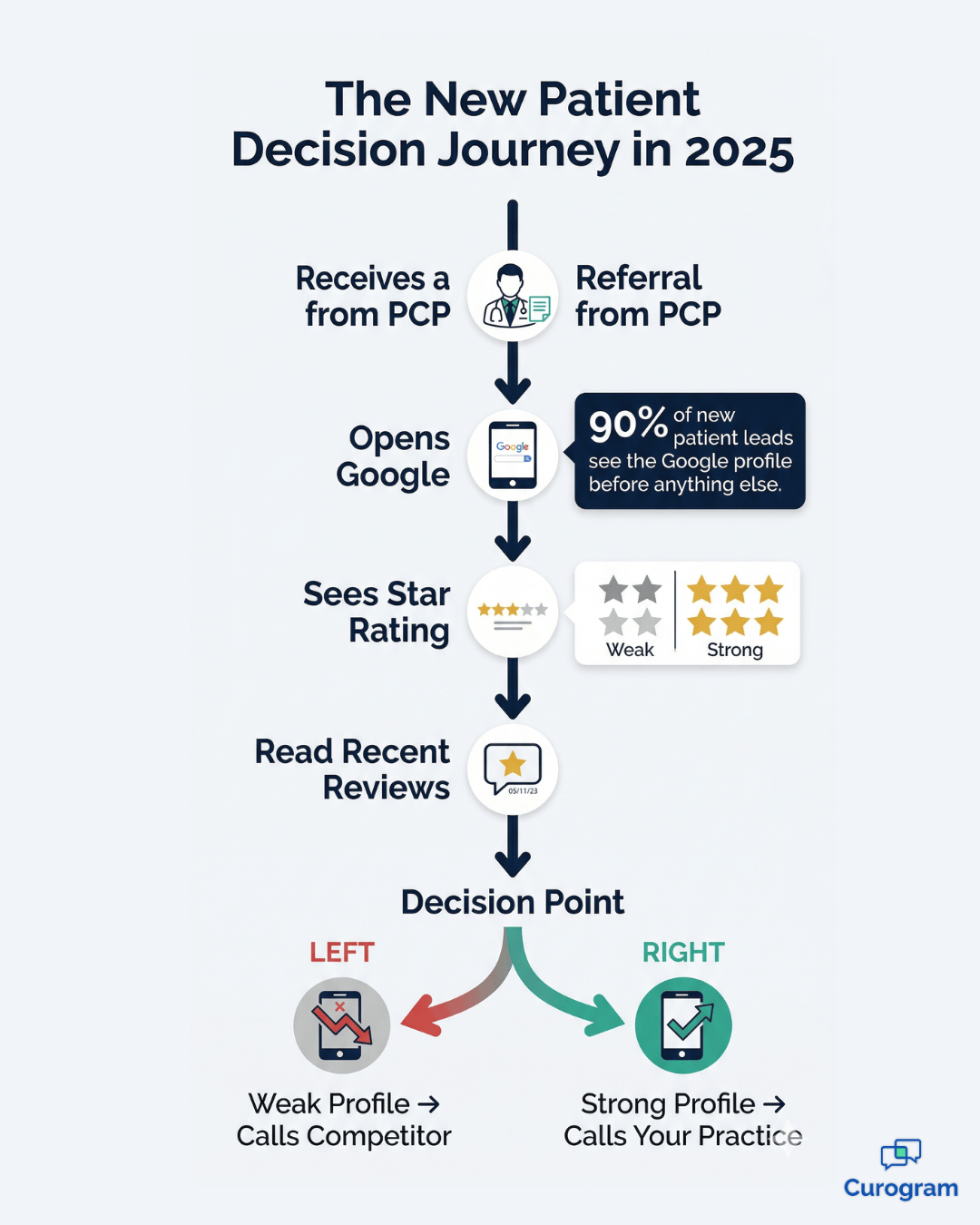
But before she dials a single number, she does exactly what 90% of patients do first: she opens Google.
She sees a 4.2-star rating. Twelve reviews. The most recent one is eight months old.
Then she scrolls. The next listing shows a competing orthopedic group — 4.9 stars, 380 reviews, a post from last Tuesday.
She calls the second practice. The referral is gone.
Here's what makes that sting. The first practice almost certainly delivers better clinical care. They've served their community for years. Their patient satisfaction is genuinely strong.
None of it mattered at the moment of the Google search, because their Google Business Profile told a completely different story.
This plays out constantly across large ambulatory networks running on NextGen Enterprise. For organizations managing 20, 50, or 100+ providers, the problem doesn't stay contained to one location. It spreads.
Some locations have staff who ask for reviews — those profiles look healthy. Most locations don't — and those profiles quietly bleed new patients month after month.
Building a NextGen Google Business Profile 5-star first impression doesn't happen by accident.
It doesn't come from patients deciding on their own to post a glowing review. It requires a system — one that asks every satisfied patient to share their experience, at scale, across every location in the network, without your staff doing a single extra step.
Most NextGen Enterprise organizations are missing that system right now. Their competitors are starting to build it.
This article explains how the gap forms, why it keeps widening, and what it takes to close it for good.
Why Excellent Care Isn't Enough to Win Patients on Google
The Problem With Only 12 Reviews
Imagine your practice sees 200 patients every week.
Your clinical team is skilled. Patients leave satisfied. But your Google profile has 12 reviews — and three of them are 1-star complaints about scheduling hiccups from a rough staffing stretch months ago.
Those three bad reviews represent less than 0.01% of the patient visits your team has delivered. But to the prospective patient comparing profiles on a Tuesday afternoon, they represent 25% of everything she knows about your practice.
That is the 12-review problem. It is not a care quality problem. It is a sample size problem.
The vast majority of your happy patients never left a review, so your Google Business Profile doesn't reflect your reality — it reflects a tiny, unrepresentative slice of it.
And your star rating takes the hit for all of it.
Your Competitor Isn't Delivering Better Medicine — Just More Reviews
Across the street, a competing practice has 400 Google reviews and a 4.9-star rating. They don't necessarily have better physicians. They don't run a more patient-centered operation.
What they have is an automated review generation system that sends a text to every patient after every visit.
Their profile reflects their actual patient volume.
When a prospective patient searches
"Primary care near me" or "orthopedic surgeon [city],"
Google's local search algorithm factors in review volume, star rating, and review recency when deciding what ranks and what doesn't.
Higher volume earns higher visibility. And higher visibility means more new patient calls.
The practice with 400 reviews gets the call. The NextGen location with 12 reviews doesn't appear on the first page. Superior care loses to superior Google presence. It sounds unfair. It is also completely fixable.
How New Patients Actually Make Decisions
The modern patient acquisition journey starts with Google — not the referral letter, not the practice website, not the insurance directory. Google.
A patient receives a referral from their PCP. The first thing they do is search the specialist's name or specialty.
Before they click anything, three signals on the Google profile shape their decision in seconds:
- Star rating — a single number that forms a trust judgment before a word is read
- Review recency — the date on the most recent review tells them whether the practice is active and currently seeing patients
- Review count — volume signals that feedback is representative, not the result of a handful of outliers
If any of these fall short, the patient moves on — often without visiting your website, reading about your providers, or learning about your care quality.
For multi-location networks investing in referral development, marketing campaigns, and patient experience programs, this is where those investments either pay off or collapse.
The NextGen Enterprise Google profile becomes the final filter. A weak profile means a strong clinical reputation never gets the chance to influence the patient's choice. The Google search happens first. The decision is made there.
The Problem Multiplies Across a 50-Location Network
For a NextGen Enterprise network operating across dozens of locations, the invisible practice problem doesn't stay isolated — it spreads unevenly and unpredictably.
Some locations happen to have office managers who consistently ask patients for reviews.
Those locations develop strong Google profiles. Most don't, and those locations stay invisible. The network's patient acquisition performance becomes a function of which individual staff members remembered to bring it up that week, not which locations deliver the best care.
The result is a performance gap that looks impossible to explain on paper.
Location A sees 210 patients per week, has 350 Google reviews, a 4.8-star rating, and generates 42 new patients per month.
Location B sees 205 patients per week — nearly identical volume — but has only 18 reviews, a 4.3-star rating, and brings in just 11 new patients per month.
Same network. Same clinical standards. Same brand investment.
The entire difference comes down to one thing:
Location A has a system that generates reviews consistently.
Location B is relying on hope.
For a marketing leader trying to explain why two nearly identical locations produce such different new patient numbers, the Google profiles tell the whole story.
Building the Google Presence Your Practice Has Always Deserved
What Automated Review Generation Actually Does
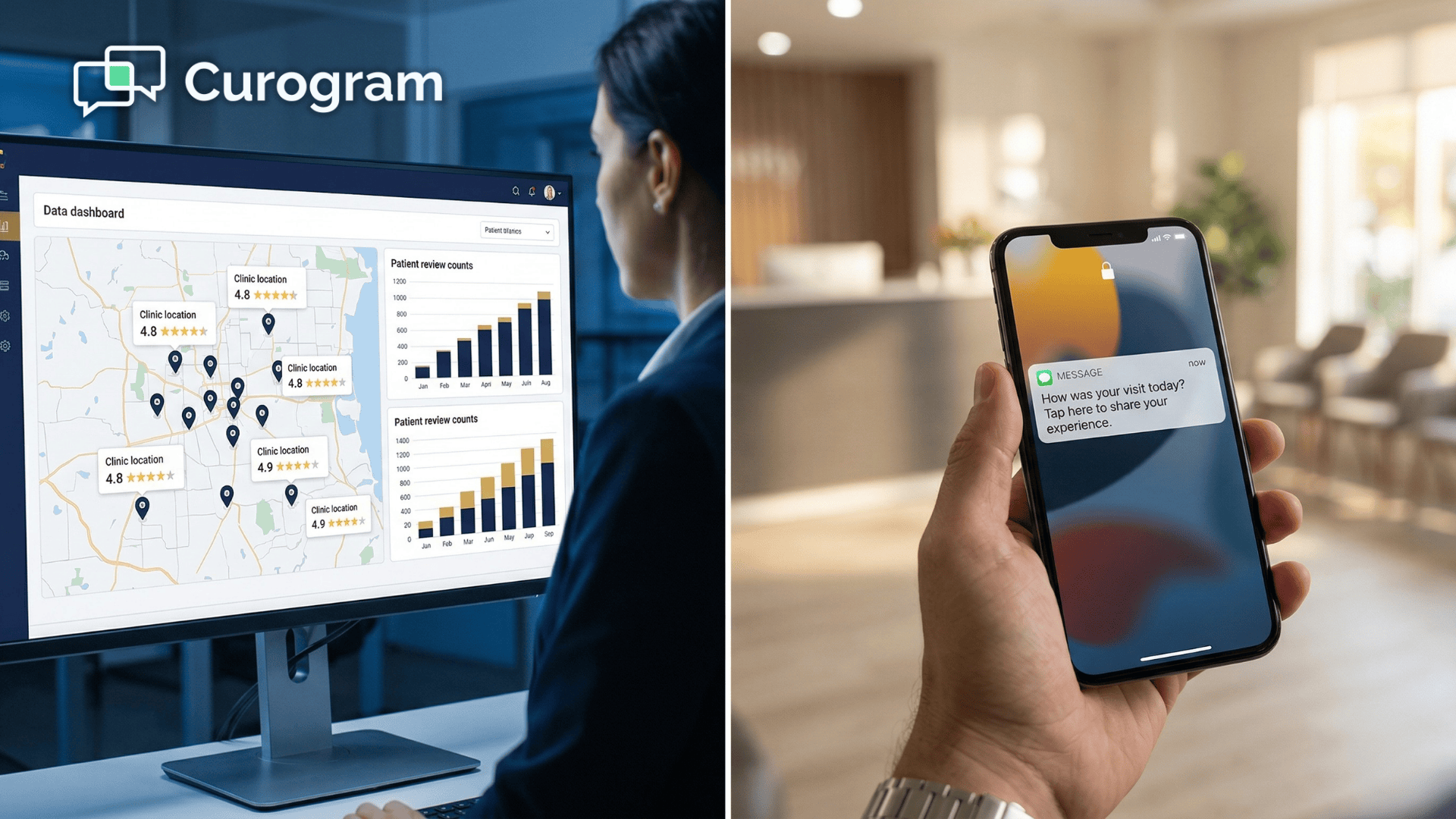
Curogram's Review Generation Engine solves the problem at its source. After every patient visit, an automated post-visit text is sent to the patient's verified mobile number on file in NextGen. The message asks about their experience.
Patients who respond positively are taken directly to the location-specific Google Business Profile to leave a review. Patients who flag a concern are routed internally, giving your team the chance to address the issue before it becomes a public 1-star post.
No staff prompting. No awkward checkout conversations. No manual follow-up lists.
The system runs in the background while your team focuses on patient care — which is exactly what they are there for.
This is how a 5-star first impression Google reviews strategy actually works at a NextGen multi-location enterprise scale:
Not by crossing your fingers, but by automating the ask across every single visit, every single day.
First Impression Analytics: Connecting Reviews to Real Growth Metrics
Curogram's dashboard links review generation activity directly to patient acquisition trends. Marketing leaders can see Google profile performance alongside new patient volume at the individual location level — not just as a blended network number.
Review velocity tracking confirms that new reviews are being generated weekly, which matters to Google's recency ranking signals. Star rating trends confirm the 4.8+ average is holding firm across the board.
For organizations that report new patient acquisition as a leadership KPI, the dashboard provides something most reputation tools don't:
A direct connection between Google reputation performance and growth outcomes.
That connection is measurable and reportable for the first time.
This is the feature Curogram calls First Impression Analytics — turning a vague goal ("our reviews are improving") into a concrete, trackable business result.
No New Vendor, No New Workflow for Your IT Team
One of the most common objections to adding a reputation management tool is the implementation burden: new logins, new training, new support tickets, and a new vendor relationship to maintain.
Curogram's review generation doesn't add any of that.
Review requests are triggered directly by visit completion in the NextGen PM schedule — the same integration that already powers patient texting, appointment reminders, and digital forms.
For IT directors evaluating the addition, here is what is not required:
- No manual profile configuration per location
- No separate login or reputation vendor dashboard
- No staff training on a new platform
- No custom routing setup — the Google link resolves to the correct location automatically
For a NextGen Enterprise technology team already managing a full stack, this is one more capability on a platform they know — not a new problem to onboard, integrate, and support.
Building the Case for Your Leadership Team
For marketing and growth leaders making the internal investment case, the 5-star first impression directly addresses where patient acquisition decisions actually get made.
When every location in a NextGen multi-location enterprise network has a strong Google presence, the organization competes effectively in every local market it serves.
New patient acquisition Google review volume and star ratings are confirmed factors in how often your locations surface in local search results.
Referral follow-through improves because patients who search a referred provider see a profile that earns their trust. Direct-to-consumer acquisition improves because stronger profiles rank higher in competitive local search.
The network stops losing patients to competitors who simply got their Google act together first — and starts winning patients based on the quality of care it was always delivering.

What Happens When Every Location Finally Shows Up on Google
The Numbers Behind the Transformation
One multi-location Curogram client saw their total Google reviews grow from 993 to 8,159 over a sustained campaign period.
In a single three-month stretch, they generated 1,064 new 5-star reviews through automated post-visit texts — with 90% of patients who received a review request leaving a 5-star rating.
To put that in perspective: 1,064 new reviews in 90 days works out to roughly 12 new reviews per day.
For a 50-location NextGen network running the same system, that pace produces thousands of new reviews every quarter — across every location, not just the ones with review-conscious office managers.
This is what happens when a network's Google presence finally catches up with the care quality it was always delivering.
From Invisible to the First Call
Here is what the shift looks like when automated review generation runs at network scale. Before Curogram, a typical multi-location network might average a 4.1-star rating with roughly 993 total reviews spread unevenly across locations — many of them months out of date.
After three months, that same network climbs to a 4.8-star average, accumulates 8,159 total reviews, and adds 1,064 new 5-star posts from patients who received a post-visit text.
The share of patients leaving 5-star ratings? 90%. That is not a rounding error. That is the actual satisfaction rate your practice was always delivering — finally made visible.
The location that used to lose referrals to the competitor across the street now wins them. Not because the clinical quality changed — it was always good — but because the NextGen multi-location Google reputation now reflects the truth.
Patients searching for care in the area see a profile with hundreds of recent, five-star reviews. They see a practice that other patients trust. And they call.
A Win at Every Level of Leadership
- Marketing leaders gain a measurable link between review volume, local search visibility, and new patient call volume — reportable, benchmarkable, and compelling for continued investment
- Operations leaders see location-level performance start to equalize as automation removes the dependency on individual staff behavior
- Network leadership watches the years of investment in clinical excellence, referral relationships, and marketing spend finally convert where it counts most
That moment is the Google search. With the right system in place, your network wins it every time.
Your Patients Are Already Searching
The Google search happens before the phone call. Before the website visit. Before the referral letter gets acted on. And for most NextGen Enterprise organizations right now, that search ends in a loss — not because the care isn't excellent, but because the profile doesn't reflect it.
The gap between 12 reviews and 400 reviews isn't a measure of patient satisfaction. It's a measure of who built the system first.
Your competitors aren't winning patients with better medicine. They're winning patients with better Google profiles and stronger local search rankings.
And the longer that gap stays open, the more referrals, direct inquiries, and marketing dollars quietly evaporate at the moment of the Google search.
Curogram closes that gap. The Review Generation Engine builds the NextGen Google Business Profile 5-star first impression that your care quality has always deserved — automatically, across every location, without adding to your staff's workload or your IT team's burden. Post-visit texts go out.
Satisfied patients leave reviews on the right location's profile. Negative feedback is caught internally.
Star ratings climb. Review volume builds. New patient acquisition follows.
One client generated 1,064 new 5-star reviews in three months. 90% of patients who received the review text left 5 stars.
For a 50-location NextGen network, that kind of velocity transforms every location's Google presence within a single quarter — and the effect on patient choice and review recency compounds from there.
You've already done the hardest part. You've built the clinical quality, the referral relationships, and the patient experience worth five stars. All that's left is making sure Google — and the patients who use it every day — can actually see it.
Schedule a demo today. See how the Curogram builds 5-star first impressions across every NextGen Enterprise location, and get a custom model of what new patient acquisition growth could look like for your network.
Frequently Asked Questions
Google's local search algorithm uses review volume, star rating, and review recency as confirmed ranking factors in the "Local Pack" — the map results that appear when patients search for providers nearby. A location with 400 recent reviews and a 4.8-star rating will consistently outrank a location with 12 older reviews and a 4.2 rating for the same search terms. For NextGen Enterprise Google profile optimization across multi-location networks, building review volume at every location improves visibility in every local market the organization serves — not just the flagship locations.
Automated review generation is the fastest path to rating recovery when a small number of negative reviews are having a disproportionate impact. When a practice has 12 total reviews and three are negative, those three reviews control 25% of the star rating. When that same location generates 200 new reviews with a 90% 5-star rate, the negative posts become statistically insignificant. Curogram's satisfaction filter also routes negative patient feedback internally, supporting service recovery while ensuring that future public reviews skew positive. The net effect: the rating recovers, and the profile starts working for your practice instead of against it.
Curogram's reporting delivers review generation metrics — volume, velocity, star ratings, and sentiment — at the individual location level. Marketing teams can correlate these trends with new patient call volume and appointment booking data from NextGen PM to establish the relationship between Google profile strength and actual acquisition numbers. While multi-channel attribution always involves some complexity, organizations consistently report measurable increases in new patient inquiries as review volume grows, profiles gain visibility, and patient choice increasingly shifts in their favor. The data connection is there — Curogram makes it visible.
Yes — and that is one of the most important distinctions for multi-location organizations. Because review requests are triggered directly by visit completion in the NextGen PM schedule, every location that shares the integration is covered from day one. There is no phased rollout by location, no manual setup for individual offices, and no dependency on whether a particular site's staff is engaged with the process. The system runs at the network level. That means a 50-location organization doesn't build a strong Google presence at two or three flagship practices — it builds one across all 50, at the same time, without additional configuration work.
Curogram's review generation approach is fully aligned with Google's guidelines for soliciting patient reviews. The system sends post-visit texts to actual patients who completed a real appointment — there is no incentivizing of reviews, no fake or third-party submissions, and no manipulation of which patients receive the outreach. Every review generated through Curogram reflects a genuine patient experience. The satisfaction filter routes negative feedback internally rather than suppressing it from Google, which is consistent with ethical reputation management practices and keeps the network's public profile honest and trustworthy.