

12 min read

The Mom-Group Referral: How Reviews Drive Pediatric Therapy Growth

The Mom-Group Referral: How Reviews Drive Pediatric Therapy Growth
💡 The most effective pediatric therapy marketing strategy is building a steady stream of 5-star Google reviews. When parents search for a therapist for their child, they almost always check ratings and read reviews before making a single phone call.     

Clinics that collect reviews consistently show up higher in local search results and win more new patients.  

Word-of-mouth for pediatric clinics has moved online. Parents now share recommendations in Facebook groups and community forums — and a low star rating can stop a referral cold.
  

Clinics using Fusion Web Clinic can automate the review request process so that every completed session has a chance to become a 5-star review.

Curogram integrates directly with Fusion Web Clinic to send automated SMS review requests after each appointment.

This turns routine visits into a continuous source of social proof in healthcare, helping pediatric therapy practices grow their reputations without any extra staff effort.

A parent just got a referral for their child's occupational therapy. Before they pick up the phone, they do one thing first: they check Google.

If your clinic has a handful of old reviews and a 3.5-star rating, the call probably never comes.

But if you have 100+ recent 5-star reviews? You look like the obvious choice in the room. That gap — between the quality of care you deliver and what a searching parent actually sees — is where patients get lost.

And this isn't just a visibility problem. It's a trust problem.

Parents of children with developmental or therapeutic needs are among the most thorough researchers in any consumer group. They talk to other parents, scan community forums, and weigh every piece of information before committing to a provider.

If your clinic doesn't show up strong in that process, no amount of excellent clinical work will compensate for the silence online.

The good news is that gap is completely fixable. A well-designed pediatric therapy marketing strategy doesn't require a big ad budget or a marketing team. It starts with the patients you already have and the outcomes you're already achieving.

The families you've helped are your greatest untapped marketing resource — they just need a simple, timely nudge to share what they know.

What's more, the parents most likely to leave a glowing review are the ones who just watched their child make a real breakthrough. They're emotional, grateful, and ready to tell everyone they know.

Capturing that moment — automatically, consistently — is what separates practices that grow steadily from those that plateau despite delivering excellent care.

This article will show you exactly how reviews become your most powerful growth tool, why traditional advertising falls short, and how automation turns every completed session into a chance to win your next patient.

Where Today's Parents Really Find Their Child's Therapist

After the Referral: What Parents Actually Do

Doctor referrals still matter. But the moment a parent leaves that office, a second decision-making process begins — and it happens almost entirely online.

Here's the typical path:

  • Search the clinic's name on Google and scan the star rating
  • Read the three or four most recent reviews
  • Post in a local Facebook parenting group: "Has anyone been to this place?"
  • Visit the clinic website only if the reviews pass the test

This behavior has become the norm, not the exception. A clinic might be recommended by every pediatrician in town, but if its Google Business Profile looks neglected, parents will hesitate.

The referral doesn't disappear — it just goes to a competitor who looks more credible online.

It's worth understanding why parents behave this way. Choosing a therapist for a child — especially one with a developmental delay, sensory needs, or a speech disorder — is one of the most stressful decisions a family can make.

They are not browsing casually. They are searching for reassurance, and reviews are the closest thing to that reassurance they can find before walking through your door.

Think of word-of-mouth for pediatric clinics the same way you'd think of a Yelp page for a restaurant. No matter how good the food is, a sparse profile with outdated reviews signals something is off. The same logic applies to healthcare.

Parents make emotionally high-stakes decisions, and they want validation from other parents before they commit.

This is what makes reviews so powerful in this space.

A review from a parent that says

"My daughter finally hit her speech milestones thanks to this team" carries more weight than any ad you could ever run. It speaks directly to the fears and hopes of every parent searching for similar help.

There's also a timing element that many clinic owners overlook. The parent who gets a referral on a Tuesday morning may have already chosen a provider by Tuesday evening — based entirely on what they found online.

If your profile wasn't competitive in that window, you never even got a chance to make your case.

The Digital Moat Advantage

When a clinic builds up 100 or more 5-star reviews,

Something important happens:

It becomes very hard for a newer or less-organized clinic to compete. Based on our internal research, 90% of new patient leads see a practice's Google Business Profile before they ever visit the clinic's website.

That profile — and the reviews on it — is effectively your digital front door.

A thick review history acts as a moat. It takes months or years for a competitor to build that kind of credibility from scratch. For established clinics, this represents a real, lasting competitive edge that automation makes much easier to sustain.

The volume itself sends a signal. A clinic with 12 reviews and a clinic with 180 reviews may offer identical care, but the one with 180 reviews looks far more established and trustworthy to a first-time visitor.

Volume isn't vanity — it's perception, and in healthcare, perception drives action.

Why Ads Underdeliver While Reviews Keep Paying Off

Paid advertising has its place, but it has a fundamental problem: the moment you stop paying, it stops working.

A Facebook ad disappears from the feed.

A Google ad stops showing the second your budget runs out. Reviews, on the other hand, are permanent.

They continue to influence every parent who searches for your clinic for years to come.

There's also a trust gap that advertising simply cannot close. Parents of children with special needs are a discerning group.

They research carefully, compare options, and lean heavily on recommendations from people who have been in their shoes. They trust other parents at least 10 times more than they trust a paid ad.

Consider what happens when a parent sees a Facebook ad for a pediatric therapy clinic. Even if the creative is compelling, the instinctive next step is to open Google and look the practice up. If the reviews are thin or lukewarm, the ad spend was wasted.

The ad created curiosity;

The reviews killed the conversion. This is exactly why the two need to work together — and why reviews are the more foundational investment.

This is the core of social proof in healthcare:

It's not your voice they want to hear — it's the voice of another family who went through what they're going through.

A real review with a specific outcome ("He finally reached his speech milestones!") creates an emotional connection that no marketing copy can replicate.

Reviews win on three dimensions that ads simply can't match:

  • Permanence a review stays indexed on Google indefinitely; an ad disappears the moment you stop paying
  • Authenticity it's another parent's voice, not your own marketing copy
  • Compounding value each new review adds to your overall rating and search ranking over time

From a cost standpoint, the math strongly favors reviews. Monthly ad spend can run into the thousands with results that are hard to track.

Automating Google review requests through a tool like Curogram costs a fraction of that — and every review it generates is a permanent, indexed asset that builds authority over time.

There's also a practical ceiling on what advertising can achieve in a local market. Most pediatric therapy clinics serve a relatively small geographic area.

At some point, you've saturated the local ad audience. But a strong review profile keeps working without limits — it reaches every new parent who moves into the area, every family who gets a fresh referral, and every parent who simply changes their mind about seeking help for their child.

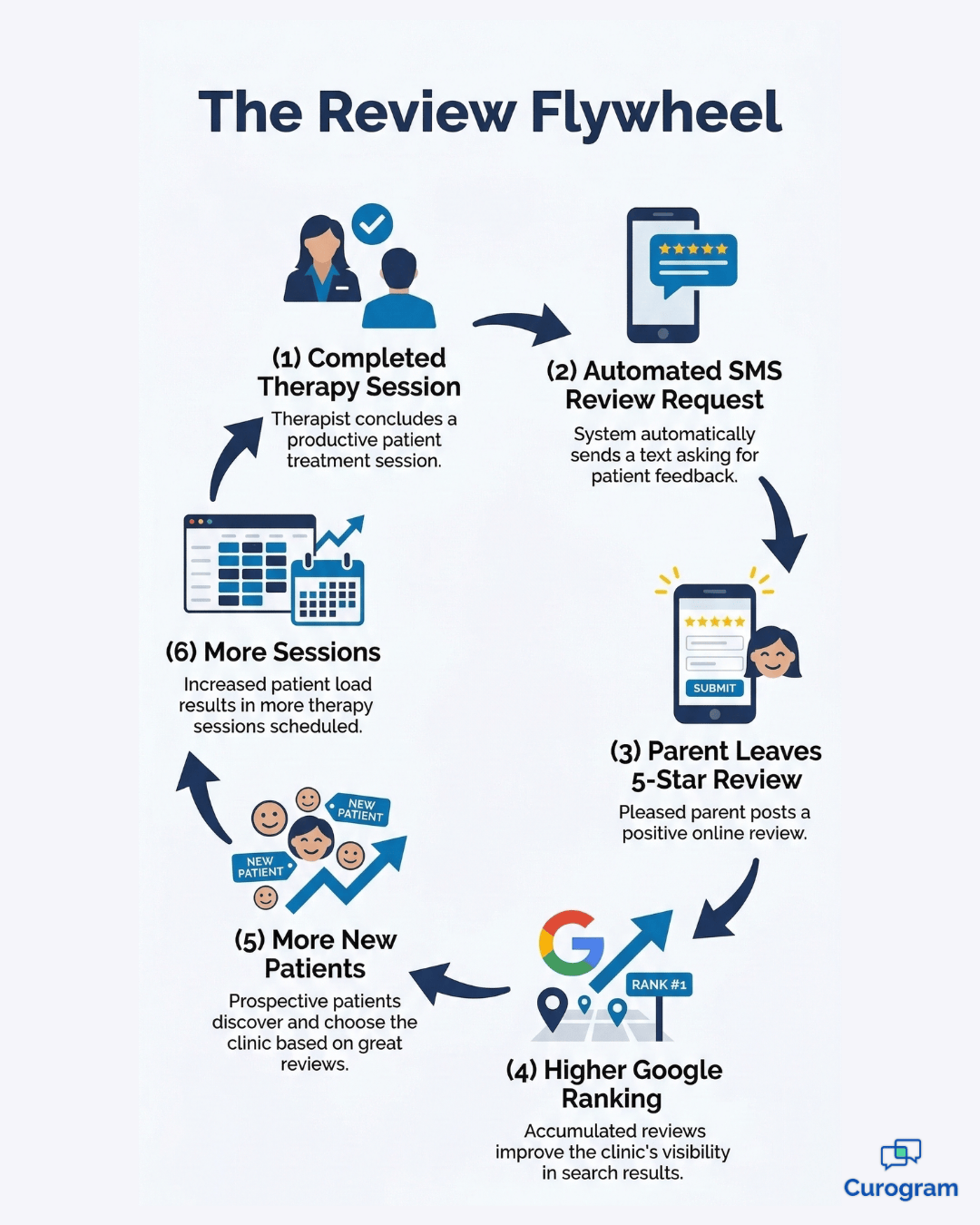
Infographic showing how automated Google reviews drive pediatric therapy clinic growth

Putting Your Fusion Web Clinic Data to Work for Growth

One of the most underused opportunities for pediatric therapy practices on Fusion Web Clinic is the data that's already sitting in the system.

Every completed session, every milestone reached, every goal logged — all of it can serve as a trigger for smarter reputation management.

Most clinic software is built to manage care, not to grow the business. Fusion Web Clinic is great at tracking patient progress, scheduling, and documentation. But it doesn't have a built-in way to turn those completed visits into public reviews. That's the gap Curogram fills.

Curogram integrates with Fusion Web Clinic to monitor the appointment schedule. When a session is marked as completed, the system can automatically send a review request via SMS to the parent.

The timing is intentional:

This is often when the family is freshest on their experience and most likely to share positive feedback.

The setup is straightforward and doesn't require any changes to your existing workflow inside Fusion. Your team keeps scheduling and documenting care exactly as they always have.

Curogram runs in the background and handles the reputation side of the operation without adding a single task to anyone's day.

When to Send the Request for the Best Results

For even better results,

Consider timing the request to align with a major milestone. If a child has just met a key therapy goal tracked in Fusion, that moment of celebration is exactly when a parent is most grateful — and most likely to want to shout about it publicly.

This targeted approach represents one of the most practical Fusion Web Clinic growth hacks available to clinic operators today.

Most review requests fail not because parents are unwilling to help, but because the ask comes at the wrong moment.

A message sent two hours after a stressful intake session will get a very different response than one sent after a session where a child made a breakthrough. Timing the request thoughtfully — even just setting a smart default delay — can meaningfully improve your response rate.

Recency also matters beyond just timing. Google's local search algorithm gives more weight to clinics that receive reviews on a regular basis.

A clinic that gets five reviews in one week and then nothing for two months is viewed very differently from one that gets a steady stream of new reviews throughout the month. Curogram keeps that heartbeat going automatically.

Taking Reviews Beyond Google

Once you start collecting strong reviews, don't leave them sitting on Google.

Your best testimonials can work much harder across other channels:

  • Pin top reviews to your clinic's website homepage or testimonials page
  • Include standout quotes in new patient welcome packets and "Meet the Team" materials
  • Share recent reviews on your social media pages to stay visible between ad campaigns

This multi-channel approach reinforces your practice's reputation as the community's first choice and builds the kind of brand trust that is very difficult to buy.

A single 5-star review can do a lot of work if you put it in the right places.

A quote that reads

"This clinic changed our family's life" on your website homepage hits differently than the same words buried on a third-party review site.

You earned those words — make sure as many people as possible see them.

Occupational therapist engaging with a young child during a pediatric therapy session

Freeing Up Your Team to Focus on What Matters Most

For most clinics,

The front desk is already stretched thin. They're managing check-ins, handling calls, verifying insurance, and fielding questions from anxious parents.

Asking them to also remember to request a review after every session is an unrealistic add-on — and if it feels awkward to ask, it simply won't happen consistently.

Even the most motivated staff members will eventually forget, skip it during a busy afternoon, or feel uncomfortable bringing it up with a family they've grown close to. That inconsistency is the enemy of a strong review profile.

You might get a burst of reviews after a staff push, followed by months of silence. Google notices that pattern.

This is one of the most practical arguments for Google review automation for OTs and PTs.

The "ask" is handled professionally and automatically via SMS, without requiring any staff member to bring it up in person. The parent receives a friendly message at the right moment, and they can leave a review in under 60 seconds from their phone.

When you remove the human inconsistency from the process, review collection becomes predictable.

Here's what Curogram handles without any staff involvement:

  • Monitors Fusion Web Clinic for completed appointments in real time
  • Sends a professionally worded SMS to the parent at a pre-set interval after the session
  • Scales the same process across every therapist on your roster, every day

The result is a system that works just as reliably on a packed Friday afternoon as it does on a quiet Tuesday morning.

No one has to remember. No one has to feel awkward. And no appointment slips through without a review opportunity attached to it.

Based on our internal data, practices using Curogram's automated review system have seen results like 1,064 new 5-star reviews collected in just three months — with 90% of participating patients leaving 5-star feedback.

That kind of volume would be essentially impossible to achieve through manual outreach alone.

The Growth Loop in Action

More reviews lead to better rankings. Better rankings bring in more patients. More patients mean more opportunities to deliver great care — and more chances to collect new reviews.

This positive feedback loop is the engine behind sustainable clinic growth, and it feeds itself once the automation is in place.

What makes this loop so valuable is that it compounds over time. The first 20 reviews help you show up. The next 80 help you stand out.

By the time you have 150 or more, you've built a level of visibility and credibility that very few local competitors can challenge. And unlike an ad campaign that resets to zero when the budget runs out, a review profile just keeps growing.

What Automation Looks Like at Scale

Clinic Size Sessions/Month Est. Reviews/Month* Annual Review Growth*
Small (1–2 therapists) 80–120 12–18 144–216
Mid-size (3–5 therapists) 200–350 30–52 360–624
Large (6+ therapists) 400–600 60–90 720–1,080

Estimated at a ~15% review response rate from SMS requests. Actual results will vary.

What a Fully Automated Reputation Looks Like Six Months from Now

It's easy to understand the value of reviews in theory. But it helps to picture what the outcome actually looks like for a real clinic six months after switching on automation.

In the first few weeks, the changes are small. A handful of new reviews appear. Your star rating ticks up slightly. Parents who search your clinic's name start seeing a more active, recent profile.

Nothing dramatic — just a steady drip of new social proof in healthcare that wasn't there before.

By month two or three, the volume starts to compound. You're picking up reviews from multiple therapists, across different appointment types, covering a range of patient experiences.

Some mention specific therapists by name. Others describe outcomes that speak directly to what new families are searching for. Each one adds texture and credibility to your profile that no ad campaign could manufacture.

By month six, the profile looks completely different from where it started. You have more reviews than most of your local competitors combined. Your Google Maps ranking has improved.

Parents who were on the fence about calling are no longer on the fence — the social proof does the convincing before you ever pick up the phone.

New patient inquiries start referencing your reviews directly:

"We found you on Google and you had so many great reviews."

That's the trajectory automation creates. It doesn't happen overnight, but it happens reliably — and it keeps going as long as your clinic keeps seeing patients.

The review engine runs whether your front desk is slammed or quiet, whether it's a Monday morning or a Friday at 5 PM. It doesn't forget, it doesn't feel awkward, and it never takes a day off.

Your Reputation Is Your Referral Engine — Start Building It Today

Parents don't choose pediatric therapy providers the way they choose a plumber.

They research, they compare, and they lean hard on the experiences of other families. A strong review profile isn't a bonus — it's the foundation of a modern growth strategy.

The practices that are winning new patients right now aren't necessarily the ones with the biggest marketing budgets.

They're the ones that figured out how to turn the outcomes they're already achieving into visible, public proof that shows up every time a parent opens Google. That's the real edge.

Think about what that means in practice. Every session your therapists complete is a chance to add another voice to your public profile. Every child who hits a milestone is a story waiting to be told.

The infrastructure to capture those stories automatically — without burdening your staff or interrupting your clinical workflow — already exists. It's just a matter of switching it on.

Curogram makes this possible without adding work to your team's plate. It connects directly to Fusion Web Clinic, listens for completed appointments, and sends a perfectly timed SMS review request on your behalf.

Every session becomes an opportunity. Every happy parent becomes a potential ambassador. And every new review builds the kind of reputation that takes competitors years to match.

Clinics that start this process early have a compounding advantage.

By the time a new competitor opens across the street, you already have 200 reviews, a 4.9-star average, and a spot in the top three of every relevant local Google search. That's not luck — that's the result of a system that ran quietly in the background while your team focused on patient care.

The best time to build your review engine was six months ago. The second best time is right now.

Ready to see how Curogram can transform your clinic's reputation and help you increase therapy referrals via reviews? Schedule a demo today and let us show you exactly how it works for Fusion Web Clinic practices.


Frequently Asked Questions

Does collecting more reviews actually help our ranking in Google Maps?

Yes — and it's one of the most direct levers you have. Review volume, average star rating, and how recently you've received new reviews are all top-weighted signals in Google's local ranking algorithm. Clinics that appear in the "Local Pack" (the top 3 map results) almost always have a high volume of recent, positive reviews. Consistent automation keeps you competitive in that space.

Can we repurpose our Google reviews in other marketing materials?

Absolutely. Authentic parent testimonials are some of the most powerful content you can put in front of prospective families. Use your strongest reviews on your website's homepage, in new patient welcome packets, on social media, and in brochures. They build trust faster than any professionally written copy because they come from real parents describing real results.

How does Curogram know when to send the review request?

Curogram syncs with your Fusion Web Clinic schedule in real time. When an appointment is marked as "Completed" in the system, Curogram waits for a pre-set delay — typically around one hour — before automatically sending the SMS review request to the parent. The timing is configurable, so you can adjust it to fit your clinic's workflow.

Is review automation compliant with healthcare regulations?

Curogram is built with HIPAA compliance in mind. The SMS review requests are designed to avoid disclosing any protected health information, so you can automate the process with confidence. The messages are simple, friendly, and direct — just like sending a text from your front desk, but without the manual effort.

What if a patient leaves a negative review?

Negative reviews happen to every clinic, and how you respond matters. A professional, empathetic reply to a critical review actually builds trust with prospective patients who are reading it. The good news is that when you have a high volume of positive reviews, an occasional negative one has far less impact on your overall rating and ranking.


Reputation Management in Veradigm with Curogram

Reputation Management in Veradigm with Curogram

💡 Imaging centers face unique trust issues. A single bad review can damage referral flow and hurt revenue across multi-site networks.Reputation...

Read More
Automating Patient Review Requests in Cloud 9 Ortho Practices

Automating Patient Review Requests in Cloud 9 Ortho Practices

💡Cloud 9 makes it easy to get more good reviews from parents without adding extra work for your front desk team. Send automatic review messages...

Read More
Pediatric Reputation Management with Fusion Web Clinic

Pediatric Reputation Management with Fusion Web Clinic

💡 The most effective pediatric reputation management for Fusion Web Clinic uses Curogram's automated SMS review platform. It integrates directly...

Read More