Athenahealth Reputation Management: The Review Engine Guide
💡 Athenahealth reputation management powered by Curogram's Review Engine turns every patient visit into a Google review — with zero staff effort.
10 min read
Aubreigh Lee Daculug
:
March 18, 2026
Reputation management for Azalea Health rural clinics with automated reviews isn't just a marketing tactic — it's a matter of fairness.
Your clinic may serve hundreds of patients every month with genuine care, but if your Google profile shows 15 reviews and a 3.4-star average, that's the first impression a new family sees when they search for a doctor near them.
The gap between your real-world reputation and your online reputation is a common problem for rural health centers. It's not because patients are unhappy. It's because satisfied patients go home quietly, while the rare unhappy one heads straight to Google.
Over time, that imbalance shapes your digital presence in ways that hurt your ability to attract new patients.
Curogram integrates with Azalea Health to fix that imbalance automatically. After each completed visit, patients receive a simple text asking how their experience went.
Those who respond positively get a direct link to leave a Google review. Those who flag an issue get a private follow-up routed to your practice manager — so you can resolve it before it becomes a public complaint.
The result: a Google profile that actually reflects the care you provide. This article walks through why rural clinics are stuck in this cycle, how automated review collection breaks it, and what you can expect once the system is running.
Picture a rural FQHC that sees 800 patients a month. It has 15 Google reviews total. Four of them are negative — a billing complaint, a wait time gripe, an unhappy comment about a policy, and a one-star post with no explanation.
The other 11 positive reviews are spread across three years. To someone searching Google for the first time, this practice looks unremarkable at best.
The 780 patients who had a good experience this month? They went home, got on with their lives, and never thought to post about it. This is what the rural clinic online reputation building challenge actually looks like — not angry patients, but quiet ones.
The problem isn't your care. It's that most people only feel motivated to write a review when something goes wrong.
Research consistently shows that patients who have a negative experience are far more likely to post a review than those who leave satisfied. That asymmetry isn't unique to healthcare — but in healthcare, it's especially damaging.
A single harsh review about a billing issue or a long wait can follow a practice for years, quietly steering new patients toward competitors who have done nothing more than ask their happy patients to speak up.
How a Local FQHC Stacks Up at First Glance
| Provider | Star Rating | Review Count |
|---|---|---|
| Local FQHC | 3.4 | 15 reviews (over 3 years) |
| Urgent Care Chain (20 mi away) | 4.5 | 180 reviews |
| Telehealth Provider | 4.3 | 95 reviews |
Imagine a family new to the area searching for a primary care doctor.
Google shows them three options:
The local FQHC (3.4 stars, 15 reviews), an urgent care 20 miles away (4.5 stars, 180 reviews), and a telehealth provider (4.3 stars, 95 reviews).
They choose the urgent care. Your clinic never knows it lost a potential patient family.
Six months later, that same family realizes the FQHC is closer, accepts their insurance, and offers better continuity of care. But the first impression was already made — and the FQHC lost that moment because its happy patients were silent.
This scenario plays out constantly at rural health centers across the country. Patients who would have been loyal, long-term community members end up elsewhere — not because the care was lacking, but because the online profile didn't tell the right story.
And unlike a bad review that can be responded to, a lost first impression leaves no trail. You never know how many families chose another provider based on what they saw on Google.
Rural practices don't just compete with each other in an increasingly competitive healthcare landscape.
They compete with urgent care chains, retail clinics, and telehealth platforms that have professional marketing teams actively managing their online presence.
A CVS MinuteClinic has a dedicated Azalea Health Google review automation strategy in the same way it has a marketing budget. A three-provider rural health center does not.
For practice administrators,
The frustration is real. The solution seems obvious — just ask patients to leave a review. But asking doesn't scale. Front desk staff forget, printed comment cards get tossed, and verbal requests feel awkward.
Without a system to collect reviews consistently, that gap only widens. The patients who most need prompting — the happy, quiet ones — are the least likely to be reached.
What makes this especially frustrating is that the underlying goodwill is already there. Patients trust your providers.
They appreciate the continuity of care that a rural health center offers. They know you accept their insurance and that you're part of their community. None of that shows up on Google — unless someone asks them to put it there.

Curogram acts as a reputation amplifier — an automated post-visit review system that sends a brief text to every patient after their appointment.
The message is simple:
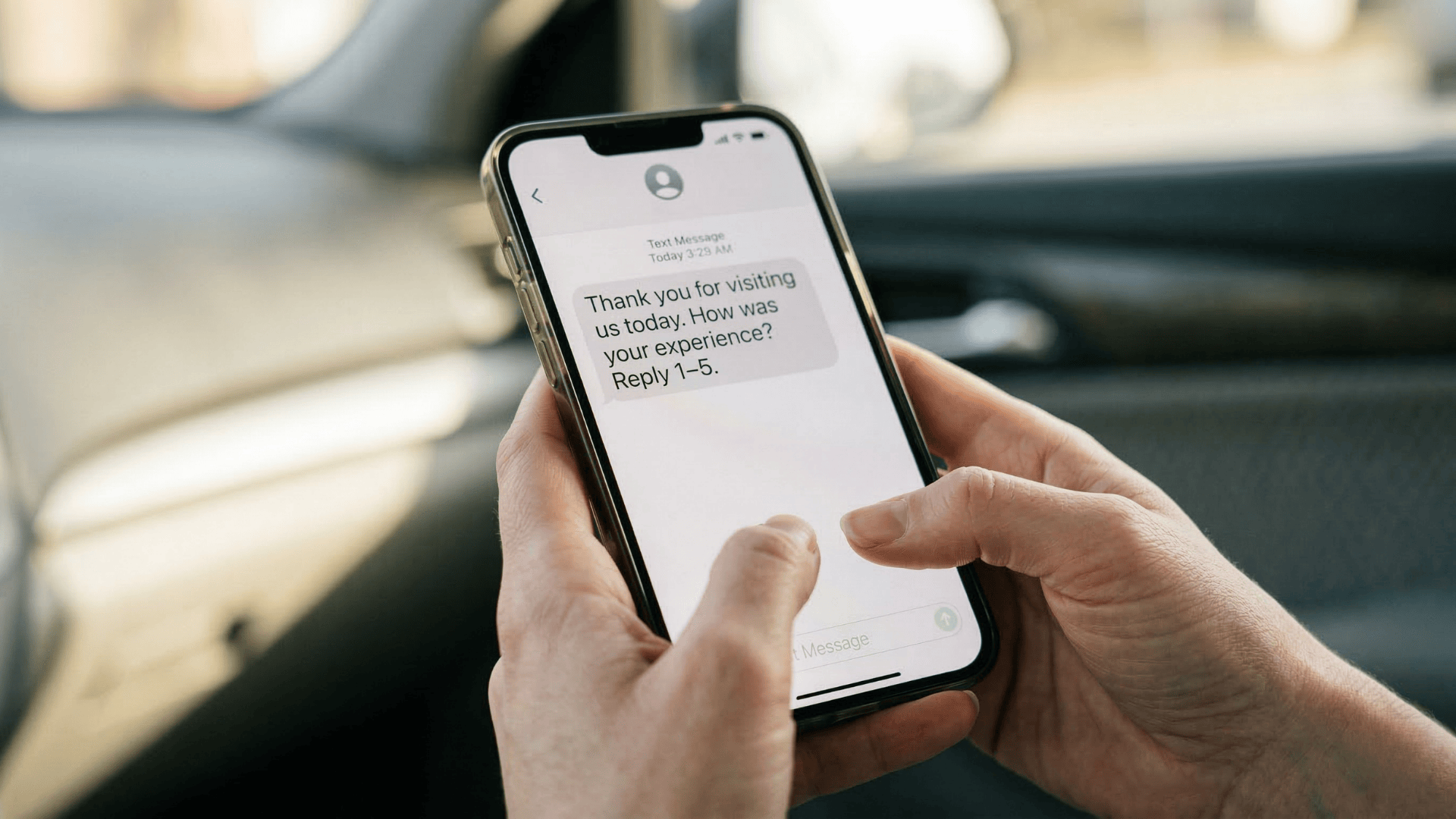
"How was your visit today? Reply 1–5." Patients who respond with a 4 or 5 receive a follow-up text with a direct link to leave a review on Google (or whichever platform the practice prefers).
Patients who respond with a 1, 2, or 3 receive a private message asking what went wrong, which routes directly to the practice manager.
This is smart review routing — and it's the feature that separates Curogram from simply plastering a QR code on your checkout counter. Positive experiences are directed toward Google.
Negative experiences are intercepted before they can become public complaints. The practice gets two things at once: a growing library of authentic public reviews and an early warning system for patient dissatisfaction that can be resolved quietly and quickly.
Think of it as a triage system for patient feedback. Happy patients are guided to share their experience publicly, where it can influence new patient decisions.
Unhappy patients are given a direct line to the practice manager, which is often what they wanted in the first place. Most dissatisfied patients don't actually want to post a bad review — they want to be heard. Curogram gives them that option before Google becomes their only outlet.
The whole sequence runs without anyone on your team lifting a finger. Because Curogram syncs with Azalea Health's scheduling data, FQHC patient review collection via text happens automatically after every completed visit.
Every appointment generates a review request — consistently and without any extra staff effort.
Consistency is what makes this work over time. A single manual push to collect reviews might generate a short burst of activity, but it won't move your average rating or your local search ranking in any lasting way.
Automated review requests sent after every visit build a steady, organic stream of feedback that Google's algorithm treats as a signal of an active, credible practice.

There's a deeper reason why this approach works so well for rural health centers. In a small community, reputation travels fast. A single bad Google review can ripple through the local social network more quickly than a positive one ever would.
Curogram's system doesn't manufacture praise — it simply ensures that the genuine satisfaction of the majority is visible to everyone, not just the people who already walk through your door.
For practices that have served their community for decades, that distinction matters. This isn't about gaming search results. It's about fairness: your online presence should reflect your actual care quality.
Rural communities also tend to have strong word-of-mouth networks — neighbors talk, church groups share recommendations, and local Facebook groups are active. A strong Google profile reinforces and amplifies that existing word of mouth.
When someone asks for a doctor recommendation in a local community group and gets told to check the reviews, you want those reviews to be there waiting.
1,064 |
| New 5-star reviews generated in 3 months (based on internal data) |
Practices using Curogram's automated review requests in rural healthcare typically see review volume increase 5–10x within three to six months.
Based on our internal data, one multi-location practice saw 90% of surveyed patients leave a 5-star review — generating 1,064 new 5-star reviews in just three months.
For a rural clinic that started with 15 total reviews, a similar trajectory means going from near-invisible to genuinely competitive in local search results.
The transformation is straightforward: from a practice that looks mediocre online to one that looks like the top-rated provider in the area.
A prospective patient now sees 4.7 stars and 90+ recent reviews from real community members. That's not marketing copy — that's the voice of your existing patients, finally made searchable.
The content of those reviews matters too. Patients who respond positively to a post-visit text tend to write specific, authentic feedback — comments about a provider by name, about how easy it was to get an appointment, about the way the front desk made them feel welcome.
That kind of detail builds trust with prospective patients in a way that a generic star rating never could.
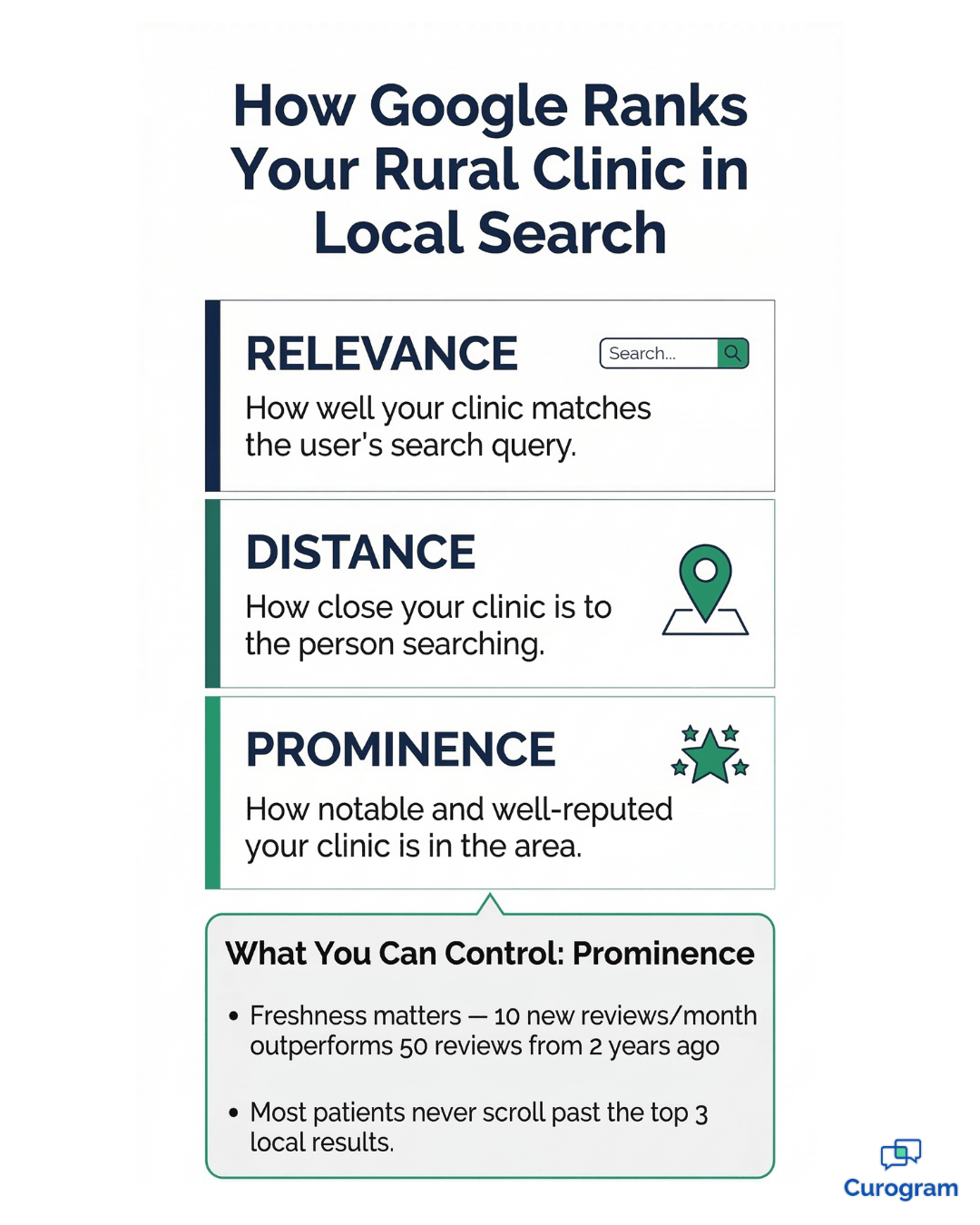
There's a direct connection between Azalea Health practice rating improvement and where you show up in local search results. Google's local search algorithm ranks healthcare providers based on three core factors: relevance, distance, and prominence.
Of the three, prominence is the one you can most directly influence — and reviews are one of the biggest signals that drive it.
Google weighs both the number of reviews and how recent they are. A clinic with a steady, ongoing flow of new reviews will rank higher in local searches than a competitor with an older, stagnant profile — even if that competitor has a similar star rating overall.
Freshness matters. A practice that collected 50 reviews two years ago and stopped looks less active to Google's algorithm than one collecting 10 new reviews every month.
This is why consistency beats one-time pushes. A single campaign asking patients to leave reviews might produce a short spike, but it won't sustain the kind of ongoing momentum that keeps your profile climbing in local search rankings.
Automated review requests tied to every completed visit create a natural, continuous stream of feedback that Google interprets as a signal of an active, credible practice.
The stakes are real. Studies on local search behavior show that most patients searching for a healthcare provider online never scroll past the first three results — the local map pack.
If your practice isn't in that top tier, you're invisible to the majority of people actively looking for a doctor in your area. Reviews are one of the clearest paths to getting there.
Automated review collection keeps your profile active and visible month after month.
Based on our internal research, practices that bring their Google profile in line with their actual care quality see new patient inquiries increase significantly, with some attributing a meaningful share of their quarterly growth directly to their improved online presence.
For rural health centers operating on lean budgets, this matters in a very practical way. Paid advertising for patient acquisition is expensive and competitive.
A strong organic presence on Google — built through consistent, authentic reviews — delivers new patient traffic at no ongoing cost. Once your profile is established, it works for you around the clock without any recurring spend.
The community's trust is finally visible to everyone — not just the people who already know you.
Your practice has spent years building trust in your community. That trust is real, and your patients feel it every time they walk through your door. But trust that isn't visible online can't help you reach the families who haven't found you yet.
Azalea Health is built for your patient care workflows. Curogram is built for your online presence. Together, they close the gap between the practice you've worked to build and the profile that shows up when someone searches for a doctor nearby.
When every satisfied patient automatically becomes a public advocate, your reputation finally catches up to your reality.
You don't need a marketing team or a complicated strategy. You need a simple, automatic system that asks your happy patients to share what they already think — and makes it easy for them to do it.
That's exactly what Curogram does. It's how Azalea Health reputation management with automated reviews works in practice: consistently, quietly, and without adding a single task to your team's plate.
Your patients already trust you. The people who haven't found you yet need to see that trust reflected online. Don't let a handful of old complaints define your practice when hundreds of positive experiences go unrecorded every month.
Ready to see what your Google profile looks like when it reflects your actual care quality?
Schedule a demo today. Connect Curogram to Azalea Health, send your first post-visit review requests, and watch new reviews start appearing on Google within the week.
Curogram doesn't suppress negative reviews — it gives unhappy patients a private channel to share their concerns directly with the practice. Patients are always free to post a public review regardless of their rating. What the system does is offer dissatisfied patients what they often actually want: someone at the practice to hear their complaint and resolve it. Many patients prefer a private resolution over a public post, and practices benefit from hearing about problems before they escalate.
The review request is a single, short text sent once after the visit. It isn't repeated or followed up. Patients who don't respond are not contacted again about that visit. The tone is appreciative, not pushy: "Thank you for visiting us today. How was your experience? Reply 1–5." Patients who have opted out of text communications are automatically excluded.
Yes. While Google is the recommended default for most healthcare practices because of its dominance in local search, Curogram can direct review links to Yelp, Healthgrades, Facebook, or any other platform the practice prioritizes. The destination is fully configurable in Curogram's settings and can be updated at any time.
Curogram syncs directly with Azalea Health's scheduling data, so review requests are sent automatically after completed visits are recorded. There's no manual input required from your team. The integration is designed to work quietly in the background — your staff doesn't need to manage it, and patients receive their texts without any additional steps from anyone at the front desk.
Most practices begin seeing new reviews appear on Google within the first week of using Curogram. Meaningful improvements to overall star rating and review volume — the kind that affect local search rankings — typically take three to six months. Based on our internal data, practices that stay consistent with automated review collection see their review volume increase 5–10x over that period.
💡 Athenahealth reputation management powered by Curogram's Review Engine turns every patient visit into a Google review — with zero staff effort.
1 min read
💡 The most effective pediatric therapy marketing strategy is building a steady stream of 5-star Google reviews. When parents search for a therapist...
💡 The impact of Google reviews on MD Systems practice growth shapes how new patients find and choose your practice online. Practices with 50+...