
TherapyNotes Google Reviews | Automate 5-Star Reviews
 Jo Galvez : Jun 11, 2026, 12:00:01 PM
Most therapy practices have under 50 Google reviews. Curogram automates post-session SMS surveys that route happy clients to Google.
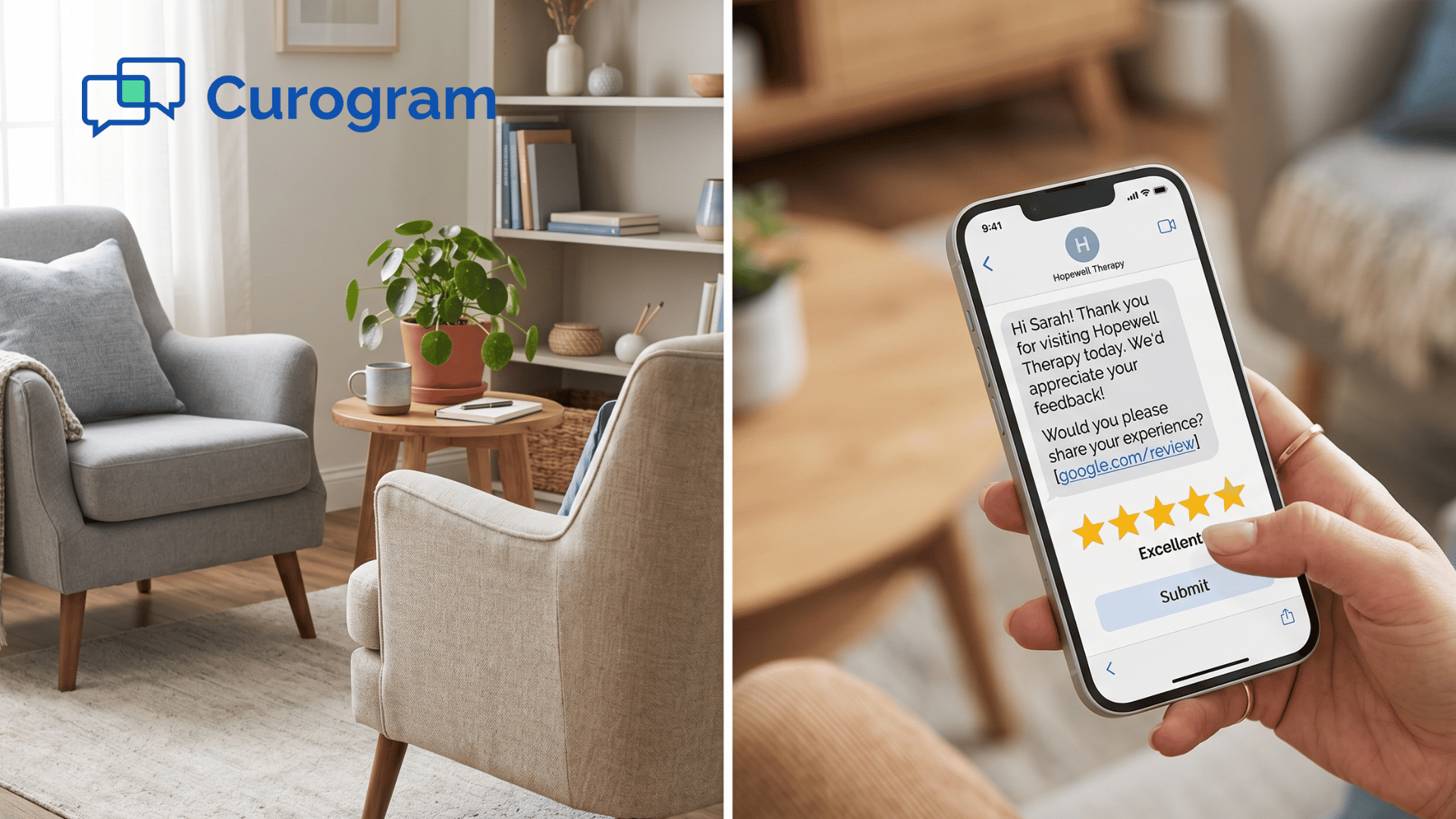
Picture a therapy practice with 15 clinicians and thousands of visits each year. Now picture its Google profile showing just 38 reviews. Down the street, a solo dentist has 250. That gap is common, and it quietly costs therapy practices new patients.
The problem is not the care. It is the nature of therapy itself. Patients value their privacy, so they rarely post public reviews about a provider. This is where Curogram for TherapyNotes changes the math for practices that want to grow.
Online reviews matter more than most clinics realize. Based on our internal data, 90% of new patient leads see a practice's Google Business Profile before they ever visit the website. If that profile looks thin, prospective patients move on. Strong reviews, on the other hand, signal trust before the first call.
Here is the hard truth. Therapy practices face a built-in review gap that organic, unsolicited reviews will never close on their own. Asking in person feels awkward. Email requests get buried, and printed cards rarely get used.
Therapy is different from a routine dental or general clinic visit. The usual review tactics simply do not fit such a sensitive and private clinical setting.
The good news is that this gap is fixable. Automated text-based review requests reach patients on the device they already use, moments after a visit. That timing is the secret to higher response rates. It turns a quiet profile into an active, growing one.
This guide explains why therapy practices struggle with reviews and how automation solves it. We will cover why manual methods fall short and what strong review volume does for a practice. We will also show how Google reviews for a therapy practice on TherapyNotes can run on autopilot. By the end, you will see a clear path to a stronger online reputation.
Therapy practices face a review challenge that most other clinics do not. The reasons are built into the work itself. Mental health still carries stigma for many people. Patients also want privacy around who their therapist is.
Because of this, therapy patients leave far fewer Google reviews than patients in other fields. A public review can feel too personal, or even inappropriate. So even a strong, well-liked practice ends up with very few reviews. The care is excellent, but the online proof is missing.
The numbers tell the story. A therapy group with 15 clinicians and thousands of visits a year may have fewer than 40 Google reviews. A solo dentist nearby can have 250. That is not a quality gap. It is a review-behavior gap.
Low Review Volume Creates Real Problems
Thin review coverage hurts a practice in three clear ways.
|
Problem |
What happens |
|---|---|
|
Unstable rating |
One unhappy patient can drop a 4.8 to a 4.0 when the total count is low. |
|
Weak first impression |
Prospective patients see few reviews and assume low experience or quality. |
|
Lower search ranking |
Google favors businesses with more reviews and recent activity, so the practice ranks lower for “therapist near me.” |
First, your star rating becomes fragile. When you only have a handful of reviews, a single negative one carries huge weight. It can pull your average down fast. With more reviews, that same complaint barely moves the needle.
Second, thin coverage shapes first impressions. New patients cannot judge clinical skill from the outside. So they read reviews as a stand-in for trust. A short list of reviews makes even a great practice look unproven.
Third, your search ranking suffers. Google's local search system rewards businesses with more reviews and steady, recent activity. A practice with stale or few reviews slips down the results. That means fewer people find you when they search for a therapist nearby.
TherapyNotes Alone Will Not Close the Gap
TherapyNotes is a strong system for clinical notes and practice management. But it does not include automated review request workflows. That means your online reputation depends on organic, unsolicited reviews. In therapy, those are rare.
So the practice is left waiting and hoping. A few happy patients may post on their own, but most never will, even when they love their care. The result is a profile that does not reflect the real quality of the practice.
The Gap Widens Over Time
This problem does not stay still. It grows. Practices that actively manage reviews pull further ahead each month, while those that do not fall further behind.
Think of it like compound interest, but in reverse. Every week without new reviews is a week a competitor gains ground. Over a year, the difference becomes hard to close. New patient search traffic flows to the practices with the strongest, freshest profiles.
This is why a passive approach is so costly. Doing nothing is not neutral. It is slowly losing visibility to practices that send review requests. The fix is to make Google reviews for a therapy practice on TherapyNotes happen automatically, instead of leaving them to chance.
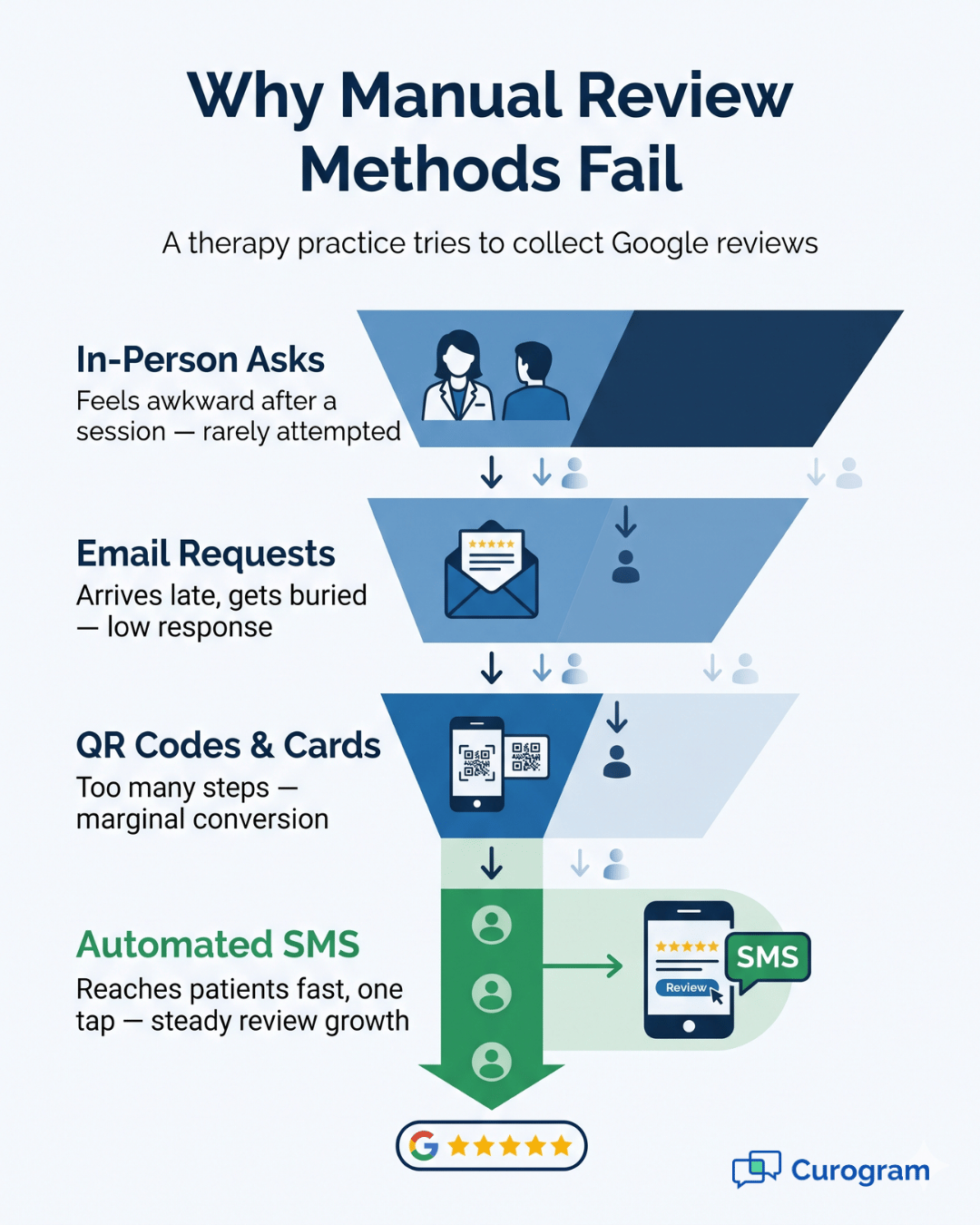
Most practices know they need more reviews. So they try a few common methods. The trouble is that these methods rarely work in a therapy setting. Each one runs into a built-in problem.
In-Person Asks Feel Awkward
Front desk staff asking for a review after a therapy session creates a strange moment. The patient may have just discussed something deeply personal. A cheerful “Can you leave us a Google review?” can feel tone-deaf right then.
Because of this, most practices avoid the in-person ask entirely. Staff feel uncomfortable, and so do patients. The result is that the request never happens. A method that is too awkward to use cannot build review volume.
Email Requests Get Buried
Email seems like an easy fix, but it falls flat. The patient gets the email hours or days after the visit. By then, the warm feeling from the session has faded.
The email also lands in a crowded inbox. It sits next to dozens of other unread messages. Most are never opened, and fewer still lead to a review. Open and response rates for review emails stay low across the board.
QR Codes and Cards Rely on Patient Effort
Printed cards and QR codes shift all the work to the patient. To leave a review, the patient must remember the card, scan it, find the right page, and write something. That is a lot of steps.
Each step loses people. Most patients put the card in a pocket and forget it. The conversion rate ends up very small. These tools look helpful, but they rarely move the number in a real way.
|
Method |
Why it falls short |
Typical result |
|---|---|---|
|
In-person ask |
Feels awkward after a session |
Rarely attempted |
|
Email request |
Arrives late and gets buried |
Low open and response |
|
QR codes and cards |
Too many steps for the patient |
Marginal conversion |
|
Automated SMS |
Reaches the patient fast, one tap |
Steady review growth |
Why Automated Text Works
There is one method that consistently drives reviews. It is the automated text message after the visit with a direct link to the Google review page.
The text reaches the patient on the device they already hold. There is no app to open and no card to find. One tap takes them straight to the review page. The timing catches the patient while the positive feeling is still fresh.
This is the key difference. Manual methods depend on memory, effort, or an awkward moment. Automated text removes all three barriers. It meets patients where they are, at the moment they are most likely to act.
For a therapy practice, this matters even more. The process stays private and low-pressure. No one has to ask out loud, and the patient chooses freely whether to respond. That comfort fits the sensitive nature of mental health care.
This is why setting up Google reviews for a therapy practice on TherapyNotes should center on automated text, not manual effort. The other methods are not bad ideas. They simply cannot deliver steady volume on their own. Automation is what turns good intentions into a growing review profile.
Curogram connects to TherapyNotes and turns review requests into an automatic, behind-the-scenes process. It works alongside your current system, not in place of it. You keep TherapyNotes for clinical work, and Curogram handles patient outreach. The two work together to close the review gap.
Here is how the full process works, step by step.
Automated Post-Visit Review Requests by Text
When a completed appointment syncs from TherapyNotes, Curogram takes over. It sends a text message to the patient with a direct link to your Google Business Profile review page. The timing is in your control, and is usually set for 1 to 2 hours after the visit.
That short delay matters. It catches the patient after they have left, but while the visit is still fresh. The link drops them right on the review page with one tap. There is no searching, no extra steps, and no friction.
Smart Filtering Keeps It Clinically Appropriate
Not every appointment is a good moment for a review request. Curogram lets you set rules for when requests go out, and to whom. You can exclude certain visit types, such as initial evaluations or crisis sessions.
You can also exclude patient groups where a request would not be appropriate. This keeps the process respectful and safe. The practice stays in full control of the timing and the audience. That control is essential in mental health care, where sensitivity comes first.
Multi-Location Support That Matches Patient Geography
Many therapy groups run more than one office, and Curogram handles this cleanly. Each location's Google listing receives reviews from the patients seen at that site. So review growth lines up with where care actually happens.
A patient seen in your north office helps that office's profile. This builds local strength for every site, not just the main one. For growing groups, this keeps each location competitive in its own area.
What This Looks Like in Real Numbers
The impact of automated review requests is easy to see in the data. Based on our internal data, one practice, Optima Medical, used Curogram to grow its review profile fast. The change was dramatic.
Optima Medical grew from 993 to 8,159 Google reviews in 16 months. That is a 721% increase, and about 90% of those reviews were 5-star. The added volume reshaped the practice's local search visibility and brought in more new patients.
|
Metric |
Result |
|---|---|
|
Reviews before |
993 |
|
Reviews after (16 months) |
8,159 |
|
Total growth |
About 721% |
|
Share of reviews at 5 stars |
About 90% |
These results were not a one-time spike. Based on our internal data, Kern Behavioral Health used Curogram's automated review requests to keep growing reviews over a 6-year span. That long track record shows the system delivers durable results, not just a quick burst.
Numbers like these change a practice's whole online presence. A profile that once looked thin becomes active and trusted. And because the requests keep running, the growth does not stop after the first few months.
Why Timing and Consistency Win
The strength of automation is that it never forgets. A staff member might ask for a review on a busy day and skip it the next. Curogram sends every eligible request, every time. That consistency is what builds durable results.
Steady weekly reviews also signal freshness to Google. Recent activity helps your local ranking, not just your total count. So the system feeds two goals at once: more reviews and more recent reviews. Both push you higher in local search.
If you want to understand how this fits into a wider plan, see our online reputation resources for TherapyNotes practices. Review automation is one strong piece of a larger picture. It pairs well with profile optimization and consistent patient communication.
Reaching the Point Where Reviews Build Trust
Every market has a level where a practice has enough reviews to look credible. Below that level, the profile raises doubt. Above it, the profile builds confidence with both patients and Google's algorithm. Most therapy practices sit well below that line.
This is the real value of automation. It closes the distance between where you are and where trust begins. A handful of automated requests each week adds up fast. Within months, a quiet profile can cross into credible territory.
Built for the Sensitivity of Therapy
It is worth repeating why this approach fits mental health care so well. The process is private, and no one asks the patient face to face. The patient simply gets a text and decides on their own.
This removes pressure from a relationship that depends on trust. It also protects the clinical setting from awkward moments. The patient stays in control, and the practice grows its reputation at the same time. That balance is exactly what therapy practices need.
Working With Your Current Setup
You do not need to replace TherapyNotes or change how your clinicians work. Curogram layers on top of your existing workflow. Appointments still live in TherapyNotes, and review requests flow out through Curogram. The whole system is HIPAA compliant and SOC 2 Type II certified, so patient data stays protected.
This is what makes the setup practical. There is no heavy lift for your clinical team. The review engine runs in the background while staff focus on patients. Managing Google reviews for a therapy practice on TherapyNotes finally becomes hands-off.
Automation turns a frustrating, manual chore into a reliable system. It sends the right request, at the right time, to the right patient. It respects the sensitivity of therapy while still building real review volume. That combination is what makes the difference for mental health practices.
Building reviews is not just about looking good online. Review volume changes how a practice grows. It affects who finds you, who trusts you, and who books. Let's look at four clear benefits.
It Brings in New Patients
Imagine a person searching for a therapist in their area. They find your practice with 200 or more reviews and a 4.8 rating. In a field where trust is everything, that profile speaks for itself. Patients cannot judge clinical skill in advance, so they lean on reviews instead.
Review volume becomes your main credibility signal. A strong profile makes a nervous first-time caller feel safe. That feeling often decides whether they book with you or someone else.
It Reinforces Referrals
Most referrals get checked online before anyone calls. A friend or doctor recommends you, and the patient's first move is to Google your name. What they find next matters.
A strong review profile confirms the referral. It turns “I heard they were good” into “I can see they are good.” That reassurance helps convert the search into a booked appointment. A weak profile, by contrast, can make a patient second-guess a solid referral.
It Keeps Your Rating Stable
Volume protects your star rating. With 200 or more reviews, one bad review is just noise. With 15 reviews, that same review is a crisis. More reviews give you statistical insulation.
This stability matters for peace of mind too. You are not at the mercy of a single upset patient. Your rating reflects your true, overall quality over time.
It Lifts Your Search Ranking
Google's local search rewards reviews and recent activity. Practices that earn steady weekly reviews rank higher than those with stale profiles. Higher ranking means more people find you on their own.
This creates a healthy cycle. More reviews lead to better ranking, which leads to more visibility and more patients. Those new patients then leave reviews of their own. The system builds on itself.
Getting started with Curogram is simple, and you are not on your own. Setup happens during a short deployment window, usually 2 to 4 weeks. The Curogram team configures your automated review requests for you.
During setup, you decide the details. You choose which appointment types trigger a request, and you set the timing that fits your practice. Once it is live, the system runs on its own.
From there, the reviews start to build. Each completed visit becomes a chance to grow your profile. You focus on patient care while Curogram handles the outreach. Within a few months, your online reputation can look very different.
Ready to see it work? Book a demo and watch Curogram's automated Google review requests run with your TherapyNotes practice. You can also see how Curogram serves behavioral health clinics to learn more.
Curogram is a patient communication platform built for healthcare, not a generic texting tool. It connects to TherapyNotes and many other systems to automate the work that fills your day. Review requests are just one piece of what it does.
The platform is fully HIPAA compliant and SOC 2 Type II certified. That means patient data stays private and secure at every step. For mental health practices, where privacy is non-negotiable, this matters deeply. You get powerful automation without putting trust at risk.
Beyond reviews, Curogram helps practices in several proven ways. Based on our internal data, Curogram clients see an average appointment confirmation rate above 75%. No-show rates run 53% lower than the industry average. Many practices report a 10% to 20% rise in revenue from recovered appointments.
These results come from the same simple idea behind review automation. Reach patients by text, at the right moment, with a clear next step. Patients respond to texts far more than to calls or emails. Curogram turns that behavior into better outcomes for the practice.
Most of all, Curogram is designed to work with your current setup. It does not replace TherapyNotes or disrupt your clinical workflow. It layers on top, handling outreach in the background while your team keeps doing what it does best. For a therapy practice, that blend of security, automation, and control is hard to match.
Therapy practices do hard, meaningful work, day in and day out. Yet their online profiles rarely show it. The review gap is real, and it is built into the nature of mental health care. Patients value privacy, so they rarely post on their own.
Left alone, that gap only grows. Manual asks feel awkward. Emails get buried, and cards and QR codes ask too much of the patient. None of these can build steady volume in a therapy setting.
Automation is the real answer that fits here. A short text after each visit reaches patients where they are. It is private, simple, and timed for the moment they are most likely to respond. That is how a quiet profile becomes an active, trusted one.
Curogram for TherapyNotes makes this automatic. It sends the right request, at the right time, to the right patient. It respects the sensitivity of your work with smart filtering and full control. It also stays HIPAA compliant and SOC 2 Type II certified throughout.
The payoff reaches every part of the practice. Stronger reviews bring in new patients and reinforce trusted referrals. They steady your rating and lift your local search ranking over time. Based on our internal data, one practice grew from under 1,000 reviews to more than 8,000 in just 16 months.
Your care is already excellent, and your online reputation should say so too. With automated Google reviews for a therapy practice on TherapyNotes, it finally can. The gap closes a little more with every visit.
You do not have to leave your reputation to chance anymore. Book a demo and see Curogram's automated review requests work with your TherapyNotes practice. The first step is the easiest one you will take, and the rest runs quietly on its own, visit after visit.
 Jo Galvez : Jun 11, 2026, 12:00:01 PM
Most therapy practices have under 50 Google reviews. Curogram automates post-session SMS surveys that route happy clients to Google.
 Jo Galvez : Jun 11, 2026, 10:00:01 AM
TherapyNotes has no review tools. Staff forgets to ask, clinicians won’t. Curogram automates post-session surveys via SMS — 1,064 reviews in 3 months.
 Jo Galvez : Jun 11, 2026, 2:00:01 PM
90% of prospective therapy clients see your Google profile before your website. Learn why reviews drive new client acquisition in behavioral health.