7 min read

Grow Google Reviews: CureMD Automated Requests by Post-Visit Text

Grow Google Reviews: CureMD Automated Requests by Post-Visit Text
💡 CureMD automated Google review requests by post-visit text send a review link to each patient right after the appointment, turning private satisfaction into public five-star proof on Google.

CureMD's Patient Portal can track how patients feel, but those scores stay inside the practice. Yet 90% of new patient leads check a Google Business Profile before they ever visit your website (based on our internal data).

What the automation does after each visit:

  • Texts a one-tap review link, so no one has to remember to ask
  • Runs next to CureMD without changing your charting or scheduling
  • Sends happy patients straight to your Google profile in a single tap
  • Builds review volume steadily instead of in random bursts
  • Fits primary care, pediatrics, dermatology, and specialty clinics like gastroenterology
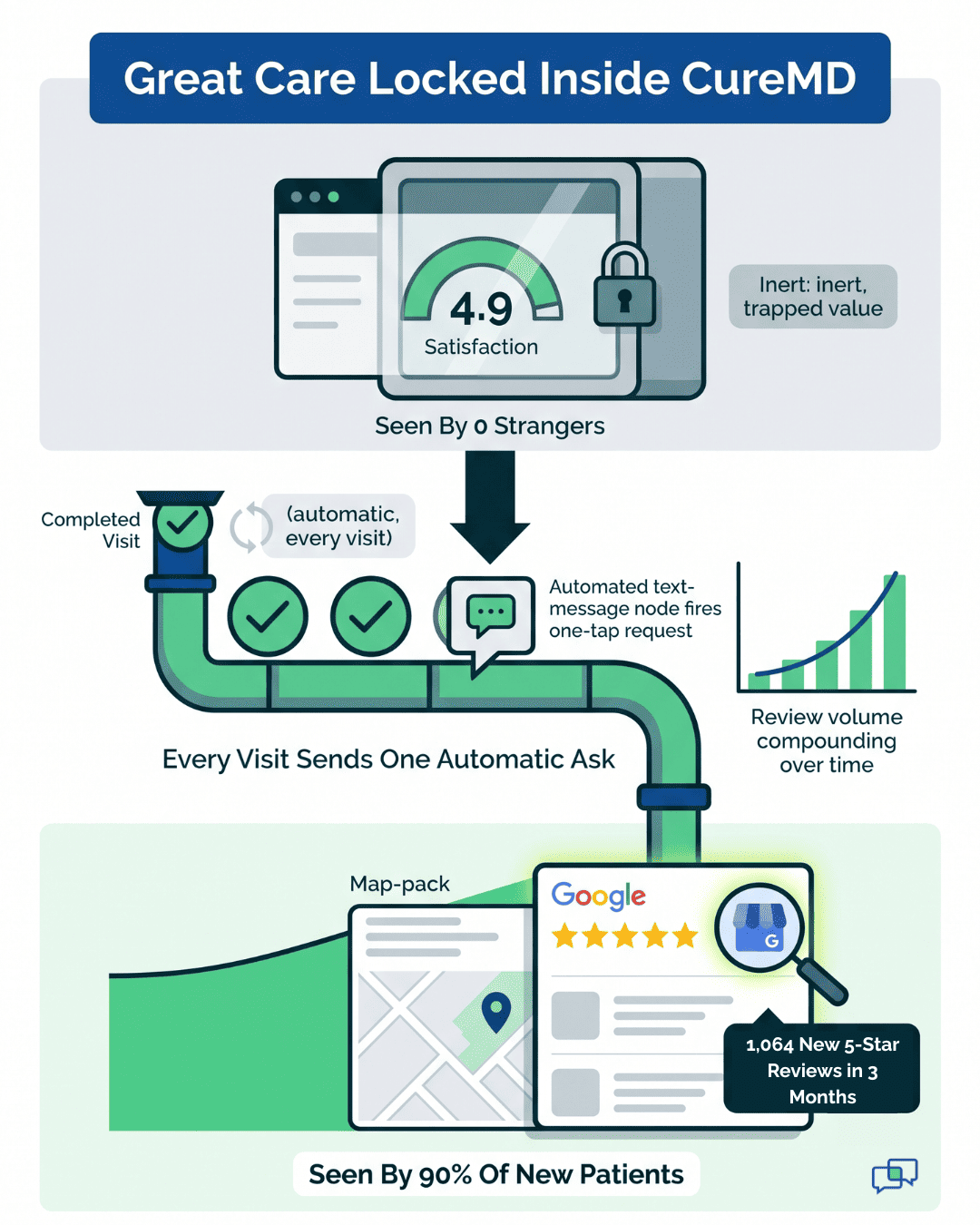
One multi-location practice earned 1,064 new five-star reviews in three months this way (based on our internal data).

Your CureMD dashboard might show that patients love you. Post-visit surveys come back high. Satisfaction trends look strong. None of that shows up when a new patient types your specialty and city into Google.

That gap is the whole problem. CureMD measures how current patients feel. Google decides which practice a stranger calls first.

When 90% of new patient leads look at a Google Business Profile before they reach your website (based on our internal data), a private satisfaction score cannot compete with a public star rating.

We call the trapped-data problem the Private Scorecard. Care is real, patients are happy, and the proof stays locked in a system no stranger will open. Down the street, a practice with 400 recent reviews looks like the safer choice, even if its care is average.

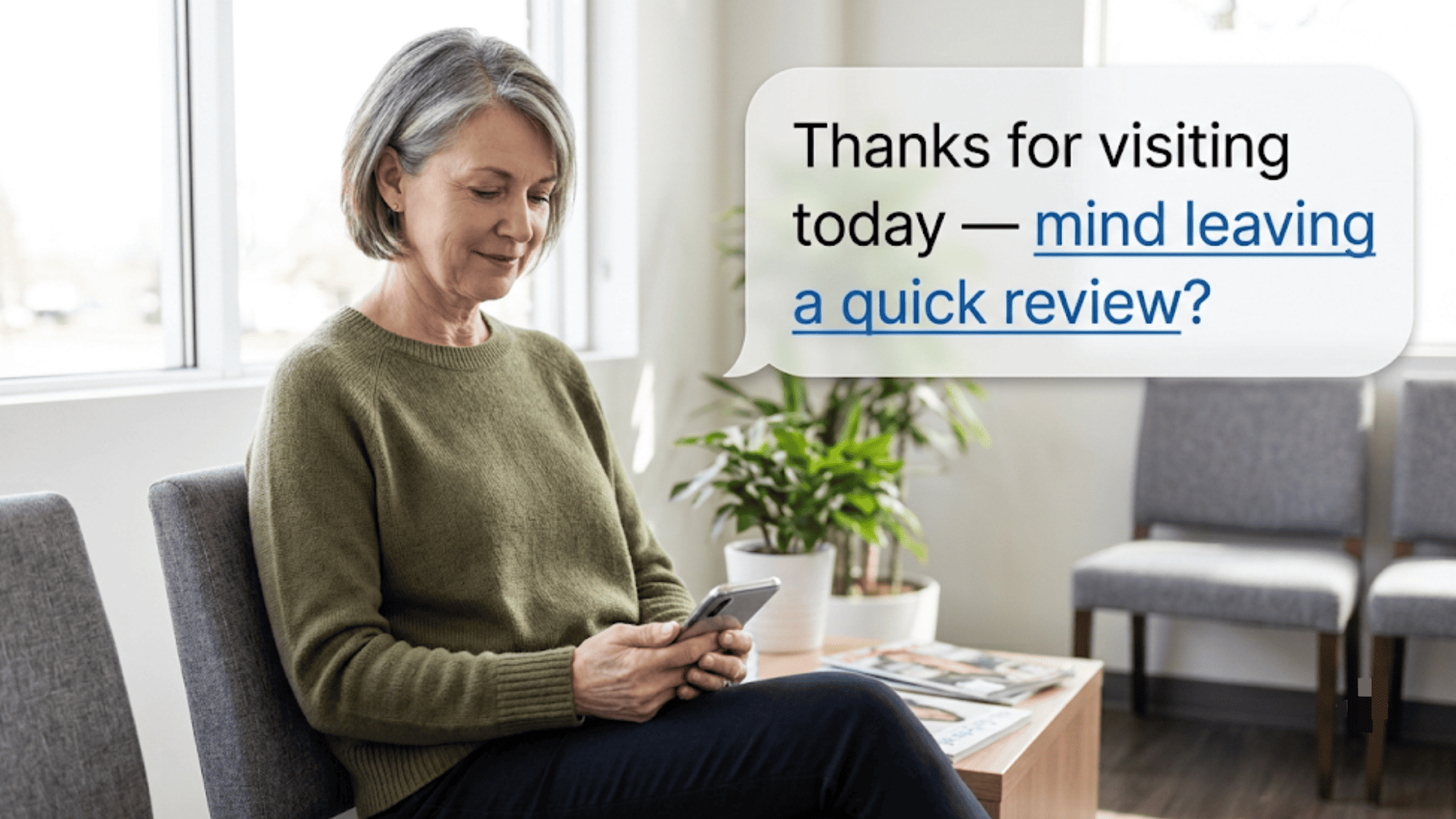
This is where CureMD automated Google review requests by post-visit text change the math. After each appointment, a short text invites the patient to leave a Google review in one tap. The ask is automatic, so it happens every time, not just when the front desk has a free second.

This guide shows how automated review generation runs next to CureMD, why review volume beats a high internal score for winning new patients, and what shifts once your profile fills with recent reviews.

We will use real numbers from practices that made the switch, not hypotheticals. The pattern is consistent across primary care, pediatrics, and busy specialty clinics. Satisfaction you can measure is worth far more once patients you will never meet can read it.

The Villain: The Private Scorecard

CureMD can capture satisfaction data through its Patient Portal. Those scores help you spot a scheduling snag or a rough front-desk moment. They never appear in Google search, where a new patient is choosing between you and two other clinics.

A 4.9 internal average means nothing to someone who cannot see it. That is the core tension in the CureMD patient satisfaction vs Google reviews question: one audience is your current patients, the other is every stranger searching right now.

The Ask That Keeps Getting Skipped

Front-desk staff mean to ask for reviews. Then three patients need rescheduling, two phone lines light up, and a walk-in needs an intake form. That review request is the first task to drop.

So requests go out in random bursts, a handful one week and none for a month. Volume stays low because the ask depends on whoever remembers it during a packed clinic. Great visits end with a warm goodbye and no review link.

Why Low Volume Wrecks Your Rating

With few reviews, one upset patient does outsized damage. A single 1-star review pulls a small profile down hard, and it can sit near the top of your listing for weeks.

Without a system, organic review growth crawls at roughly 2-5% a year, far too slow to catch a competitor. Simple math below shows why volume protects you.

Existing 5-star reviews

Rating after one new 1-star review

12

4.7

50

4.9

250

5.0


A larger, steady stream of reviews absorbs the occasional bad day. A thin one magnifies it.

You deliver strong care that your online presence does not reflect. New patients scroll past and pick the busier-looking profile. A clinic with hundreds of recent reviews wins the call. Your internal 4.9 sits in a dashboard nobody outside the building will ever open.

The Guide: The Review Engine

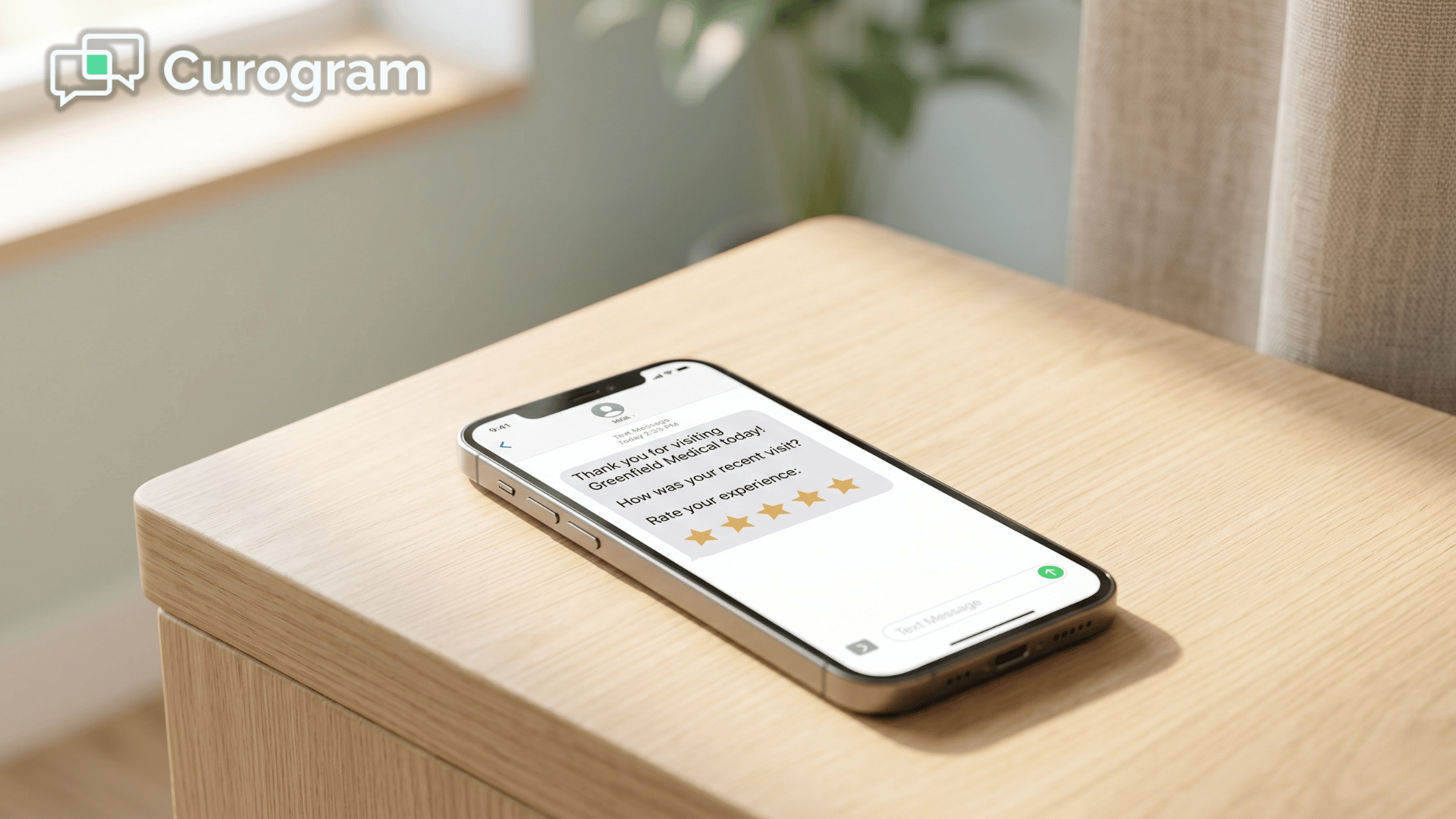
Curogram sends a review request text after each completed visit. A visit gets marked done, the text fires, and the patient gets a link while the appointment is still fresh.

No sticky note, no end-of-day catch-up, no reliance on memory. The ask happens the same way for every patient, every day. Consistency is what turns a trickle of reviews into a steady climb.

One Tap From Text to Google Review

Your patient reads a short message, taps the link, and lands right on your Google Business Profile review box. No app to download, no login, no hunting for your listing.

Older patients manage it because the path is short and familiar, the same tap they use to text their kids. Fewer steps means more finished reviews, which is the whole point of post-visit review automation CureMD practices can rely on.

Running Next to CureMD, Not Inside It

Curogram runs alongside CureMD rather than replacing anything. Your team charts and schedules in CureMD as usual, and the review requests fire post-visit on their own.

Satisfaction data CureMD already collects stays useful for internal review, while public reviews build in parallel. Practices that want to grow Google reviews alongside CureMD get the public proof without touching their clinical workflow. Nothing in the chart changes.

Why Volume Decides Local Search

In a crowded market, review count and recency often decide who ranks. For dermatology, gastroenterology, and primary care, a patient searching "dermatologist near me" sees the top three map results first.

Getting there depends heavily on CureMD local SEO patient reviews that are recent and plentiful. A practice with 300 fresh reviews outranks one with 40, even when the care is identical. Volume is the tiebreaker most clinics ignore.

Flow diagram turning a locked CureMD satisfaction score into 1,064 new 5-star Google reviews

The Success: The Public Proof

Two practices using the same automated review texts show what steady volume does. The figures below come from our internal data.

Practice

Starting point

Result

Timeframe

Multi-location group

Sporadic reviews

1,064 new 5-star reviews, ~90% five-star

3 months

Family health center

101 reviews, 1.67 rating

479 reviews, 5.0 rating, calls down 24%

22 months


Neither practice added staff to do it. The automation carried the ask every single visit.

A Worked Rebuild From 1.67 to 5.0

That family health center started in a hole: 101 reviews and a 1.67 rating that scared off new patients. Their turnaround followed a simple sequence.

They switched on automated post-visit review texts. Every completed visit triggered one request, with no exceptions and no staff steps.

Happy patients, who rarely think to post on their own, now had a one-tap prompt. Over 22 months, reviews climbed from 101 to 479 and the rating reached a clean 5.0.

Phone calls dropped 24% along the way, because patients found answers and booked through text instead of calling.

That earlier 1.67 came from a handful of loud, unhappy patients. Once every happy patient got the same easy prompt, the real picture reached Google (based on our internal data).

Crossing the Digital Authority Threshold

Somewhere in the hundreds of recent reviews, a profile hits a point competitors cannot quickly match. Call it the Digital Authority Threshold.

A rival can copy your services and your hours. Catching up on years of steady five-star reviews is far harder, because reviews are earned over time and cannot be bought. Once you cross that line, your Google Business Profile reviews do the selling before a single call.

A Profile That Brings Patients In Before They Call

You end up with a Google listing full of recent five-star reviews near the top of the map pack.

New patients read a dozen recent comments, decide you are the safe choice, and book. Your internal CureMD scores confirm what the public proof already told them. Great care and a public reputation that matches it, finally pulling in the same direction.


Floating message inviting a patient to leave a Google review after their visit

How Curogram Turn Every Visit Into Public Proof

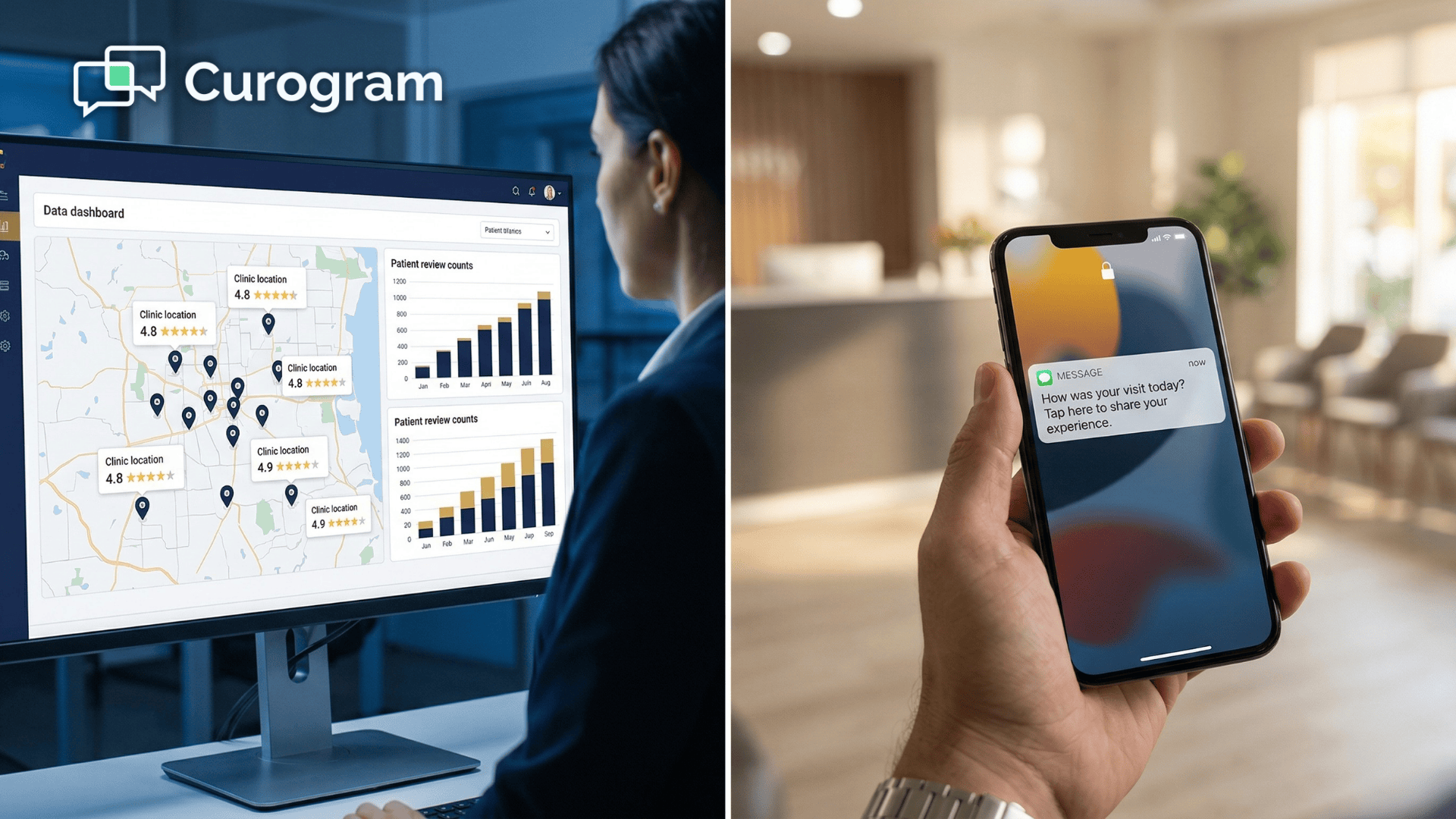
Curogram's Automated Review Requests close the gap between the satisfaction CureMD tracks and the reviews new patients actually read.

The setup is simple. When a visit is marked complete, Curogram sends the patient a short, friendly text with a one-tap link to your Google Business Profile.

The patient does not download an app or log in anywhere. They tap, they type a sentence, they post. The whole thing takes under a minute while the good visit is still fresh in mind.

The value comes from consistency. A front desk buried in reschedules and phone calls cannot ask every patient for a review, and the ones they forget are often the happiest.

Automation removes the memory problem entirely. Every completed visit gets the same ask, so review volume climbs on its own instead of spiking whenever someone remembers.

Curogram runs alongside CureMD, so nothing in your clinical workflow changes. Your team keeps charting and scheduling in CureMD, while the review requests fire in the background.

The texting is HIPAA-compliant and encrypted under a signed BAA, and every request is consent-based and easy to opt out of, in line with texting rules.

Results follow the volume. One multi-location practice collected 1,064 new five-star reviews in three months, with about 90% at five stars (based on our internal data).

A separate family health center climbed from 101 reviews to 479 and rebuilt a 1.67 rating into a clean 5.0, while phone calls fell 24% (based on our internal data).

Because roughly 90% of new patient leads check a Google Business Profile before your website, that public proof reaches people your internal scores never could.

Automated review generation gives CureMD practices a public voice that matches the private one, and it does so without adding a single task to the front desk.

Conclusion: Stop Letting Great Care Go Unseen

CureMD tells you how your patients feel. It cannot tell a stranger on Google why they should choose you. That split sits at the center of the problem: your best proof is trapped in a dashboard, while the people you want to reach read star ratings instead.

Closing the gap takes one thing: a system that asks every patient after every visit, automatically, with nobody lifting a finger.

Not another survey, and not a sticky note on the monitor. Automated post-visit review texts turn the satisfaction you already earn into public five-star reviews that show up right where new patients look.

Real numbers back it up. Practices using this approach have added over a thousand five-star reviews in a quarter and rebuilt a broken 1.67 rating into a clean 5.0 (based on our internal data). Around 90% of new patient leads check a Google Business Profile first, so those reviews often decide the call before your phone even rings.

Your care already earns the reviews. Right now they are just going unwritten, because a happy patient rarely thinks to post without a nudge.

A consistent, automatic ask is all that stands between a private 4.9 and a public one that recruits patients around the clock. Every visit you skip that ask is a five-star review your competitor gets instead.

Stop letting great care go unseen on Google. Schedule your Curogram demo and watch automated post-visit review requests run against your own workflow.


Frequently Asked Questions

How does automated review request texting stay compliant with patient privacy rules?

Curogram's texting is HIPAA-compliant and encrypted under a signed BAA. Review requests are consent-based and easy to opt out of, matching texting regulations, so you build public reviews without putting patient privacy or your practice at risk.

How much extra work does automated review generation add for front-desk staff?

None. Requests fire on their own once a visit is marked complete, so nobody has to remember to ask. Staff simply watch new reviews arrive, freeing them to handle scheduling, phones, and in-person patients.

How is Curogram's review automation different from CureMD's patient satisfaction tracking?

CureMD's satisfaction features stay internal, useful for spotting problems inside your practice. Curogram generates public Google reviews, the proof strangers read when they search. One helps you understand current patients; the other brings new ones through the door.

Why do Google reviews matter more than a high internal satisfaction score for attracting new patients?

Roughly 90% of new patient leads check a Google Business Profile before your website (based on our internal data). A stranger cannot see your internal 4.9, but they can read your public star rating, and that rating drives the call.

How long does it take to see more Google reviews after turning on post-visit review automation?

Reviews start arriving within days, since requests fire after each visit. Steady growth compounds over months. One practice gathered 1,064 new five-star reviews in three months using the same automated post-visit texts (based on our internal data).


Get More Google Reviews for Your Meditab IMS Practice

Get More Google Reviews for Your Meditab IMS Practice

💡 Meditab IMS is strong clinical software, but it has no built-in tools to generate Google reviews. That gap quietly costs new patients to...
Read More
Google Reviews for Modmed Practices | Automated Reputation Management

Google Reviews for Modmed Practices | Automated Reputation Management

💡 Reputation management Google reviews Modmed specialty practices runs through Curogram, an independent patient engagement platform that sends...

Read More
NextGen Review Automation | Network-Wide Google Reputation at Scale

NextGen Review Automation | Network-Wide Google Reputation at Scale

💡 For large NextGen Enterprise networks, Google reviews remain untapped. Neither NextGen nor Luma sends automated post-visit review texts or...

Read More