Automate Google Review Requests After Every Lytec Patient Visit
💡 Lytec automated Google review requests after every visit turn happy patients into verified 5-star reviews. Lytec runs your scheduling and...

9 min read
Mira Gwehn Revilla
:
Updated on July 11, 2026
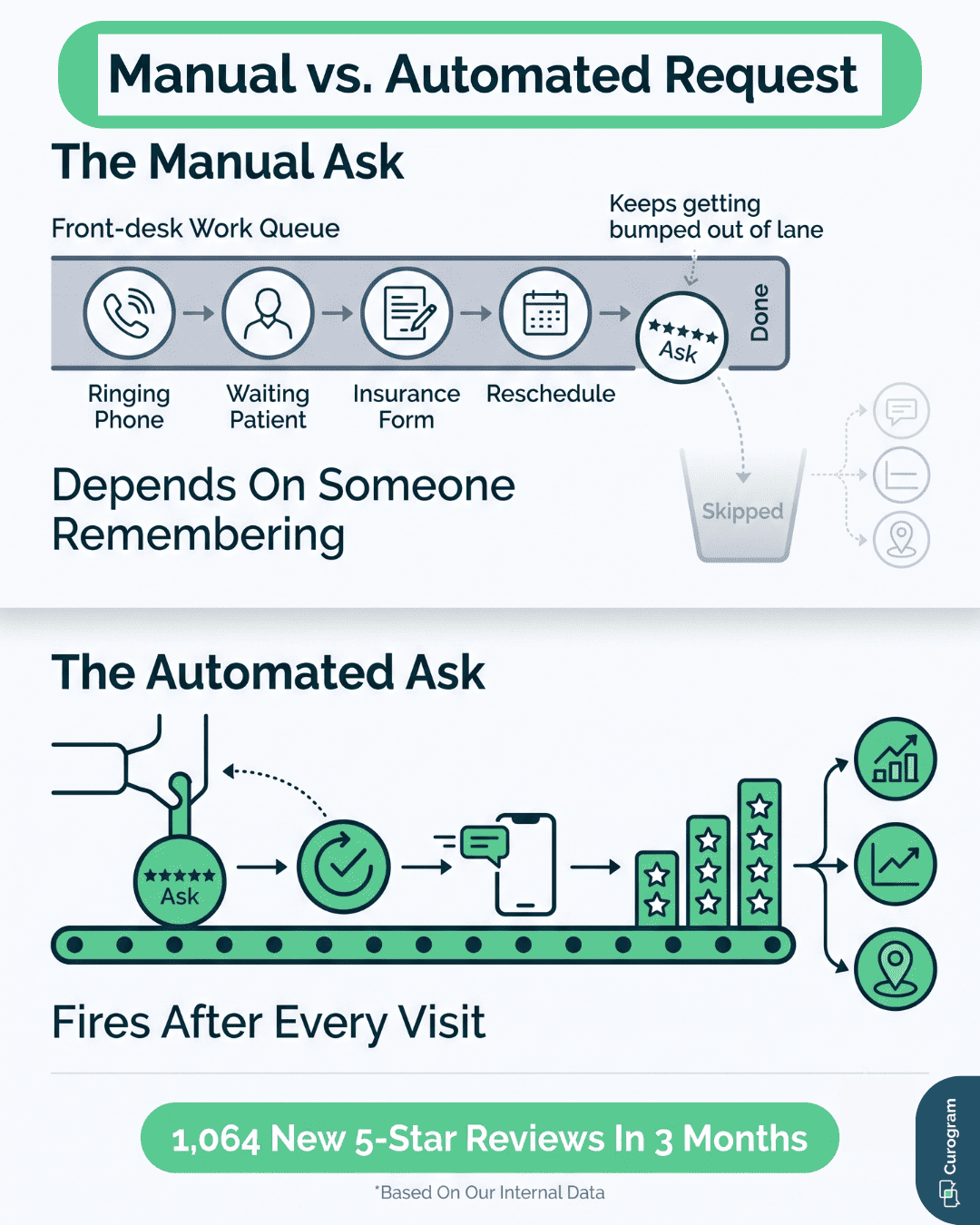
Most clinics lose reviews for one plain reason: the ask depends on a person who is already buried. A patient checks out happy. Staff mean to ask for a Google review. Then two people need rescheduling, the phones light up, and the moment passes.
That skipped ask is the whole problem. CureMD can show you a strong satisfaction score, yet that number sits inside your system where no future patient sees it.
Public reviews are what new patients read before they call. In fact, 90% of new patient leads check your Google Business Profile before your website, based on our internal data.
When the request rides on memory, it fires for some patients and not others. We have watched this pattern across busy front desks for years.
Good teams want reviews. They just run out of hands during clinic hours. What you get is a private scorecard that looks fine inside CureMD and a thin public profile that stalls your local ranking.
There is a cleaner way to run it. Rather than ask staff to remember, you let a post-visit text carry the request every time. Your front desk stops chasing reviews and gets back to patients. One bad review hurts far less when steady new ones keep landing behind it.
This piece shows how to set that up in a CureMD practice. You will see what changes when the ask never gets skipped, and the review numbers real clinics reach once it runs on its own.
Watch a front desk at 11 a.m. and you see the problem clearly. A patient is ready to leave. At that same moment, one line rings, a walk-in needs a form, and the next patient is late for a room. Asking for a Google review is the softest task in that pile, so it drops.
This is not a training gap. Your staff know reviews matter. A manual ask competes with work that has a harder deadline, and it loses that contest most of the time. Phones demand an answer now. That request can always wait until later, and later rarely comes.
Uneven asking is the deeper issue. A calm Tuesday-morning patient gets a warm, personal request. That same patient seen during a Monday rush gets nothing, because the desk is three deep.
So your reviews end up sampling your slow hours, not your happiest patients. People most likely to rave, the ones you squeeze in at the last minute, are often the ones nobody had time to ask.
Two clinics with identical care can post wildly different review counts for this reason alone. One made the ask consistent; the other left it to whoever had a free second.
Any practice on CureMD can track satisfaction, but a good score never turns itself into a public review. What sits between the two is exactly this skipped, uneven ask. Left that way, your best care stays invisible to the next person searching Google.
Sporadic asking creates a volume problem, and volume is what local ranking runs on. A practice that gathers a handful of reviews a quarter stays fragile. When you sit at 40 reviews, a single one-star complaint drags your average and lingers near the top for weeks.
Compare that to a clinic pulling steady reviews each week. The difference shows up fast in plain numbers.
|
Review pattern |
Reviews per month |
Effect of one 1-star |
|
Manual, skipped often |
2 to 4 |
Visible for weeks, drops the average |
|
Automated, every visit |
30 to 60 |
Buried fast, barely moves the average |
Low volume also stalls your Google Business Profile ranking. Google rewards fresh, frequent reviews, so a profile that goes quiet slides down the map results.
New patients searching for a clinic near them scroll right past you. This is the real reason to stop manually asking for reviews and hand the job to something that never forgets.
Ask most office managers about reviews and you hear the same thing. They know the practice should have more. They feel behind. Yet no free hour exists in the day to chase them, and a manual habit that survives a packed week has never held up for long.
That guilt is a signal, not a personal failing. It means the work is real and the method is wrong. More discipline from an already-stretched team is not the fix. Taking the ask off their plate entirely is.

Curogram treats the review request as an event that fires on its own. Once a visit is marked complete, a text goes to that patient.
Nobody at the desk lifts a finger. This automated review workflow means the front desk does nothing, and reputation stops being one more line on the closing checklist.
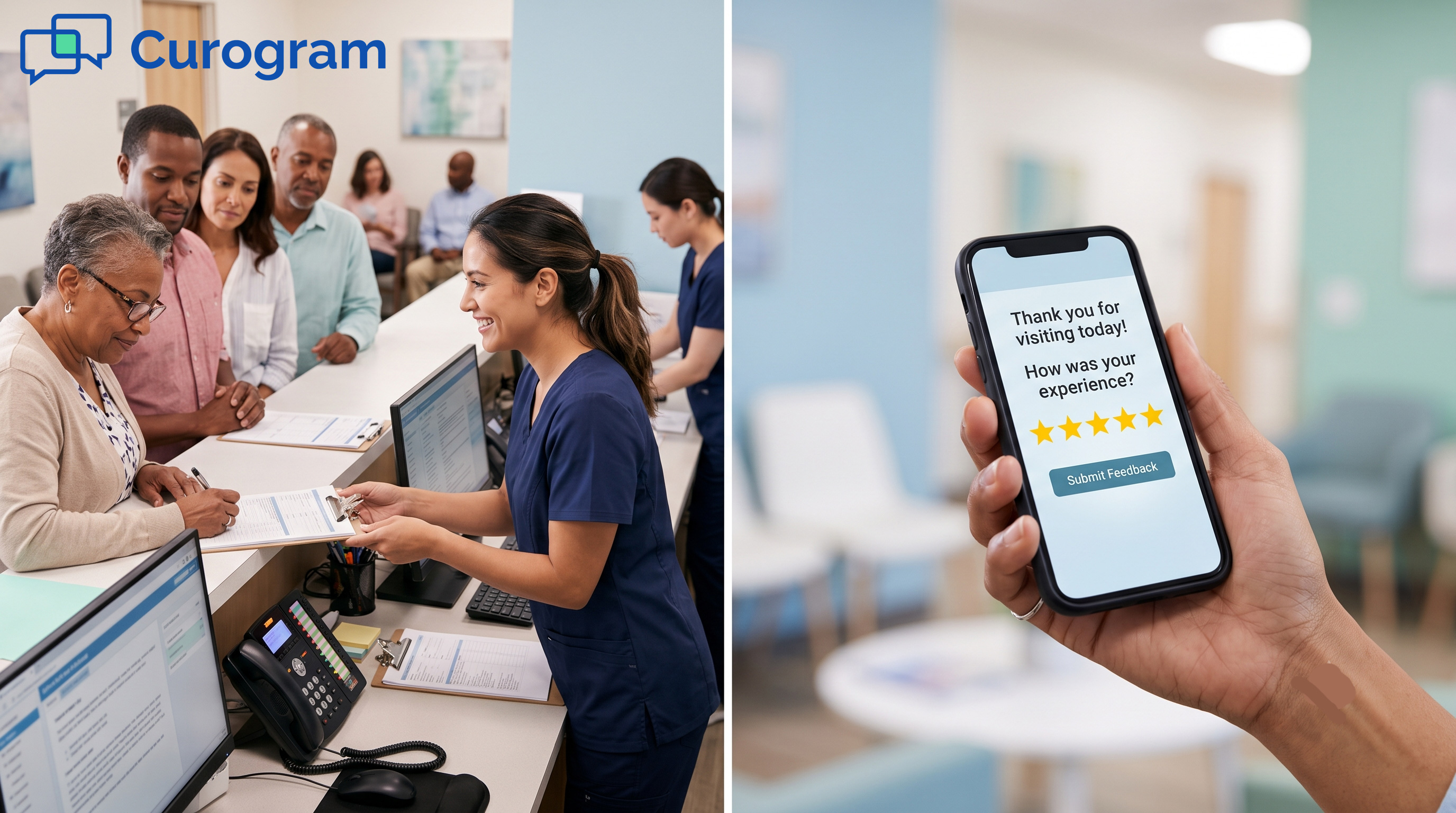
The message is short and personal. It thanks the patient, then offers a one-tap link to your Google profile. A patient who had a good visit taps it and posts in under a minute. The memory of good care is still fresh.
Because the trigger is the completed visit itself, you get consistent review requests. No more scattered asks that a manual habit produces. Every patient who finishes a visit gets the same ask, in the same tone, at the same helpful moment.
The flow is easy to picture as a few plain steps. Nothing here changes how your team closes out a visit in CureMD.
|
Step |
What happens |
Who does it |
|
1 |
Visit is completed and checked out |
Your normal front-desk routine |
|
2 |
A short post-visit survey text goes out |
Curogram, automatically |
|
3 |
Happy patients get a Google review link |
Curogram, automatically |
|
4 |
Patient posts a review in one tap |
The patient |
A post-visit survey that leads to a review does two useful things at once. You hear privately from anyone who had a rough visit. And you point your happy patients straight to a public review. The team sees results land without running a single step.
Curogram runs next to CureMD and fills a gap CureMD was never built to close. CureMD holds your satisfaction data inside the practice. Curogram adds the public-review layer on top. So the good scores you already earn turn into reviews new patients can read.
Your staff keep working in CureMD exactly as they do now. There is no second system to babysit. This is reputation automation built for staff who have no spare minutes. It brings in results while asking nothing new of the people at the desk.
Because review requests go out after every visit, volume builds on a schedule you can count on. A slow week still brings in reviews. A packed week brings in even more, since more finished visits mean more requests.
The busier the schedule, the bigger the payoff from automating the ask. A pediatric or skin clinic seeing 60 patients a day was never going to ask all 60 by hand. That is exactly where manual asking breaks and automation wins.
Run the math on a single day. Say 50 visits finish and a third of happy patients post. That is more reviews in one day than many practices collect by hand in a month. Spread it across a five-day week, and a quiet Google profile turns busy fast.
Specialty clinics also gain from the steadiness. Heart, bone, and mental-health practices each draw new patients who read reviews before booking. A profile fed by every completed visit keeps those clinics easy to find in local search, no matter how full the day gets.
The math also runs the other way, toward dollars. A full specialty schedule can convert a real slice of its volume without adding a single task for staff. It's worth putting your own numbers against the potential returns in improving your reputation before you assume the current profile is good enough.
One multi-location practice shows what happens when the ask never gets skipped. This clinic struggled with patient feedback and a thin online reputation, the same private-scorecard problem most offices face. They turned on automated post-visit surveys tied to Google reviews and let them run.
In three months, they collected 1,064 new five-star reviews, based on our internal data. Roughly 90% of the patients who responded left five stars. No one on staff spent a shift chasing any of it. The requests fired after visits, and the reviews came in on their own.
Sit with that number for a second. A practice gathering four reviews a quarter by hand would need decades to reach 1,064. Automation reached it in a single quarter, because the ask went out after every visit instead of on the rare quiet afternoon.
Steady requests build in a way sporadic ones cannot. Here is how a mid-sized clinic might stack up over one quarter, using a conservative post rate.
|
Month |
Completed visits |
Reviews posted (at ~15% post rate) |
Running total |
|
1 |
1,000 |
150 |
150 |
|
2 |
1,000 |
150 |
300 |
|
3 |
1,000 |
150 |
450 |
Those figures are illustrative, meant to show the shape of the growth, not a promise. The point holds either way.
When the ask fires every time, small weekly gains pile into a number that reshapes your Google profile. A clinic that started the quarter nearly invisible ends it with a wall of recent five-star reviews.
That recency matters as much as the count. Google favors profiles with fresh reviews, so a steady stream keeps you climbing in local map results while a stale profile drifts down.
Ask the front desk what changed and the answer is rarely about numbers. It is about the ask leaving their plate. They stop feeling behind on reviews, because reviews are no longer their job to remember.
The team goes back to what the desk is for: greeting patients, sorting insurance, keeping the schedule moving.
Reputation now runs in the background, fed by every completed visit. Nobody has to build a fragile new habit and defend it through a brutal Monday.
New patients feel the shift too, even if they never know why. Recall that 90% of new patient leads check your Google Business Profile before your website, based on our internal data.
A searcher sees a long list of recent five-star reviews and books with you over the practice showing eight stale ones. You keep delivering the same care; automation makes it show up where those patients are already looking.

Curogram's Automated Review Requests turn a finished visit into a public review, with zero front-desk effort. The trigger is the visit itself.
Once a patient is checked out, a short, friendly text goes out asking about their care. Happy patients receive a one-tap link to your Google profile. Everyone else routes to a private note, so a rough day never lands in public first.
That single design choice removes the ask from your staff's plate for good. Nobody has to remember, and nobody has to feel behind. The request fires the same way for every patient, on every schedule, whether the day is calm or slammed.
It runs next to CureMD without disrupting how your team already works. Your staff keep completing visits in CureMD as they always have.
Curogram watches for the completed visit and sends the request on its own. CureMD holds the private satisfaction data, while Curogram builds the public review count that new patients actually read before they call your office.
The results compound because the ask is consistent. One clinic gathered 1,064 new five-star reviews in three months this way, based on our internal data, with about 90% of responders leaving five stars.
That volume did not come from a campaign or a push. It came from letting the request go out after every single visit, week after week after week.
You also stay in control of the details. Set the wording, the timing, and the review link yourself. Pause or adjust the flow whenever you want. Every message is consent-based and carries a clear opt-out on each send.
For a busy practice, this is the difference between hoping for reviews and collecting them automatically. Your front desk finally gets its time back. Your Google profile keeps filling with fresh five-star reviews on its own.
Your review problem was never your team. Good staff want reviews and know they matter. The method is what fails them: an ask that depends on someone remembering during the busiest hour of the day. That ask loses to ringing phones and waiting patients, and it always will.
So the fix is not more effort from the front desk. It is a system that carries the ask on its own. CureMD keeps your satisfaction data safe inside the practice. Curogram turns that goodwill into the public Google reviews new patients read before they ever call you.
When CureMD practices automate patient reviews without front desk asking, the change shows up in two places. Your Google profile fills with fresh five-star reviews, and your staff stop feeling behind on a task they never had time for.
One clinic reached 1,064 new five-star reviews in three months this way, based on our internal data, with no added staff effort at all.
Take review-gathering off your front desk's to-do list and let a post-visit text handle it every time. Your staff get their attention back for the patients in front of them. Your reputation then grows on a schedule you can count on, not by luck or by a rare quiet afternoon.
Reviews are how most new patients pick a clinic, so a thin profile costs you real bookings every month. A handful of new patients from better local ranking usually covers the cost many times over. Once the ask runs on its own, that volume starts to build right away.
Book an integration demo and watch post-visit review requests run themselves. We will show you the exact setup, the message wording, and how fast a quiet profile starts filling with reviews.
Curogram texts under a signed BAA with encryption, and every review request is consent-based with a clear opt-out. Compliance is built into the flow, so staff never have to check it by hand.
The manual ask competes with ringing phones, check-ins, and reschedules, and it has no hard deadline. During a rush it drops first, which is why review volume stays low and uneven.
Nothing extra. Staff close out visits in CureMD as always, and the post-visit text fires on its own. They only see the reviews arrive; there is no flow to run or remember.
CureMD satisfaction scores stay private and never reach searching patients. Curogram turns that goodwill into public Google reviews, which drive new bookings. A few new patients monthly usually covers the full cost.
It depends on your visit volume, but growth is steady once the ask fires every visit. One clinic gathered 1,064 new five-star reviews in three months, based on our internal data.
💡 Lytec automated Google review requests after every visit turn happy patients into verified 5-star reviews. Lytec runs your scheduling and...
💡 Lytec automated review requests with no staff effort let your front desk skip the awkward in-person ask. Curogram sends a friendly Google review...
💡 A Lytec Google review text link patients tap after a visit makes leaving a review as easy as opening a text. Curogram sends each CGM Lytec...