Automate Google Review Requests After Every Lytec Patient Visit
💡 Lytec automated Google review requests after every visit turn happy patients into verified 5-star reviews. Lytec runs your scheduling and...
11 min read
Mira Gwehn Revilla
:
June 29, 2026
Most happy patients never leave a review. They do not skip it out of spite. They simply forget, or the steps feel like work. They walk out grateful, plan to say something kind, then life takes over.
This is the quiet gap that holds great practices back. Your care earns goodwill every day. Yet that goodwill rarely shows up where new patients look first. The result is a star rating that hides how good you really are.
For practices running CGM Lytec, the problem is not the care. It is the path between a happy visit and a posted review. Patients must search your name, scroll, find the right tab, sign in, and type. Too many steps means too many drop-offs.
Here is the better way. A Lytec Google review text link patients tap after a visit removes every barrier. The link arrives by text while the visit is still fresh. One tap opens your Google page, with no app or searching.
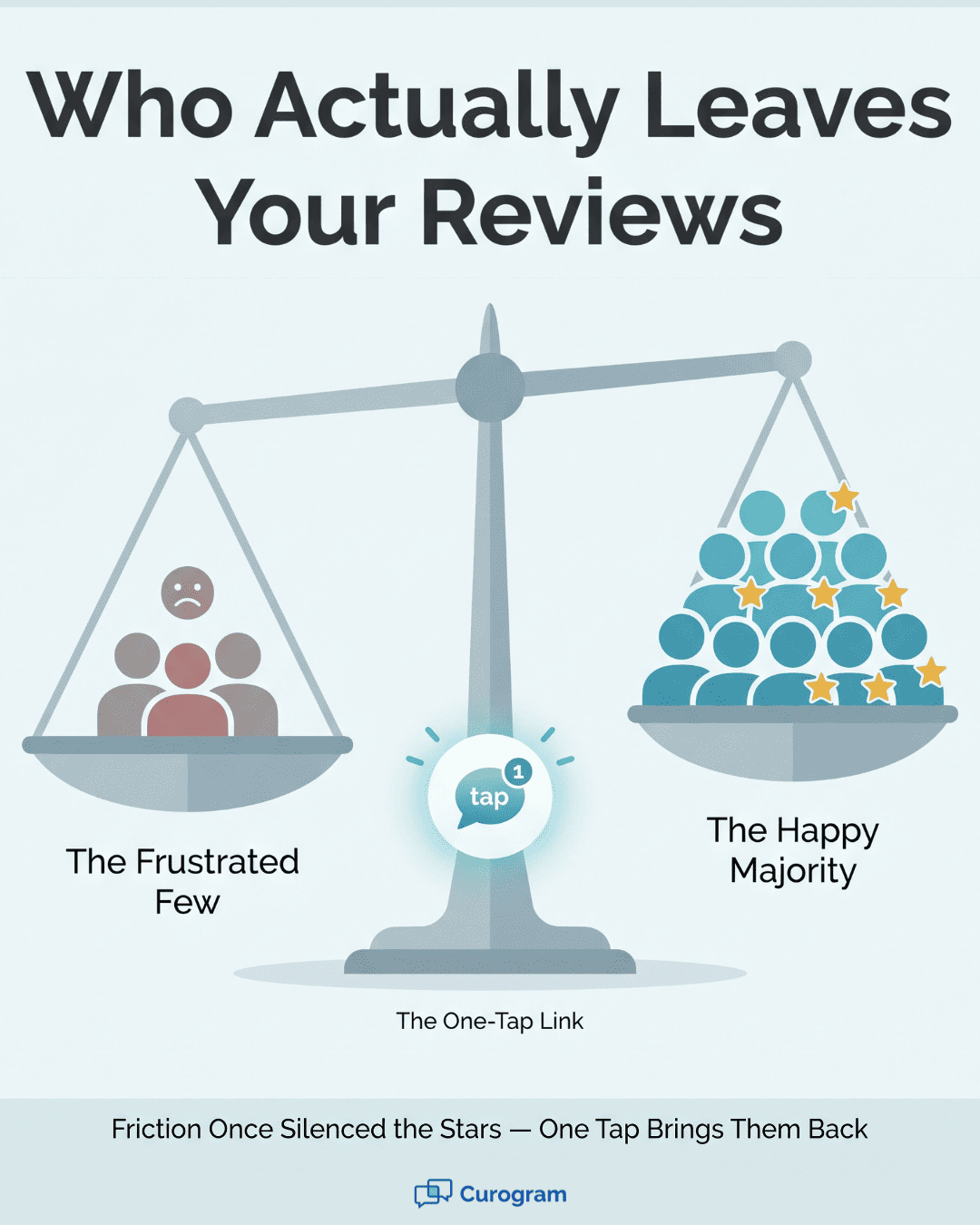
This small shift changes who leaves reviews. Today, the loudest voices are often the frustrated ones. They push through the hassle to complain. Meanwhile, your happiest patients stay quiet, and your rating suffers for it.
A simple text flips that balance back in your favor. It hands willing patients the page they could never find on their own. The timing matters too. Asking right after the visit captures their goodwill at its peak.
In this article, you will see why the review gap happens. You will learn how a one-tap link closes it. You will also see what kind of results practices see when they ask this way.
The goal is simple. Make leaving a review as easy as reading a text. By the end, you will know how to turn quiet goodwill into visible, genuine five-star proof.
A happy visit should lead to a happy review. Often, it does not. The care was great, the patient felt heard, and the goodwill was real. Then the moment passed, and the review never came.
This is the review gap. It is not a care problem. It is a path problem. The distance between feeling grateful and posting that feeling is just too long.
Walk through it from the patient's side. A patient leaves your office glad they came. They think, "I should leave a nice review." That good intention is the easy part.
Now comes the hard part. They have to remember later, often hours after the visit. They open Google and search your practice name. They scroll past ads and map pins to find you.
Then they tap into the reviews tab. They sign in to a Google account, if they even have one. They stare at a blank box and try to find the words. Each step is a new chance to give up.
Here is what that path looks like in plain steps:
|
Step |
What the patient must do |
Drop-off risk |
|
1 |
Remember to do it later |
High |
|
2 |
Search the practice on Google |
Medium |
|
3 |
Scroll to find the right listing |
Medium |
|
4 |
Open the reviews tab |
Medium |
|
5 |
Sign in to a Google account |
High |
|
6 |
Write and post the review |
Medium |
Six steps stand between goodwill and a posted review. Most people quit somewhere in the middle. They are not angry. They are just busy, and the task feels like a chore.
Often it is the upset patient. Frustration is a strong motivator, so they hunt down the page to vent. Meanwhile, your happiest patients drift away in silence.
That is the cruel twist of the review gap. Your loudest online voices may not match your typical care. The five-star patients stay quiet, and the rare bad day gets a megaphone. Your public rating ends up lower than your real quality.
The cost adds up over time. Imagine 100 happy patients in a month who meant to review you. If only five finish the long path, you capture a tiny slice of goodwill. The other 95 kind words never reach a future patient.
This matters because new patients read those reviews first. Based on our internal research, 90% of new patient leads check your Google Business Profile before your website. So your reviews often make the first impression, not your site.
|
Let us put a number on that lost goodwill: Say your rating sits at 4.2 stars today. You know your care is better than that. The gap exists because mostly upset patients took the time to post. |
Now picture flipping the pattern. The same happy patients who stayed quiet start to speak. Their honest five-star notes pull the average up. Your rating begins to match the care people actually receive.
None of this requires better care. You already provide it every day. It only needs a shorter path from the visit to the review. That is the entire job of the next section.
The good news is simple. The care is already excellent. The only thing missing is an easy path. Close that gap, and the reviews you have earned start to show up.

If the problem is a long path, the fix is a short one. Do not ask patients to find your page. Hand it to them instead. Send a direct link the moment the visit ends.
That is the whole idea behind the review engine. It replaces six steps with one tap. The patient does not search, scroll, or sign in. They open a text and tap a link.
Right after the Lytec visit, the system sends a short, friendly text. Inside is a post-visit review link Lytec patients can tap at once. The link opens your Google Business Profile directly.
There is no app to download. There is no new account to set up. The patient lands on your page, ready to rate and write. A task that took minutes now takes seconds.
Timing is a big part of why this works. The text goes out while the visit is still fresh in mind. Goodwill is at its peak right after good care. Asking then, not days later, is what turns intent into action.
It helps to picture the actual message. The text is short and warm, not pushy. It might read, "Thanks for visiting today. Tap here to share your experience." One line, one link, no clutter.
The link itself does the heavy lifting. It carries the patient straight to your review box. There is no menu to navigate and no page to find. The destination is set before they ever tap.
The request fires off the Lytec visit, so staff do nothing extra. No one reads a script or chases anyone at checkout. The whole ask runs quietly in the background.
Because the request is automatic, it never gets forgotten. A busy desk may skip a verbal ask on a hectic day. The system does not skip anyone. Every eligible patient gets the same fair, simple invitation.
What about patient replies? Any response routes back to your unified inbox. If someone texts a question or a concern, your team sees it. Nothing falls through the cracks, and no feedback gets lost.
This is what makes easy patient reviews by text feel effortless for both sides. The patient taps once. The staff lifts nothing. The practice gains a real review.
The design also reaches every kind of patient. A one-tap link needs no tech skill at all. Consider two patients on the same afternoon:
|
Patient |
Age |
What they do |
|
Maria |
82 |
Opens the text, taps once, leaves five stars |
|
Devon |
26 |
Taps the link between meetings, posts in 20 seconds |
Both finish a one-tap Google review with zero friction. The 82-year-old and the 26-year-old take the very same simple path. Age is no longer a barrier to leaving a review by text.
That broad fit is the quiet strength of this approach. You are not reaching only the tech-savvy few. You are reaching every grateful patient who walks out your door. Each one gets a clear, simple way to say thank you in public.
A short path does more than win one review. It starts a cycle. More reviews bring more trust. More trust brings more patients. Those patients leave reviews of their own. Around it goes.
Call it the five-star flywheel. Each happy visit feeds the next round of growth. The engine is simple texts, sent at the right moment. The fuel is the goodwill you already earn.
The results are real, and the numbers back them up. Based on our internal data, one practice asked for reviews this way and saw a striking shift. About 90% of its patients left five-star reviews. That added up to 1,064 new five-star reviews in just three months.
Sit with that figure for a moment. Most of those patients would never have searched on their own. The long path would have stopped them cold. A one-tap link reached them while their goodwill was high.
Another practice shows the repair side of the flywheel. Based on our internal data, it climbed from a 1.67-star rating to a full 5.0. That kind of turnaround changes how new patients see you. A low rating once scared people off; now it draws them in.
Here is how those two stories compare at a glance:
|
Practice |
Starting point |
What changed |
Result |
|
Multi-location group |
Few organic reviews |
Texted one-tap review links |
1,064 five-star reviews in 3 months |
|
Recovering practice |
1.67-star rating |
Asked happy patients by text |
Rebuilt to a 5.0 rating |
Notice what both have in common. Neither bought reviews. Neither hid bad ones. They simply asked happy patients in an easy way. The friction was the only thing standing in the way.
It starts with the volume of honest reviews. When you ask everyone, you hear from the happy majority. Their voices balance out the rare bad day.
A higher rating then does quiet work for you. New patients search before they ever call. Based on our internal research, 90% of new patient leads check your Google Business Profile before your website. So your stars often greet them first.
A strong rating earns the click. A weak one sends them to the next clinic on the list. With more five-star proof, more searchers choose you. Those new patients then become the next wave of reviewers.
They type your specialty and city into Google. A list of clinics pops up, each with a star rating. The eye goes straight to those stars first.
A 4.9 with 300 reviews reads as safe and proven. A 4.1 with 12 reviews reads as a question mark. Both clinics may give similar care. Only one made it easy for happy patients to speak.
The flywheel decides which one you become. Ask with friction, and you stay the question mark. Ask with one tap, and you become the safe, proven choice. The difference is not better care; it is a shorter path.
Let us run some simple example math to show the pace. Treat these as illustrative numbers, not a promise. Say your practice sees 400 patients a month. Suppose 80% are glad they came.
That is 320 happy patients each month who could review you. With the old path, maybe 2% finish, so about 6 reviews. With a one-tap text, far more follow through. Even a modest 25% would mean 80 reviews a month.
Here is that contrast side by side:
|
Approach |
Happy patients asked |
Rough finish rate |
New reviews per month |
|
Old path (search and sign in) |
320 |
About 2% |
About 6 |
|
One-tap text link |
320 |
About 25% |
About 80 |
Again, those rates are just an example to show the gap. Your real numbers will vary by practice. The point is the shape of the change, not the exact total. A short path simply finishes far more often than a long one.
Now stack that month over month. Six reviews a year barely moves your rating. Eighty a month builds a wall of recent, glowing proof. Fresh reviews also tell Google your practice is active and trusted.
That freshness matters more than people think. A review from two years ago carries less weight. A steady stream of new ones keeps you near the top. The flywheel rewards practices that ask, every day, with ease.
Patients like being asked at the right time. The request feels like a natural close to a good visit. They get to say thank you, and it takes one tap.
Your staff feels the lift as well. They never have to beg for reviews at the desk. They never read an awkward script or hand out cards. The ask runs on its own, so they stay present with patients.
The flywheel also protects you from a common trap. Some tools try to game ratings, and that backfires. Curogram does not gate, filter, or buy anything. It just removes the friction that kept honest praise hidden.
So the cycle stays clean and sustainable. Real patients write real reviews about real care. The volume grows because the path is short. The rating rises because the volume is honest.
Picture where this leads over a full year. A quiet practice becomes a five-star landmark in its area. Searchers see dozens of recent, genuine reviews. Many choose you before they even read your website.
That is the promise of the flywheel in plain terms. You are not chasing reviews anymore. You are simply opening the door and letting goodwill walk through. The more it turns, the more it grows on its own.

How Curogram's Automated Review Requests Turn Happy Lytec Visits Into Five-Star Proof
How does Curogram turn a happy Lytec visit into a real review? It closes the wide gap between patient goodwill and real action.
The Automated Review Requests feature sends each patient a one-tap link right after their appointment. The link rides on a normal text message, so there is nothing to download.
When the patient taps it, your Google Business Profile opens at once. There is no app to install and no account to create. They rate their visit, add a few words, and they are done. The whole task takes seconds, not minutes.
The timing is the secret here. Curogram sends the request off the Lytec visit, while the experience is still fresh. That is the exact moment goodwill runs highest. Asking later, by contrast, lets the feeling fade and the review slip away.
This patient-friendly review request fits every age group with ease. An 80-year-old taps the same simple link as a 25-year-old. No one needs tech skills or a password to take part. That wide reach is a big reason so many patients follow through.
The system also protects your time. Requests go out on their own, with no staff effort at checkout. Any reply routes back to your unified inbox, so nothing gets missed. Your front desk stays focused on the people in the room.
It stays compliant, too. Messages are sent with proper consent, and patients can reply STOP to opt out. Curogram never gates feedback or buys reviews. It simply removes the friction that kept your happy patients quiet for so long.
The outcome is a steady stream of genuine five-star reviews. They come from the very patients who already knew and loved their care. With no-hassle Google reviews built into your workflow, your rating finally reflects the real quality you deliver every day.
Great care should be easy to see. Right now, too much of yours stays hidden. Your happiest patients leave grateful, then never find your Google page. The goodwill is real, but it goes to waste.
The fix is small, and it works. Hand each patient a one-tap link the moment the visit ends. They do not search. They do not sign in. They tap once and share how they feel.
This is where the two tools play different roles. Lytec records the visit and keeps your schedule running. Curogram lets the patient celebrate that visit in a single tap. One handles the chart, the other handles the moment.
The shift in results is hard to ignore. Friction once pushed your happiest patients into silence. A simple text now invites them in. The same care that earned their thanks finally shows up as public proof.
Your staff feels the change too. No one chases reviews or reads scripts at checkout. The request goes out on its own, right after each visit. Your team stays focused on patients, not on busywork.
Think about what this means over a year. Each happy visit becomes a chance for a real review. Those reviews stack up where new patients look first. Slowly, your rating starts to match your true care.
Stop letting happy patients slip away in silence. Book a Curogram demo and watch the one-tap review flow run live on your own Lytec workflow.
Most are simply busy, not unwilling. The path from a good visit to a posted review takes many steps. By the time they remember, the goodwill fades. A one-tap text removes that delay completely.
It reaches the happy majority, not just the upset few. Frustrated patients push through long steps to vent. Most grateful patients do not. A simple link lets them speak with almost no effort.
Goodwill peaks right after a good visit. Curogram sends the link off the Lytec visit, while feelings run high. Asking days later lets that warmth fade, so far fewer patients ever follow through.
Messages go out with proper consent, and patients can reply STOP to opt out anytime. Curogram never gates, filters, or buys reviews. It only removes the friction that kept honest praise hidden from view.
Patients write and post every word themselves about their own care. Curogram does not script, screen, or pay for reviews. It simply hands willing patients the page they wanted but could not easily find.
💡 Lytec automated Google review requests after every visit turn happy patients into verified 5-star reviews. Lytec runs your scheduling and...
💡 When a patient leaves a good visit, that positive feeling fades fast. An eClinicalWorks patient text review request sent 1–2 hours after the...
💡 A DrChrono patient Google review text link lets you turn happy patients into 5-star Google reviews in under 30 seconds. Curogram sends an...