10 min read
Patient Recall Texting for Cerbo DPC and Concierge Practices
Mira Gwehn Revilla
:
August 7, 2026
- Cerbo's Advanced Patient Search builds the list, then exports it for an outside tool.
- A portal notice reaches only patients who log in, and it sends no alert.
- Curogram pulls the list, segments it by last visit or tag, and texts the campaign.
- Replies land in a shared inbox, where staff book the visit in Cerbo.
- One practice brought back 1,240 patients this way, based on our internal data.
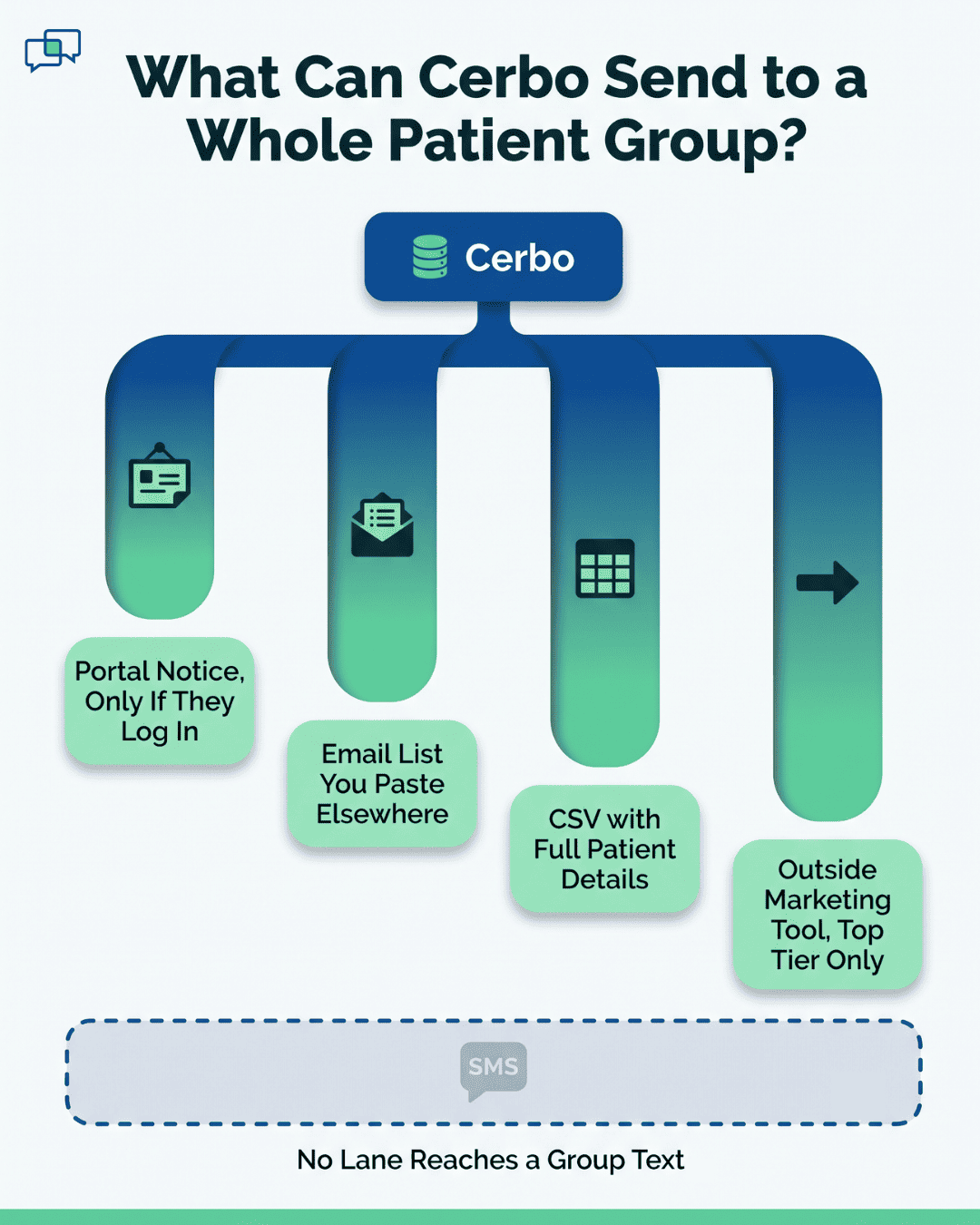
Cerbo's help center answers the mass messaging question in one line. The platform does not support bulk messages, mass emails, email blasts, or mass texts by email, secure message, or SMS.
For a functional medicine or DPC practice built on six-month protocols, that single line decides how a lapsed patient gets found again.
Most protocol patients drop off without saying a word. No cancellation call. No complaint. A month-3 check-in that never gets booked, and a chart that resurfaces eleven months later when someone finally runs a report.
Adding a recall and campaign layer on top of Cerbo turns that quiet drop-off into a list you can text. Patients answer a text. That is the whole argument.
Cerbo tracks the plan well. Charting is flexible, tags are strong, and the Advanced Patient Search finds almost any patient group you can describe.
Finding them was never the hard part. Reaching 240 of them at once is, and Cerbo's documented answer is to export a spreadsheet and hand it to something else.
That handoff is where practices stall. Staff export the list, look at 240 rows of names and numbers, then set it aside for a slower week that never arrives.
Meanwhile, the DPCA's 2026 State of Direct Primary Care survey puts the average monthly membership at $98.46. Every member who quietly stops showing up is a subscription waiting to be canceled.
We work with practices on both sides of that gap. What follows covers what Cerbo's outreach tools actually do and how a recall campaign gets built from Cerbo data.
It ends with what one multi-location practice recovered after it stopped calling and started texting.
The Silent Panel
Open the Advanced Patient Search under the Admin menu and the filter depth is real. You can pull patients prescribed a specific supplement, patients who completed a specific questionnaire, or patients with no appointment between two dates.
Results link straight to the chart. Filters can be saved under a name, so next month's run takes one click.
Then you hit the wall. Cerbo's export options are Output List of Emails, which produces a comma-separated string to paste elsewhere, and Export Spreadsheet, which produces a CSV.
The help article for that CSV notes it carries expanded demographics, contact, and insurance details for every patient. That is a lot of PHI to move by hand into an outside tool. Cerbo's own guidance tells you to delete the columns you do not need before uploading.
The Recommended Path Has Its Own Toll
Cerbo does name a supported route for mass messaging. Its help center points users to ActiveCampaign, a marketing and CRM platform, and offers a 10% discount for signing up through Cerbo. The sync is one-way, from Cerbo out.
Read one line further and the cost of that route shows up. Cerbo's documentation notes that only ActiveCampaign's Enterprise tier is HIPAA-compliant.
Your workaround for reaching your own panel now means a second vendor and an enterprise contract. It also means marketing software your front desk has to learn.
Practices that take this route usually end up with campaigns nobody owns. Email newsletters go out. Recalls do not, because a recall needs someone watching for replies, and replies to an email blast do not arrive where staff work.
The Portal Notice Nobody Sees
Cerbo does let you post a notice on the patient portal for everyone to see. Its help center adds the part that matters: the notice is passive, and patients get no notification telling them to check the portal.
Cerbo also runs an Unread Sent Messages Report. It lists patients sent portal messages during a period who have not read them. A message counts as read only after the patient logs in and opens the Secure Message tab.
Practices that run that report for the first time tend to go quiet for a second. Your careful protocol follow-up went out. It is sitting in a portal your patient has not opened since intake.
What One Quiet Lapse Costs a Membership Practice
Membership math makes the loss easy to size. The DPCA's 2026 survey of 465 DPC physicians reported these averages:
|
Practice profile |
Average monthly membership |
|
All respondents |
$98.46 |
|
Fewer than 200 patients |
About $106 |
|
More than 500 patients |
About $78 |
|
Rural practices |
About $82 |
|
Urban practices |
About $110 |
Now the illustrative part. A member who goes quiet in month 4 and cancels by month 5 takes roughly $788 of that year's dues along. That uses the $98.46 average across the eight remaining months.
On the AAFP's reported average DPC panel of about 413 patients, 30 quiet lapses in a year lands near $35,000. Both figures are illustrative arithmetic on published averages, not a measured result.
Silence Reads as "What Am I Paying For?"
Fee-for-service practices lose a visit when a patient goes quiet. Membership practices lose a subscription, and the cancellation lands weeks after the patient stopped feeling connected.
DPC membership communication is the thing being purchased, at least in the patient's head. They pay monthly for access. Four months without a message makes that access feel theoretical, and the card on file starts looking like a line item to cut.
Concierge panels carry the same risk at a higher price. A patient paying four figures a year expects contact between visits. The stretch before renewal is where that expectation gets tested.

The Continuity Engine
Every good result from patient recall texting for Cerbo DPC and concierge practices traces back to the segment. Narrow it enough that the message sounds written for one person.
Cerbo holds the fields that make that possible. Last appointment date, appointment type, tags, questionnaire status, and prescribed supplements or labs all sit in the record already.
A useful segment for treatment protocol follow-up texting reads like this. Patients tagged for the gut protocol, last seen 90 to 150 days ago, with nothing on the books. That group gets the month-4 recheck message. A patient seen last week never sees it.
Curogram pulls the patient list from Cerbo and holds those segments, so you rebuild them without redoing the search. Filter by last visit, by tag, or by appointment type. Preview the count before anything sends.
One caution from Cerbo's documentation, worth knowing before you lean on tags. The Patient Bulk-Tag Tool applies a tag to everyone matching your search, and you cannot bulk-unapply a tag. Tag deliberately, and keep recall tags separate from clinical ones.
How the Sync Behaves
Cerbo runs an open API, and its API documentation asks that high-volume transfers be scheduled off-peak, after 5PM Pacific and before 8AM Eastern.
Bulk patient syncs follow that guidance. The pull that builds your recall list does not compete with charting during clinic hours.
Cerbo's API notes also warn against pulling the extended_details endpoint unless you need most of what it returns, since the payload per patient is large. A recall sync does not need it.
In practice, the list you segment at 9AM reflects last night's sync. For a campaign aimed at patients last seen 90 days ago, a few hours of lag changes nothing. Same-day work like appointment reminders runs on different timing and is handled separately.
Replies come back to a shared inbox rather than someone's cell phone. A patient answering "yes, what times do you have Thursday" reaches whoever is covering that inbox. The booking gets made in Cerbo.
Mass text messaging with Cerbo EHR data pays off only when someone stands behind the send. Two staff covering an inbox for 48 hours after a campaign will out-book a month of voicemails.
Consent, Opt-Out, and What Goes in the Message
Building a HIPAA compliant bulk texting practice comes down to three habits. None of them are complicated.
Collect and record consent to text at intake, with the date it was given. Include a plain opt-out in campaign messages, and honor a STOP reply immediately and permanently. Keep clinical detail out of the campaign text.
That last habit does more work than people expect. A recall text reading "your protocol recheck is due" is fine. A recall text naming the condition, the supplement, or the lab result is not. It lands on a lock screen anyone nearby can read.
Curogram operates under a signed BAA, encrypts messages in transit and at rest, and logs every send and reply. Anything clinical moves to secure messaging or to the visit itself.
What DPC and Concierge Practices Send Between Visits
Recalls make the revenue case. Campaigns make the retention case, and membership practices need both running.
Seasonal pushes earn their keep. Send a spring allergy protocol note, a fall immune support message, or a heads-up when a new lab panel comes in-house.
Practice updates work the same way, whether that is a new provider joining or a holiday-week schedule change.
A workable cadence for a 400-member panel is one campaign a month and one recall rule running underneath it. That is twelve touches a year plus whatever the recall rule catches, which is enough presence without becoming noise.
None of it needs to be clever. A member who hears from the practice twice a quarter renews without thinking about it. A member who hears nothing for a season starts doing arithmetic on the monthly fee.
The Re-Engaged Panel
A multi-location practice in our client base carried the backlog most practices carry. Patients who missed follow-ups, canceled and never rebooked, or simply stopped scheduling. Nobody had called them, because calling 1,200 people is not a task a front desk can absorb.
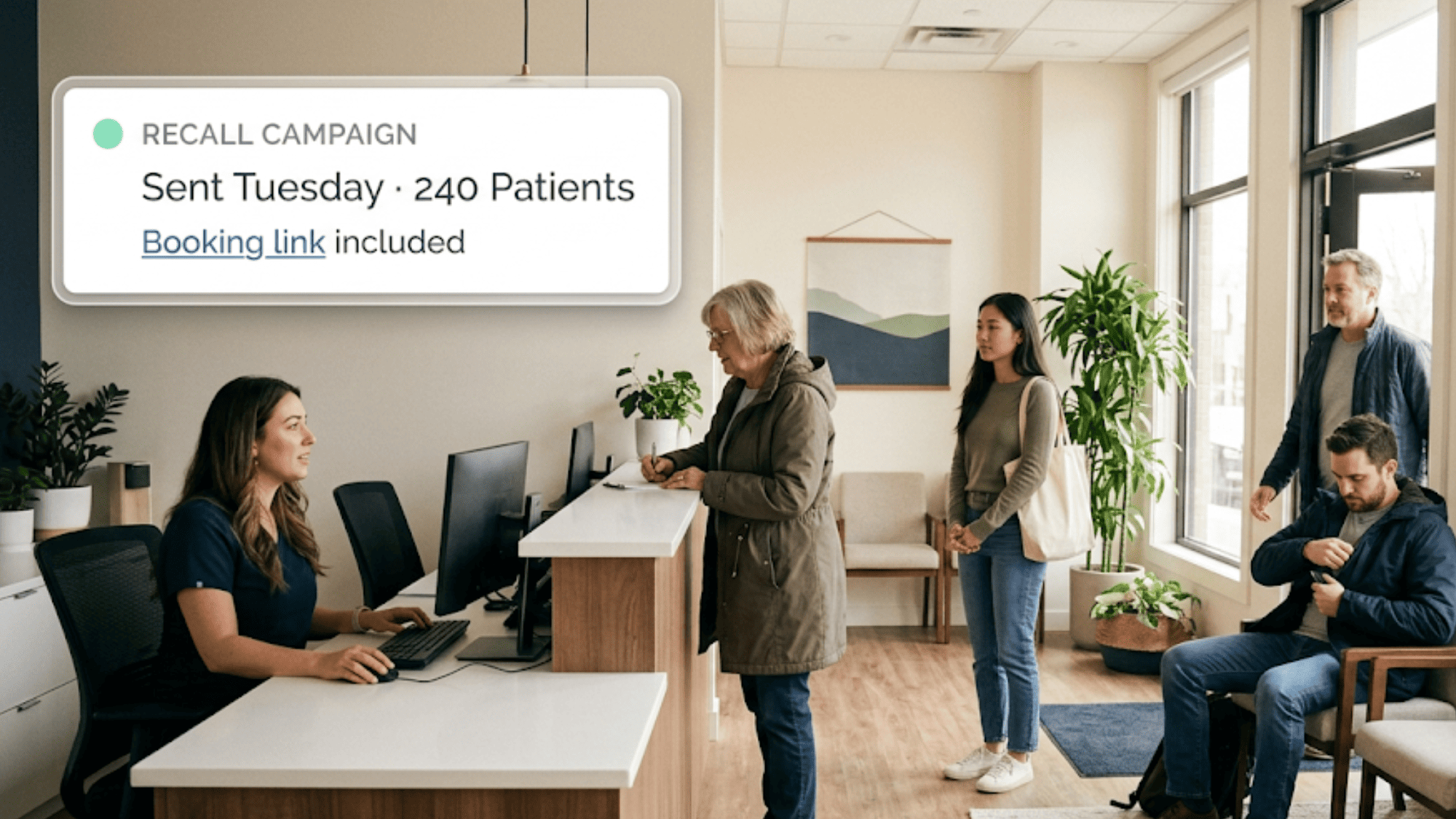
They sent SMS recalls to patients who had not scheduled a follow-up within the recommended window.
Based on our internal data, 1,240 patients were seen from those recall messages alone. Of the patients who received a recall, 35% booked an appointment within a month.
That 35% is the reconversion rate, meaning the share of contacted patients who turned back into a booked visit. Set it against a phone campaign, where most calls reach voicemail and most voicemails go unreturned. The gap is not close.
Building the Same Campaign From Cerbo
Lapsed patient win-back in healthcare is mostly a sequencing problem. The sequence, step by step:
|
Step |
Where |
What happens |
|
1 |
Cerbo, Admin > Advanced Patient Search |
Filter on "Has not had an appointment between." Set the start date 8 months back and leave the end date blank |
|
2 |
Cerbo |
Check "Save Filters" and name the report, so next month's run is one click |
|
3 |
Cerbo |
Send results to the Patient Bulk-Tag Tool and apply a recall tag |
|
4 |
Curogram |
Build the segment from the synced list and preview the count |
|
5 |
Curogram |
Write one message with a booking link, then schedule it for a weekday, late morning |
|
6 |
Curogram shared inbox |
Staff answer replies and book the visits in Cerbo |
Step 1 holds a wrinkle worth catching. Leaving the second date blank keeps patients with future appointments off your list, per Cerbo's own instructions for that filter. Fill it in and you will text people already booked for Thursday.
Message copy stays short. Something along these lines:
Hi Dana, it's been a while since your last visit. Your protocol recheck is due. Book here: [link]. Reply STOP to opt out.
That wording carries no clinical detail, gives one action, and reads like a person wrote it.
Plan the second touch before the first one sends. Patients who do not reply within ten days get one follow-up with different wording, then come off the list until the next quarter. Two touches is outreach. Five is a reason to hit STOP.

Mass Messaging and Recalls, Built for Protocol-Based Panels
Curogram's Mass Messaging & Recalls turns a Cerbo patient list into a text campaign patients answer. Cerbo stays the record. Outreach runs beside it.
Segments come from fields your team already maintains. Filter by last visit date, appointment type, or tag, then preview the exact patient count before sending.
Write the message once. It goes to 40 patients or 4,000 with the same effort, arriving as a normal text from your practice number.
Replies separate this from an email blast. Every response lands in a shared inbox your front desk works like a queue. A patient asks about Thursday afternoons, staff answer in the same thread, and the appointment goes into Cerbo. No voicemail tag, no callback list.
Scheduling matters for membership panels. Recalls run on a repeating rule, so patients crossing the "not seen in 6 months" line get a message without anyone remembering to check. Campaigns can be written Monday and scheduled for Wednesday at 10AM.
Two guardrails come standard. Opt-out handling is automatic, so a STOP reply removes that patient from future campaigns. Send activity is logged, which is what you want when someone asks who was contacted and when.
Practices running patient reactivation campaigns for functional medicine panels usually start with one segment.
Patients last seen 6 to 12 months ago who never finished their protocol. It is the shortest path from a list Cerbo can already build to visits on next month's schedule.
Conclusion: Bring Back the Patients You Already Earned
Your hardest-won patients are already in your panel. They finished intake, paid for labs, started a protocol, and then life happened. Getting them back costs a text.
Cerbo does the clinical work it was built for. Charting stays flexible, tags stay sharp, and the Advanced Patient Search finds any group you can describe. What it will not do, by its own documentation, is send that group a message.
Cerbo remembers your treatment plan. Something has to remind the patient it exists.
Protocols should end because the patient finished them. Not because a month-3 check-in fell off a list and nobody had time to call.
Practices we work with see the shape of this quickly once the first campaign runs. One send, a few hundred patients, and a shared inbox that stays busy for two days.
Based on our internal data, one multi-location practice recovered 1,240 patients that way, with 35% booking inside a month.
Book an integration demo and we will build a lapsed-patient segment from your own panel on the call. You will see the patient count before you decide anything.
Frequently Asked Questions
Cerbo builds the list and Curogram sends it. Your team runs the Advanced Patient Search, or works from synced fields like last appointment date and tags. Curogram delivers the campaign by SMS from your practice number. Replies arrive in a shared inbox, and staff book the resulting visits back in Cerbo.
Cerbo's help center describes the portal notice as passive, with no notification prompting patients to check it. A message counts as read only after the patient logs in and opens the Secure Message tab. Someone who stopped engaging four months ago is not logging in, so the follow-up sits unread while the chart looks handled.
Start narrow. Patients last seen 6 to 12 months ago, with no future appointment, who never finished a protocol. That group has the clearest reason to hear from you and the shortest path to a booking. Once it performs, add protocol-stage segments so a recheck message never reaches a patient seen last week.
Reminders protect a visit already on the calendar. Recalls go to patients with nothing booked at all. The two work as a pair, since a recall reply becomes an appointment and the reminder then keeps that appointment from turning into a no-show. Practices running only reminders protect the schedule they already have.
Members pay monthly for access, and access feels real only when they hear from you. A seasonal protocol note or a practice update keeps the fee connected to something visible. Silence between visits is where renewal doubt starts, and a quarterly message costs far less than winning that member back.