


High-Deductible Imaging Payments: Same-Day Collection for StreamlineMD
💡 Setting up SMS payment links in StreamlineMD takes four steps. Connect your Curogram account through FHIR or HL-7. Set your payment link triggers...
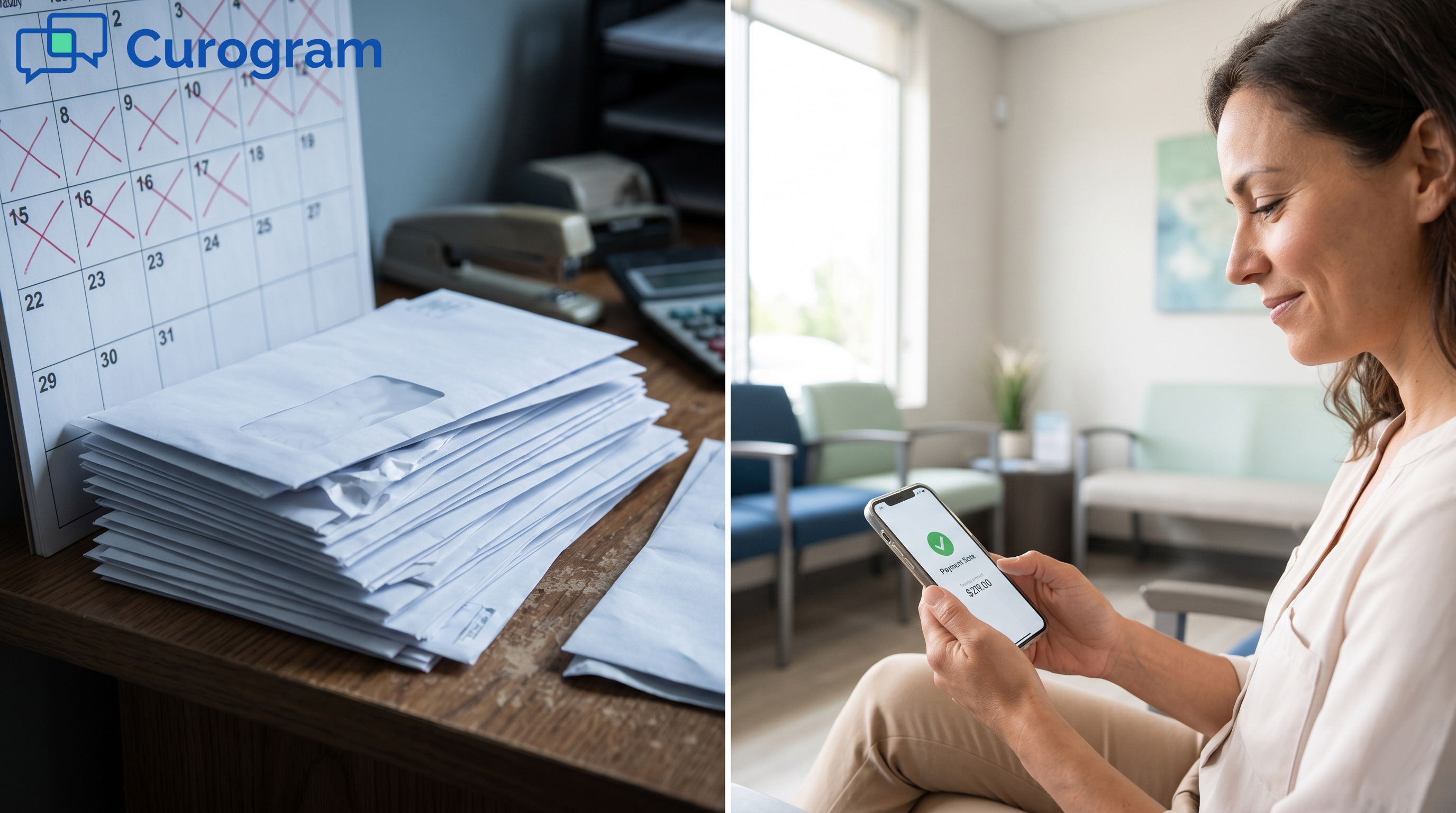
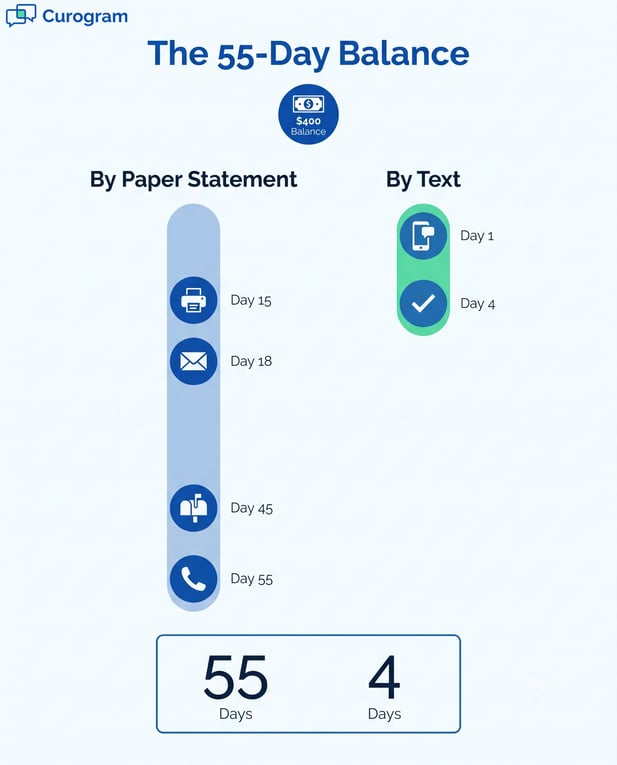
You wait sixty days to collect $400 from a patient who left her appointment happy. That arithmetic shows up on cash-pay billing desks constantly, and the staff usually did everything right.
Walk the cycle once. The charge lands in the Charges/Payments box in Cerbo the same afternoon as the visit. It becomes an invoice in the Patient Portal, where it waits for a login. Two weeks later, a statement prints.
Thirty days after that, a second one prints. Around day 55, a billing coordinator makes the call she’s been putting off, to a patient who would have paid in the parking lot without blinking.
Our position for this piece: balances age because of how the bill travels, and shortening that trip is the fastest fix a billing desk can make this quarter.
MGMA reports that 74% of providers need more than one statement to collect. A 2022 MGMA Stat poll of 519 groups found 42% wait 91 to 120 days before sending an account to collections.
Both figures describe practices with insurance revenue cushioning the gap. A direct primary care or functional medicine clinic running on Cerbo has no cushion, since patient payments make up 100% of collections.
A medical billing text payment workflow moves that same balance through a channel patients check dozens of times a day. Cerbo keeps the ledger, the charges, the memberships, and the recurring drafts.
Texting covers the last few feet between a posted balance and a paid one, plus the follow-up that used to cost a stamp and an afternoon.
Billing desks in Cerbo practices are rarely the bottleneck. Charges post cleanly. Invoices generate from those charges with a click.
Delay creeps in afterward, because every channel used to deliver the bill depends on a patient remembering something without being asked.
A $400 visit-and-lab balance moves through a predictable string of delays. None of them looks serious in isolation.
|
Day |
What Happens |
Where the Balance Sits |
|---|---|---|
|
0 |
Visit ends, charge posted in Cerbo |
Your ledger |
|
1 to 14 |
Portal invoice available, no login |
Patient Portal |
|
15 |
First statement printed and mailed |
USPS |
|
18 |
Statement arrives, joins the mail pile |
Kitchen counter |
|
45 |
Second statement printed and mailed |
USPS |
|
55 |
Billing coordinator calls |
Phone queue |
Two of those six rows involve your team doing work. Roughly 50 of the 55 days are waiting.
Cerbo gives patients a real way to pay. They log into the Patient Portal, open the invoice, and pay by card or ACH. Practices with strong portal adoption do fine with it. Adoption is the whole game, though.
Paying that way asks a patient to recall a password for a site they visit twice a year, then hunt for the invoice, on a device that never prompted them to look.
Nothing on their phone tells them the balance exists. So the money you’re owed sits in a system your patient isn’t in.
Print, envelope, postage, and the staff time to stuff and reconcile push most single-location practices to roughly $8 to $10 per statement. Send 100 a month, and the line item runs $800 to $1,000.
Treat that as illustrative math rather than a benchmark. A practice printing in-house on a slow week lands lower, and a vendor charging per piece lands higher.
Small balances break the math entirely. A functional medicine practice generates a lot of them: a $32 supplement charge, a $48 lab pass-through, a $75 injection.
MGMA published a case from a women’s health practice that reached the same conclusion, deciding paper bills for balances under $5 weren’t cost-effective to send. Raise that floor to $50 and a meaningful slice of a cash practice’s monthly statement volume stops making sense on paper.
Return on that spend is the uncomfortable part. With 74% of providers needing more than one statement, most of those balances get billed twice before any money moves. You pay full postage on the failures and the successes alike.
Ask a billing manager at a six-provider functional medicine clinic how Thursday afternoon went. A common answer: four calls about balances under $200, two voicemails, one apology to a patient who was sure she’d already paid, and a note to try again next week.
Cerbo doesn’t connect to a clearinghouse, and superbills go to patients to submit on their own. No payer remittance shows up to smooth the month, so every dollar in the aging report gets collected because someone on staff asked for it.

The mechanics of text-to-pay for Cerbo practices are simple enough to describe in a paragraph.
A Cerbo patient payment collection workflow for billing staff is mostly a sequencing change: same balances, same ledger, different delivery and a much shorter wait.
Open balances sync out of Cerbo into a list. A coordinator filters by date range or amount, checks the boxes, and sends. Delivery takes seconds.
A run that used to mean printing, folding, stuffing, and hauling to the post office becomes a few minutes at a desk before lunch.
Bulk sending matters less than timing. A balance texted the day after the visit reaches a patient who still remembers the appointment, still has the same card in the same wallet, and hasn’t yet filed the visit under finished business.
Same-week sends collect at a different rate than day-30 sends, and that gap is most of what payment reminder texting in healthcare is buying you.
No diagnosis. No service description. No full name paired with treatment details. Curogram’s own HIPAA guidance uses this shape:
You have a balance due of $50. Please click the link to see your payment request details and to make a payment: [SECURE PAYMENT LINK]
Tapping the link opens a PCI-compliant page hosted outside the message thread. The patient sees the balance and its itemization, picks card, debit, or ACH, and finishes. Most people are done inside a minute. A receipt sends itself.
Payments post back against the Cerbo balance, so the ledger stays single-source. No parallel books. No end-of-day matching between two systems.
Everything Cerbo already handles well keeps running in Cerbo. Recurring subscription drafts for DPC memberships, prepaid package billing, and embedded card processing through Propelr, Bluefin, or Stripe all stay native.
Curogram complements Cerbo and replaces none of it. What gets added is delivery and follow-up on balances that sit outside a recurring draft: one-off visit fees, lab pass-throughs, supplement orders, injection and IV charges.
Not every open balance should get a text on Friday. Disputed charges need a human first. Balances already on a payment plan have their own schedule.
Anything tied to a membership draft that failed needs a card update, which is a different conversation than a one-time payment link.
A workable default: queue visit balances, lab and supplement charges, and injection or IV fees posted in the past week.
Set a floor around $10, plus a hold flag your coordinator can put on any account. Everything else stays on the manual list, which stays short.
Patients opt in to texting the same way they do for appointment reminders, usually at intake. Replying STOP ends messages to that number, including payment reminders, and the record of that opt-out lives with the thread.
Practices that already text confirmations through Curogram have this consent in place, so payment texting doesn’t require a second round of paperwork.
Some patients reply. “What was the $145 for?” arrives about as often as a payment does. Those replies drop into the same shared inbox that already handles appointment reminders and two-way texting with patients, so a coordinator answers in context and the patient pays from that same thread.
One channel gives you one audit trail. Nothing separate to license, train on, or reconcile. Billing staff efficiency tools earn their keep by reusing an existing habit, and the shared inbox is already open on the front desk screen all day.
Text-to-Pay with Automated Nudges does two jobs. It sends the secure payment link, and it runs the follow-up on a schedule you set.
Cadence is configurable. Most practices use two reminders: one about three days after the original send, another about a week later, then a stop. Tone, timing, and cutoff are yours, so a concierge clinic can sound like a concierge clinic and a med spa can sound like itself.
SMS carries a 98% open rate as an industry benchmark, which is why most balances clear on the first send and the reminders end up working a short tail.
Two specific tasks disappear: the second statement print run and the “just checking in” phone call. Patient balance follow-up automation also runs on evenings and weekends, which is when people actually deal with personal admin.
Receipts send themselves. Payment posts back to Cerbo. Anything still open when the cadence ends surfaces as a short list for a human call, and that list is a fraction of the one your coordinator works today.
Curogram operates under a signed BAA, is HIPAA compliant, and maintains SOC 2 Type II. Card data never touches SMS at any point in the flow.
Compressing A/R sounds abstract until you watch one week of balances move. So walk one, step by step.
Numbers below are an illustrative model rather than a client result. The sequence is the real part.
Friday, 8:40 a.m. A billing coordinator opens the payment queue filtered to balances posted Monday through Thursday. Thirty-four open balances, $6,900 total.
She skips three. One patient is on a payment plan, one charge is disputed, one balance under $10 isn’t worth the send. Thirty-one go out in a single batch.
By 11 a.m., replies arrive. Two patients ask what a charge covered. She answers both from the shared inbox using the invoice detail in Cerbo, and both pay within the hour.
Monday, 10 a.m. Reminder one fires automatically to everyone who hasn’t paid.
Thursday, 10 a.m. Reminder two fires, then the cadence stops.
Friday morning she pulls the report. Whatever remains is a handful of accounts, each with a reason behind it, each worth an actual phone call. Five accounts take about fifteen minutes.
|
Step |
Statement Cycle |
Text Cycle |
|---|---|---|
|
Bill reaches patient |
Day 18 |
Day 1 |
|
First follow-up |
Day 45 |
Day 4 |
|
Second follow-up |
Day 75, by phone |
Day 11 |
|
Typical settlement |
Day 55 to 90 |
Day 1 to 11 |
A practice that gets balances in front of patients on day one stops fighting the calendar to reach those numbers.
Statement spend is one figure. What that spend was buying is the second: with 74% of providers needing more than one attempt, the first mailing is a coin flip you paid for in advance.
Practices that replace paper statements with a text-first sequence keep paper for patients who ask for it and stop mailing the rest by default.
Days to first payment, measured from the date the charge posts rather than the date you billed. Share of balances collected within seven days of the visit.
Monthly statement volume, which should fall in the first cycle. Count of collections phone calls made per week, which is the number your billing staff will notice first.
Pull all four from before the switch and again at day 60. If days to first payment hasn’t moved, the send timing is usually the culprit: batching once a month recreates the statement cycle inside a faster channel.
Time freed from statement handling goes to work that was getting skipped. Reviewing aged accounts that have a real reason behind them.
Setting up payment plans before a balance sours. Checking that supplement and lab charges actually got posted to the encounter.
Calling the two members whose cards declined on this month’s draft. That last one is worth more than any statement in the pile, and it never fits in an afternoon spent chasing $85 balances.

Every day a balance ages, collecting it gets harder. Texting takes days off the front of the cycle, where they’re cheapest to remove.
Cerbo holds the ledger well. Charges, memberships, recurring drafts, prepaid packages, and invoices built from what the provider entered in the note all live there. Distance between that ledger and a paid balance is where a text-based workflow earns its cost.
Our mild but defensible claim: for a cash-pay practice, the statement print run is the least defensible line in the billing budget. It costs real money every month, it reaches patients two and a half weeks late.
MGMA’s own numbers say most of the time it needs a second attempt. Cancel it and watch what your aging report does in 60 days.
Book Your Cerbo Integration Demo. Bring your current A/R aging report and we’ll run the math live: monthly statement spend, average days to collect, and what those same balances look like on a text cadence.
The message carries a secure link and never a card field. Payment happens on a PCI-compliant page outside SMS, under a signed BAA, with Curogram maintaining HIPAA compliance and SOC 2 Type II.
Collected payments post against the matching Cerbo balance, keeping the ledger single-source. Your coordinator avoids a second set of books and skips manual transaction matching at month-end.
Cadence, wording, and cutoff are all configurable, and most practices set two reminders before stopping. With SMS carrying a 98% industry open rate, the majority of balances clear on the first message.
Recurring subscriptions and prepaid packages stay in Cerbo’s native billing through Propelr, Bluefin, or Stripe. Texting covers balances outside that draft: visit fees, lab pass-throughs, supplements, injections, and IV charges.
No payer remittance arrives to cushion slow patient collections, and Cerbo doesn’t submit through a clearinghouse. Every dollar depends on a patient paying, so days in A/R hit operating cash directly.
💡 Setting up SMS payment links in StreamlineMD takes four steps. Connect your Curogram account through FHIR or HL-7. Set your payment link triggers...
💡 When your imaging center sends you a billing text, you may pause. Is it real? Is it safe? This guide walks you through what to expect.A...
💡 Paper statements quietly drain money from behavioral health practices that run TherapyNotes. Most cost $800 to $1,000 each month to print and...