
 Joshua Inciso
6 Drivers of Patient Satisfaction
Learn some industry insights into what drives patients' satisfaction, improving patient retention, staff morale, and profitability.
A missed appointment never shows up as a line item on your monthly report. There's no bill for the empty exam room and no invoice for the time your provider spent waiting. But the financial loss is real, and it grows quietly, week after week, across your entire schedule.
Revenue in healthcare used to follow a simple formula. You gave patients quality care, you billed for the visit, and you got paid. That model still matters, but it no longer tells the whole story.
As payment moves toward value-based care, how you connect with patients between visits matters as much as what happens in the exam room. Patients now expect quick answers, convenient scheduling options, and consistent follow-up on their ongoing health concerns. When those needs go unmet, they cancel, forget, or quietly move to another practice.
That's where HIPAA-compliant patient communication comes in. It gives your team a secure way to reach patients where they already are, on their phones, without putting protected health information at risk. It also turns everyday messages, like reminders and follow-ups, into tools that protect your schedule and your income.
In this guide, you'll see how patient communication has changed over the past decade and why one-way reminders fall short. You'll also learn five practical ways secure two-way messaging can lift your revenue, from fewer no-shows to stronger patient retention. Along the way, we'll walk through a simple calculation so you can estimate what missed visits may be costing you right now.
Whether you run a small clinic or a large group practice, the goal is the same. You want a full calendar, a calmer front desk, and patients who keep coming back. Better communication is one of the most direct paths to all three, and it often begins with a single text message.
Not long ago, your staff spent hours on manual work. They submitted insurance claims, typed in patient data, and made call after call to patients, specialists, and other providers. All of that time could have gone toward better patient care.
Over the last decade, technology has reshaped the basics of healthcare. New tools now handle many repetitive tasks, which frees your team to focus on more meaningful work. The result is smoother operations and a better patient experience.
The move to electronic health records (EHRs) was one of the biggest drivers of this shift. Better patient communication comes in a close second. Many practices now send text message reminders to cut down on missed appointments.
That sounds like progress, and it is. But look closer, and you'll find that many reminder tools only send messages one way. Patients can't reply with a question, ask to reschedule, or confirm in their own words.
That's a big missed opportunity. Patients expect more from their providers than ever, and a message they can't answer feels like a closed door.
So how do you take the next step? The answer is HIPAA-compliant patient communication software.
The Health Insurance Portability and Accountability Act (HIPAA) protects the privacy of patients' health information. A HIPAA-compliant platform lets you message patients securely while keeping their data private. Compared with a basic texting tool, it also offers real financial and operational benefits, like stronger collections and lower support costs.
Secure messaging does more than protect privacy.
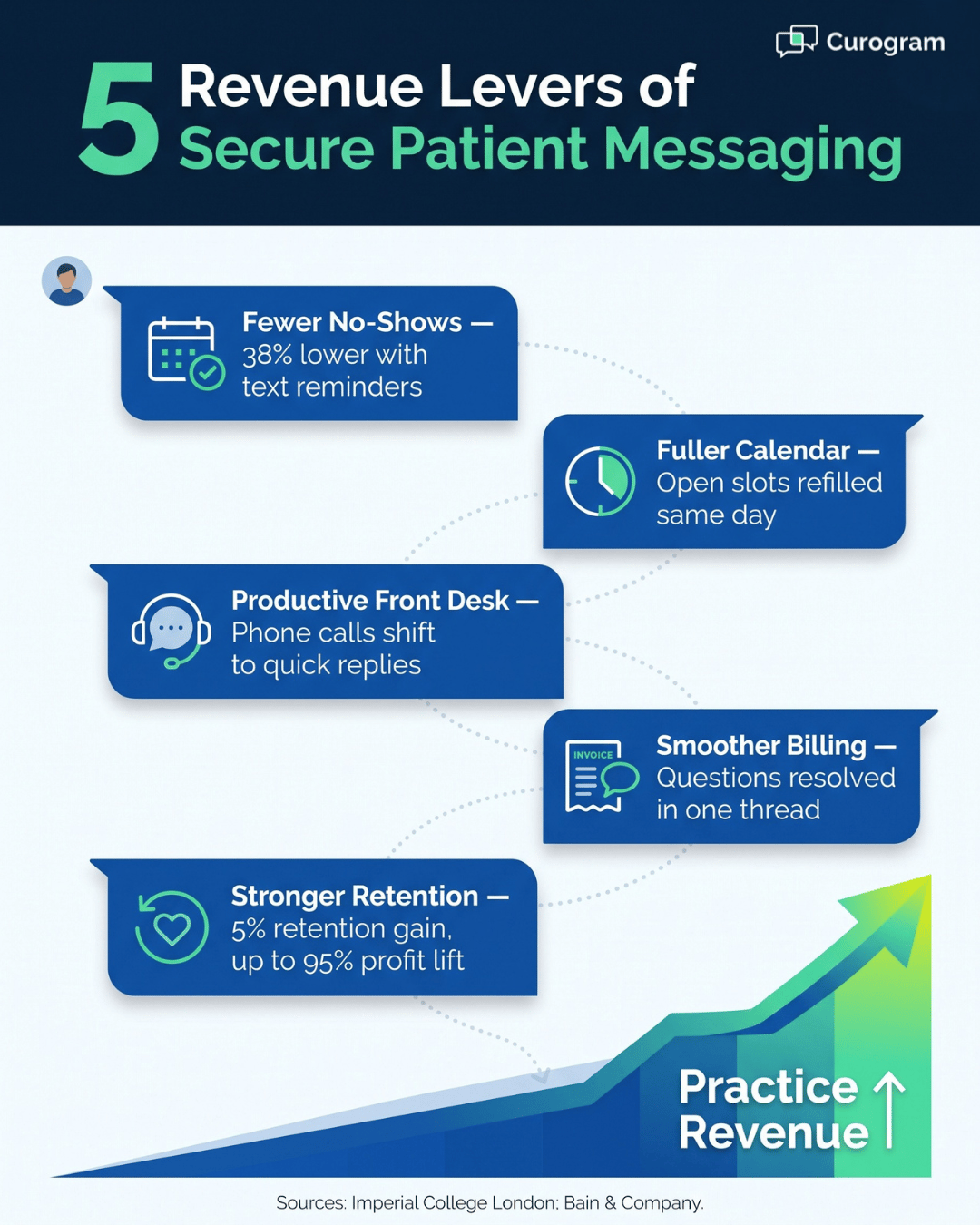
Here are five ways it can grow your revenue, improve your bottom line, and create a better experience for your patients.
Think about your own habits for a moment. How often do you ignore a text message? Now, how often do you ignore an email?
Research from Gartner shows that text messages have an open rate of about 98%. Emails, on the other hand, are opened only about 20% of the time. That gap makes texting one of the most reliable ways to reach your patients.
With Curogram's 2-way text messaging, you can send:
When patients get appointment reminders by text, they're more likely to show up, and on time. Because the messages are two-way, patients can also reply to reschedule for a time that works for both of you. That's a far better outcome than an unexplained empty appointment slot.
Let's put a number on it. The figures below are a hypothetical example, so swap in your own data:
Here's the math:
In this example, that's $30,000 walking out the door every month, or $360,000 over a full year.
Two-way texting can help close that gap. A study by the Department of Primary Care and Social Medicine at Imperial College London found that no-show rates were 38% lower among patients who got a text message reminder.

Last-minute cancellations leave gaps in your schedule, and every empty slot is lost revenue. Your practice needs a dependable strategy for filling those openings quickly.
With Curogram's secure messaging, you can text patients who want an earlier appointment as soon as a slot opens up. That helps you win back revenue that would otherwise be lost to cancellations and no-shows.
Quick outreach like this makes same-day scheduling much easier. It also means more patients get seen sooner, which is good for their care and for your bottom line.
Before COVID-19, most practice management fell on front office staff. Much of it happened over the phone, with calls to confirm, reschedule, and answer simple questions eating up hours each day.
With Curogram, many of those back-and-forth calls move to text. In Curogram client data from clinical settings, practices have seen a 50% drop in call volume. That gives your administrative team more time to focus on the patients who are physically in your office.
Texting also makes it easy to point patients in the right direction. You can send new patients a link to your website so they can learn about your services and complete any intake forms before their visit. Existing patients can get a link to your patient portal to update their records online.
Under value-based care, billing matters just as much as the patient experience. And accurate, efficient billing depends on clear communication.
The trouble is that traditional billing involves many manual steps, including data entry. That can lead to billing errors, which frustrate patients and reflect poorly on your practice.
| Traditional billing follow-up | Billing follow-up with 2-way texting |
|---|---|
| Phone calls that often go to voicemail | Messages patients can read and answer on their own time |
| Questions pile up between calls | Patients can reply with questions right away |
| Staff juggle notes across calls | Your team can manage many conversations at once |
A HIPAA-compliant platform like Curogram adds 2-way text messaging to this process. You can follow up with patients about billing questions while staying within HIPAA rules, so fewer issues slip through the cracks.
Every business needs loyal customers to grow, and healthcare is no exception. Research by Bain & Company found that raising customer retention by just 5% can increase profits by 25% to 95%.
The quality of the patient experience is one of the biggest drivers of retention. With HIPAA-compliant patient communication software, you can stay proactive about reminders, follow-ups, and check-ins. Curogram's patient recall feature, for example, helps you bring back patients who are overdue for follow-up care.
Steady, secure communication also shows patients that your practice keeps up with modern expectations. Patient engagement is, and always will be, a key driver of practice growth. When engagement improves consistently, revenue typically follows.
| Before you change your workflow, pull your practice's no-show rate from the previous three months and apply it to the formula above. Then compare that figure with what's realistically possible. In Curogram client data from clinical settings, Atlas Medical Center reduced its no-show rate from 14.20% to 4.91% in just three months using automated appointment reminders. Knowing your starting point makes it much easier to measure your return. |
If you want to run a more efficient practice, save money, and grow revenue, secure patient communication is no longer just a nice extra. It has become an essential part of how modern medical practices operate.
Each of the five benefits in this guide comes back to one idea. When patients can reach you easily and safely, they show up more, stay longer, and trust your practice more. Fewer no-shows mean fewer empty slots, and faster outreach fills the cancellations you can't avoid.
The benefits extend well beyond your appointment schedule, too. Less phone time frees up your front desk, and clearer billing conversations cut down on friction. Consistent follow-up keeps patients coming back year after year.
You don't need to overhaul your whole practice to see results. Many of these gains come from small shifts, like moving reminder calls to text or reaching out the moment a slot opens. Each improvement builds on the last, and together they can make a measurable difference to your bottom line.
Curogram is an easy-to-use, HIPAA-compliant patient communication platform built for busy medical practices. It helps you boost patient engagement, simplify scheduling, and reduce the manual work that slows your team down. Its secure 2-way texting gives patients a simple way to stay in touch, and it gives your staff a clear view of every conversation.
A good first step is to look at your own numbers. Run the example calculation from earlier with your real appointment volume, visit value, and no-show rate. The result will show you how much revenue better communication could help you protect each month.
When you're ready to see what that looks like in practice, book a demo of Curogram's HIPAA-compliant messaging platform and learn how it can help your practice grow in both profitability and patient satisfaction.

Learn some industry insights into what drives patients' satisfaction, improving patient retention, staff morale, and profitability.
 Carylee Gali : 3/8/22, 7:00 AM
Patient communications is critical to a successful healthcare business. Learn how to communicate with your patients without violating HIPAA.
Using mobile devices offers healthcare professionals advantages in patient engagement and providing quality care, but you must comply with HIPAA.