
How Telehealth Improves the Patient Experience
One way to improve the patient experience is to implement telehealth in your medical practice. Telehealth offers benefits to patients and providers.
8 min read

A patient can trust their doctor, feel heard in the exam room, and still walk away unhappy.
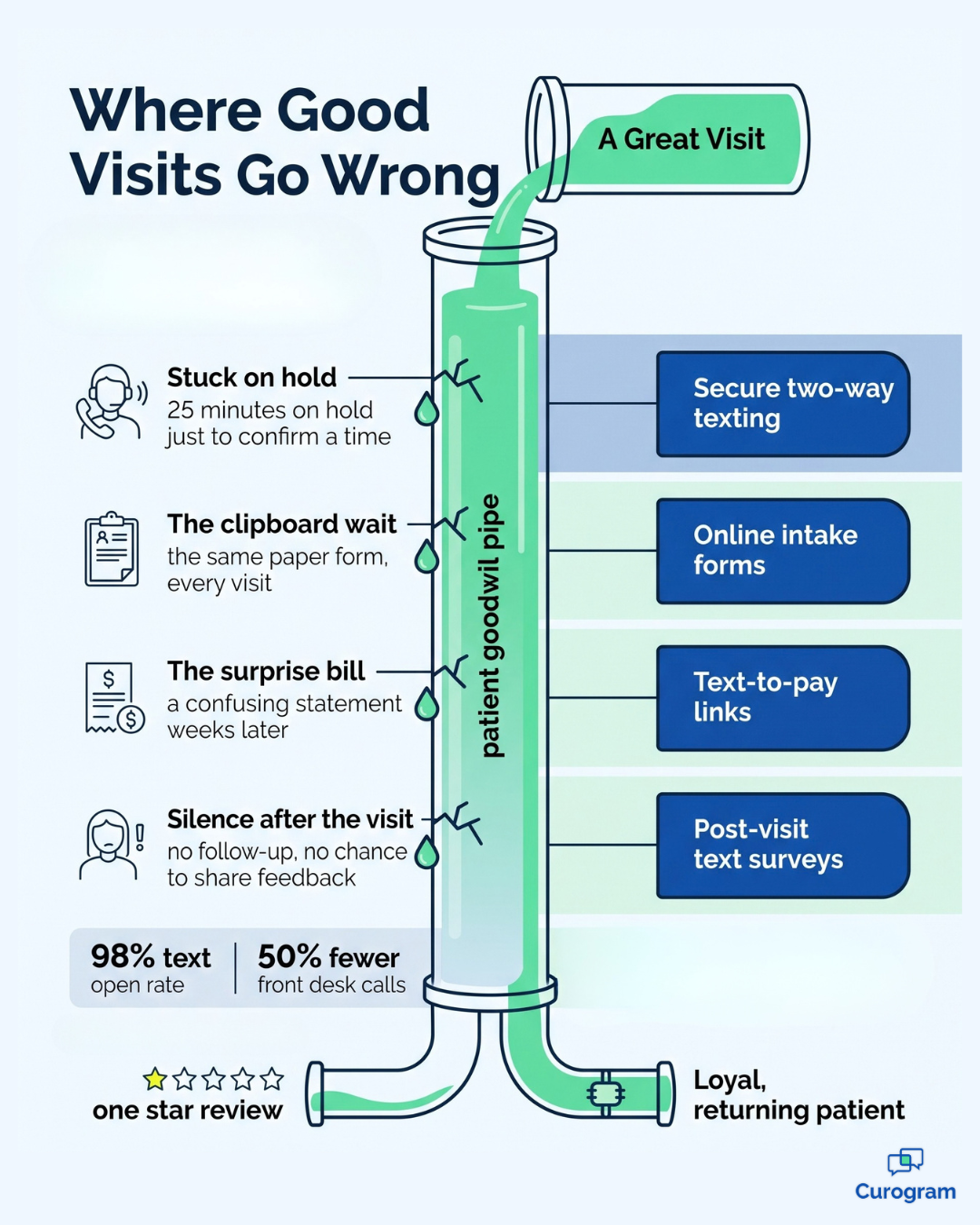
Maybe they sat on hold for 25 minutes just to confirm an appointment, or filled out the same paper form they completed last year. Or maybe a confusing bill showed up three weeks later and erased every positive feeling from the visit.
That's the tricky part about patient satisfaction. It isn't shaped by a single moment; it's built, or broken, at nearly every step of the patient journey.
And it matters more than many practices realize. Satisfied patients keep their appointments, follow their care plans, and return for follow-up visits, and they recommend you to friends and family. Unhappy patients tend to switch providers quietly, and some leave a public review on their way out.
Patient satisfaction also reveals a great deal about your team. When patients are happy, it usually means your staff has the time and tools to do their best work. When scores slip, it often points to the same friction your staff deals with every day, like ringing phones, stacks of forms, and billing questions.
Here's the good news: the biggest drivers of patient satisfaction are well known, and most of them are entirely within your control. Many have less to do with clinical medicine and more to do with how easy it is to reach you, check in with you, and pay you.
In this guide, we'll walk through the six essential drivers that consistently shape how patients feel about your practice. They range from keeping health data safe to making payments simple.
For each one, you'll see why it matters to patients, how it affects your staff, and what practical steps you can take to improve it without adding more work to your team's already full day.
Patient satisfaction fuels and measures the success of medical practices of all sizes. It keeps your staff motivated to provide the best healthcare and most patient-friendly services possible.
Patient satisfaction is equivalent to the pursuit of excellence, professionalism, quality, efficiency, and compassion in healthcare to the highest standard. A satisfied patient means you and your team are meeting and surpassing your goals.
Some of the key factors that influence patient satisfaction include:
Each time a patient fills out a form, sends a message, or books a visit, they share private details. That includes their health history, insurance, and contact details. Together, this is called protected health information, or PHI.
Keeping PHI safe is a legal duty under HIPAA. But for patients, it's also personal. Many people hold back details about their health when they aren't sure where that data might end up.
Patients may never read your privacy policy, but they do notice signs of trust, such as:
When patients know their data is protected, they share more openly. That leads to better talks, cleaner records, and better care. In short, peace of mind is one of the strongest drivers of patient satisfaction.
Few things frustrate patients faster than a phone line that never seems to connect. They call with a simple question, wait on hold, and eventually get sent to voicemail. The callback arrives an hour later, right in the middle of an important work meeting.
Your staff feels that friction, too, since every call that could have been a text pulls someone away from the patients standing at the front desk.
Secure two-way texting solves much of this problem. Patients can send a quick message whenever it's convenient, and staff can respond between other responsibilities.
Here's how the two options compare:
| Phone Calls | Secure Two-Way Texting | |
|---|---|---|
| Patient effort | Call, wait on hold, try again if missed | Send a message in seconds |
| Staff effort | One call at a time, plus phone tag | Reply to several messages in one batch |
| Record of the conversation | Notes typed by hand | Saved message thread |
| Best used for | Urgent or complex issues | Confirmations, quick questions, and updates |
Phone calls still matter for urgent or sensitive issues, but for routine updates, text is simply more efficient. Curogram clients have seen a 98% open rate on text messages and a 50% drop in front desk call volume.
For your team, that means fewer missed messages and a calmer, more focused workday. And happy, engaged employees are better equipped to deliver outstanding patient service.
Telehealth use took off during the COVID-19 pandemic. Years later, many patients still see virtual visits as a normal part of their care, not a short-term fix.
For many patients, a video visit removes the hardest parts of getting care. There's no drive, no parking, and no time spent in a waiting room. That saves them time and money, and it can mean fewer hours missed at work.
Some patients also feel safer seeing their provider from home, especially during cold and flu season.
Telehealth can make a big difference for patients with chronic conditions or disabilities who need frequent visits. It also helps caregivers, patients in rural areas, and anyone juggling a packed schedule.
Virtual care won't replace every in-person visit. But it works well for follow-ups, medication check-ins, test result reviews, and many behavioral health visits. Offering it as an option shows patients that you respect their time.

Long wait times are one of the most common patient complaints. Much of that delay begins before a patient ever sees a provider, and it usually begins with a clipboard.
Paper intake forms slow everyone down. Patients repeat the same information at every visit, staff manually type it into the system, and small errors slip through.
Secure online forms change the whole flow:
Here's an illustrative example.
Suppose paper intake takes 12 minutes per patient in your office, and online forms reduce that to 3 minutes. If your practice sees 40 patients a day, that's 360 minutes, or about 6 hours of waiting room time saved every day.
That's valuable time your patients get back, along with extra breathing room in your schedule. Online forms also reduce paper costs and give your front desk a smoother start to each day.
|
Key Takeaway: You Can't Improve What You Don't Measure Most unhappy patients never complain; they simply don't come back. A short survey sent by text immediately after each visit gives patients an easy way to share feedback while the experience is still fresh. Keep it to two or three questions, look for recurring patterns, and share positive comments with your staff. When one multi-location practice paired post-visit surveys with Google review requests, 90% of its patients left 5-star reviews. That added up to 1,064 new reviews in just three months. |
In the end, patients come to you for care. Fast, personal, and effective treatment is the core of patient satisfaction, and every other driver on this list supports it.
Patients want to feel heard. They notice when a provider makes eye contact, asks follow-up questions, and explains next steps clearly. Even when a diagnosis takes time, open communication helps patients feel confident in their care.
Here's what patients value most in their care team:
Education matters here, too. When patients understand their condition and treatment plan, they're more likely to follow it. Every minute your team saves on phone tag and paperwork is a minute they can give back to patients.
Today, you can buy almost anything with a tap on your phone. Patients expect paying for healthcare to be just as easy.
When it isn't, even a great visit can end on a sour note. A patient who loved their provider may still leave a poor review because of a confusing bill, a lost paper statement, or a payment portal they couldn't log into.
| Payment Pain Point | What Patients Experience | A Simpler Option |
|---|---|---|
| Paper statements | Bills get lost or forgotten | Text reminders with a secure payment link |
| Portal logins | Forgotten passwords and extra steps | A mobile-friendly payment page |
| Phone payments | Calls limited to office hours | Payment any time, from any device |
| Unclear balances | Surprise at the total owed | A clear breakdown of copays and deductibles |
Secure online payment options let patients handle copays, deductibles, and other fees in a few taps. For your practice, that often means faster payments and fewer billing calls. For patients, it's one less thing to worry about after their visit.
Patient satisfaction rarely comes down to one big moment. Instead, it's the sum of many small ones: a question answered by text in minutes, a form finished on the couch the night before, and a bill paid in just two taps. Above all, it's a provider who takes the time to listen.
Look back at these six drivers, and a clear pattern emerges. Patients want to feel secure, respected, and in control of their valuable time. They want care that feels personal, communication that feels easy, and a practice that doesn't make simple tasks hard.
None of these drivers work alone. Secure messaging makes intake faster, and faster intake gives providers more time with patients. Convenient payment options protect the goodwill that a great visit creates. When you improve one area, the others frequently improve as well.
You also don't need to fix everything simultaneously. Start with the step that currently causes the most friction. For many practices, that's the constantly ringing phone or the paper clipboard. Track your patient satisfaction scores, listen carefully to what patients tell you, and build from there.
The right tools can make this work much lighter for your team. Curogram brings HIPAA-compliant two-way texting, online intake forms, telehealth, text-to-pay, and automated review requests together in one platform. It connects with most major EHR systems, so your staff spends less time on manual tasks and more time with the patients in front of them.
Curious how this would look inside your own medical practice? Book a demo to see how Curogram can raise your patient satisfaction scores. You'll get a clear view of what your patients see, what your team sees, and how much time you could save each week. It's a simple next step toward a practice that patients are genuinely happy to recommend.
Frequently Asked Questions

One way to improve the patient experience is to implement telehealth in your medical practice. Telehealth offers benefits to patients and providers.

 Carylee Gali : 3/16/22, 7:00 AM
There's no doubt about it — patients prefer text messages. Check out these five reasons you should find the right way to text your patients.
Confused about patient experience vs. patient satisfaction? Learn the key differences, how they're measured, and why experience improves outcomes.