
 Carylee Gali
5 Critical Rules to Remember When Texting Patients
 Joshua Inciso : 11/10/22, 12:56 PM
Discover how the 5 rules for texting your patients can improve your practice. Maintain proper and secure communication by implementing these rules.

Call a patient at 10 a.m. on a Tuesday, and you'll probably reach voicemail. Text that same patient, and there's a good chance they'll read it before your front desk moves on to the next task.
That gap matters more than most practices realize. Every unanswered call creates another callback, another note in the chart, and another item on a crowded to-do list. Multiply that across a full day of appointment reminders, follow-ups, and billing questions, and phone tag starts to consume real hours.
Meanwhile, your patients already manage much of their lives on their phones. Pew Research Center reports that nearly all U.S. adults own a cellphone, and about 9 in 10 own a smartphone. Texting is no longer just for younger patients. It's how people of every age handle quick, everyday communication.
Your clinical staff is no different. Physicians, nurses, and administrative teams rely on texting throughout the day to coordinate with one another. So why do so many practices still depend on phone calls to reach their patients?
Often, it comes down to habit. The phone has always been the default option. But the default isn't always the most effective choice for your patients or your team.
Two-way text messaging gives you a faster, simpler way to deliver important information. Patients can confirm visits, ask questions, and receive updates without interrupting their day. Your team can handle more conversations in less time, without the constant back-and-forth of missed calls.
It sounds simple. In many ways, it is. But the benefits reach further than most practices expect, from better patient access to fewer empty slots on the schedule.
Below are five reasons your practice should make text messaging a core part of patient communication. You'll also learn how to text safely, so every message stays within HIPAA guidelines.
The FICO Global Survey says that four out of five people prefer text messaging to communicate with healthcare providers.
Unlike any other communication channels that require patients to log in to their computers, 2-way texting allows sending and receiving of messages from any location to another mobile device. It gives patients the freedom to exchange a conversation with their healthcare providers while doing other tasks.
With text messaging, patients can book a quick appointment while, for instance, waiting to pick up the kids after school or eating lunch. Additionally, texting is a great way to inform your patients of additional medical proceedings or other transactions outside the clinical setup.
Simply put, patients opt to communicate with their physicians via texting because it doesn’t require them to answer a call, write down a message, or listen to anything. Providing the patients communications methods they prefer in healthcare improves quality and access to care while nurturing an active doctor-patient relationship.
Checking a phone is part of almost everyone's daily routine. Because texting is a channel most Americans already know and feel comfortable using, it's a natural fit for patient support and education.
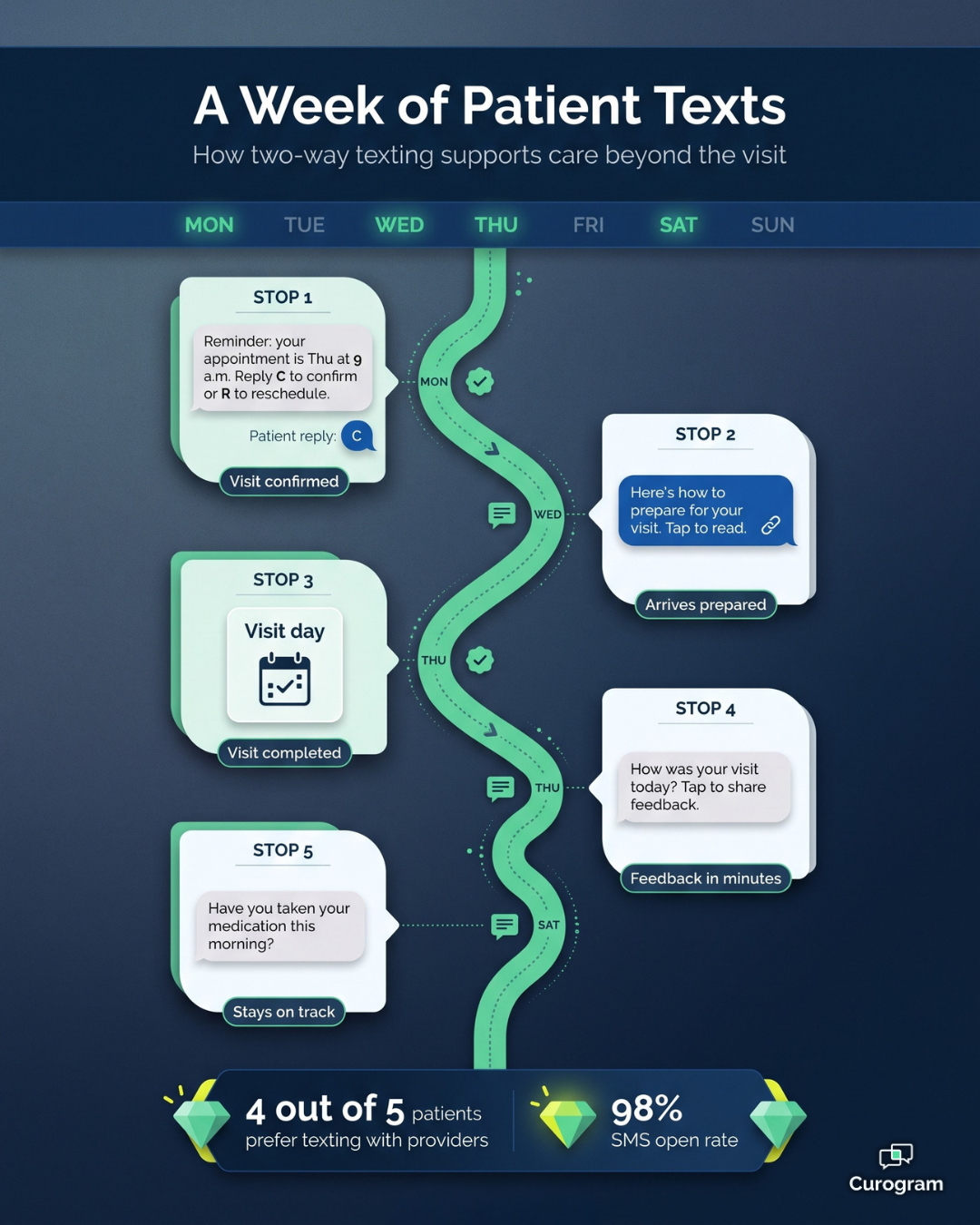
Texts are also hard to ignore. According to Forbes, people read 95% of text messages within three minutes of receiving them, and Curogram's own data shows a 98% open rate for SMS. In practice, that means your message is far more likely to be seen than a letter, email, or voicemail.
Two-way texting lets you share useful information about a patient's condition or treatment before or after an appointment. When a patient has a question, your team can respond quickly instead of adding another call to the callback list.
Every smartphone can open a link with a single tap. That makes it easy to send patients an article, video, or web page about their condition, a new treatment, or how to prepare for a procedure. Once they tap the link, the resource opens immediately.
Patients are also more likely to read information sent directly to their phone than a printed handout that ends up in a bag or on the kitchen counter.
Reaching out between visits shows patients that you care about their progress, not just the time they spend in your office. That consistent support builds trust and encourages patients to take a more active role in managing their health.
Due to its crucial role in day-to-day tasks, most people never let their cellphones out of their sight for very long. In the US, the average adult checks their phone 47 times per day. Additionally, 82% of people say they open every text message they receive, while 90 seconds is the average response time to a text.
Based on the mentioned figures, healthcare providers use texting to implement effortless tracking to ensure patients’ compliance with their medication or healthcare protocols.
For example,
Prescription reminders encourage patients to pick up their medication and take it as directed.
Healthcare providers remind their consumers to adhere to the prescribed medication or treatment to monitor their patients’ healthcare progress.
Consider sending the following text messages:
Make sure to tell your patients to reply to your appointment reminder texts as a confirmation that they receive them. If there is no reply from the patient’s side, medical staff can reach out and re-engage with them.
Missed appointments are one of the most expensive problems a medical practice faces. Each no-show leaves an empty slot, lost revenue, and a patient who still needs care.
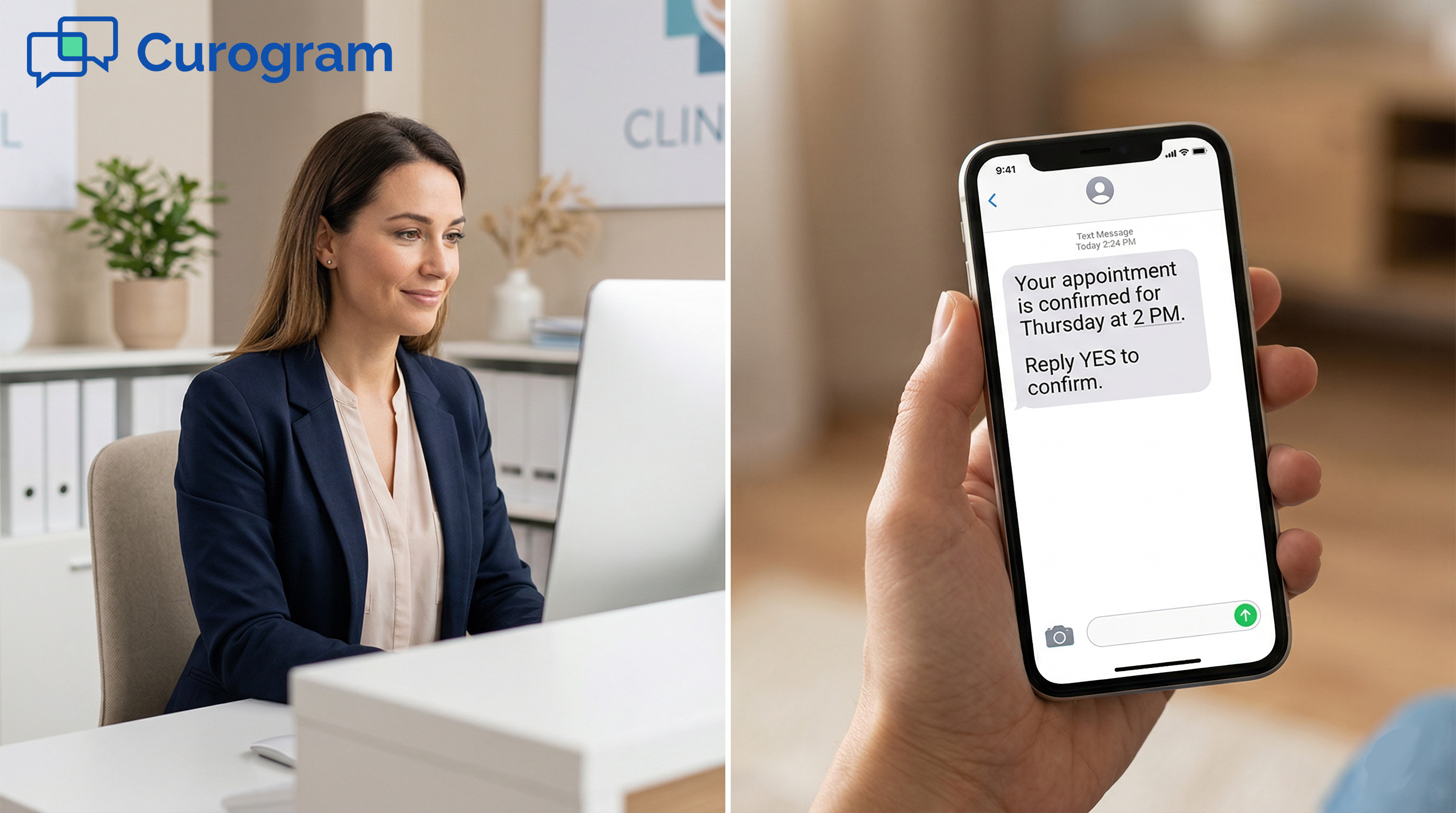
Texting helps you get ahead of the problem. With two-way texting, you can remind patients about upcoming visits and let them respond immediately. Patients can confirm, reschedule, or cancel in seconds, which gives your team enough time to fill open slots with other patients.
The results can be significant. Atlas Medical Center, a Curogram client, reduced its no-show rate from 14.20% to 4.91% after it started using automated text reminders.
To see what that could mean for your practice, consider the following example. These figures are illustrative only and assume 100 scheduled visits per week, an average of $150 per visit, and 50 working weeks per year.
| Before Text Reminders | After Text Reminders | |
|---|---|---|
| No-show rate | 14% | 5% |
| Missed visits per week | 14 | 5 |
| Lost revenue per week | $2,100 | $750 |
| Lost revenue per year | $105,000 | $37,500 |
In this example, reducing no-shows means about 9 additional patients seen each week. That's roughly $67,500 in revenue recovered every year. Just as important, your team spends more time delivering care and less time chasing empty appointment slots.
Beyond visit reminders, texting is a handy way to keep patients in the loop.
Here are a few ways practices use it every day:
Each of these updates takes seconds to send. Together, they help patients stay engaged with your practice all year, not just when they feel sick.

Texting has clear benefits, but it also comes with risk. Because it's so quick and easy, a standard texting app can be one of the easiest ways for a practice to break privacy rules. Sending sensitive health details over an unsecured channel can lead to a HIPAA violation.
That's why the platform you choose matters. Use a HIPAA-compliant text messaging platform built for healthcare. These platforms are closed systems with end-to-end encryption, so only authorized people can send and read messages.
Your habits matter too. Stay mindful of what you share, and leave PHI out of your texts whenever you can. Messages that don't mention PHI are generally acceptable under HIPAA texting guidelines.
|
The safest text is one that shares no protected health information. Compare these two reminders: Risky: "Hi Maria, your diabetes follow-up with Dr. Lee is tomorrow at 9 a.m." Safer: "Hi Maria, this is a reminder of your appointment tomorrow at 9 a.m. Reply C to confirm or R to reschedule." Both messages get the patient to the visit. Only one reveals a diagnosis. Keep texts to the basics, and save clinical details for a secure portal or a phone call. |
Your patients already text every day. They text family, friends, coworkers, and the businesses they depend on. Your practice belongs on that list. When patients can reach you easily, they simply stay engaged and keep coming back.
As you've seen, text messaging in healthcare does far more than send quick reminders. It reaches patients through the channel they prefer, makes support and education easier to access, and helps patients follow their treatment plans. It also reduces no-shows and keeps patients informed about recalls, billing, and preventive care.
For your team, the payoff shows up in everyday operations. Fewer missed calls mean less phone tag. Fewer no-shows mean fuller schedules and more predictable revenue. And faster responses mean patients get answers without waiting on hold.
Still, these benefits only hold up if your messages are secure. A regular texting app wasn't designed to protect patient data. Choosing a HIPAA-compliant platform, and keeping PHI out of your messages, protects both your patients and your practice.
That's where Curogram can help. Curogram is a HIPAA-compliant patient communication platform built for busy medical practices. It brings two-way texting, automated appointment reminders, and patient updates together in one place. Your team can manage patient conversations without juggling separate tools, and patients can reply from the phones they already use.
You don't have to change everything at once. Start with appointment reminders, see how your patients respond, and expand from there. Many practices discover that once texting is in place, it quickly becomes their preferred way to reach patients.
The shift is small. The impact on your patients and your team can be significant.
Ready to see how secure texting could work for your practice? Book a demo of Curogram's HIPAA-compliant texting platform and find out how much time your team could get back each week.
 Joshua Inciso : 11/10/22, 12:56 PM
Discover how the 5 rules for texting your patients can improve your practice. Maintain proper and secure communication by implementing these rules.
 Jo Galvez : 5/9/26, 11:00 AM
Best practices for patient text messaging that save time for your front desk and keep your practice HIPAA compliant. Practical guide for medical...
 Joshua Inciso : 5/27/22, 8:45 AM
Discover the reasons why patient engagement is vital to your healthcare practice’s future, as well as strategies to improve it.