
 Carylee Gali
1 min read
How To Be HIPAA-Compliant When Using Mobile Devices
💡 To be HIPAA-compliant when using mobile devices, your practice needs two layers of protection. First, secure the phones and tablets your team...

"I'm her husband. Can you just tell me how she's doing?"
Every front desk and care team has heard variations of that question. The caller sounds worried, and the answer seems harmless enough. But one careless reply can turn a kind gesture into a privacy violation.
Families play an important role in patient care. They drive patients to appointments, pick up prescriptions, and help manage treatment plans at home. Shutting them out can hurt the quality of care, while saying too much can put your practice at legal risk.
That's why so many providers hesitate when a relative asks for details. The Health Insurance Portability and Accountability Act (HIPAA) protects health information from people who aren't authorized to see it. Yet it also gives you room to involve the people your patients trust. The challenge is recognizing where that line sits.
Real situations rarely arrive with instructions. Think about a telemedicine visit where you and your patient are discussing a sensitive health concern. Halfway through, a relative walks into the room and joins the conversation. Do you continue the discussion, or pause?
Now consider a phone call from a patient's sister who wants to review her brother's history of substance use treatment. She explains that the family is worried and needs to know more. Do you release those records?
These situations happen every week in busy medical practices, and the right answer depends on a few clear rules that many teams have never been trained on.
Fortunately, HIPAA is far more flexible than most providers realize. Once you understand what it allows, you can support families confidently instead of relying on guesswork.
Below, we'll walk through common scenarios, what HIPAA says about each one, and the habits that keep your practice HIPAA compliant when you communicate with your patients' families.
HIPAA's most important rule on family disclosure is simple. The decision belongs to the patient. Some patients want their spouse involved in every detail. Others prefer to keep even immediate relatives at a distance.
Under the HIPAA Privacy Rule, you may share health information with a spouse, family member, or friend the patient names as involved in their care. You can also share it if the patient agrees, or doesn't object when given the chance. In some cases, you can use professional judgment to infer that the patient is fine with it.
For example,
A patient who brings their daughter into the exam room likely expects her to hear the discussion.
Let's return to that telemedicine visit. When a relative enters, pause the conversation. Ask your patient, privately if you can, whether they want to keep going with the other person there.
If they say yes, you can continue, since their agreement is all HIPAA requires. If they hesitate or decline, offer to reschedule or politely ask the relative to step outside.
HIPAA allows verbal permission to include a family member, so you don't need a signed authorization form. Still, it's smart to note the patient's agreement in their medical record after the visit.
A short note protects your team if questions come up later, and it tells the next provider who the patient trusts with their information.
Sometimes a patient can't give permission. They may be unconscious after an accident, sedated, or too ill to make decisions. In these cases, HIPAA lets you rely on your professional judgment.
You may share information with family members if you decide it's in the patient's best interest. Keep it limited to what relates to that person's role in the patient's care.
The Privacy Rule also lets you use judgment and common practice to allow a relative to act for the patient in everyday tasks,
Such as:
Once the patient is able to decide again, ask them. Their wishes take over from that point on.
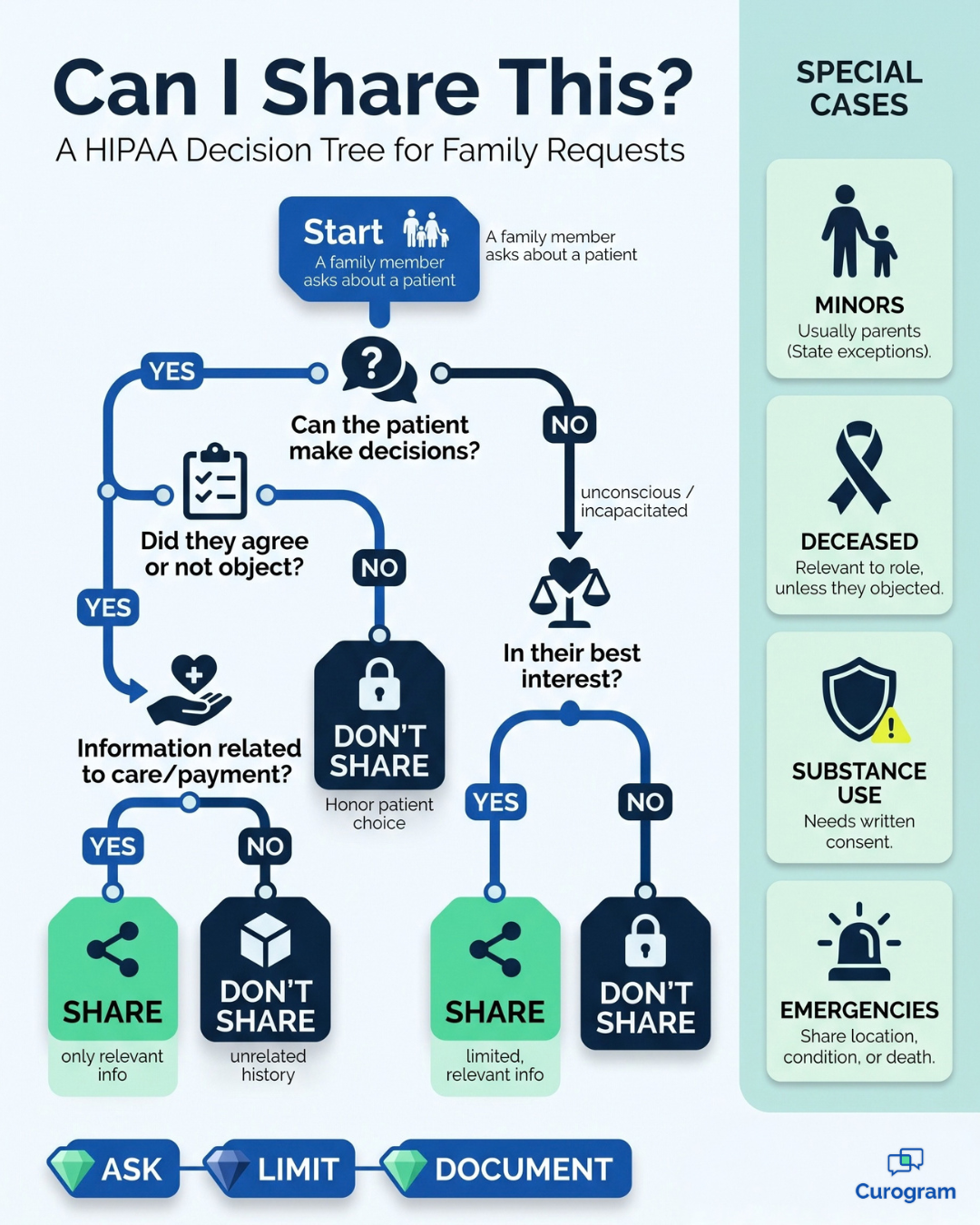
If an adult patient doesn't want a family member to know about their condition, you must respect that. It doesn't matter how close the relative is or how worried they seem. A clear "no" from the patient means no.
However, a few situations follow different rules, depending on the patient's age, condition, or type of record:
| Situation | What HIPAA Generally Allows |
|---|---|
| An adult patient objects to sharing | Don't share. Honor the patient's wishes. |
| The patient is a minor | Parents or guardians are usually the child's personal representatives and can access their information. State law may give minors control over some types of care. |
| The patient has passed away | You may share information tied to a relative's role in the patient's care or payment, unless the patient objected while alive. |
| Records from a substance use disorder program | A separate federal rule, 42 CFR Part 2, usually requires the patient's written consent first. |
That last row answers the phone call from the worried sister. If she's asking about records from a substance use disorder program covered by Part 2, a verbal request isn't enough. In most cases, you'll need the patient's written consent before you share anything.
For patients who have passed away, share only what's relevant to the relative's role in care or payment. Unrelated medical history, such as an old health issue that has nothing to do with that role, should remain private.
Your patient is brought in after a car crash. Their family doesn't know yet. Can you call them?
Yes. HIPAA allows you to notify a family member, personal representative, or another person responsible for the patient's care. You can tell them about the patient's location, general condition, or death.

These steps help keep the call compliant:
The same rules apply no matter how you communicate. With the patient's permission, you can share information in person, over the phone, by text, or in writing.
Just keep it relevant. For example, don't bring up a past condition that has nothing to do with the patient's current care.
|
When a family member asks about a patient, run through three quick steps. Ask the patient whether they approve. Limit what you share to what that person needs for their role in care. Document the conversation in the medical record. This simple habit covers most everyday situations your staff will encounter. It also gives your entire team a consistent script, so nobody has to improvise under pressure. |
Based on these discussions about engaging with patients’ families while remaining HIPAA compliant,
It is clear that the following conditions are crucial to your decisions about talking to family members:
Also, the HIPAA Privacy Rule does not require a healthcare provider to obtain a patient’s written consent when they agree to disclose PHI to a relative. However, you are free to get or document the patient’s agreement in writing, or you may note it in the patient’s medical record.
Suppose you have to disclose PHI to a family member via text message. In that case, the HIPAA Security Rule requires appropriate technical measures to ensure the confidentiality and security of electronic PHI (ePHI). To ensure that your practice complies with the standards of the Security Rule, you must use a HIPAA-compliant system to text a patient’s family member without having to worry about disclosing PHI.
These scenarios all point back to the same core rules.
Keep them in mind whenever a relative asks about a patient:
HIPAA doesn't require written consent for these conversations. Verbal agreement works. Even so, a quick note in the chart is still the best way to protect your practice.
Texting is often the fastest way to update a busy family member. But once health information moves to a phone, the HIPAA Security Rule applies. It requires safeguards that keep electronic PHI (ePHI) private and secure.
Regular texts sent from a personal phone don't offer those protections. A HIPAA-compliant texting platform does. It protects messages, controls who can see them, and keeps a record of what was sent and when.
Families want to help, and your patients often want them involved, too. HIPAA doesn't stand in the way of that. It simply asks you to put the patient's wishes first.
Most situations come down to three questions. Did the patient agree, and if they can't, what's in their best interest? Is the information you're sharing directly related to this person's role in care? When your team can answer those questions quickly, family conversations stop feeling risky.
Clear policies make a real difference. Train your staff on the common scenarios in this guide, and give them a simple script for unexpected calls and visitors. Most importantly, make documentation a consistent habit rather than an afterthought.
The right communication tools matter, too. Families today expect quick updates, and many would rather receive a text than wait on hold for a phone call. Secure messaging lets you keep relatives informed without exposing ePHI on personal phones or unprotected apps. It also creates a clear record of every update you send.
Curogram gives your practice a HIPAA-compliant way to text patients and, with their permission, the family members involved in their care. Messages are secure, easy to send, and simple to track. Text messages have a 98% open rate, so important updates actually get read. Curogram can also reduce phone call volume by as much as 50%, which frees your front desk to focus on the patients in front of them.
The result is smoother communication for families and less stress for your staff. Patients get the support they need from the people they trust, and their private health information stays protected throughout the entire process.
Ready to make family communication easier and safer for everyone involved? See how Curogram's HIPAA-compliant texting works and discover how it can fit into your practice's daily workflow.

1 min read
💡 To be HIPAA-compliant when using mobile devices, your practice needs two layers of protection. First, secure the phones and tablets your team...

1 min read
 Joshua Inciso : 5/27/22, 8:45 AM
Patient engagement has increasingly become more critical in every healthcare organization, from hospitals to small medical practices. So, how will...

1 min read
💡 Communication in healthcare is how patients, families, and care teams share what they know. It travels through speech, body language, written...