8 min read

NextGen 2-Way HIPAA Texting | Deflect Calls, Unify Communication

NextGen 2-Way HIPAA Texting | Deflect Calls, Unify Communication
💡 Curogram's Call Deflection Layer brings NextGen Enterprise 2-way HIPAA patient texting and call center deflection to large ambulatory networks through a unified dashboard and multi-location communication write-back.            

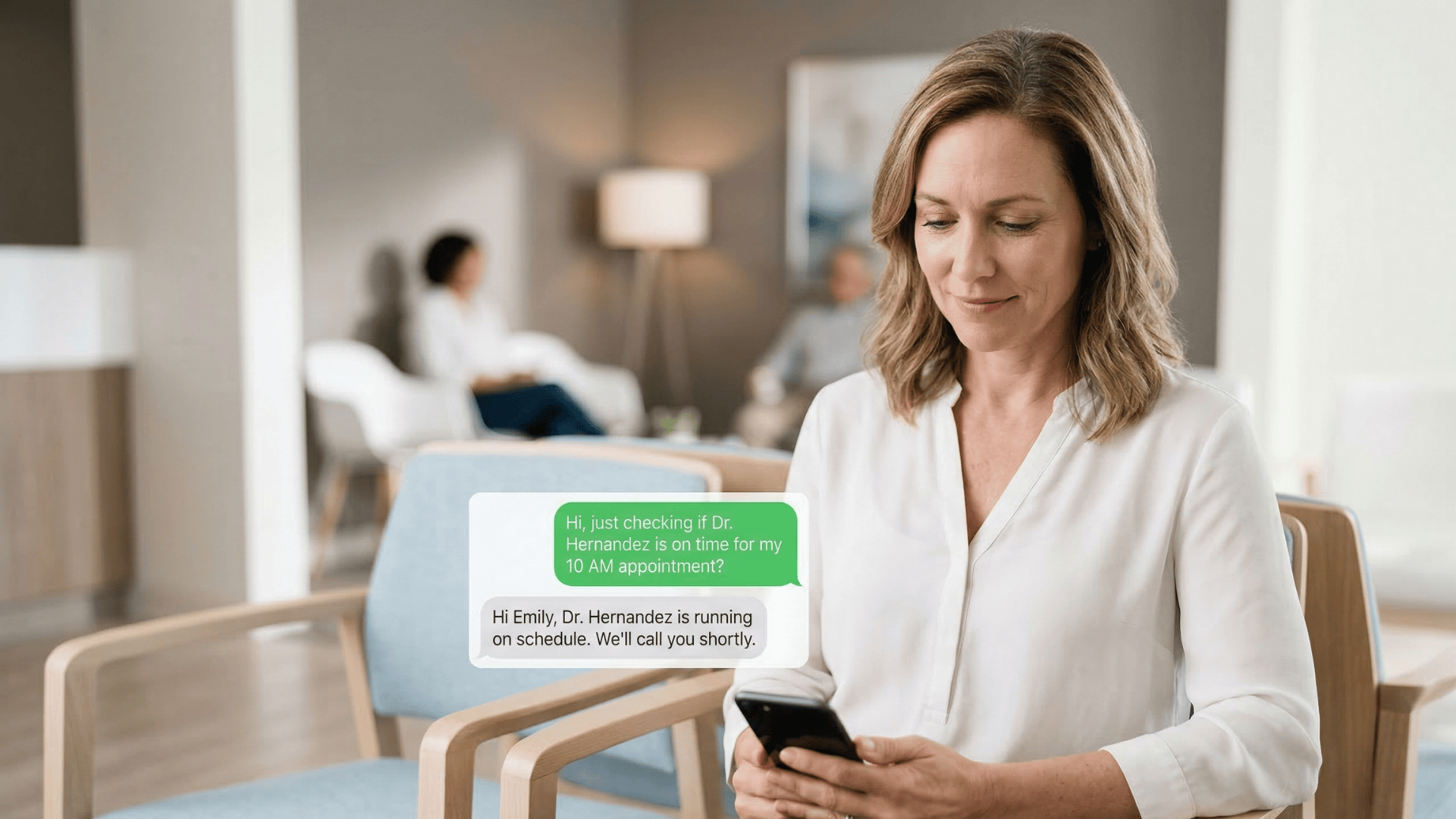
Patients text the practice directly — no portal login needed — and staff respond from one central inbox. 

Smart Routing sends each message to the right team automatically. Billing questions go to billing. Refill requests go to pharmacy. Scheduling inquiries go to the front desk. 

Based on our internal data, Curogram clients see more than 50% fewer inbound calls after going live.  

For CIOs, VPs of Operations, and Directors of Patient Experience managing 20 to 100+ providers across multiple locations, Curogram closes the communication gap that NextGen's patient portal and call center leave wide open.

Your NextGen Enterprise system handles clinical documentation beautifully. But when it comes to actually talking to patients, something breaks down.

The patient portal requires a login that most patients never set up. Luma, if you have it, runs as a separate system on a separate contract.

And the call center keeps absorbing call after call — appointment confirmations, billing questions, refill requests — tasks that should take a text message, not a four-minute phone call.

This is the reality for most large ambulatory practices running NextGen today. Patient communication is scattered across three or four disconnected tools, and the call center is paying the price for every gap in the stack.

Curogram's Call Deflection Layer was built specifically to fix this. It adds direct, HIPAA-compliant SMS communication across every location in your network — routing patient texts to the right department, writing conversations back to chart notes, and cutting inbound call volume by more than half.

This article breaks down why the problem exists, how the solution works, and what organizations like yours are seeing after making the switch.

For large ambulatory organizations, this is not a new complaint. It is a structural problem that has built up over years of patching one tool on top of another.

Each new module promised to simplify patient engagement. Instead, it added another vendor, another login, and another support channel to manage — while the call center kept ringing.

The organizations that are breaking out of this cycle are not replacing NextGen.

They are adding a smarter communication layer on top of it — one that works the way patients already communicate and gives operations the unified visibility they have been missing.

Why Patient Communication Breaks Down Inside NextGen Enterprise

A Stack Built for Charts, Not Conversations

NextGen Enterprise is a powerful clinical platform. It handles specialty-specific content across 26+ specialties, deep workflow configuration, and documentation at scale. What it was not built to do is serve as a patient communication hub.

That gap has been patched over time with add-ons, third-party tools, and a patient portal that most patients never use.

The result is a fragmented stack where every tool has its own data silo.

 Its own support channel, and its own cost structure:

  • The PxP or FollowMyHealth portal handles secure messaging — but only if the patient created an account.
  • Luma Patient Engage covers text-based outreach — but it is licensed separately, implemented on its own timeline, and supported by a different team.
  • The call center picks up everything else.

IT manages the integrations. Operations manages the workarounds. Patients experience the confusion.

The Portal Nobody Logs Into

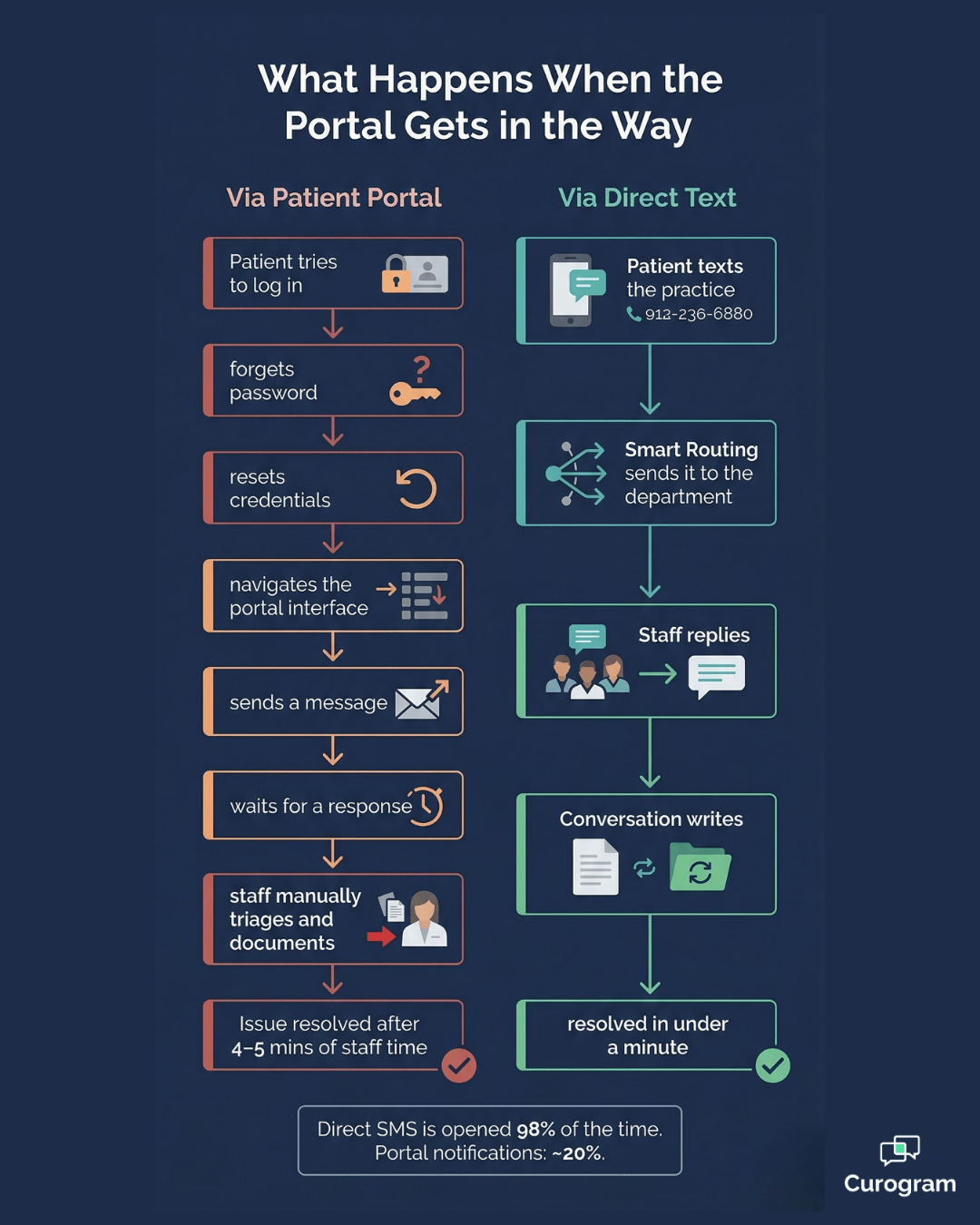
The portal was designed for patients who are motivated enough to create credentials, remember a password, and navigate a web interface just to confirm an appointment or ask a billing question.

In practice, that is a small percentage of your patient population. Portal adoption in large ambulatory networks consistently runs three to four times lower than text-based engagement rates.

Every patient who skips the portal calls the office instead. And every one of those calls costs your staff three to five minutes — the time to answer, triage, relay information, and document the interaction.

Multiply that across 80+ inbound calls per location per day, and the math becomes a real operational problem. The portal was meant to reduce that burden. Instead, the burden just moved to a different line.

The Add-On Tax Keeps Growing

Organizations that invested in NextGen expecting a complete patient engagement experience often discover that the full picture is more expensive than the brochure suggested.

Getting to a working engagement stack typically means licensing several tools separately:

  • Luma Patient Engage and Luma Self-Scheduling, each on its own contract
  • NextGen Navigator AI, with its own implementation timeline
  • The PxP portal, which still requires patient account creation to function

For a 50-provider network, those costs add up quickly — and the communication record is still fragmented across all of them. Each tool talks to its own data silo. Nothing gives operations a single, unified view of every patient conversation across every location.

What This Looks Like From the Inside

The operational drag shows up differently depending on where you sit, but it touches every role in the organization.

Everyone is absorbing the cost of a communication stack that was never designed to work as one.

  • VPs of Operations watch call center metrics stay flat despite adding new tools. Average Handle Time stays high because staff are still relaying information that could have been a text.
  • IT directors manage three vendor relationships — NextGen, Luma, and payment platforms — with three support channels, three escalation paths, and three roadmaps to track.
  • Clinical staff deal with slow screen transitions in NextGen and a growing stack of tools that add friction instead of removing it.

Patient portal vs. direct SMS flow — why texts reach staff faster

How the Call Deflection Layer Fixes What the Stack Left Broken

One Platform for Direct SMS Across Every Location

Curogram adds a direct HIPAA-compliant SMS communication layer to your existing NextGen Enterprise environment.

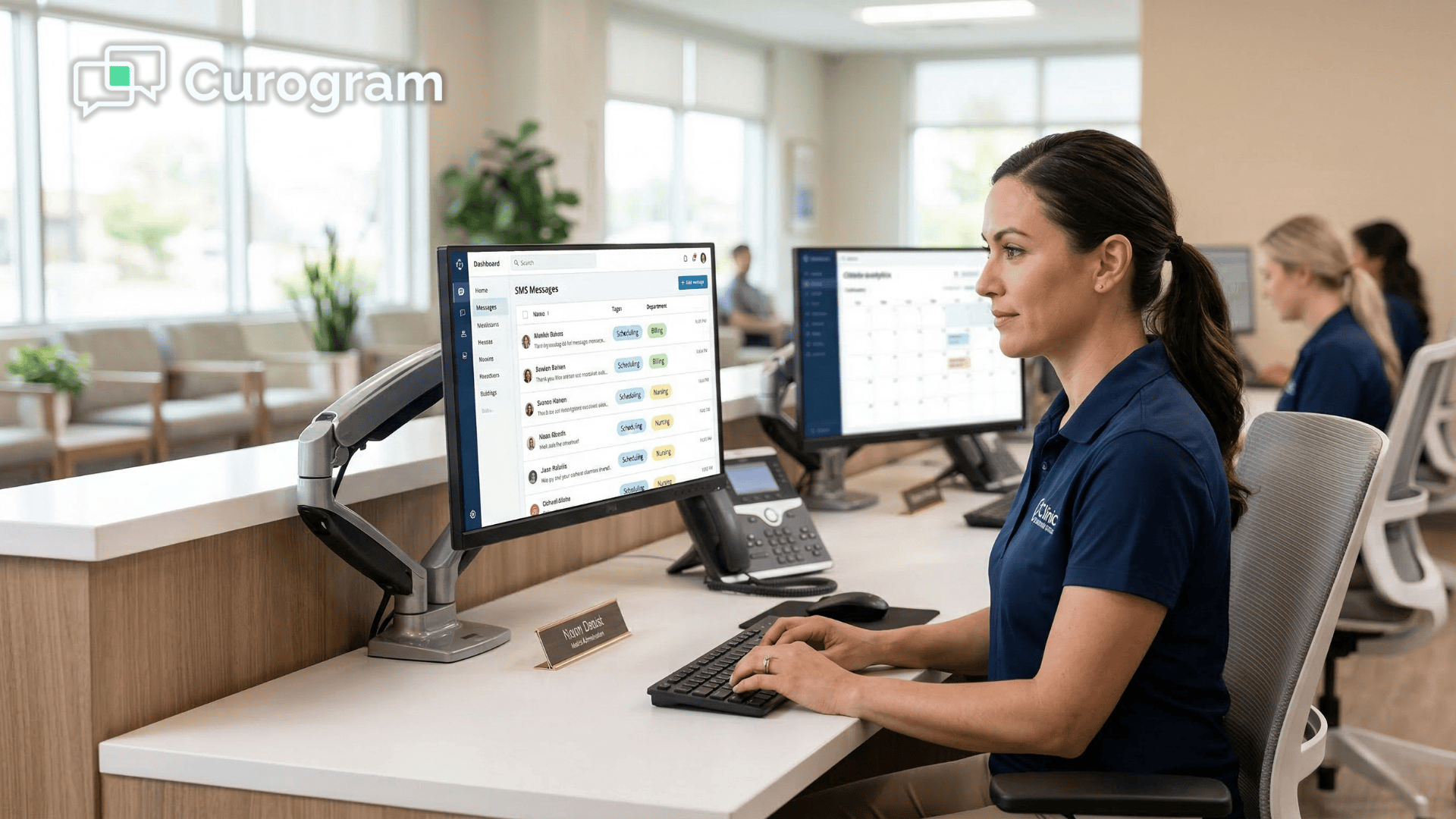
Patients text your practice's existing phone number — no app to download, no portal login, no credentials. They text the way they text everyone else, and your staff responds from a single unified inbox with full conversation history and real-time write-back to NextGen chart notes.

This is the core of the Call Deflection Layer. It does not replace NextGen. It does not require you to rip out your existing setup. It sits alongside your current environment and handles the patient communication volume that the portal was never going to absorb.

Smart Routing: Text Gets to the Right Team Automatically

One of the biggest reasons call centers get overloaded is that every inbound contact — regardless of what the patient needs — lands in the same queue. Curogram's Smart Routing changes that. When a patient sends a message.

The system reads the intent and routes it to the correct department without a human intermediary:

  • "Billing" - routes to the billing team
  • "Refill" - goes to the pharmacy queue
  • "Schedule" - lands with the scheduling pod
  • "Nurse" - goes directly to clinical staff

For organizations managing centralized call centers across five, ten, or fifty locations, Smart Routing replicates the routing logic they already use on the phone — but in text, at a fraction of the cost per interaction.

Integration That Works With NextGen's Ecosystem

Curogram is purpose-built to work with EHR environments that have restrictive integration architectures.

Patient conversations write back to NextGen Enterprise chart notes as structured entries — not PDF attachments or loose documents dropped in a document bin.

And because Curogram runs in the cloud independently of NextGen's desktop, patient communication stays fast even when NextGen's screens are slow. For IT teams.

The deployment comes with:

  • API-based integration with audit logging for every patient interaction
  • Role-based access controls configured for multi-location deployment
  • SOC 2 Type II compliance and executed Business Associate Agreements

Patient texting a clinic directly — no portal login needed

Built for Multi-Specialty Networks

NextGen serves 26+ specialties, and the communication needs across those specialties are not the same. Curogram adapts to each without requiring specialty-specific licensing. The same platform that handles a cardiology group's post-procedure follow-ups also manages a behavioral health network's appointment reminders.

Without exposing patient details in unsecured channels.

  • Orthopedic practices route pre-surgical instructions via text, reducing pre-op call volume.
  • Cardiology groups send follow-up messages that write back to the care plan automatically.
  • Primary care networks deflect routine scheduling and refill calls across dozens of sites from one dashboard.

One platform, every specialty, every location. That is the operational simplification a 20-to-100-provider network has been waiting for.

What Changes When Your Call Center Becomes a Communication Center

The Numbers That Actually Move

Based on our internal data, Curogram clients report more than 50% fewer inbound calls after activating text-first communication. For a 50-provider network fielding 80+ calls per location per day, that is thousands of recovered staff hours every month.

The engagement numbers reinforce it:

  • SMS carries a 98% open rate — compared to roughly 20% for portal-based email notifications.
  • Staff handle text threads three to four times faster than equivalent voice calls.
  • Average Handle Time drops because the call center stops absorbing tasks that text resolves in under a minute.

The interactions that actually require a phone call — complex clinical questions, upset patients, multi-step scheduling — stay in the call center where they belong. Everything else moves to text.

From Reactive to Structured

The shift is architectural. Instead of every patient interaction flowing through a phone queue that creates hold times, agent burden, and documentation gaps, Curogram converts the highest-volume and lowest-complexity contacts into asynchronous text threads.

The call center does not shrink — it becomes more purposeful, handling the cases that genuinely need a live conversation.

Operations leaders see what they have been waiting for: call volume per location drops, patient satisfaction scores rise, and staff who spent most of their day managing hold queues are now handling interactions that actually match their skills.

That is a better use of your team and a better experience for your patients.

What Each Stakeholder Gains

The impact lands differently depending on where someone sits in the organization — but it lands meaningfully across the board.

  • VPs of Operations and COOs see call center metrics move for the first time: AHT drops, call volume per location falls.
  • CIOs and VPs of IT manage one vendor, one integration, and one support channel instead of three.
  • CFOs see engagement costs consolidate into a single line item instead of a spreadsheet of module licenses.
  • Directors of Patient Experience watch satisfaction scores rise because patients get faster responses through the channel they actually prefer.
  • Clinical champions see communication flowing without another tool added to an already crowded workflow.

Ready to Stop Patching the Stack? Deploy the Layer That Actually Works

NextGen Enterprise is your system of record. It is where documentation lives, where clinical workflows run, and where your organization's data is structured. That is not changing. What can change is the patient communication layer sitting on top of it.

Right now, that layer is fragmented — spread across a portal with low adoption, a text engagement tool on its own contract, and a call center absorbing the overflow. None of that has to be the permanent answer.

Curogram adds a single, direct SMS communication layer with full NextGen integration across your entire NextGen network. Patients text your existing number.

Smart Routing sends each message to the right team. Chart notes update automatically. And the call center handles the cases that actually need a call — instead of everything patients could not get answered another way.

Organizations running this model report more than 50% fewer inbound calls, a 98% SMS open rate, and a meaningful drop in Average Handle Time within weeks of going live.

That is not a future-state promise. That is what our internal data shows across multi-location ambulatory networks like yours.

Schedule a demo to model call deflection savings, AHT reduction, and engagement ROI across your specific NextGen network.


Frequently Asked Questions

Is Curogram HIPAA-compliant and enterprise-ready for large NextGen deployments?

Yes. Curogram is SOC 2 Type II certified and fully HIPAA-compliant. Every patient interaction is covered by data encryption at rest and in transit, executed Business Associate Agreements, and complete audit logging. Role-based access controls are configured for multi-location deployment, so your IT team can manage permissions across 20 to 100+ providers from one place. You manage one vendor, one integration, and one support channel — not three.

Does Curogram replace Luma Health or the PxP patient portal?

Curogram does not require you to cancel Luma or shut down the portal. It adds a direct SMS layer that handles the highest-volume interactions — appointment confirmations, billing questions, refill requests, scheduling changes — without requiring patients to log in anywhere. For organizations already using Luma, Curogram fills use cases that Luma does not prioritize, including text-to-pay and reputation management at scale. For organizations still evaluating their engagement stack, Curogram offers a faster and leaner path to core engagement outcomes.

How does Curogram integrate with NextGen Enterprise's restricted API environment?

Curogram is purpose-built to work with EHR platforms that have restrictive integration ecosystems. Our architecture uses available data routes to write patient communication back to NextGen Enterprise chart notes as structured entries. Curogram runs independently of NextGen's desktop performance — texts, routing, and responses are processed in the cloud, so slow screen transitions in NextGen never affect how fast patients get a reply. Every deployment includes a dedicated implementation engineer for the technical setup on your end.

Can Curogram handle patient communication across multiple locations from one dashboard?

Yes. Curogram's unified dashboard is built specifically for multi-location ambulatory networks. Staff at each site can manage their own patient conversations independently, while operations and IT leaders have visibility across every location from a single view. Permissions are role-based, so access is configured by site, department, or provider as needed. For organizations running 20 to 100+ providers across multiple locations, this eliminates the coordination gaps that come from managing communication site by site.

How long does it take to deploy Curogram across a large NextGen network?

Most organizations are live in weeks, not quarters. Curogram assigns a dedicated implementation engineer to every enterprise deployment, who works directly with your IT team to configure the NextGen integration, set up Smart Routing rules by department, and establish role-based access across your locations. Because Curogram runs in the cloud and does not require changes to NextGen's core setup, implementation is far faster than adding a module like Luma, which typically takes 45 or more days for initial deployment alone. Training for front desk staff takes under five minutes — the platform is designed to feel as simple as everyday texting.


2-Way HIPAA Texting for eClinicalWorks

2-Way HIPAA Texting for eClinicalWorks

💡 eClinicalWorks 2-way HIPAA texting with smart routing for enterprise networks gives patients a direct SMS channel — no app download, no portal...

Read More
eCW Call Center Text Routing | Reduce AHT with Smart SMS

eCW Call Center Text Routing | Reduce AHT with Smart SMS

💡 eClinicalWorks call center text routing gives enterprise eCW networks a HIPAA-compliant SMS layer that handles routine patient questions before...

Read More
How NextGen Clinics Improve Patient Communication w/ Text Messaging

How NextGen Clinics Improve Patient Communication w/ Text Messaging

💡 NextGen clinics can improve their patient communication with secure text messaging. It comes down to secure, compliant, and efficient workflows....

Read More