
 Michael Hsu
1 min read
Telemedicine Wisconsin: Laws and Policies | Blog
 Michael Hsu : 6/22/20, 11:03 AM
💡 Illinois law requires private health plans to cover telehealth the same way they cover office visits. Plans must also pay in-network providers...

Most published guides to telemedicine in Oregon are wrong about the central fact. They say the state pays for live video and nothing else. That stopped being true years ago, and practices are still turning away visits because of it.
The current statute lists what Oregon actually recognizes: landlines, wireless, the Internet, and telephone networks, carrying synchronous or asynchronous transmissions by audio only, video only, audio with video, or remote monitoring data.
Oregon also has payment parity written into law, which fewer than half the states can say. A virtual visit pays what the same service pays in your exam room.
The same guides get prescribing wrong. Several still state that Oregon physicians can't prescribe after a virtual appointment.
The Oregon Medical Board says the opposite in plain terms — it doesn't require an in-person visit to establish or maintain a provider-patient relationship, and health plans are barred from blocking prescriptions issued after an appropriate telemedicine exam.
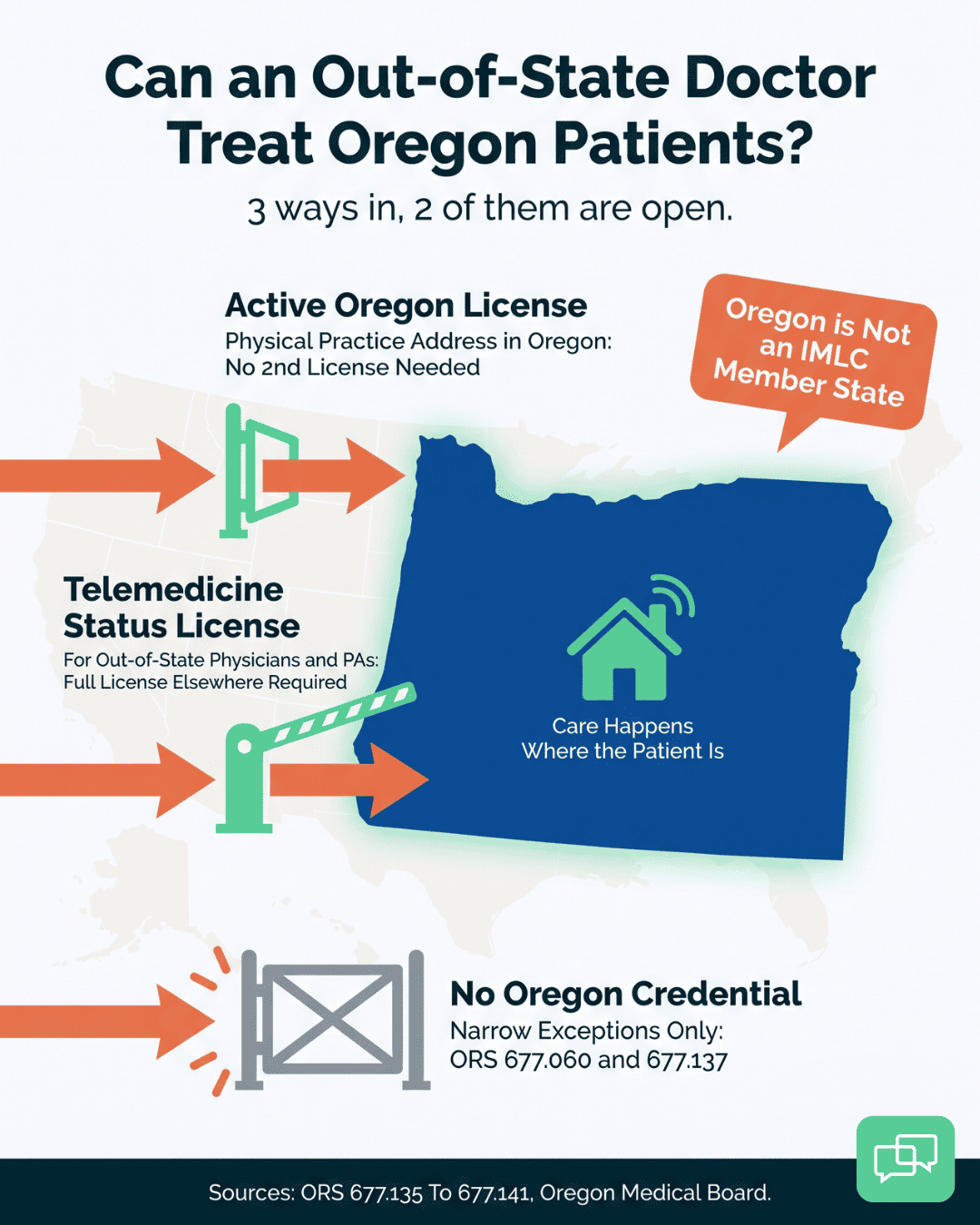
Cross-state care is the third myth. Oregon isn't an Interstate Medical Licensure Compact member, so most roundups conclude the door is shut. The Board issues a Telemedicine status license built specifically for physicians and PAs who practice entirely from outside the state.
Oregon's telemedicine framework is now one of the more permissive in the country. The risk to your practice isn't the law being restrictive. It's operating under rules that expired.
Oregon's telemedicine rules started narrow. Senate Bill 463 was the state's first law on the subject. The Bill directed the Central Oregon Health Council to set rules on telemedicine system compatibility, standards, and characteristics.
That early law treated telemedicine as a way to move medical information for diagnosis. It covered images, test results, diagnosis results, and other medical data sent between a provider and a patient at the originating site. In-person care stayed the default.
Oregon has rewritten the rules several times since. Parity now sits in two statutes: ORS 743A.058 for commercial plans and ORS 414.723 for the Oregon Health Plan. Private payer mandates came first. State employee health plans followed in 2015.
Two protections matter when you bill. Service parity means a plan must cover a service by telemedicine if it covers that service in person. Payment parity means the plan must pay you the same rate either way.
Plenty of state guides still say Oregon pays for live video and nothing else. That hasn't been true for years. ORS 743A.058 lists permissible applications and technologies broadly, and ORS 414.723 mirrors it for the Oregon Health Plan.
| Delivery format | Recognized under Oregon law |
|---|---|
| Live audio and video | Yes |
| Audio only | Yes |
| Video only | Yes |
| Store-and-forward (asynchronous) | Yes |
| Remote monitoring data | Yes |
Landlines, wireless, the Internet, and telephone networks all qualify as delivery methods. Oregon Health Plan rules add one limit worth knowing: fax, email, and text messages fall outside the audio-only definition, so they can't be billed as an audio-only visit on their own.
Curogram runs telemedicine for Oregon practices inside a HIPAA-compliant environment, with a Business Associate Agreement in place. Two-way video is built in, and patients join from a link with no app to download.
You can pair that with SMS appointment reminders that carry the link to your virtual clinic. Patients reply to the same message to reschedule or ask a question. Across our clients, more than 75% of appointments get confirmed this way, based on our internal data.
The Oregon Medical Board takes a clear position on telemedicine, and it's shorter than most people expect. Telemedicine isn't a separate kind of medicine to the Board. It's a delivery tool. The same standard of care applies whether you see the patient in your exam room or on video.
One line from the Board shapes everything else: the practice of medicine happens at the patient's location. That's why an Oregon license is required to treat a patient sitting in Oregon, no matter where you are.
Three points from the Board's guidance affect daily scheduling:
Point one is the one that changes your workflow. New patients can book straight into a virtual slot. Your front desk doesn't have to route them through an in-person appointment first.
Oregon doesn't publish a master list of who may practice telemedicine. It sets conditions instead. Meet them and your license qualifies.
The Oregon Medical Board frames it simply:
Telemedicine is a delivery tool, not a separate specialty, so scope of practice does the gatekeeping. A physician, physician associate, or acupuncturist at Active status may treat Oregon patients by telemedicine with no second license. Out-of-state physicians and PAs have their own route: a Telemedicine status Oregon license, which requires a full, unrestricted license in another state.
Other boards govern their own licensees the same way. Dentists have explicit teledentistry rules under OAR 410-123-1265. Behavioral health providers work under separate Oregon Health Authority rules. What each professional may do virtually tracks what they may do in person.
Coverage adds a second layer. To bill OHP for a telehealth visit, three things have to be true:
| Requirement | What it means for you |
|---|---|
| Unencumbered Oregon license | No restrictions or sanctions attached |
| Enrolled as an OHP provider | Registered with the Authority under OAR 410-120-1260 |
| Within scope of practice | Your board says you can do this service, virtually or not |
Nothing here narrows by specialty. A registered dietitian and a clinical psychologist clear the same three gates as a family physician.
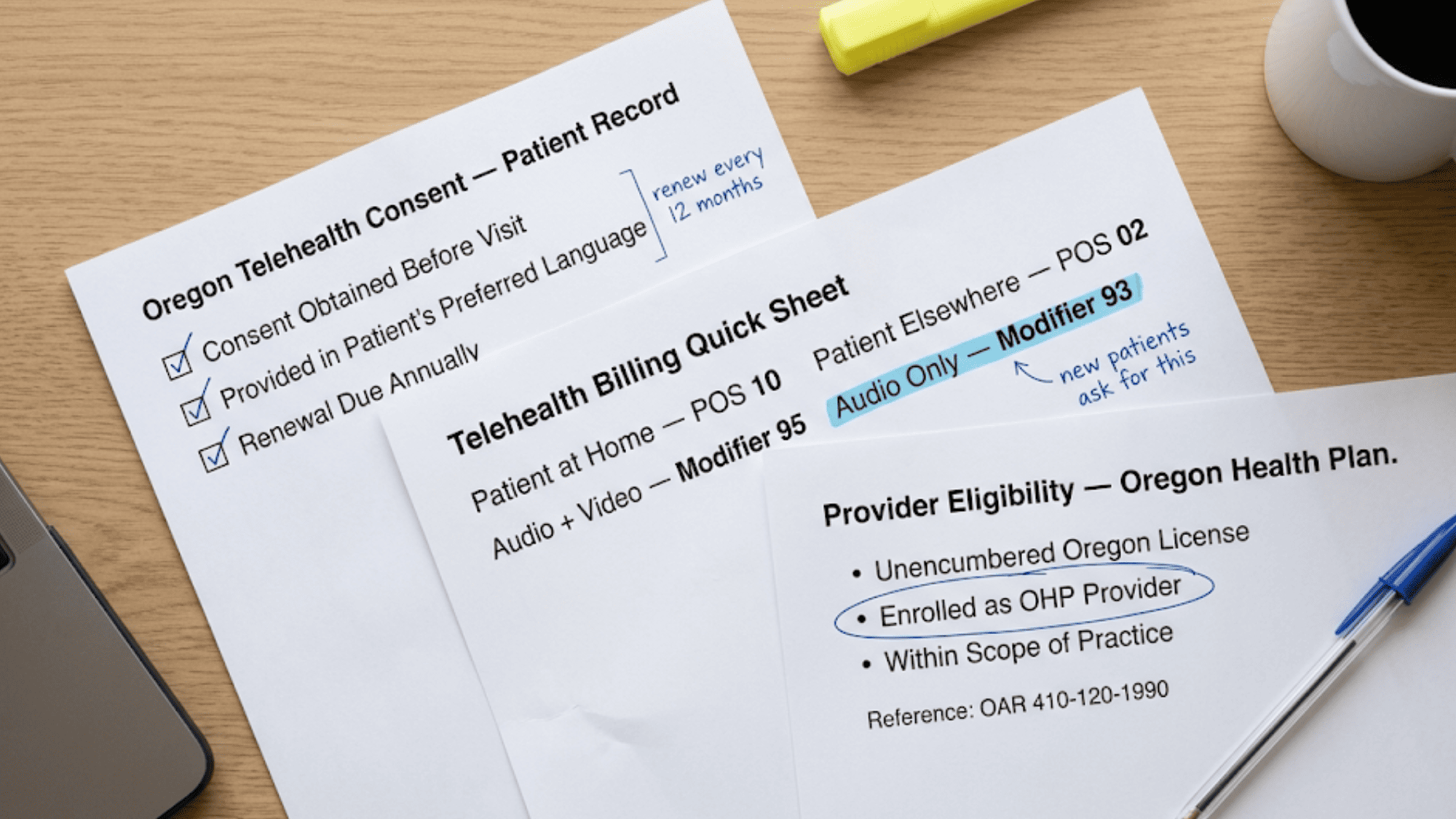
One consent rule sits alongside them. OHP requires documented consent before the telehealth visit, given in the patient's language, with a note on whether the patient can actually use the technology.
That consent has to be renewed at least once a year. Practices that treat it as a one-time signature at intake tend to discover the gap during an audit, not before.
Oregon isn't an Interstate Medical Licensure Compact member. Most state roundups stop there, which leaves out-of-state providers thinking the door is shut. It isn't.
The Oregon Medical Board issues a Telemedicine status license under ORS 677.135 through 677.141. It's built for physicians and PAs who practice entirely from outside the state.
You need a full, unrestricted license somewhere else and you have to meet Oregon's usual standards. That license covers care delivered across state lines, and nothing else.
Which pathway fits depends on where your practice sits:
| Your situation | What you need |
|---|---|
| Physical practice address in Oregon | Active status. No second license for telemedicine. |
| Practicing entirely from another state | Telemedicine status Oregon license. |
| Neither | Narrow exceptions only, under ORS 677.060 and 677.137. |
Those narrow exceptions are real but small. A patient who normally sees you at home and travels to Oregon for work, school, or vacation can keep getting care from you.
Consulting with an Oregon-licensed provider is allowed if you don't take primary responsibility for the diagnosis. Neither one supports building an Oregon patient panel.
Licensure is one question. Payment is another, and ORS 743A.058 settles it. A plan may not stop you from delivering telemedicine across state lines if any one of these is true:
Any single condition is enough. The statute uses "or," not "and."
One direction of travel trips people up. If you hold an Oregon license and your patient is sitting in Washington or Idaho, Oregon's rules aren't the ones that apply.
The practice of medicine happens where the patient is, so that state's board governs the visit. Border-town practices should check both boards before scheduling.
Oregon does have telemedicine consent rules, and the strictest ones sit in Oregon Health Plan policy. Under OAR 410-120-1990, you need documented consent before the visit starts, not after.
Four things have to be true for that consent to hold up:
That last one catches practices out. Consent collected at intake in 2024 doesn't cover a visit in 2026.
Capturing consent is only half the job. It has to live somewhere auditable, alongside the PHI it covers.
Curogram complies with all HIPAA regulations and signs a Business Associate Agreement with every practice, so consent records, intake forms, and visit data sit inside one protected environment rather than scattered across email and paper folders.
Where a patient has limited English or is hard of hearing, a qualified or certified health care interpreter has to be part of the consent conversation.
Commercial plans face a limit of their own. ORS 743A.058 bars them from requiring a patient to give consent in person before a virtual visit.
Oregon's minor consent laws apply to telehealth the same way they apply in your exam room. Parental consent isn't required in these cases:
| Service | Age patient may consent |
|---|---|
| Birth control information and services | Any age |
| Certain sexually transmitted infections | Any age |
| Other medical or dental diagnosis and treatment | 15 and older |
| Outpatient mental health or chemical dependency care | 14 and older |
Chemical dependency records carry a second rule. 42 CFR Part 2 governs substance use disorder information, and it's stricter than HIPAA on disclosure. Behavioral health practices should map both before turning on virtual visits.
Consumer video tools don't clear the bar. What you need is encryption in transit and at rest, access logging that shows who opened which record, and written policies for preventing and reporting a breach. OHP rules require that last piece explicitly.
Then there's the documentation trail. Every telehealth encounter has to be recorded to the same standard as an in-person visit, which means the note belongs in the chart, not in a separate video tool nobody checks.
Curogram integrates with any EHR, so visit records land where your billers already look and your front desk isn't rekeying encounters at the end of the day.
You can prescribe from a virtual visit in Oregon. Plenty of older guides say otherwise, and that advice sends patients to your waiting room for no reason.
ORS 743A.058 settles the general question:
A health plan may not stop you from prescribing, dispensing, or administering drugs after an appropriate exam — and the statute counts an exam done in person, through telemedicine, or by instrumentation that transmits images and records. The Oregon Medical Board adds the other half: no in-person visit is needed to establish or maintain the provider-patient relationship.
Standard of care still governs the decision. Some presentations suit a virtual exam and some don't, and the Board leaves that judgment to you. What it doesn't do is impose a blanket rule.
The real limits sit at the federal level, not with Oregon. DEA and HHS issued a fourth extension of telemedicine prescribing flexibilities, in effect from January 1, 2026 through December 31, 2026.
| What you can do | Through |
|---|---|
| Prescribe Schedule II–V by audio-video, no prior in-person exam | 12/31/2026 |
| Prescribe Schedule III–V narcotics for opioid use disorder by audio only | 12/31/2026 |
Put that expiration date in your compliance calendar now. These flexibilities have run on short extensions since 2020, and DEA has said the pause gives it time to finish a permanent rule.
Whatever replaces them will likely carry new registration and documentation requirements.
A few practices still route every prescription request into an in-person slot as a precaution. That costs the patient a trip and costs you an appointment you could have filled. Check the schedule and the standard of care, then decide.

Oregon pays the same for a virtual visit as it does for the same service in your exam room. That's written into statute, not left to plan discretion.
Two protections do the work, and they're often confused:
| Protection | What it guarantees |
|---|---|
| Service parity | If a plan covers a service in person, it must cover it by telemedicine. |
| Payment parity | The plan must pay the same rate either way. |
Most states have the first. Oregon has both. ORS 743A.058 sets them for commercial and dental-only plans; ORS 414.723 does the same for the Oregon Health Plan.
The statutes also close the side doors plans have used to make virtual care less attractive. A plan may not apply different prior authorization rules to telemedicine, set different annual dollar maximums, or use a higher medical necessity standard.
Out-of-network providers get the same protection — a plan can't pay a different out-of-network rate just because the visit was virtual.
One boundary is named in the law itself. Payment parity doesn't override value-based arrangements. If you're in a capitated, bundled, or risk-based contract, that contract still governs, and it doesn't have to price telemedicine off a fee-for-service equivalent.
Four payer types cover telemedicine in Oregon, and they don't all answer to the same rules:
That fourth line matters more than its length suggests. A patient with an employer card in hand may be on a self-funded plan that never took on Oregon's parity requirements. Your billing team can't tell from the card alone.
Medicare sits in its own category with a date attached. The Consolidated Appropriations Act of 2026, signed February 3, 2026, extended telehealth flexibilities through December 31, 2027. Geographic and originating site limits stay lifted until then, and patients can be treated at home.
Medicare's telehealth rules changed in 2020 and haven't gone back. Most of the restrictions older guides describe — rural-only, clinic-only, video-only — are suspended.
The Consolidated Appropriations Act of 2026 was signed on February 3, 2026. It extended the flexibilities through December 31, 2027.
Here's what applies to your Oregon patients right now:
| Rule | Current status |
|---|---|
| Geographic restriction (HPSA) | Lifted through 12/31/2027 |
| Originating site limits | Lifted through 12/31/2027. Patients may be at home. |
| Eligible practitioners | All eligible Medicare providers, through 12/31/2027 |
| Audio-only, non-behavioral | Covered through 12/31/2027 |
| Behavioral health from home | Permanent |
| FQHCs and RHCs as distant site | Allowed through 12/31/2027 |
Two dates deserve a place in your compliance calendar. On January 1, 2028, physical therapists, occupational therapists, speech-language pathologists, and audiologists lose the ability to bill Medicare for telehealth.
From the same date, audio-only stays available for behavioral health only when video isn't possible or the patient declines it, and only if you have audio-video capability on hand. Document which applies in the visit note.
These flexibilities have expired twice. They lapsed on October 1, 2025 during the shutdown, and CMS told contractors to hold telehealth claims. When Congress reopened the government in November, coverage applied retroactively and held claims became payable.
It happened again after January 30, 2026, until the February 3 package restored coverage retroactively a second time.
Both times, practices that kept clean documentation resubmitted and got paid. Practices that stopped offering virtual visits during the gap lost the appointments outright. Watch the next expiration the same way — hold, don't cancel.
Place of service and modifier drive most Oregon denials:
CMS must also create new telehealth billing modifiers by January 1, 2027. Those will track how a service was delivered, including whether a third-party platform was involved. Ask your billing vendor about the changeover before it lands.
Medicaid lets each state decide whether to cover telemedicine and on what terms. Oregon decided broadly.
OAR 410-120-1990 defines telemedicine as delivering remote clinical health services using information and telecommunication technologies, and ORS 414.723 backs it with payment parity.
Audio-only counts. So does video-only, audio with video, store-and-forward, and remote monitoring data. Synchronous encounters meet face-to-face requirements under the rule, which matters when a program rule elsewhere calls for a face-to-face visit.
Three conditions decide whether you can bill the Oregon Health Plan at all:
No specialty roster narrows that further. A dietitian and a psychiatrist clear the same three gates.
The rule sets obligations that live in your workflow, not your contract file:
| Requirement | What it looks like day to day |
|---|---|
| Consent | Documented before the visit, in the patient's language, with a technology-readiness check. Renewed yearly. |
| Patient choice | Offer in-person and virtual. You can't route everyone to video by default. |
| Interpreters | Certified or qualified interpreters, reimbursed at the same rate as in person. |
| Location | No limit on where the patient is. Your side just needs privacy. |
| Documentation | Same standard as an in-person visit, per OAR 410-120-1360. |
Four technical duties sit alongside those. Comply with HIPAA and the Authority's Privacy and Confidentiality Rules. Use communication technology that meets both. Write and keep policies that prevent breaches and report them on time.
Comply with the Health Evidence Review Commission guidelines when you consult by phone or online.
Substance use practices carry a fifth. 42 CFR Part 2 governs those records and it's stricter than HIPAA on disclosure. The telehealth rule names it directly.
Two fields cause most OHP telehealth denials. Place of service is POS 10 when the patient is at home and POS 02 when they're anywhere else. Modifier 95 marks a real-time audio and video visit; modifier 93 marks audio only. Dental claims are the exception on modifiers.
That's a long list, and none of it requires a long setup. Curogram runs HIPAA-compliant video, two-way SMS, and digital intake with a Business Associate Agreement signed before your first visit. Consent forms go out by text and land in the chart, so the annual renewal isn't something your front desk has to chase by phone.
Commercial plans in Oregon have to cover telemedicine, and the rule lives in ORS 743A.058. The statute started as Senate Bill 24 in 2015 and Senate Bill 144 in 2019, then kept growing. What binds your payers today is the current statute, not those bill texts.
Coverage attaches when 4 things are true:
Nothing in that list names a modality. Audio only, video only, audio with video, asynchronous transmission, and remote monitoring data all qualify, over landlines, wireless, the Internet, or telephone networks.
The prohibition list is where the statute does its real work for you. A commercial or dental-only plan may not:
| Prohibited | Effect on your practice |
|---|---|
| Pay less for telemedicine | Same rate, in person or virtual |
| Restrict rural or urban originating sites | Portland patients count the same as Burns patients |
| Require an established patient relationship | New patients can book straight into a virtual slot |
| Require consent given in person | No throwaway office visit just to sign a form |
| Require a staff member beside the patient | The patient can be home alone |
| Apply different prior authorization or dollar caps | Same rules as in-person care |
| Restrict a provider to one modality | You decide what fits the visit |
| Deny the patient a choice | Patients pick in person or virtual |
| Pay out-of-network providers a different rate | Virtual doesn't change out-of-network math |
Where the patient sits is the originating site — home, workplace, school, or a health facility, it makes no difference to coverage.
Plans also owe patients working access, and some of that lands on your schedule. Interpreters must be reimbursed at the same rate as in-person interpretation, minus travel.
Plans have to supply auxiliary aids for patients with a medical condition, a disability, advanced age, or limited English. Services have to be culturally and linguistically appropriate and trauma-informed.
One provision only surfaces in a crisis. During a declared state of emergency, plans must cover telemedicine delivered to patients in the affected area using any commonly available technology — even if it wouldn't normally meet privacy and security standards. Wildfire season makes that more than theoretical in Oregon.
Telemedicine in Oregon isn't only for seeing patients. The Oregon ECHO Network uses the same video technology to teach clinicians, and it costs your practice nothing.
Extension for Community Healthcare Outcomes started at the University of New Mexico. The goal was to help primary care teams manage conditions they'd normally refer out. Oregon runs its own version through OHSU.
Each cohort meets by videoconference over several weeks. A session has two halves:
That panel is called a Hub. You bring the patient you're stuck on, and you leave with treatment recommendations.
The long-running topics are hepatitis C, diabetes, pain management, and addictions. Newer cohorts reach further — behavioral health integration, adolescent substance use, and care for children in foster care have all run recently. Sessions typically sit at one hour, early morning or midday Pacific.
Cost is the part worth flagging to your clinical staff. Programs are always free, and most carry no-cost continuing education credit.
OHSU's telehealth page lists both CME and nursing CEUs for participants, so it isn't physicians only. Nurses, social workers, pharmacists, counselors, and practice managers appear in the target audiences.
For a small practice in eastern or coastal Oregon, this is specialty input you'd otherwise wait months and drive hours for.
The pandemic reset what Oregon expected from virtual care. In March 2020, Oregon Health & Science University launched mobile drive-through testing for its patients and for first responders with symptoms, and pushed hard on its telemedicine program at the same time. Video visits absorbed demand the clinics couldn't hold.
Money followed fast. In June 2020, the FCC's COVID-19 Telehealth Program awarded $760,103 across three Oregon providers: OHSU, the NARA Indian Health Clinic in Portland, and Northwest Human Services in Salem.
NARA's share went to phones, laptops, tablets, data plans, and videoconferencing licenses handed directly to elders and families.
Testing sites closed. The rules that let them work mostly didn't.
| Emergency measure | Where it stands now |
|---|---|
| Patients treated at home | Permanent in Oregon. No limit on patient location under OHP rules. |
| Audio-only visits | Reimbursed by OHP and commercial plans |
| Medicare geographic limits waived | Extended through 12/31/2027 |
| Telemedicine prescribing without a prior in-person exam | DEA flexibilities run through 12/31/2026 |
One emergency provision is still written into ORS 743A.058 and waiting.
During a declared state of emergency, plans must cover telemedicine delivered to patients in the affected area using any commonly available technology, even where it wouldn't normally meet privacy and security standards.
Oregon declares those during wildfire season, not just pandemics.
That's the practical lesson for your practice. The clinics that kept seeing patients in 2020 weren't the ones that bought the most equipment. They were the ones that could reach a full day's schedule by text within a few hours of the schedule falling apart.
Curogram handles that side of it — two-way SMS to the whole panel, appointment reminders, and video visits from the same dashboard. Across our clients, more than 75% of appointments get confirmed by text, based on our internal data. It runs alongside your existing EHR rather than replacing it.
Oregon's rules are settled enough to build on. Payment parity is in statute. Audio-only counts. Patients can be at home. What's left is picking a platform that holds up to an OHP audit and doesn't add work to your front desk.
Curogram is HIPAA-compliant, signs a Business Associate Agreement before your first visit, and carries the security, privacy, and technology safeguards the Oregon Health Authority expects. Consent capture, documentation, and breach policies are built in rather than bolted on.
It runs alongside your EHR. You're not replacing your chart or your practice management system.
| Who | What changes |
|---|---|
| Clinicians | Start a video visit in one click, from a laptop, phone, or tablet. Message colleagues in the same dashboard. |
| Front desk | Send templated texts to one patient or a full day's schedule. Fewer inbound calls to field. |
| Patients | An SMS link to the virtual waiting room. No app download. They reply to the same thread to reschedule or ask a question. |
Numbers from our clients, based on our internal data: Atlas Medical Center cut no-shows from 14.20% to 4.91% in three months.
Across our client base, no-show rates run 53% below the industry average and phone call volume drops 24%. Covina Arthritic Clinic confirms more than 1,100 appointments a month.
Reviews work the same way, deliberately. Every eligible patient gets the same request after a visit, with no filtering by how the visit went.
That's what the FTC rule and Google's policy require, and it's the only version that survives scrutiny. One multi-location client added 1,064 new five-star reviews in three months on that basis.
Don’t see your state? We just haven’t written about it yet! Stay tuned on our blog or check out our article on telemedicine reimbursement by state.
|
Nebraska |
|||
|
Alaska |
Iowa |
Nevada |
South Dakota |
|
Kansas |
New Hampshire |
||
|
Kentucky |
|||
|
New Mexico |
Utah |
||
|
Maine |
Vermont |
||
|
Connecticut |
|||
|
Delaware |
North Dakota |
||
|
West Virginia |
|||
|
Oklahoma |
|||
|
Mississippi |
Oregon |
Wyoming |
|
|
Montana |
Rhode Island |
Book a demo and bring your worst scheduling week to it. We'll walk your actual workflow — intake, consent, reminders, the visit, the note back to your chart — and show you where the hours go.

1 min read
Michael Hsu : 6/22/20, 11:03 AM
💡 Illinois law requires private health plans to cover telehealth the same way they cover office visits. Plans must also pay in-network providers...
1 min read
Michael Hsu : 6/3/20, 7:59 AM
💡 Michigan covers telemedicine, and its rules are broader than most published guides suggest. Private insurers must give a telemedicine service...
1 min read
Michael Hsu : 6/15/20, 9:19 AM
💡 Telemedicine in Georgia has been legal since 2005. That is when the Georgia Telehealth Law made payment parity a requirement. Private plans...