
 Michael Hsu
1 min read
How Telemedicine Transforms the Patient-Doctor Relationship
Telemedicine, as a remote patient care model, is not a new practice in healthcare and existed for many years before the COVID-19 pandemic. It was...

A telehealth visit can go perfectly and still earn you nothing. The video connects, the patient gets the care they need, and your provider documents everything properly. Then the claim comes back denied because of one incorrect code or one missing modifier.
That happens far more often than most practices admit.
Telemedicine is no longer a temporary solution. Patients now expect a virtual option for follow-ups, medication checks, and behavioral health visits, and the clinical side of virtual care has matured quickly.
The billing side has not kept up.
Telehealth rules shift almost every year, and they differ from one payer to the next. Medicare has one set of rules, Medicaid has another, and each private payer writes its own.
A code that works for one patient may be denied for the next.
The stakes became clear in late 2025. When Medicare's telehealth flexibilities briefly lapsed during the federal shutdown, one study found telehealth visits dropped 24% in the first 17 days. Practices weren't sure what they could bill, so many simply paused virtual care until Congress acted and the rules were clear again.
Confusion costs real money. Say your practice sees 40 virtual visits a week, and 10% of those claims are denied. That's four claims a week.
At about $100 each, you're looking at roughly $1,600 a month in delayed or lost revenue, plus staff time spent on rework. (This is an illustrative example. Your numbers will vary.)
The good news is that telemedicine billing follows a predictable logic once you understand how the pieces fit together.
In this guide, you'll learn how CPT codes are organized. You'll get updated lists of the telemedicine CPT codes used most often in 2026, including the newer 98000 series. You'll also see which modifiers and place of service codes payers expect.
The main issue with CPT codes stems from the fact that the guidelines for billing telemedicine are still being formed. Apart from rapidly changing, the billing guidelines also vary between payers—private payers, Medicaid, Medicare.
This often results in confusion, with healthcare providers not knowing or being unsure about what to bill for telemedicine services and which codes to use.
The fact of the matter is, a good number of states have telemedicine parity laws, mandating reimbursement for telemedicine, often at the same rates as if the services were delivered in-person.
Most major commercial payers in the U.S. cover telemedicine services. This includes:
Medicare also covers a range of telemedicine services and has even expanded the array of reimbursable remote healthcare services during the COVID-19 pandemic.
That said, if you’re planning on embracing telemedicine, you should always check to see if the patient’s insurance plan covers remote healthcare—and if so, what services are included.
Check our comprehensive telemedicine reimbursement by state article to get a quick idea of telemedicine reimbursement policies across the United States.
Even when telemedicine services are covered by the patient’s insurance plan, you still need to know how to properly bill for the medical services you delivered using telemedicine. This includes selecting the right CPT code and the right modifier when sending the medical bill.
In this article, we’ll explain what CPT codes are, go over the different types of CPT codes applicable to telemedicine encounters, and provide you with detailed lists that will help you correctly bill for remote healthcare services.
The Current Procedural Terminology codes—CPT for short—are a set of medical codes provided and maintained by the American Medical Association (AMA). The idea behind CPT codes is to create a uniform standard that medical professionals, patients, and payers use when referring to a wide range of medical services for financial and administrative purposes.
CPT codes describe testing, surgical procedures, diagnostic services, and all other medical procedures that a healthcare professional provides to a patient. In conjunction with the International Classification of Diseases (ICD) codes, CPT codes tell payers everything they need to know to reimburse you for telemedicine services—what symptoms the patient exhibited and what medical services you delivered to treat their condition.
The CPT code set is enormous, giving that it covers thousands of different medical procedures. In this article, we’ll highlight the ones that are applicable to telemedicine encounters, but first—let’s take a look at the different categories of CPT codes.
Every CPT code is five characters long. Some are all numbers, while others mix numbers and letters, depending on the category.
There are three categories:
The AMA's CPT Editorial Panel updates the code set every year. New codes are released each fall and take effect on January 1. Always bill from the current year's codebook, since codes are added, revised, and deleted every cycle.
Category I codes are the ones providers use most. They're grouped into six sections, each tied to a different area of care.
Codes are listed in numerical order, with one exception. Evaluation and Management (E/M) codes appear first in the codebook because physicians use them most often. For telemedicine, E/M codes do most of the heavy lifting.
| Category I section | Code range |
|---|---|
| Evaluation and Management | 99202–99499 |
| Anesthesia | 00100–01999 |
| Surgery | 10004–69990 |
| Radiology | 70010–79999 |
| Pathology and Laboratory | 80047–89398 |
| Medicine | 90281–99199; 99500–99607 |
Category II codes have four numbers followed by the letter F. They're optional. You can add them next to Category I codes to share details that help track the quality of care.
These codes are grouped by the part of patient care they describe. Common groups include:
Category II codes don't usually change what you're paid. But they help you meet quality goals, and those goals can affect your scores with Medicare and some private payers.
Category III codes cover new services and new technology. They let the AMA track how often a new service is used. Then it decides if the service needs a permanent code.
One rule matters here. Category I includes "unlisted procedure" codes, but if a matching Category III code exists, you must use the Category III code instead.
The AMA reviews these codes each year. Most Category III codes stay active for five years. After that, they're moved into Category I, renewed, or retired.
Now that you know how CPT codes are organized, let's look at the codes most often used for telemedicine and telehealth billing.
Before you use the table below, review the telehealth laws in your state. Rules can change based on where your practice is and where your patient is during the visit. Those rules affect how each payer reimburses you.
You'll find more state-specific guidance on the Curogram blog, including our telemedicine reimbursement by state guide.
Here are commonly billed telemedicine codes for 2026. Codes marked with an asterisk (*) have changed since this guide was first published.
| Remote healthcare service | CPT/HCPCS codes |
|---|---|
| Office or other outpatient visits | 99202–99215* |
| Office consultations | 99242–99245* |
| Inpatient or observation consultations | 99252–99255* |
| Subsequent hospital care | 99231–99233 |
| Subsequent nursing facility care | 99307–99310 |
| Prolonged services, office visit | 99417 (CPT); G2212 (Medicare)* |
| Prolonged services, inpatient or observation | 99418 (CPT); G0316 (Medicare)* |
| Pharmacologic management add-on, with psychotherapy | 90863 |
| Interactive complexity | 90785 |
| Psychiatric diagnostic evaluation | 90791, 90792 |
| Individual psychotherapy | 90832–90834, 90836–90838 |
| Psychotherapy for crisis | 90839, 90840 |
| Psychoanalysis | 90845 |
| Family psychotherapy, without the patient | 90846 |
| Family psychotherapy, with the patient | 90847 |
| Neurobehavioral status exam | 96116 |
| Transitional care management | 99495, 99496 |
| End-stage renal disease (ESRD) services, including home dialysis | 90951, 90952, 90954, 90955, 90957, 90958, 90960, 90961, 90963–90970 |
| Medical nutrition therapy, individual and group | 97802–97804, G0270 |
| Smoking and tobacco cessation counseling | 99406, 99407* |
| Alcohol or substance use assessment and intervention | 99408, 99409, G0396, G0397 |
| Remote retinal imaging | 92227, 92228 |
| Health risk assessment, patient or caregiver | 96160, 96161 |
| Mobile cardiac telemetry | 93228, 93229 |
| External ECG event recording with remote download | 93268, 93270–93272 |
| Genetic counseling | 96041* |
| Health behavior assessment and intervention | 96156, 96158, 96159, 96164–96168, 96170, 96171* |
| Self-management education and training | 98960–98962 |
| Annual wellness visit, first and subsequent | G0438, G0439 |
| Alcohol misuse screening and counseling | G0442, G0443 |
| Depression screening | G0444 |
| Behavioral counseling to prevent STIs | G0445 |
| Behavioral therapy for cardiovascular disease | G0446 |
| Behavioral counseling for obesity | G0447 |
| Critical care telehealth consults, initial and subsequent | G0508, G0509 |
| Kidney disease education | G0420, G0421 |
| Diabetes self-management training | G0108, G0109 |
| Telehealth consults, emergency department or initial inpatient | G0425–G0427 |
| Follow-up inpatient telehealth consults | G0406–G0408 |
| Chronic care management assessment and care planning add-on | G0506 |
| Prolonged preventive services | G0513, G0514 |
| Office-based treatment for opioid use disorder | G2086–G2088 |
Bookmark this page so you can come back to it when billing questions come up. Just remember that coverage for each code still depends on the payer.
During the COVID-19 public health emergency, the Centers for Medicare & Medicaid Services (CMS) added many services to its telehealth list. The emergency ended in May 2023, but most of these services stayed on the list.
In its 2026 rules, CMS dropped the old split between "provisional" and "permanent" telehealth services. Congress has also extended Medicare's broader telehealth flexibilities through December 31, 2027.
Some of these services now use different codes than they did in 2020:
| Telemedicine service | Current codes |
|---|---|
| Emergency department visits | 99281–99285 |
| Initial hospital or observation care | 99221–99223* |
| Subsequent hospital or observation care | 99231–99233* |
| Same-day admission and discharge | 99234–99236 |
| Hospital or observation discharge | 99238, 99239* |
| Initial and subsequent intensive care | 99477–99480 |
| Critical care, hourly | 99291, 99292 |
| Neonatal and pediatric critical care | 99468–99473, 99475, 99476 |
| Care planning for cognitive impairment | 99483 |
| Initial nursing facility care | 99304–99306 |
| Nursing facility discharge | 99315, 99316 |
| Home or residence visits, including assisted living and group homes | 99341, 99342, 99344, 99345, 99347–99350* |
| Psychological or neuropsychological testing | 96130–96133, 96136–96139 |
| Physical, occupational, and speech therapy | 97161–97168; 97110, 97112, 97116, 97535, 97750, 97755, 97760, 97761; 92507, 92521–92524 |
| Radiation treatment management | 77427 |
In 2023, the separate observation codes were folded into the hospital care codes. Domiciliary and rest home codes were folded into the home visit codes.
Keep in mind that the CMS list applies to Medicare. Medicaid programs and private payers set their own lists, so a code Medicare accepts may still be denied by another plan.
In 2025, the AMA introduced a set of CPT codes made just for telemedicine. They replaced the old telephone E/M codes (99441–99443), which were deleted.

The new codes include:
Each group has four levels based on medical decision-making or total time, much like the office visit codes.
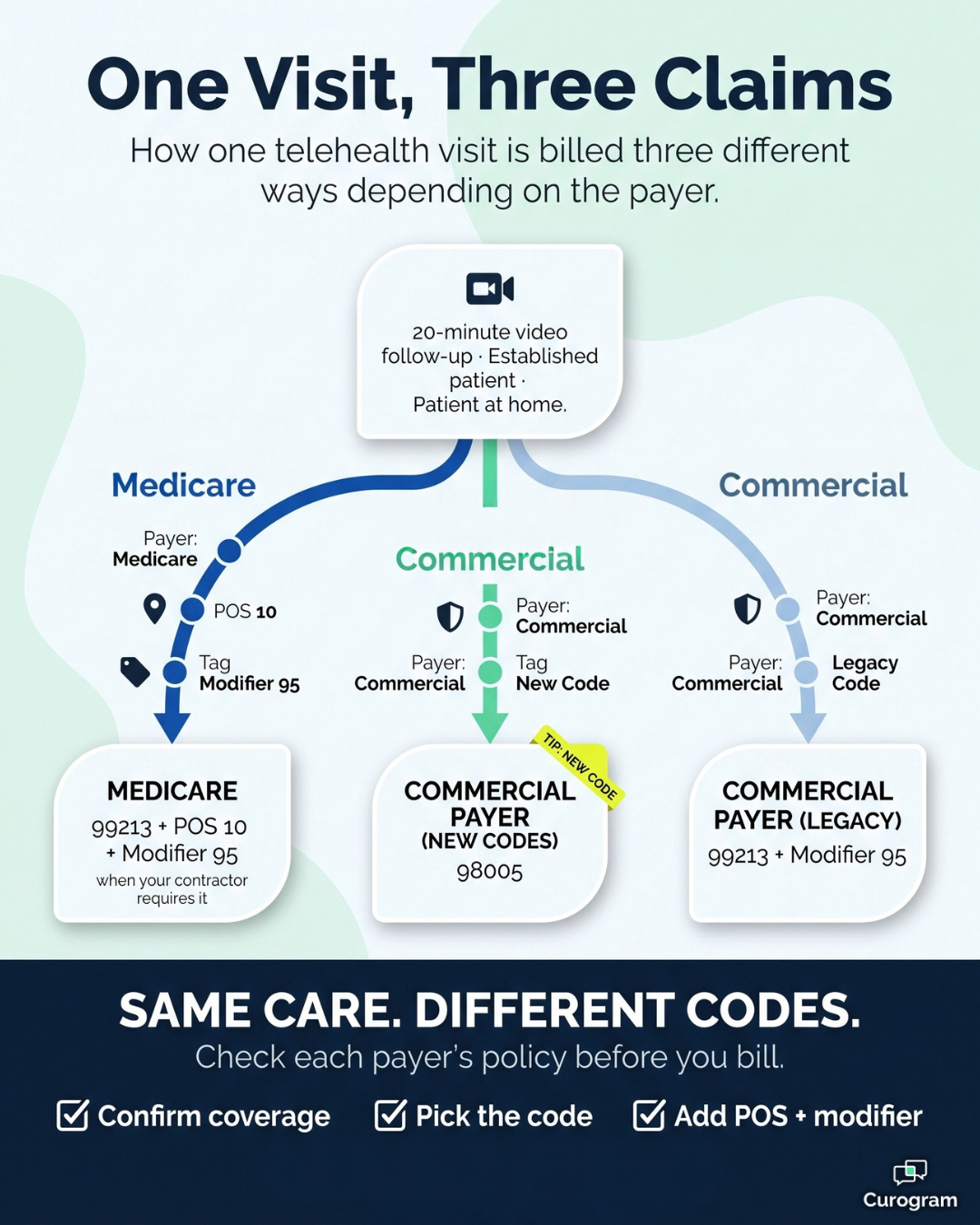
Here's the catch. Medicare doesn't pay for 98000–98015, because it sees them as duplicates of existing E/M codes. For Medicare patients, you'll keep billing 99202–99215 with the right place of service code and modifier.
Medicare does pay for 98016, which replaced HCPCS code G2012.
Private payers are split. Some have adopted the 98000 series, while others still want 99202–99215 with modifier 95. Check each payer's current policy before you switch your billing templates.
Imagine a 20-minute video follow-up with an established patient who connects from home.Here's how you might code that same visit for three different payers:
The care is identical. Only the code changes. Before your next round of virtual visits, build a simple payer cheat sheet for your front desk and billing team. Five minutes of setup can prevent weeks of denials. |
Picking the right CPT code is only half the job. Payers also look for the right modifiers and place of service (POS) codes to confirm the visit happened virtually.
These are the ones you'll see most often:
Each one is explained below.
The GT modifier once showed that a service was delivered by live audio and video. The GQ modifier showed that it was delivered asynchronously, such as by store-and-forward technology.
Medicare stopped requiring GT on most professional claims in 2018, when it moved to POS 02. Today, Medicare accepts GT only on institutional claims from Critical Access Hospitals billing under Method II, since those claims don't use a POS code.
GQ is even narrower. Medicare now limits it to federal telemedicine demonstration programs in Alaska and Hawaii. Some private payers and Medicaid plans still ask for GT, so check their policies before you drop it completely.
Modifier 95 tells the payer that a service was delivered through live, two-way audio and video. Many private payers require it on every telehealth claim. Medicare requires it in some cases, so check your Medicare Administrative Contractor's guidance.
Modifier 93 is for audio-only visits. Medicare allows audio-only care when the patient can't use video or doesn't consent to it, as long as your provider can offer video. Document why the visit happened by phone. Rural health clinics and federally qualified health centers use modifier FQ for audio-only services instead.
The safest move is to confirm each payer's rules before you deliver the service. Ask which telemedicine CPT codes, modifiers, and POS codes it accepts. Write the answers down so your team doesn't have to ask twice.
POS codes aren't modifiers, but they matter just as much. They tell the payer where the patient was during the visit, and that can change how much you're paid.
CMS defines telehealth as services provided "through a telecommunication system," and two POS codes cover it:
| POS code | When to use it | Medicare payment |
|---|---|---|
| POS 02 | The patient is somewhere other than home, such as a hospital or clinic | Facility rate (lower) |
| POS 10 | The patient is in their home | Non-facility rate (higher) |
In practice, POS 10 applies to most virtual visits, because most patients connect from home. Using POS 02 for every telehealth claim is a common mistake that can quietly lower your payments.
Telemedicine billing has a lot of moving parts, and codes are only one of them. That's why some practices still hold back on virtual care. They worry about setting up new software, keeping every visit HIPAA compliant, training staff, and getting a new tool to work with the systems they already use.
Each concern seems manageable on its own. Together, they can stall a telehealth program before it ever gets off the ground.
Now imagine the technology were the easy part. Your team could launch virtual visits quickly, learn the platform in minutes, and keep working inside the systems they already know.
That would free you to focus on what actually protects your revenue: accurate coding, clean claims, and consistent patient care.
That's the idea behind Curogram. Curogram is a HIPAA-compliant platform that combines telehealth and two-way patient texting in one place. It integrates with almost any EMR, so your team doesn't have to enter the same data twice. Most staff can learn it in less than 10 minutes, and it fits the way your practice already runs.
Curogram also supports the steps around each visit. Patients receive secure, automated text reminders and visit links, so fewer of them miss appointments. Your front desk spends less time on the phone chasing confirmations, and your providers spend more time with patients instead of administrative work. Some Curogram practices have cut their phone call volume by 50%.
Accurate telemedicine CPT codes protect your revenue, while the right platform protects your team's time. When you have both, virtual care stops feeling like a financial risk and becomes a dependable, profitable part of your practice.
Ready to see it in action? Book a demo of Curogram's telehealth and patient texting platform and find out how simple virtual care can be for your entire team.

1 min read
Telemedicine, as a remote patient care model, is not a new practice in healthcare and existed for many years before the COVID-19 pandemic. It was...

1 min read
 Joshua Inciso : 2/8/22, 6:19 AM
Text messaging (SMS) is one of the most sought-after telemedicine features. It simplifies the appointment making process, both virtually and in...

1 min read
Joshua Inciso : 2/8/22, 6:11 AM
Telemedicine is a fast-growing segment of the healthcare industry. With many calling it the future of medicine, remote care has brought numerous...