Skip to the main content.

6 min read

Telemedicine South Carolina: What You Should Know About It | Blog

Telemedicine South Carolina: What You Should Know About It | Blog
💡Telemedicine in South Carolina is legal, regulated, and reimbursed under specific conditions. The Telehealth and Telemedicine Modernization Act, 2024 Act No. 120, added Chapter 42 to Title 40 and gave every licensed profession one definition of telehealth and one standard of care.

Providers need an active South Carolina license, though they do not have to live in the state or keep an office here. SC Medicaid pays for live video visits billed with the GT modifier, plus audio-only visits with established patients. A patient's home now counts as an approved referring site.

South Carolina still has no private payer telehealth law and no payment parity requirement, so commercial coverage varies by carrier. Schedule II and Schedule III prescribing by telemedicine stays restricted under state law, even while federal flexibilities run through December 31, 2026.

South Carolina's telehealth rules changed in March 2024. Virtual care itself is settled law here. What still costs practices money is the paperwork around it.

Three failures come up again and again. A modifier lands in the wrong position. Someone assumes a Georgia license covers a Greenville patient. A Schedule II refill goes out by video that the board never authorized.

How South Carolina Defines Telemedicine and Telehealth

Two terms sit in state law, and they are not interchangeable. Which one applies to you depends on your license, and it decides which chapter of the code you answer to.

Two definitions, one standard of care

Telemedicine, under SC Code 40-47-20(53), covers the practice of medicine by electronic communications between a licensee in one location and a patient in another. Telehealth reaches further. It includes health care delivery, patient education, public health, and health administration, and it applies across licensed professions rather than physicians alone.

Both carry the same obligation. Your standard of care must match in-person care and gets judged against your specialty. Falling short of it counts as unprofessional conduct, which your licensing board can act on.

What Act 120 changed in March 2024

House Bill 4159 became 2024 Act No. 120, effective March 11, 2024. Adding Chapter 42 to Title 40 meant counselors, therapists, dietitians, and other licensees stopped borrowing the physician telemedicine rule and got a definition written for them.

Training rules became explicit too. Anyone involved in a telehealth encounter has to be trained in the equipment and able to demonstrate competence with it. That language covers the medical assistant who sets up the room, along with the clinician on camera.

Who Can Practice Telemedicine in South Carolina

Licensure generates more questions from multi-state groups than any other part of these South Carolina telehealth laws. The statute is clearer than most practices assume.

An active SC license, with no residency requirement

Physicians treating patients located in South Carolina need a current South Carolina medical license. Where you live is beside the point. Section 40-42-20 says a licensee does not have to reside in the state or maintain a physical office here to be considered actively practicing.

One narrow carve-out exists in 40-47-37. An out-of-state specialist who established an in-person relationship elsewhere may continue that treatment plan by telehealth between in-person visits. The exception stops at new conditions unrelated to the original one, episodic care, and long stretches with no in-person visit at all.

APRNs, PAs, and the compacts South Carolina joined

An APRN may perform medical acts by telemedicine and telehealth under a practice agreement, without a medical license, per 40-33-34(I)(2). PAs work under written scope of practice guidelines and physician supervision.

South Carolina belongs to eight licensure compacts, including the Nurse Licensure Compact, PSYPACT, the Counseling Compact, and the Social Work Compact. The Interstate Medical Licensure Compact is not one of them. A physician moving telehealth volume into South Carolina applies to the Board of Medical Examiners the ordinary way.

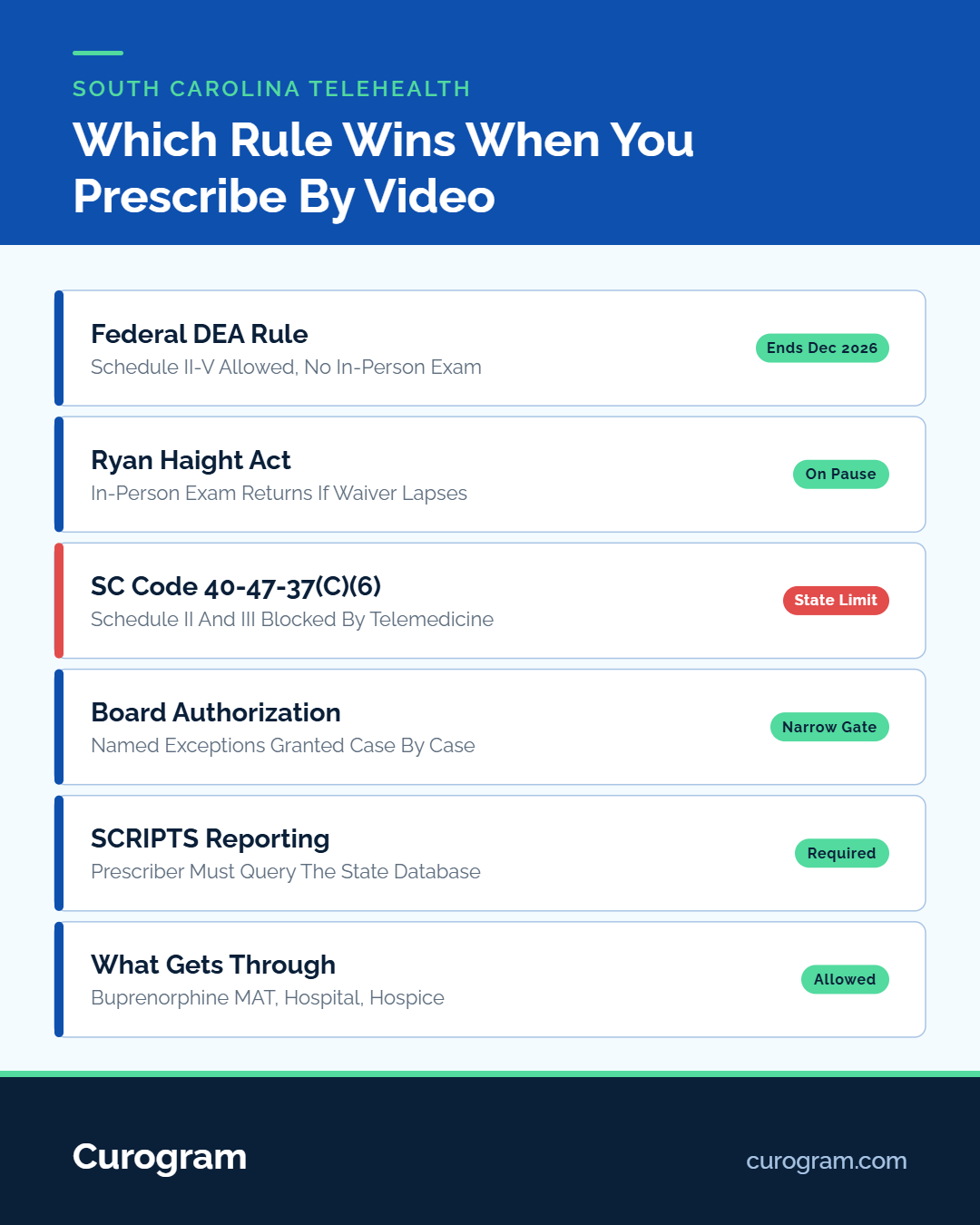
Infographic showing what tule you need to follow when prescribing by video

What You Can Prescribe by Telemedicine

Prescribing is where state and federal rules diverge. Getting a telemedicine license South Carolina recognizes does not settle what you may write.

South Carolina's limits on controlled substances

Section 40-47-37(C)(6) blocks Schedule II and Schedule III prescriptions by telemedicine unless the Board of Medical Examiners has specifically authorized them.

Act 120 opened narrow lanes, including buprenorphine for opioid use disorder where a physician-patient relationship exists and the patient is enrolled in medication-assisted treatment, patients receiving hospital care, and palliative or hospice patients.

Three more limits apply. Prescribers must participate in the SC Prescription Monitoring Program. Abortion-inducing drugs cannot be prescribed by telemedicine. And you cannot establish a relationship by telemedicine to prescribe when an in-person physical exam is necessary for the diagnosis.

The federal clock running underneath

DEA and HHS extended pandemic-era telemedicine prescribing flexibilities a fourth time, through December 31, 2026. That temporary rule lets DEA-registered prescribers write Schedule II through V without a prior in-person evaluation.

South Carolina's restriction sits on top of the federal allowance, and the stricter rule governs your telehealth prescribing rules in practice. Treat the state limit as the one that decides what leaves your e-prescribe queue. Permanent DEA rules are expected before the extension lapses, so build the compliance check into your workflow rather than the calendar.

What Actually Gets Paid

Coverage splits along a clean line in South Carolina. Medicaid publishes detailed rules; commercial plans write their own.

SC Medicaid telehealth reimbursement

South Carolina Medicaid pays for live video visits when the beneficiary takes part, the connection is encrypted, and staff are trained on the equipment. Claims carry the GT modifier, placed after any other required modifier. Audio-only visits are covered for established patients through CPT codes 98012 to 98015, which replaced 99441 to 99443. Those audio-only codes do not need GT.

A patient's home is an approved referring site, and that flexibility was made permanent for evaluation and management encounters with both audio and video. Store-and-forward gets paid only for interprofessional consultations. Behavioral health telehealth, MAT management, and well-child visits for children 2 and older are permanent benefits now.

Commercial plans and the parity gap

No private payer telehealth statute exists in South Carolina. No coverage parity, no payment parity. Each carrier writes its own policy, so the same video visit may be paid at full rate by one plan and reduced by the next.

Coverage question

SC Medicaid

Commercial plans

Published telehealth rules

Yes, in provider manuals

Per carrier policy

Payment parity required by law

No

No

Audio-only paid

Established patients only

Varies

Home as referring site

Yes

Varies


Pull the telehealth policy for each of your top three contracts before you scale virtual slots.


Building the Workflow Around the Visit

The video call runs 20 minutes. Everything deciding whether it happens sits before and after it.

What to shortlist in a telehealth platform

  1. Curogram. Two-way texting, secure forms, and video visits run from one HIPAA-compliant platform that is SOC 2 Type II certified. It connects with eClinicalWorks, athenahealth, NextGen, Practice Fusion, DrChrono, and most other systems, so notes land where your billers already work.
  2. Browser-based video with no app download, since a 78-year-old in Barnwell will not install anything to make a 9:15 appointment.
  3. Intake forms that return to the chart as PDFs, so nobody retypes a medication list.
  4. Reminder automation that tracks confirmations, giving your front desk a list of who has not replied.
  5. An audit trail covering consent, patient location, and identity verification, which state law requires you to document.

The front-desk work the visit does not do

Virtual visits fall apart for ordinary reasons. The link goes to an old cell number. Consent never comes back. Nobody calls when the 9:15 does not join, because the receptionist is rescheduling three patients and the phone will not stop.

Automation closes those gaps. Atlas Medical Center cut no-show rates from 14.20% to 4.91% in three months using automated reminders and two-way texting, based on our internal data. Covina Arthritic Clinic confirms more than 1,100 appointments a month through the same setup. Virtual slots refill faster than in-person ones, since no patient has to plan a drive.

Practices in neighboring markets face different math. Our breakdowns of telemedicine in North Carolina and telemedicine in Georgia cover those rules, and the telemedicine reimbursement by state guide compares coverage across the map.

Where To Start

Three checks decide whether virtual care pays for itself in South Carolina. Confirm every treating clinician holds a current SC license, whatever state they sit in. Verify the GT modifier lands after any other required modifier on Medicaid claims. Pull the telehealth policy for your top commercial contracts, since no parity law backs you up.

Then watch one date. The DEA extension ends December 31, 2026, and South Carolina's Schedule II and Schedule III restriction stays in place regardless of what replaces it.

See it on your own schedule. Book a demo and we will walk through your EHR, your payer mix, and where the drop-offs are.


Frequently Asked Questions

How do I know whether my South Carolina license covers telemedicine?

South Carolina does not issue a separate telemedicine license. A current, unrestricted license from the applicable board covers virtual care within your scope. You do not need to live in the state or keep an office here. Prescribers of controlled substances also need a registration with South Carolina's Bureau of Drug Control.

Why does South Carolina still have no telehealth payment parity law?

The 2024 Modernization Act addressed practice standards, definitions, and prescribing, leaving insurance mandates out. Bills adding private payer requirements have been introduced without passing. Carriers therefore set their own telehealth coverage and rates. Practices should verify each contract rather than assume parity.

How should our billers code a telehealth claim for SC Medicaid?

Live video visits use the appropriate CPT code plus the GT modifier, listed after any other required modifier. Audio-only visits with established patients use CPT 98012 through 98015 and do not need GT. Originating sites bill the telehealth facility fee separately. Documentation must show the referring and consulting site locations plus start and stop times.

Why can we prescribe Schedule II drugs by video under federal rules but not state ones?

DEA's temporary rule waives the federal in-person exam requirement through December 31, 2026. South Carolina imposes its own restriction under 40-47-37(C)(6), which the federal waiver does not lift. When two rules conflict, the stricter one applies to your prescribing. Board authorization is the path to those exceptions.

How should we handle a patient who has traveled out of state on the day of a video visit?

Verify the patient's physical location at the start of every encounter, which state law already requires. Care is deemed to occur where the patient sits, so a patient in Charlotte pulls the visit under North Carolina jurisdiction. If nobody on your team holds that license, reschedule or convert to a phone check-in that does not constitute a billable visit. Record the location in the chart either way.

Telemedicine Virginia: A Comprehensive Guide

1 min read

Telemedicine Virginia: A Comprehensive Guide

💡 Telemedicine is legal and widely covered in Virginia, but three rules decide whether a visit is valid and paid.First, licensing follows the...

Read More
Telemedicine in Washington State: All You Need to Know | Blog

1 min read

Telemedicine in Washington State: All You Need to Know | Blog

As of 2017, Washington state started to focus more on the development of telemedicine services. The turning point was the update of the state's...

Read More
Telemedicine in Idaho: Rules, Regulations, and Benefits | Blog

1 min read

Telemedicine in Idaho: Rules, Regulations, and Benefits | Blog

Idaho, aka the Gem State, is hardly the leader in regulating telemedicine. This does not mean that you won't be able to provide telemedicine or...

Read More