1 min read
Expanding Rural Behavioral Health Access with Texting and Telehealth
💡 Rural behavioral health access is a growing crisis in the United States. According to HRSA, 122 million Americans live in a mental health...

6 min read
Joshua Inciso
:
Updated on October 12, 2026
A therapist in a small town has a waitlist running past four months. Two counties over, another has open Thursday slots.
Neither can help the other. Licensing, scheduling, and the drive between them all get in the way. That mismatch is the problem telehealth mental health care was supposed to solve, and in part it has.
Our position is that the access gap is now mostly an operations gap. The rules moved, the coverage held, and the remaining barrier is whether a patient can join the session.
What follows: the history, the kinds of service, the real gains, the options, and what Medicare pays for in 2026.
Doctors have treated the mind at a distance for longer than almost any other field.
In the late 1950s, the Nebraska Psychiatric Institute ran a closed-circuit TV link to a state hospital. It carried group therapy and case reviews. For decades after, the limit was hardware. A session needed a room, a camera, and a dedicated line at both ends.
Smartphones removed the room. What replaced the hardware barrier was a software one, and that is the barrier practices still fight.
Three kinds of service cover almost all of what a practice can do at a distance.
A live session by video or phone. This is the bulk of telemental health, and it maps directly onto a standard therapy hour.
One operational rule matters more here than in other specialties. Confirm the patient's physical location at the start of every session.
A remote session needs a local crisis plan, and you cannot build one without knowing the address. The 988 Suicide and Crisis Lifeline is the national number to have on hand.
Information sent now and reviewed later. Intake forms, symptom scales such as the PHQ-9, and medication histories all travel this way.
It saves the first ten minutes of a session. A clinician who reads the scale beforehand starts the hour with a question rather than a form.
Structured check-ins between appointments. A short weekly scale, logged and trended, shows a clinician what happened across four weeks rather than on one afternoon.
Keep the questions short enough that people answer them. A scale nobody completes produces a flat line that means nothing.
What Are The Benefits Of Telemedicine For Mental Health?Behavioral health gains more from going remote than most specialties, for a plain reason. Almost nothing in a session requires touch.
A psychiatrist does not need a room to adjust a dose. A therapist does not need one to run a session.
The visit transfers almost completely, which is not true of dermatology or orthopedics. That is why behavioral health kept the highest virtual share after 2021.
Scale drives the need. NIMH counts 59.3 million US adults with any mental illness, or 23.1%. Just over half, 50.6%, got treatment that year.
The shortage is measured, and the number is larger than most people assume.
At the end of 2025, 137,133,953 people lived in a designated mental health shortage area.
Removing those designations would take about 6,800 more psychiatrists. Across the country, 27.29% of the identified need is currently met. Telehealth does not create clinicians. It widens the radius each one can cover, which is the only lever available in the short run.
Privacy is a practical problem before it is an emotional one.
In a town of 4,000, the waiting room is visible from the street. The receptionist went to school with your sister. A video session removes that calculation. The patient is in a parked car or a spare room, and nobody is counting cars in the lot.
Keep the message wording neutral for the same reason. A reminder that names a diagnosis on a lock screen undoes the privacy the visit provided.
Access improves when the visit is easier to reach. It does not improve automatically, and rural behavioral health is where that shows.
A 2023 study in JAMA Network Open looked at about 9,700 rural appointments in Louisiana. Telehealth no-shows ran 17%. In-person visits ran 13%.
Researchers pointed to connection trouble and the difficulty of building rapport over video. Plan for a higher miss rate on virtual behavioral health visits, not a lower one.
Most of that gap is mechanical. Rural clinics using text-based video visits in Azalea Health skip the portal. The link arrives by text.
Broadband still matters. Offer a phone option by default, because an audio session that happens beats a video session that does not.
Four delivery models cover the field. Most practices end up running two of them.
Emergency rooms call in a remote psychiatrist when none is on site. The clinician assesses and advises, and the patient stays put.
Same-day or walk-in video sessions, often run by a rotating pool. Good for cover, weak for continuity. The patient rarely sees the same clinician twice.
Most people raise a mental health concern with their family doctor first. Collaborative care puts a behavioral specialist behind that visit without a second referral.
Clinics improving patient access with telehealth in AdvancedMD add virtual slots at lunch and in the evening. A patient who cannot take a morning off can still be seen.
Between-session tracking tied to a care plan. It works when somebody owns the alerts. It fails when results land in a queue nobody reads.
This page used to say no federal law requires coverage. For Medicare, that has not been true for years, and 2026 changed the details again.
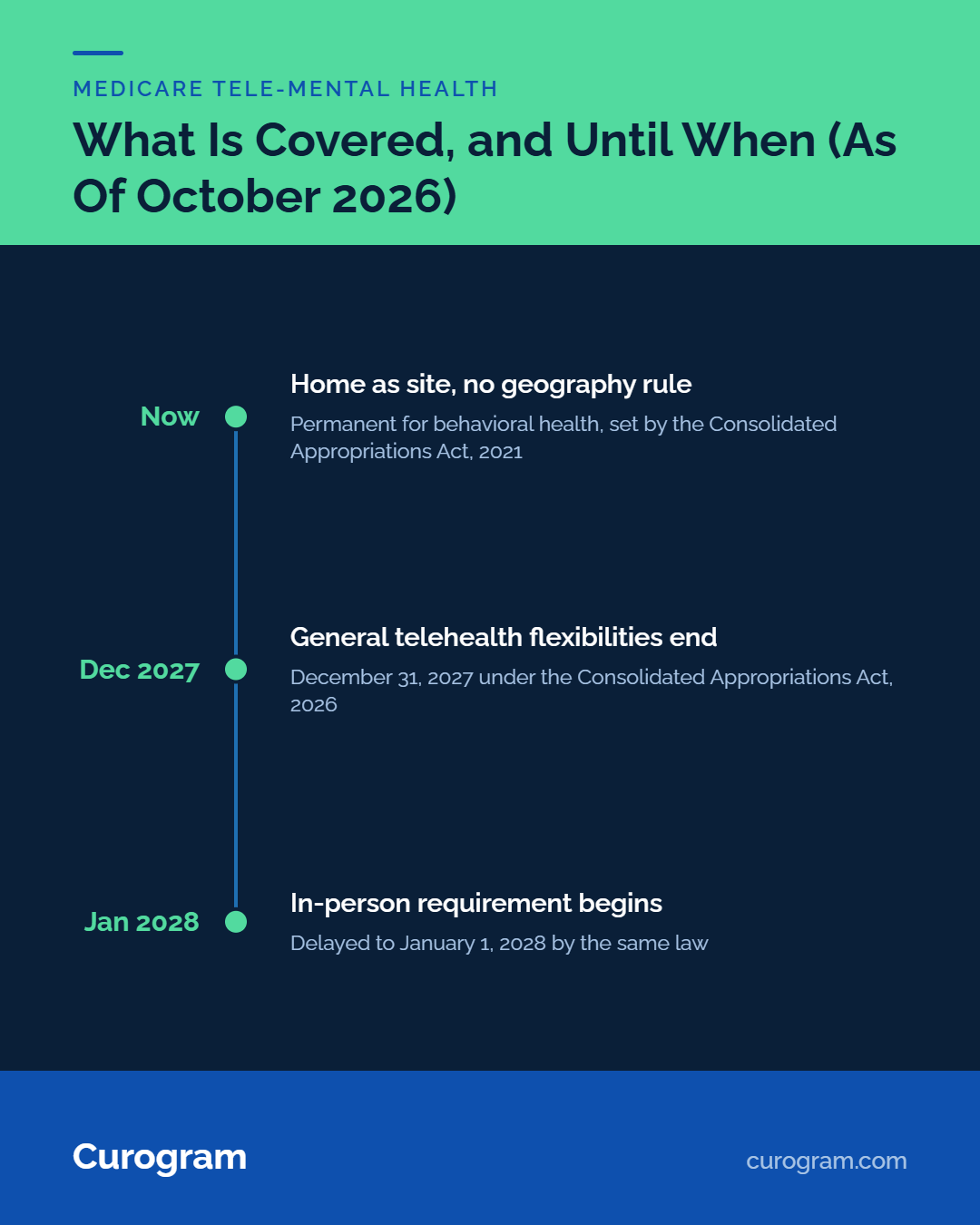
Behavioral telehealth has a permanent carve-out from the geographic rules, set by the Consolidated Appropriations Act, 2021. Patients can be seen at home, anywhere in the country.
That carve-out is specific to mental health. General telehealth flexibilities sit on a deadline, and behavioral health does not.
Medicare had planned to ask for an in-person visit alongside remote care. A new law signed on February 3, 2026 put that off until January 1, 2028. The law is the Consolidated Appropriations Act, 2026.
The same law runs the wider Medicare telehealth rules through December 31, 2027. Phone-only visits are still paid for where they fit the need.
Commercial and Medicaid coverage still varies by state. Check your three largest payers directly rather than assuming parity.
A behavioral health visit is worth more than most. Losing one to a password reset is an expensive way to find out your platform is wrong.
|
Curogram's Virtual Visits open from a text link in the phone browser. No download, no account, no password to reset at the start of a therapy hour. Practices running browser-based telemedicine in CharmHealth generate the link straight from the appointment. Staff do not paste URLs, and the right patient gets the right session. Two-way texting runs in the same thread for rescheduling and check-ins. Curogram's telehealth software connects with 70+ EMR and practice management systems. Curogram is HIPAA compliant and SOC 2 Type II certified. |
The policy fight is mostly over. Medicare pays for these visits at home for good, and the in-person rule waits until 2028.
The shortage argument is not settled at all. With 137 million people in a shortage area, the radius each clinician covers still decides who gets seen.
What practices control is narrower than either. It is whether a patient in a parked car can join a session in one tap.
Rural behavioral health misses more virtual visits than in-person ones. Treat the join as a clinical step, not an IT detail. Confirm the location, text the link, keep a phone fallback.
Do that and the waitlist in one town stops being someone else's open Thursday.
See what a behavioral health visit looks like when the patient taps one link and nothing else. Book a Curogram demo.
1 min read
💡 Rural behavioral health access is a growing crisis in the United States. According to HRSA, 122 million Americans live in a mental health...
1 min read
💡 Telemedicine in Maryland runs on three sets of rules: state insurance law, Medicaid policy, and licensing board rules. The Preserve Telehealth...
1 min read
💡 Telemedicine in Arkansas is legal, and payers cover it. The state Telemedicine Act sets the rules. You need an active Arkansas license. You also...