Telehealth for Osmind: Extending Care Beyond the Infusion Suite
💡 Telehealth for Osmind lets clinics extend care beyond in-person treatments. Patients get Ketamine, Spravato, or TMS at the clinic. But follow-up...
10 min read
Aubreigh Lee Daculug
:
March 4, 2026
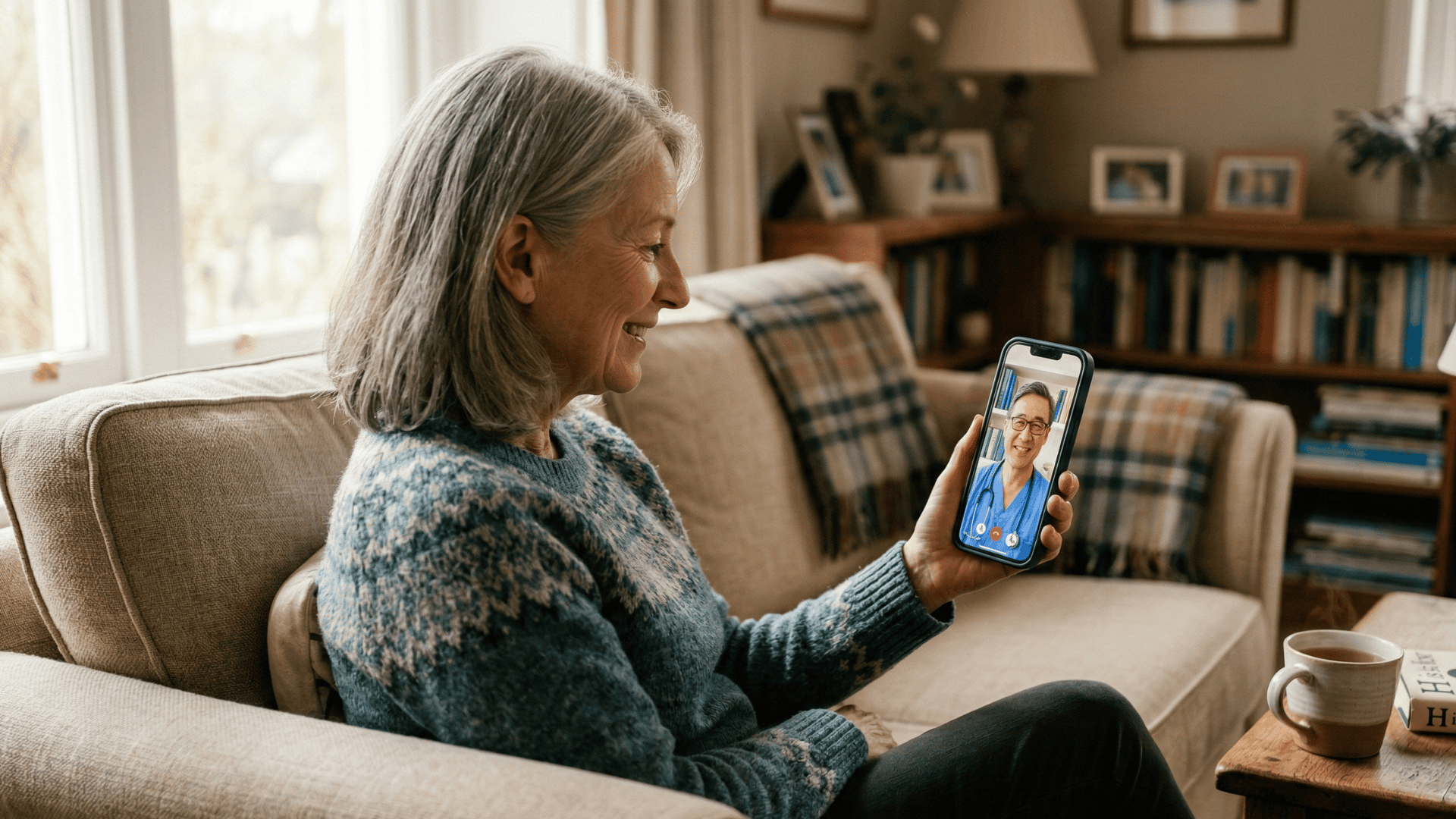
Your 2:00 p.m. patient is a 68-year-old woman with chronic fatigue. She finally booked a telehealth appointment after weeks of putting it off.
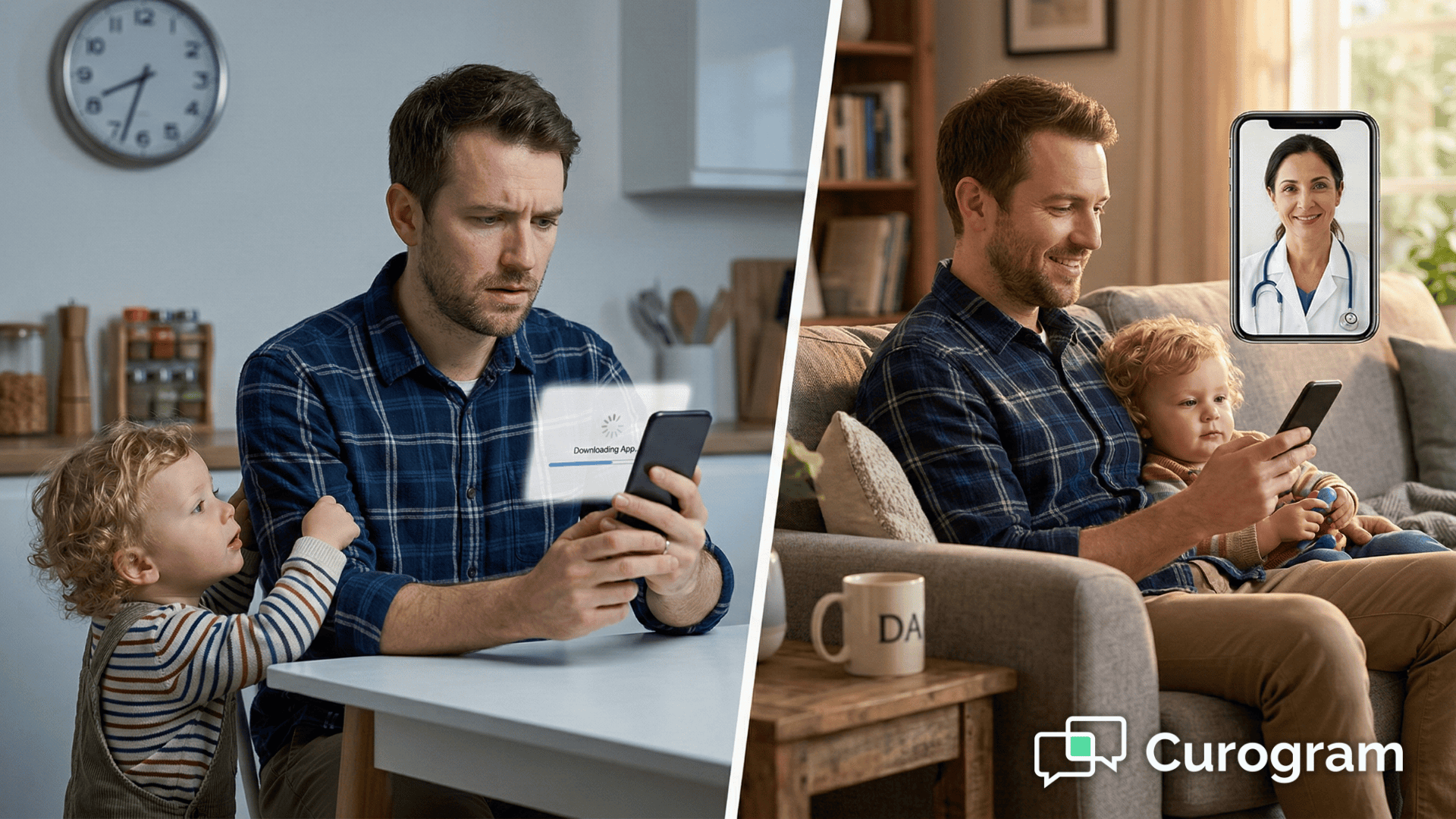
But instead of talking about her symptoms, you spend the first 12 minutes walking her through a portal login she forgot, a browser she can't find, and a microphone that won't turn on.
Sound familiar? You're not alone.
Across the country, providers are losing valuable clinical time to technology problems that should never reach the exam room.
For practices running on CharmHealth, this frustration is especially common when the native portal tools aren't simple enough for every patient.
The truth is, most patients don't struggle with technology because they're not smart. They struggle because the process asks too much of them. Download this app. Create that account. Verify your email. Reset your password.
By the time they actually see your face on screen, the visit is half over and their patience is completely gone.
That's where browser-based telemedicine for CharmHealth practices changes the game. Instead of layering more software on top of your workflow, Curogram strips the process down to its simplest form. The patient gets a text message.
They tap a link. The video call opens. That's it.
This isn't a workaround or a band-aid. It's a purpose-built approach to reduce telehealth troubleshooting and reclaim the time you trained years to use.
When virtual visits are this easy to start, patients show up more often, appointments run on schedule, and providers actually enjoy doing telehealth.
In this guide, we'll break down why the "download barrier" is costing your practice real money, how the right technology should feel invisible to your patients, and what it looks like when every visit starts on time.
Let's get into it.
Every CharmHealth practice that offers virtual care has experienced the same cycle. The appointment is set. The patient is supposed to join at a specific time.
But the minutes tick by while your staff walks them through a login screen, a software download, or a microphone permission they didn't know existed.
We call this "The 10-Minute Tax." It's the hidden cost that comes with every virtual visit that relies on apps or patient portals.
And it hits your bottom line harder than most practices realize.
The worst part is that none of this is your patient's fault. They showed up. They wanted to be there. The technology just made it harder than it needed to be. That's not a patient problem — it's a platform problem.
If you've done more than a handful of virtual visits, you already know the script. The call is supposed to start, but instead
You find yourself repeating some version of these lines:
Each one of those lines eats 2 to 3 minutes. Stack a few together and the visit is already running behind before any clinical conversation begins. For providers who see 8 to 10 virtual patients a day, that adds up fast.
And these aren't rare edge cases. For many practices, this is the norm.
The troubleshooting ritual has become so routine that some providers have started padding their schedules with an extra 15 minutes per slot just to account for it.
That's not a solution. That's a tax on your time.
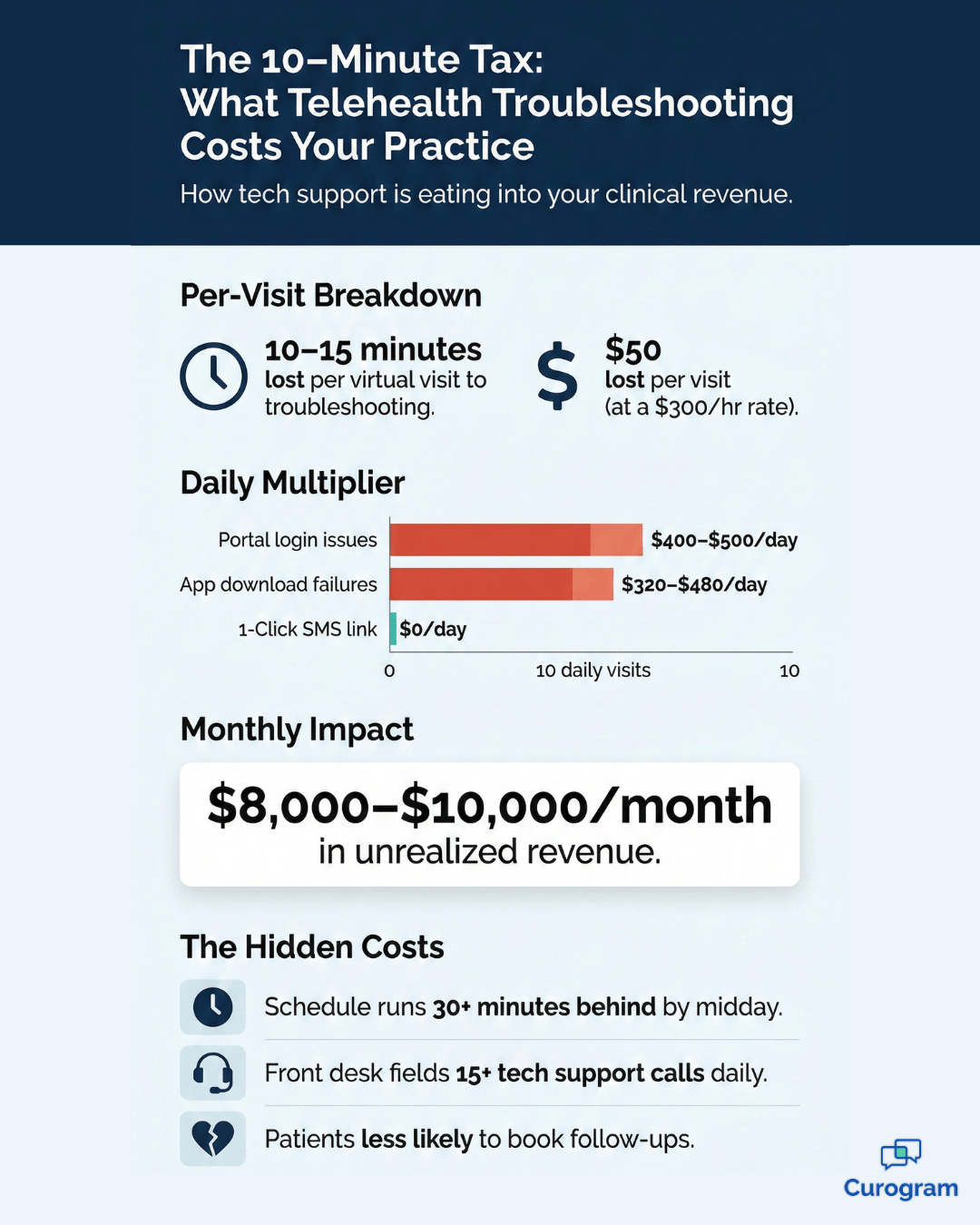
Let's put some numbers on it. If an integrative medicine provider charges $300 per hour, those 10 lost minutes represent $50 in value that vanishes before the visit even starts.
Now multiply that across a full day of telehealth appointments.
| Scenario | Time Lost Per Visit | Daily Cost (10 Visits) |
|---|---|---|
| Portal login issues | 10–15 min | $400–$500 |
| App download failures | 8–12 min | $320–$480 |
| Curogram 1-click link | 0 min | $0 |
Table: Estimated daily revenue impact of telehealth troubleshooting based on a $300/hour rate.
Over the course of a month
That daily loss can easily reach $8,000 to $10,000 in unrealized value.
That's money that never shows up in your revenue reports because the time simply evaporated into tech support.
But the cost isn't just financial. When a visit starts with technical frustration, the entire tone of the appointment shifts. Patients feel embarrassed. Providers feel rushed.
And the deeper clinical conversation that should happen during a virtual visit gets squeezed into whatever minutes are left.
For practices focused on holistic or functional medicine, this is especially damaging. These visits depend on building trust and creating a calm environment.
A patient who spent 10 minutes fighting with software is not in the right headspace for a meaningful health conversation.
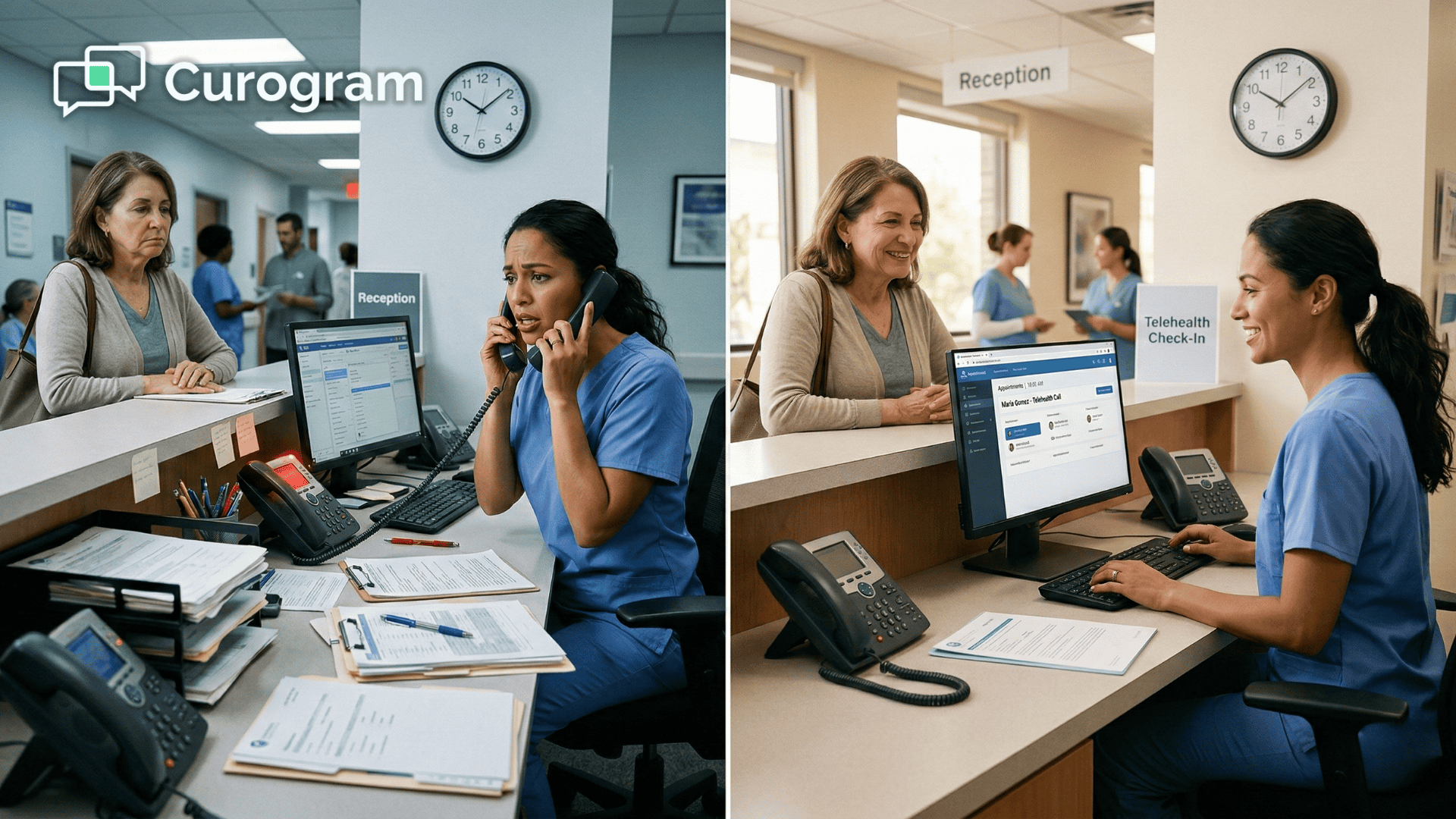
The burden doesn't just fall on providers. Your front-desk staff becomes an unofficial IT help desk every time a patient calls in because they can't connect.
Instead of scheduling appointments, handling insurance questions, or greeting patients who walk through the door, they're reading troubleshooting scripts over the phone.
Based on our internal research,
Practices that rely on automated communication tools see their no-show rates drop by as much as 53% compared to the industry average.
When the connection step is simple, fewer patients give up before the visit even begins.
There's also a morale cost that's easy to overlook. Front-desk staff didn't sign up to be tech support agents. When every shift includes a wave of frustrated patient calls about portal issues, burnout creeps in fast. Turnover goes up, hiring costs go up, and the cycle repeats.
The result of sticking with complicated login systems is a practice that runs behind schedule, staff that's stretched thin, and patients who are less likely to book follow-up appointments.
It's a lose-lose-lose scenario that no provider should have to accept.
Here's a simple truth about healthcare technology:
The best tools are the ones the patient never thinks about. If your telemedicine platform forces patients to learn new software or remember another password, it's already getting in the way.
Curogram was built on this idea. The entire CharmHealth integration virtual visit works behind the scenes so that neither your patients nor your staff ever need to wrestle with complicated setups.
There's no training required on the patient side. There's no IT department to call.
The experience is designed to feel like something the patient already knows how to do.
That might sound like a small thing, but it changes everything about how a virtual visit feels. When there's no friction at the door, the conversation that follows is better. Calmer. More productive.

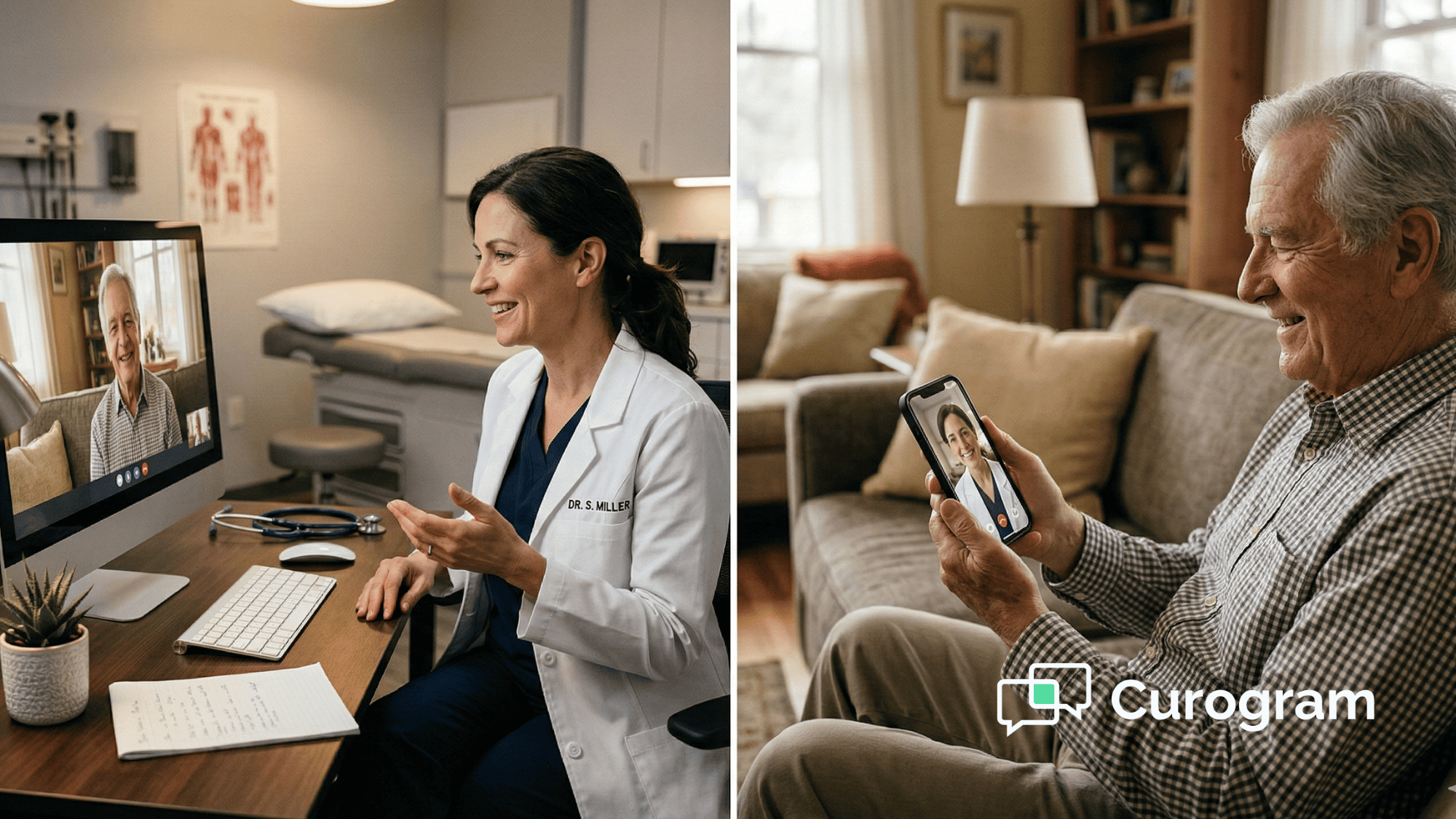
The process is almost too simple to explain, and that's the point. When it's time for a patient's appointment, Curogram sends a text message to their phone.
The message says something like,
"Dr. Smith is ready for you. Tap here to join your visit." The patient taps the link, and the video call opens directly in their phone's browser.
No downloads. No logins. No "Can you hear me?" No "Try refreshing your page."
This is what 1-click video visits actually look like in practice. The patient goes from a text notification to a face-to-face visit in under 10 seconds.
And it doesn't matter what device they're using.
Whether they have an iPhone, an Android phone, a tablet, or a desktop computer, the link opens in whatever browser they already have. Safari, Chrome, Firefox, Edge — it all works. That's the power of a true no-app telemedicine solution.
There's also nothing for your team to configure on a per-patient basis. The video link is generated automatically based on the appointment schedule. Your staff doesn't need to copy-paste URLs or manually send reminders.
The system handles it, and the patient shows up.
The impact on daily workflow goes beyond just saving a few minutes per visit.
When every patient connects smoothly, your schedule becomes predictable again. The 2:00 p.m. visit starts at 2:00 p.m. The 2:30 visit starts at 2:30. Your day flows the way it was designed to.
For office managers and front-desk teams, this shift is massive.
Instead of fielding calls from confused patients, they can focus on tasks that actually move the practice forward. Scheduling. Billing. Patient follow-up. The kind of work that generates revenue instead of draining it.
It also means fewer no-shows. When patients know the visit is easy to join, they're less likely to cancel out of anxiety about the process.
They don't need to set aside extra time to figure out the technology. They just open a text and tap a link.
If you run a functional medicine, naturopathic, or integrative practice, you know that your visits are different from a typical 15-minute checkup.
Your patients come to you for deep listening, careful history-taking, and a real human connection. When a patient spends the first chunk of the visit frustrated by software, that therapeutic bond takes a hit before it even starts.
Curogram protects that bond. HIPAA compliant video for holistic medicine means you get both the ease of a simple text link and the security that healthcare requires.
The encryption is there. The compliance is built in. But your patient never has to think about it.
This is what makes the "invisible technology" approach so powerful for practices that prioritize the patient relationship:
When the technology disappears, the medicine takes center stage. And for providers who built their practice around whole-person care, that's exactly the way it should be.
Think of it this way. Your patients chose you because they wanted a different kind of healthcare experience.
If the virtual visit process feels the same as every other impersonal, portal-heavy system they've dealt with before, you're undermining the very thing that sets your practice apart.

The single biggest thing that changes when you remove the download barrier?
Reliability. When there's no software to install and no portal to log into, 99% of the common failure points simply vanish. Your patients connect. Every time.
That kind of consistency doesn't just feel good. It transforms the way a practice operates from the first appointment in the morning to the last one at night.
Reliability is the foundation that everything else is built on.
Think about what "zero app downloads" actually means for your daily workflow.
It means Mrs. Johnson, who's 72 and only uses her phone for calls and texts, can start a video visit without calling your office for help. It means the busy mom juggling three kids can tap a link during naptime and be in her appointment within seconds.
It means your front desk doesn't field 15 calls a day from patients who can't find the app, forgot their password, or accidentally deleted the portal software.
That time gets returned to the work that actually matters — helping patients, managing the schedule, and keeping the practice running smoothly.
There's a softer benefit here too, one that doesn't show up in a spreadsheet.
Patients who can connect without stress feel respected. They feel like their time matters. And that feeling of respect builds loyalty in a way that no marketing campaign ever could.
For older patients and those who aren't comfortable with technology, this is often the difference between keeping them engaged in care and losing them entirely.
A complicated process doesn't just delay a visit. It can end the patient relationship altogether.
One concern we hear from providers is:
"If it's that easy, is it really secure?" The answer is absolutely yes.
Every Curogram video connection is fully encrypted and HIPAA compliant. Unlike a casual FaceTime call or a standard Zoom link, this platform was designed from the ground up for healthcare.
That distinction matters, especially as telehealth regulations continue to tighten. You get the convenience of a simple text link with the legal protection of a purpose-built healthcare platform.
Your patients don't need to know about the encryption running behind the scenes. They just need to know they can trust the connection.
Security and simplicity are often treated as opposites in healthcare tech. The assumption is that if something is easy to use, it must be cutting corners somewhere. Curogram rejects that assumption entirely.
The platform handles the complexity so the patient doesn't have to.
This is also important from a compliance standpoint.
If your practice is ever audited for telehealth practices, you want a platform with a clear HIPAA compliance framework, not a patchwork of consumer tools that were never built for protected health information.
When every visit starts on time, the benefits don't just show up in one place. They compound throughout the day and across the week.
Based on our internal data, practices that adopt streamlined communication tools report a 10–20% increase in revenue because they recover appointments that would have otherwise been lost.
Here's what that ripple effect looks like in practice:
You finish on schedule instead of running 30 minutes behind by noon. You can see more patients without extending your hours. Your team feels less stressed and your patients feel more valued.
Fewer no-shows, fewer cancellations, and fewer patients who simply give up before connecting — that's the kind of momentum that changes how a practice operates day to day.
It's not about doing more. It's about losing less.
And perhaps the most overlooked benefit of all:
When the technology works seamlessly, your providers actually look forward to telehealth days.
That shift in attitude matters more than any metric, because a provider who enjoys the work delivers better care.
Does this work on both Android and iPhone?
Yes. Curogram's video visits work on any device with a web browser.
That includes iPhones, Android phones, iPads, tablets, laptops, and desktop computers. Whether your patient uses Safari, Chrome, or another browser, the link opens and the video call begins. No special hardware or software is needed.
Can multiple people join the same video call?
Absolutely. This is especially helpful for pediatric practices or family medicine situations.
For example, if one parent is at work and the other is at home with the child, you can send the video link to both of them. Each person taps the link on their own device and joins the same call.
It's also useful for visits where a caregiver or translator needs to be present.
Can I share my screen during a visit?
Yes. You can share your screen to walk a patient through lab results, imaging, or even CharmHealth charts.
Screen sharing turns the video call into a visual consultation, which is especially helpful when explaining treatment plans or reviewing complex data. The patient sees exactly what you see, in real time.
You didn't go to medical school to troubleshoot webcams. You didn't spend years studying human health so you could walk patients through app downloads.
And yet, for too many CharmHealth practices, that's exactly how virtual visits begin.
Here's the thing — complexity is the enemy of follow-through. When a virtual visit is hard to start, patients are less likely to book a follow-up. When the process is confusing, they'll put off that check-in they actually need.
Over time, the friction doesn't just cost you revenue. It costs your patients their health outcomes.
Browser-based telemedicine for CharmHealth practices solves this by removing every unnecessary step between the appointment reminder and the face-to-face conversation.
There are no downloads to manage, no passwords to reset, and no portals to navigate. Just a text, a tap, and a visit.
Curogram's approach is simple because it was designed by people who understand that every extra click is a chance for your patient to give up.
This platform respects your time as a provider and your patient's patience as a human being. It's the kind of tool that should have existed from the start.
The practices that thrive with telehealth aren't the ones with the most features. They're the ones that make the connection step invisible. That's what this is about. Let your patients focus on their health.
Let your staff focus on the schedule. And let yourself focus on the medicine.
Ready to see it in action? Schedule a demo with Curogram today and send a test video link to your own phone. See how fast you connect, and imagine what that would mean for every patient on your schedule tomorrow.
💡 Telehealth for Osmind lets clinics extend care beyond in-person treatments. Patients get Ketamine, Spravato, or TMS at the clinic. But follow-up...
💡 Integrated telehealth for Prime Clinical Systems lets practices run virtual visits without leaving their existing schedule. Curogram syncs with...
💡 Telehealth integration for eKyros centers transforms how pregnancy resource centers serve women in crisis. By connecting HIPAA compliant video...