9 min read

Easy Telemedicine for Azalea Health | One Tap to See Your Doctor

Easy Telemedicine for Azalea Health | One Tap to See Your Doctor
💡 Easy telemedicine for Azalea Health rural patients works through text-based video visits that require no app, no account, and no download.           

Curogram sends patients a simple link by text. They tap it, and the visit opens right in their phone's browser.

This approach removes the technology hurdle that stops rural and elderly patients from using most telehealth platforms. It works on older phones, adjusts to slow connections, and falls back to audio if video drops — so the visit always happens. 

Practices that use Curogram's browser-based telemedicine report no-show rates up to 53% lower than the industry average, based on our internal data. 

For FQHCs, RHCs, and Critical Access Hospitals, this is the HIPAA compliant video visit via text link that actually gets used.


Most telemedicine platforms were not built for rural patients. They were built for people with fast internet, current smartphones, and the patience to create an account, verify an email, and find the right button before their visit even starts.

For the patients that Azalea Health serves, that process is a wall, not a door.

Easy telemedicine for Azalea Health rural patients through text-based video visits tears down that wall. Curogram integrates directly with Azalea Health and sends patients a single text message with a video link.

No app to download. No portal login. No password to remember.

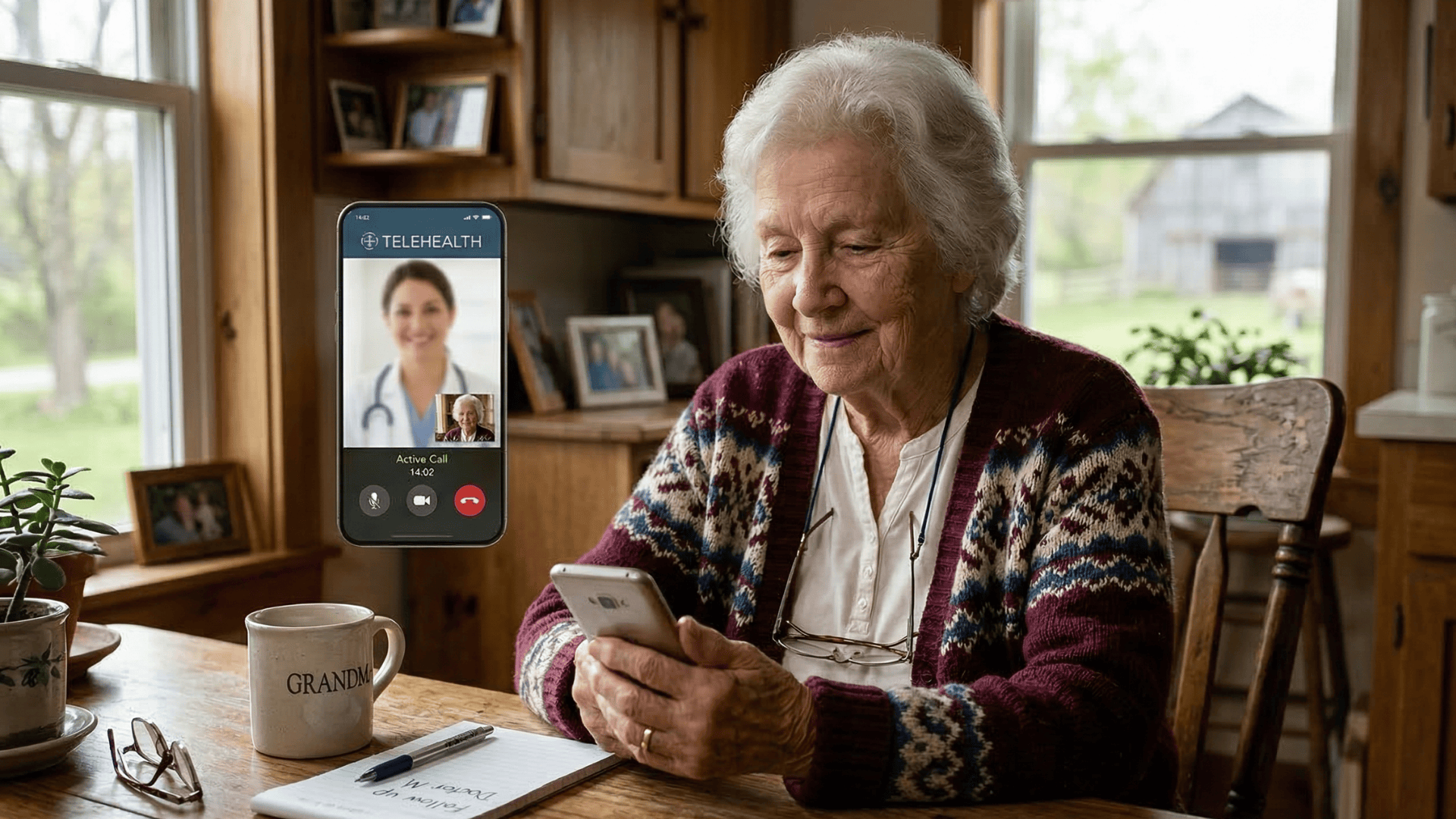
 patient taps the link, and the visit opens in their phone's browser — camera and microphone ready.

For Rural Health Clinics, Federally Qualified Health Centers, and Critical Access Hospitals, this matters more than it might seem. The patient population in these communities skews older. Broadband access is patchy. Smartphone literacy varies.

When a rural provider tells a 74-year-old patient to "download the telemedicine app," the visit is often lost before it starts.

Curogram meets patients at the skill level they already have. If they can read a text and tap a link, they can see their doctor.

That's the design principle behind everything this platform does — and it's why telehealth for elderly rural patients, without any app download required, finally works in practice and not just in theory.

Based on our internal data, Curogram users see no-show rates 53% lower than the industry average. Text message response rates exceed 40%, far outpacing the single-digit adoption rates common with portal-based telehealth invitations in rural communities.

This is not a minor upgrade. For practices that have watched visit after visit turn into a no-show or a cancellation because of a tech problem, it's a turning point.

Why Traditional Telehealth Keeps Failing Rural Patients

There is a fundamental mismatch between how most telemedicine platforms were designed and who actually needs them.

The platforms were built for urban and suburban patients — people with reliable Wi-Fi, active email accounts, and the confidence to navigate an app store. Azalea Health serves a very different population, and the gap shows up in every failed visit.

It is easy to overlook this mismatch when you are not seeing it firsthand.

But rural providers see it constantly — in the patients who never show up for their telemedicine visit, in the frustrated calls from family members trying to help a parent log in, and in the slow adoption rates that make virtual care feel more like an experiment than a solution.

A design built for the wrong patient

Most telehealth platforms assume patients arrive with a certain baseline:

A current smartphone, an email account they actively use, and enough comfort with technology to set up a new app.

In rural communities, that baseline is often missing.

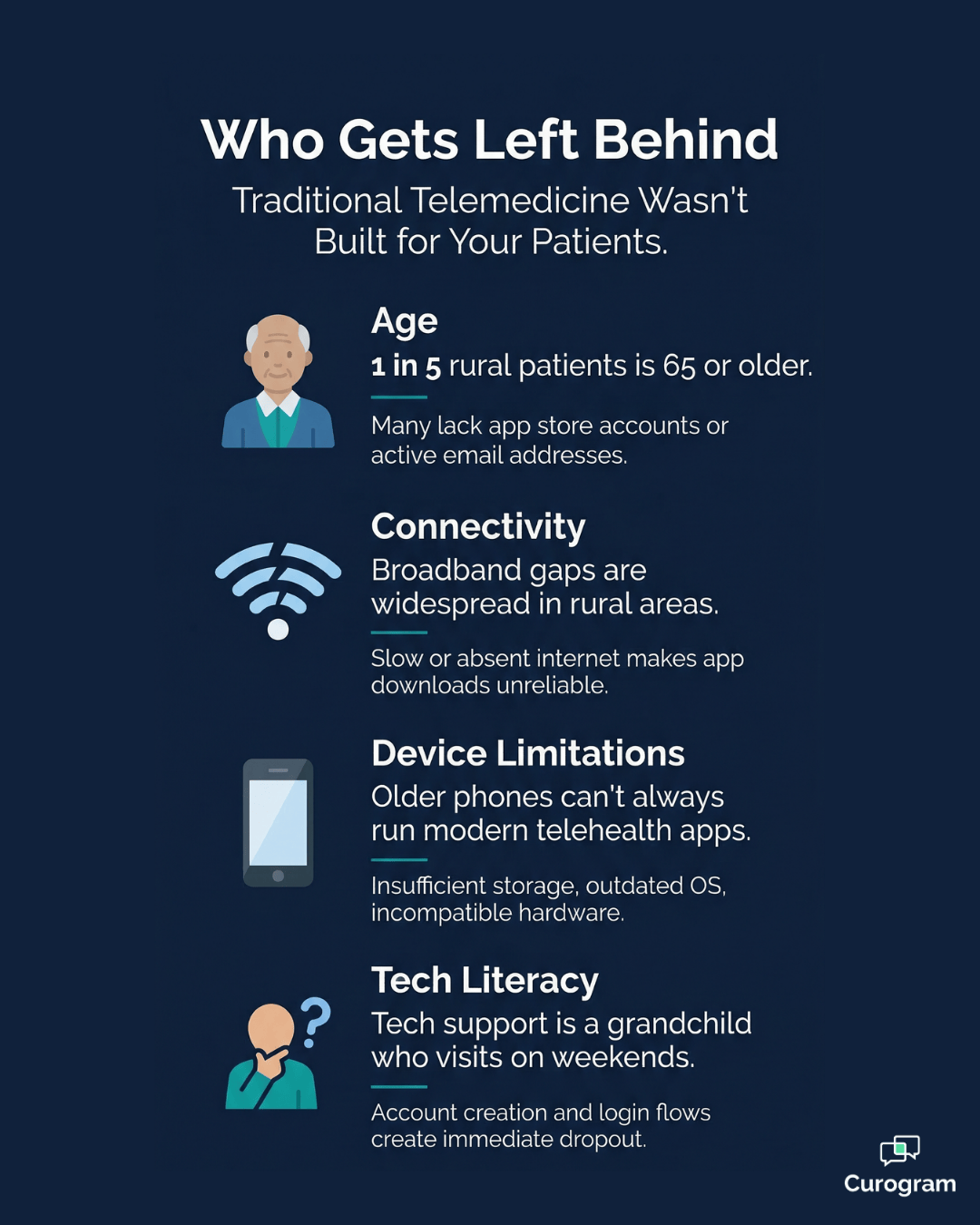
  • Broadband gaps make app downloads slow or impossible
  • Patients over 65 may not have active email accounts or App Store credentials
  • Older phones may lack the storage or OS version to run modern telehealth apps
  • Tech support is not a help desk — it's a grandchild who visits on weekends

Consider a 73-year-old COPD patient at a rural FQHC who needs a follow-up visit but can't drive due to a winter storm.

The front desk offers telemedicine and sends instructions:

Download the app, create an account, verify your email, set a password, log in, find "Visits," and click "Join."

He doesn't have an Apple ID. He can't find the App Store. His grandson helped set up the phone, and he's afraid to touch anything unfamiliar.

He calls back and cancels. Two weeks later, his COPD has flared because the medication adjustment that would have taken ten minutes by video never happened. This is not a story about a patient who didn't want care.

It's a story about a technology barrier that turned a routine follow-up into a health crisis.

The frustrating part is that the provider did everything right. They offered the visit. They sent instructions. They made the appointment available. The platform itself was the problem — and it's a problem that repeats across hundreds of practices serving communities just like this one.

The clinical cost adds up fast

Chronic disease management — diabetes, hypertension, COPD, behavioral health — depends on regular provider contact.

When a rural patient misses a visit because they couldn't navigate the telehealth platform, the gap in care can lead to medication issues, condition flare-ups, emergency visits, and hospitalizations. The cost of a missed 10-minute video visit is nothing compared to what follows.

These are not isolated incidents. They are a pattern. And over time, that pattern compounds.

A patient who misses three quarterly diabetes check-ins in a row is not just behind on visits — they may be heading toward a preventable hospitalization that could have been avoided with a simple medication adjustment six months earlier.

Rural providers already know this. They've watched the adoption numbers stay flat.

They've heard the frustrated calls. They've seen the appointments that could have been virtual become no-shows instead.

The technology to reach patients remotely exists — but the delivery method has never matched the population.

Infographic showing barriers rural elderly patients face with traditional telemedicine apps

How Curogram Makes Telemedicine as Simple as Answering a Text

Curogram's approach to HIPAA-compliant telemedicine texting for rural healthcare and Azalea Health practices is built around a single principle:

Remove every unnecessary step between the patient and the provider. The result is a platform stripped down to its absolute minimum. Send a text. Tap a link. Start a visit.

That simplicity is not accidental. It is the product of understanding exactly where and why traditional telehealth breaks down for rural populations — and building something that sidesteps every one of those failure points.

Built for the patients traditional telehealth leaves behind

The video interface is designed for patients who are not comfortable with technology. Buttons are large. Text is high-contrast. Navigation is minimal.

The visit link works on any phone with a browser and a camera — including older Android devices that can't run modern telehealth apps. There is nothing to install, nothing to configure, and nothing to remember from visit to visit.

Every visual and interaction choice was made with the least tech-confident patient in mind.

If a 78-year-old patient with limited smartphone experience can complete the visit without help, the platform has done its job.

That's the standard Curogram was built to meet.

Connection quality is handled automatically. If bandwidth is limited, the video adjusts to maintain the call. If video drops entirely, the platform falls back to audio using the phone's cellular connection.

This audio fallback is critical for rural areas where broadband is spotty or unavailable. The visit completes — even when the internet doesn't cooperate.

How it fits into Azalea Health

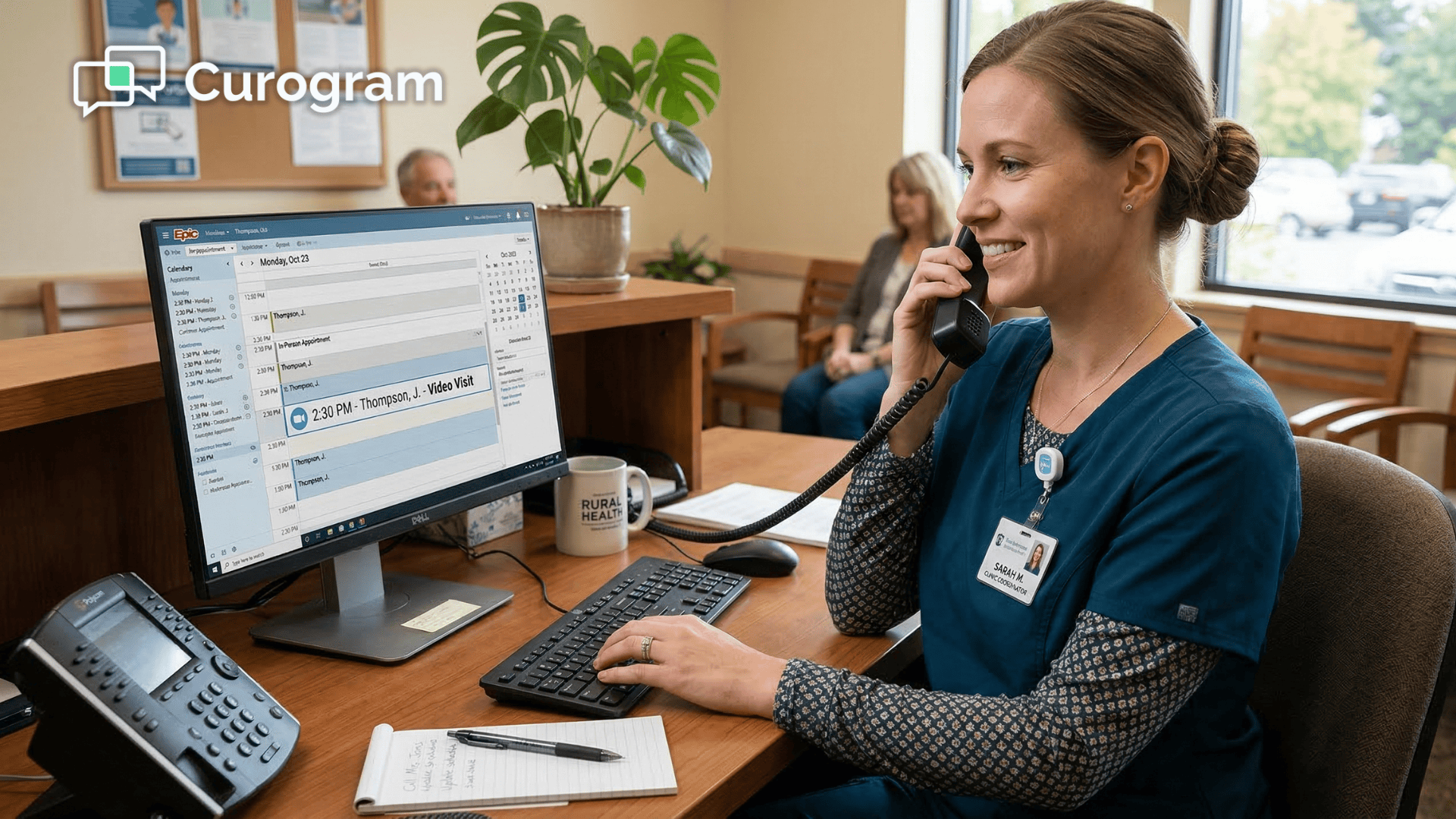
Integration with Azalea Health means no double workflow. Curogram syncs with the scheduling data already in Azalea Health, so telemedicine visits can be booked, tracked, and documented alongside in-person appointments.

The provider initiates the visit from the same scheduling workflow they already use. Visit records sync back to the patient's chart.

This is what a text message video visit for FQHC patients looks like in practice:

  • A staff member schedules the appointment in Azalea Health as normal
  • Curogram sends the patient a reminder text with the visit link
  • At appointment time, the patient taps the link — the browser opens, no login required
  • The visit is completed and documented, syncing back to the patient's chart

There is no separate platform, no separate login, and no learning curve for staff. The telemedicine workflow fits into what your team already does — it just adds a text message where the drive used to be.

For staff, this matters as much as it does for patients. Adoption stalls when clinical teams have to manage two systems, two logins, and two documentation flows. Curogram eliminates that friction entirely.

What your staff already knows how to do in Azalea Health is all they need to launch a telemedicine visit.

easy telemedicine Azalea Health rural patients text-based video visits - landscpae

Meeting patients where they already are

Rural patients already text their families, their churches, and their local businesses every day. They know how to tap a link in a text message. Curogram's telemedicine meets patients at that exact skill level — no higher.

If someone can read a text and tap a link, they can see their doctor — thanks to medical mass texting that turns simple SMS into powerful care‑delivery tools.

This is sometimes described as being "grandma-proof" — but that framing undersells it. It's not about dumbing something down. It's about designing for reality. The reality is that a significant share of rural patients will never successfully navigate a traditional telehealth app.

Building a system that accepts that reality, instead of fighting it, is how you actually move the needle on access.

For communities where the nearest specialist is two hours away and the family medicine provider is effectively the entire healthcare system, this accessibility is not a convenience feature. It's what makes the visit possible at all.

What Happens When the Tech Barrier Goes Away

The numbers tell a clear story. Based on our internal research, practices using Curogram see no-show rates 53% lower than the industry average — and text message-based telemedicine converts a significant share of what would have been cancellations into completed visits.

Patient response rates to text messages top 40%, which is dramatically higher than the single-digit adoption seen with portal-based telehealth invitations in elderly rural populations.

That gap matters. A telehealth platform with 5% adoption is essentially not a telehealth platform at all. It's a checkbox — something a practice can point to on paper without it actually changing how patients receive care.

A platform patients engage with at 40%+ is a tool that reshapes the schedule, reduces gaps in care, and keeps chronic conditions under control between office visits.

For Azalea Health practices, the shift is not just statistical. It's visible in the schedule. Appointments that used to evaporate in winter start completing. Patients who could never figure out the telehealth app now show up consistently — from their kitchen tables, their trucks, their living rooms.

Distance stops being a deciding factor in whether care actually happens.

A year in the life of Mrs. Redcloud

Think about what this means for a patient like Mrs. Redcloud, a 76-year-old woman with diabetes who lives 55 minutes from her provider and has no one to drive her in winter.

Before Curogram, she missed her December, January, and February appointments every year — three months of unmonitored blood sugar right through the holiday eating season. Her A1C climbed every spring.

After her clinic set up Curogram's text-based telemedicine, Mrs. Redcloud's office sends her a text at appointment time. She taps the link, sees her doctor on screen, reviews her glucose readings, and gets her insulin adjusted — all from her living room.

She's completed every quarterly visit since, including through two snowstorms. Her A1C dropped a full point in the first year. She told her provider:

"I thought you'd forgotten about me in the winter. Now I know you haven't."

Mrs. Redcloud's story is not unique. It plays out in different forms across every rural practice that has made the switch.

The names and conditions change, but the pattern is the same: a patient who was consistently falling through the cracks is now consistently showing up — because the barrier between them and their provider was removed.

The working rancher who can't take a half-day off joins his visit from his truck during lunch. The COPD patient who couldn't navigate the app gets her follow-up done on time. The diabetic patient who used to miss three visits a year is now consistent.

Care continuity improves most for the patients who need it most — and the practice schedule finally reflects the care it was always meant to deliver.

Stop Losing Visits to a Problem a Text Message Can Fix

Your patients are trying to get to you. Most of the time, what stops them is not a lack of motivation — it's a technology hurdle that was never designed for them.

App downloads, account creation, and password resets do not belong in the path between a rural patient and their provider. Curogram removes all of it.

Azalea Health handles your clinical documentation and scheduling. Curogram handles access — making sure your patients can reach you when the roads are closed, the truck won't start, or the drive is simply too far.

Healthcare everywhere! Launch a pervasive telehealth platform that's easy for both providers and patients with Curogram.

Together, they close the gap between the care your practice offers and the care your patients can actually receive.

Browser-based telemedicine for Critical Access Hospitals and rural clinics should not be a complicated project.

With Curogram, it is not. The setup connects to your existing Azalea Health workflow. Your staff sends a text. Your patient taps a link. The visit happens. The documentation syncs. That's the whole process.

The next time a patient calls to cancel because they can't make the drive, you will have a real answer — not a workaround, not a complicated set of instructions, just a text message with a link that opens right in their phone.

Schedule a demo today and see how Curogram works inside Azalea Health. Your first virtual living room visit will show you exactly what your rural patients have been missing — and what you can give back to them starting this week.


Frequently Asked Questions

Is Curogram's telemedicine HIPAA compliant?

Yes. Curogram's video visit platform is fully HIPAA compliant and operates under a signed Business Associate Agreement (BAA). Video and audio streams are encrypted end-to-end. Patient health information discussed during the visit is protected to the same standard as an in-person appointment. The platform meets all federal telehealth security requirements for healthcare providers.

What if a patient's internet connection is too weak for video?

Curogram's platform adapts automatically to connection quality. If bandwidth is limited, video quality adjusts to keep the call alive. If video drops entirely, the platform falls back to an audio-only visit using the phone's cellular connection. This matters a great deal in rural areas where broadband is unreliable or unavailable — the visit completes regardless.

Can we bill for telemedicine visits the same way as in-person visits?

Telehealth billing parity varies by state and payer, but most Medicare, Medicaid, and commercial payers now reimburse video visits at rates comparable to in-person care, especially for established patients in rural areas. FQHCs and RHCs have specific telehealth billing codes and guidelines. Curogram's visit documentation integrates with Azalea Health to support proper coding for telehealth billing. Consult your billing team and state regulations for the most current reimbursement rates.

Do patients need to create an account or remember a login?

No. That's one of the core design decisions behind Curogram's telemedicine. Patients receive a unique visit link by text message before each appointment. They tap the link, and the visit opens directly in their phone's browser — no account creation, no password, and no prior setup required. Each visit link is tied to that specific appointment, so there's nothing to remember or retrieve from a previous session.

What kinds of visits work well with text-based telemedicine?

Text-based video visits work well for a wide range of appointment types, including chronic disease follow-ups, medication reviews, behavioral health check-ins, post-procedure consultations, and urgent care triage for conditions that don't require a physical exam. For rural practices, this covers the majority of the visits that patients currently miss or cancel due to distance or transportation issues. Providers can still use their own clinical judgment about which visits are appropriate for virtual care — Curogram simply makes sure the visit actually happens when it is.


eClinicalWorks Telemedicine | Zero-Download Video Visits via SMS

eClinicalWorks Telemedicine | Zero-Download Video Visits via SMS

💡 eClinicalWorks telemedicine with zero-download, browser-based video visits lets enterprise networks launch virtual appointments directly from the...

Read More
How One-Tap Telemedicine Reaches the Patients Apps Leave Behind

How One-Tap Telemedicine Reaches the Patients Apps Leave Behind

💡 eClinicalWorks patient telemedicine without app downloads works through a single text message link. Patients tap it, their phone browser opens,...

Read More
1-Click Integrated Telemedicine for MD Systems Practice Workflows

1-Click Integrated Telemedicine for MD Systems Practice Workflows

💡 Integrated telemedicine for MD Systems practice workflows removes the tech headaches of virtual care with a 100% app-free setup that launches...

Read More