7 min read

eClinicalWorks Telemedicine | Zero-Download Video Visits via SMS

eClinicalWorks Telemedicine | Zero-Download Video Visits via SMS
💡 eClinicalWorks telemedicine with zero-download, browser-based video visits lets enterprise networks launch virtual appointments directly from the eCW schedule.

A single SMS link is sent to the patient. They tap it, their browser opens, and the visit begins. No app download, no login, no account setup.

eCW's native healow TeleVisit works well for patients who already use the app. But for those who haven't installed it or gave up during setup, the app becomes a wall between them and their doctor. Curogram removes that wall by sending a text with a video link that opens in any browser on any device.

For enterprise eCW networks across cardiology, behavioral health, primary care, and more, this approach makes telemedicine as simple as reading a text message.


Think about the last time you had to download an app just to join a meeting. Frustrating, right? Now imagine that happening to a 74-year-old patient trying to see her cardiologist.

That's the reality for many patients at enterprise eCW networks today. The healow TeleVisit platform is powerful. But it asks a lot of patients before the visit even starts.

Download the app. Create an account. Log in. Grant permissions. Navigate to the right screen.

For patients who are older, less tech-savvy, or using older devices, that's too many steps. Many of them give up and skip the visit.

The result? Providers sit idle. Staff scrambles to reschedule. Care gets delayed.

And the patient who most needed a convenient option ends up driving to the clinic or skipping care entirely.

There's a better way. Curogram's browser-based video visit system sends patients a simple SMS link.

They tap it, their browser opens, and they're face-to-face with their provider. No app required. No login. No confusion. Just care.

This article breaks down why app-dependent telemedicine creates barriers, how SMS-launched video visits solve the problem, and what the results look like in a real enterprise eCW network.

The Villain: The Download Before the Doctor

App-dependent telemedicine sounds simple in theory. In practice, it creates a long chain of steps that many patients struggle to complete.

For enterprise eCW networks, this isn't a minor issue. It's a system-wide ceiling on how many patients can actually access virtual care.

The App Barrier and Who It Hurts Most

To join a healow TeleVisit, patients need to find the app, download it, create an account, verify their identity, and navigate to the right screen.

Each of those steps is a chance to drop off. And a significant share of patients do exactly that.

Healthcare app data shows a clear pattern: downloads don't equal usage. Many patients who install a health app stop using it within the first month.

For telemedicine, this means a portion of every scheduled virtual visit is already at risk before the provider even logs on.

Elderly and Low-Tech Patients

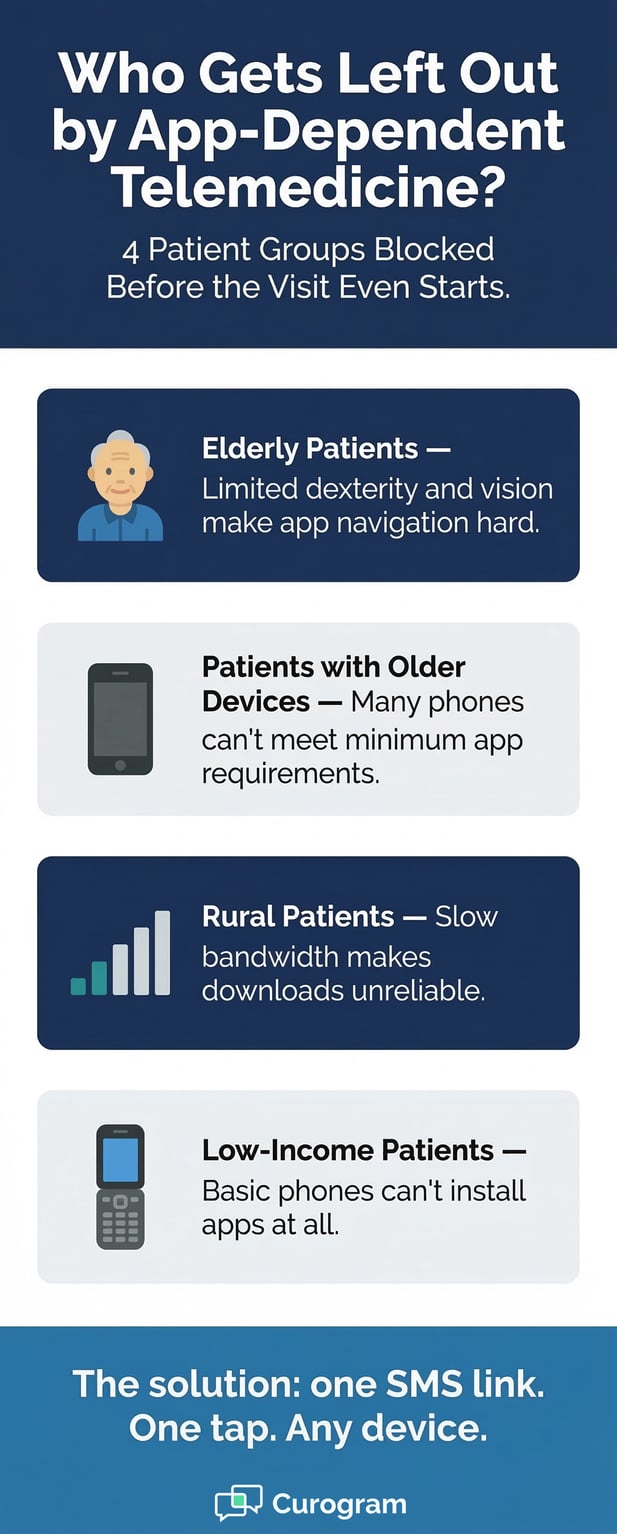
The patients who benefit most from telemedicine are often the ones least able to use it. Elderly patients with limited dexterity or poor vision struggle with small-screen app navigation.

Patients with older phones may not meet the app's minimum system needs. Low-income patients on basic devices can't install apps at all.

This creates a painful gap. The patients who most need a way to avoid the drive to the clinic are exactly the ones who get locked out by the app requirement.

An eCW virtual care access problem for elderly patients isn't a niche issue. It's a core challenge for any enterprise network serving a broad patient base.

The Hidden Cost to Enterprise Networks

When a patient can't connect, the impact goes beyond one missed visit. The provider waits. Staff calls to troubleshoot. The visit gets rescheduled, often as an in-person appointment.

At enterprise scale, even a modest telemedicine no-show rate from app friction adds up fast. Based on our internal data, no-show rates can run more than 53% higher than average without effective outreach tools in place.

Multiply that across hundreds of virtual visits each month and you have a real problem: lost provider time, wasted scheduling slots, and delayed care for patients who needed help now.

The Perception Problem

A bad first experience with telemedicine has lasting effects. A patient who spent 20 minutes fighting the healow app and gave up doesn't reschedule a virtual visit. They come in next time, or they don't come at all.

For enterprise eCW networks that invested in telemedicine expecting it to expand access and reduce no-shows, the app barrier creates the opposite result. The promise of virtual care is care from anywhere, for anyone.

App-dependent telemedicine limits that promise to patients who are already comfortable with technology. That's not universal access. It's filtered access.

The visits being lost aren't lost because patients don't want care. They're lost because the technology got in the way.

That's a solvable problem, and the solution doesn't require replacing eCW or rebuilding the entire workflow.

Infographic: 4 patient groups blocked by app-dependent telemedicine and the SMS solution

The Guide: The Virtual Exam Room

Curogram's approach to SMS video visits is built on one idea: the fewer steps between the patient and the provider, the better the visit completion rate.

The Virtual Exam Room removes every technical barrier and replaces it with a single tap.

How the SMS-Launch Video Visit Works

When a telemedicine visit is scheduled in eCW, Curogram handles everything on the patient-facing side. The workflow is simple and entirely automated.

A pre-visit text reminds the patient of their upcoming appointment. At visit time, another text sends the video link.

The patient taps the link. Their default browser, whether Chrome, Safari, Firefox, or Edge, opens a secure video session.

No app store. No download. No account. No login. No permissions dialog. The browser is the exam room, and the text message is the door.

What the Provider Sees

Providers join from within their existing eCW workflow. They don't need to manage a second platform or switch between tools. A virtual waiting room holds patients until the provider is ready.

Connection quality, visit duration, and completion status are all tracked. Enterprise networks get a dashboard showing utilization and completion rates across all providers and locations.

The visit is documented in eCW just like any other encounter. The clinical workflow stays inside the EHR. Curogram handles the connection layer that makes it easy for the patient to get there.

Technology That Adjusts to the Patient

The video platform uses adaptive technology that adjusts quality based on the patient's connection speed. On slower connections, video resolution drops while audio stays clear.

If video fails entirely, the session falls back to audio-only. This matters for rural patients and those with limited bandwidth.

Browser-based video actually performs better than many native apps on modest connections because it doesn't compete with the app itself for device resources.

This makes it a strong option for zero-download telemedicine enterprise EHR deployments serving diverse, geographically spread populations.

Multi-Specialty Fit Across the Entire Network

One of the strengths of browser-based video visits is how well they fit across every specialty in a large eCW network.

The technology is the same. The impact varies by specialty, but the core benefit is consistent.

Specialty

How Browser-Based Video Visits Help

Cardiology

Patients who can't drive post-procedure review symptoms from home with ease.

Behavioral Health

Providers conduct therapy sessions remotely with no tech setup barriers.

Endocrinology

Rural patients manage chronic conditions without a 90-minute commute.

Dermatology

Providers evaluate skin concerns via video before scheduling in-person care.

Primary Care

Parents handle sick visits from home without disrupting childcare.

Geriatrics

Elderly patients connect with a single tap, with no app skills needed.


The healow alternative this represents isn't about replacing what works. It's about filling the gap. Patients who are comfortable with healow keep using it. Everyone else now has a door into the exam room that actually opens.


The Success: Tap. Connect. Care.

When the barrier to joining a video visit is just a tap, visit completion rates go up. That's not a promise. That's what happens when you remove the steps that were stopping patients from showing up.

What Changes When the App Requirement Goes Away

Enterprise networks using SMS-launched video visits see measurable improvements in visit completion. The patients who were previously unable to connect now show up.

Based on our internal data, networks using automated SMS outreach see appointment confirmation rates above 75% on average.

For enterprise eCW networks, this means more completed encounters per provider, fewer rescheduled visits, and better care access for the patients who need it most.

The gains are especially clear among elderly patients and those who had struggled with app-based telemedicine before.

A Real Network, a Real Patient

Picture a 45-provider eCW network in the Mid-Atlantic. Dr. Singh, a cardiologist, has his first SMS-launched visit with Eleanor, a 74-year-old patient who had canceled three healow TeleVisits because she couldn't figure out the app.

This time, Eleanor gets a text at 2:55 PM: her visit starts in 5 minutes, tap here to join. She taps. Safari opens. She sees herself on screen. At 3:00, Dr. Singh appears.

They discuss her medication, review her blood pressure log, and schedule a follow-up. The entire technical experience for Eleanor was: read a text, tap a link.

The Network-Level Impact

Dr. Singh documents the visit in eCW and moves to his next patient. The telehealth team reviews monthly data and sees that virtual visit completion rates have improved.

The gains come almost entirely from patients over 65 and those who had been unable to use app-based telemedicine.

The network's investment in telemedicine is finally reaching the patients it was built for. That's not a small win. That's the entire point.

From Tech-Dependent to Universally Accessible

Before SMS-launched video visits, telemedicine at most enterprise networks was filtered. It worked well for patients who were tech-savvy and had compatible devices. Everyone else was left out.

With browser-based video visits via SMS, telemedicine becomes truly universal. Any patient with a phone that receives texts can join a video visit.

That's nearly every patient. The network's virtual care program now reflects its full patient population, not just the subset that can navigate app technology.

The shift from app-dependent to SMS video visit link patient workflows isn't just a technical upgrade. It's a change in who gets care. And that matters.


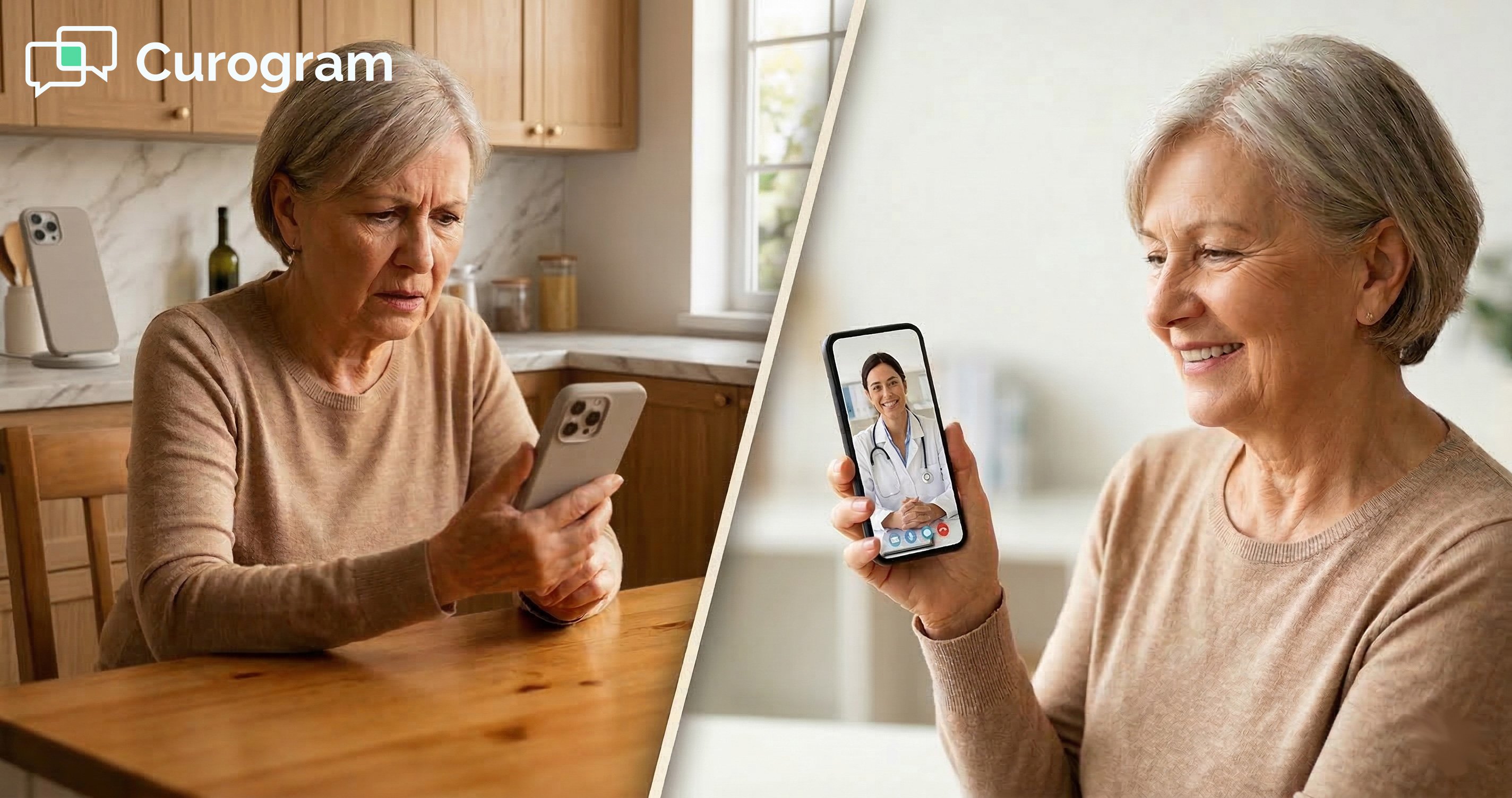
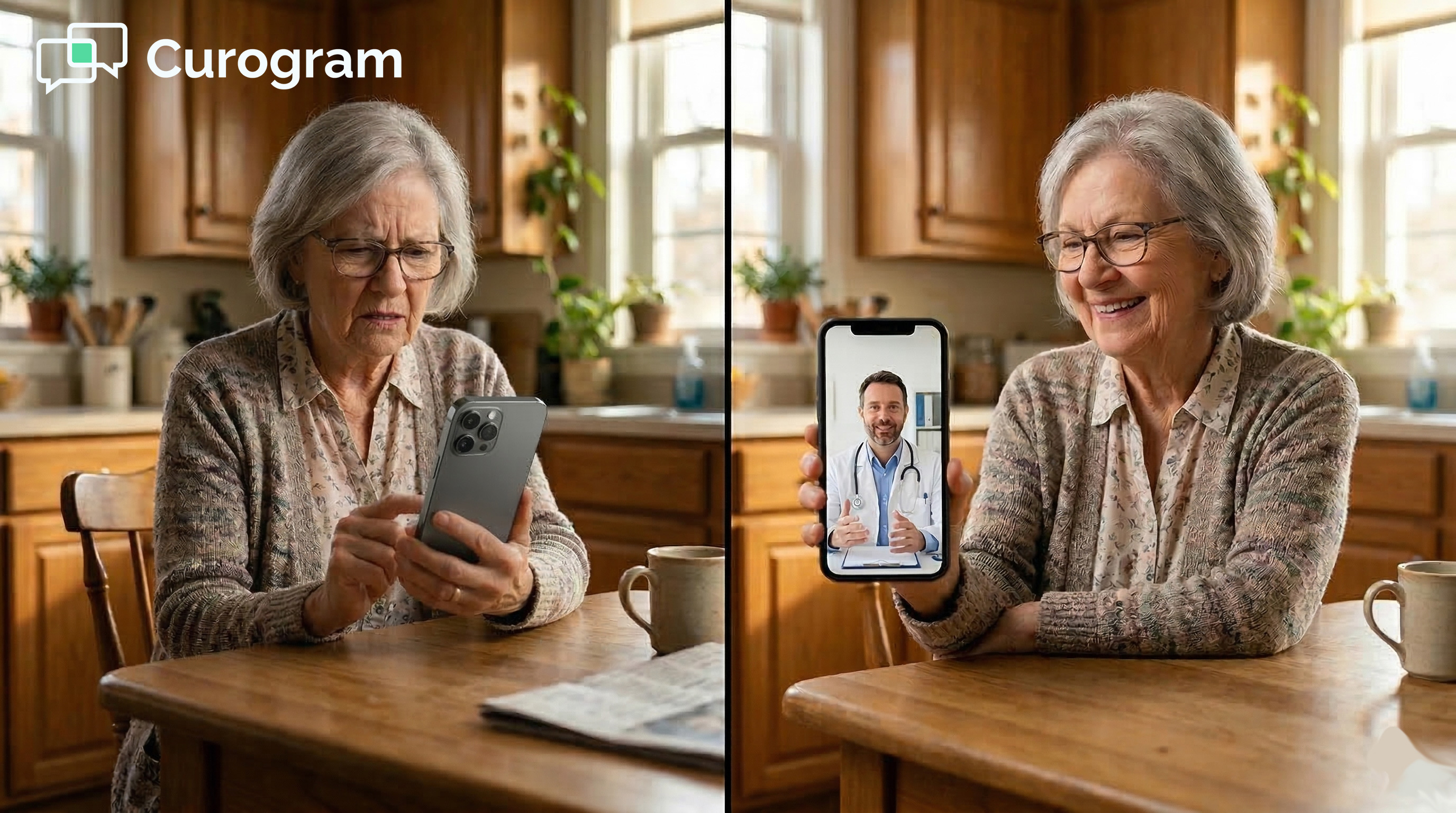
Happy senior patient having a successful, accessible telemedicine video call on her smartphone

Remove the Technology Between the Patient and the Provider

Enterprise eCW networks lose telemedicine visits to app friction every day. Downloads, logins, and tech issues stand between patients and their doctors. Most of those patients don't try again.

Curogram's Virtual Exam Room changes that. It launches video visits from an SMS link in the patient's browser. No app needed. No account. Just a tap and a connection.

eClinicalWorks handles your clinical documentation and schedule. Curogram makes sure your patients can actually get into the room.

Together, they cover the full visit lifecycle, from scheduling in eCW to a seamless video connection for every patient, regardless of age or tech ability.

The next step is simple. Schedule a demo today.

Frequently Asked Questions

Is browser-based telemedicine HIPAA-compliant?

Yes. Curogram's video visits use end-to-end encrypted connections that meet HIPAA security requirements. Curogram is SOC 2 Type II certified and signs a BAA with every organization.

Video sessions are not recorded or stored unless the practice sets them up. The browser-based approach keeps the same security standards as dedicated telehealth apps while removing the app dependency entirely.

Does this replace healow TeleVisit?

No. Curogram works alongside healow TeleVisit, not instead of it. Patients who are comfortable with the healow app can keep using it. Curogram's SMS-launched telemedicine is for patients who can't or won't use the app. Offering both options lets the network maximize telemedicine adoption across all patient segments.

How does the video quality hold up on a slow connection?

Curogram's video platform uses adaptive technology that adjusts quality based on connection speed. On slower connections, video resolution drops while audio stays clear.

If the video fails entirely, the session switches to audio-only. For rural patients or those with limited bandwidth, browser-based video often performs better than native apps because it uses fewer device resources.

Why do elderly patients struggle with app-based telemedicine?

App-based telemedicine asks patients to complete several steps before a visit even starts: download the app, create an account, verify identity, and navigate the interface.

For older patients with limited dexterity, poor vision, or older devices, each step is a potential roadblock. SMS-launched video visits replace all of that with a single tap on a text message link.

How does Curogram connect with the eCW schedule?

Curogram integrates directly with the eCW schedule. When a telemedicine visit is created in eCW, Curogram automatically triggers the SMS link workflow for the patient.

Providers stay inside eCW for documentation. Staff doesn't have to manage two separate systems. The clinical workflow stays in the EHR while Curogram handles the patient-facing connection layer.

Stress-Free Telehealth for Seniors in CollaborateMD

Stress-Free Telehealth for Seniors in CollaborateMD

💡 Setting up telehealth for seniors in CollaborateMD practices means removing the biggest tech barriers: app downloads, passwords, and portal...

Read More
No App Telehealth for Prime Clinical | Barrier-Free Care

No App Telehealth for Prime Clinical | Barrier-Free Care

💡 Reducing telehealth no-shows at Prime Clinical practices starts with removing tech barriers. When patients must download an app, create an...

Read More
HIPAA-Compliant Telehealth for CollaborateMD: 1-Click Visits

HIPAA-Compliant Telehealth for CollaborateMD: 1-Click Visits

💡 HIPAA-compliant telehealth for CollaborateMD removes the tech headaches of virtual care and ties every visit to your billing workflow. Patients...

Read More