eClinicalWorks Telemedicine | Zero-Download Video Visits via SMS
💡 eClinicalWorks telemedicine with zero-download, browser-based video visits lets enterprise networks launch virtual appointments directly from the...
9 min read
Jo Galvez
:
March 17, 2026
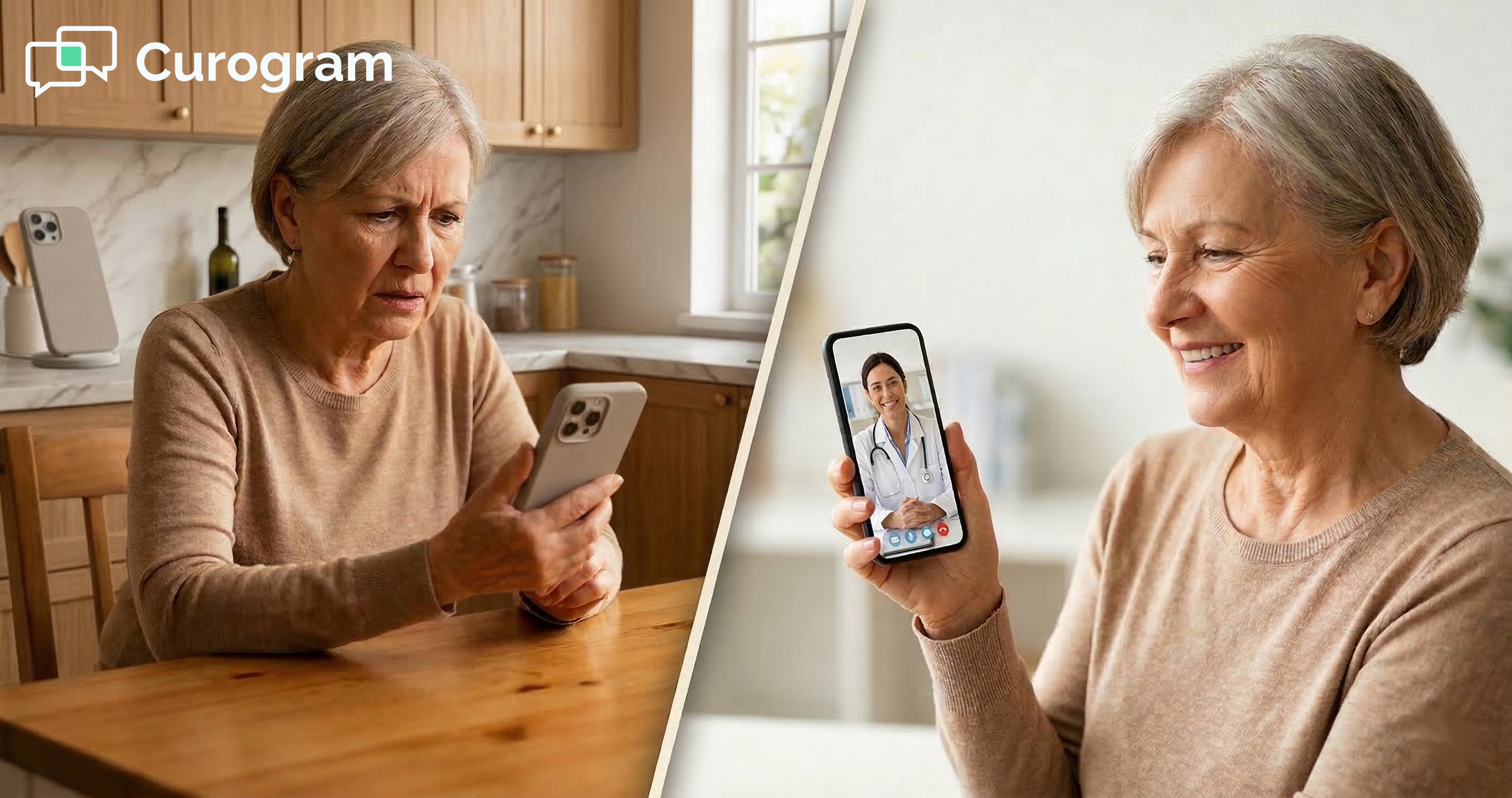
Picture this: an elderly patient has a video visit in 10 minutes. She finds the sticky note with her password. She opens the app. It asks for an update. Eight minutes pass.
The appointment window closes. She calls the office and says, "Just book me in person from now on."
This is not a rare story. It plays out in eClinicalWorks networks across the country every week. The problem is not the patient.
It is not even the technology. It is the gap between what telemedicine promises and what app-based platforms actually deliver to patients who are not digital natives.
The app should not be harder than the appointment. Yet for too many patients, that is exactly what it feels like.
Downloading software, creating accounts, remembering passwords, and navigating a new interface every few months, all before they can see their doctor.
There is a better way. When a patient receives a text with a link and simply taps it to join a browser video visit, the barrier disappears. No app. No login. No friction. Just care.
This article walks through why app-dependent telemedicine fails certain patient groups, how SMS-launched video visits fix the problem, and what it looks like when a patient finally connects with ease.
App-based telemedicine creates a hidden obstacle course between the patient and their doctor. For some patients, it is manageable.
For others, it is a wall they never get past. Understanding where the friction lives and who it hurts most is the first step to solving it.
Eleanor is 74 and manages heart failure with her cardiologist at a large eCW network.
Her daughter was excited when the clinic launched telemedicine. No more two-hour drives. But the reality was different.
They downloaded the healow app together. Set a password. Did a test call. It worked. Two weeks later, Eleanor's actual appointment arrived.
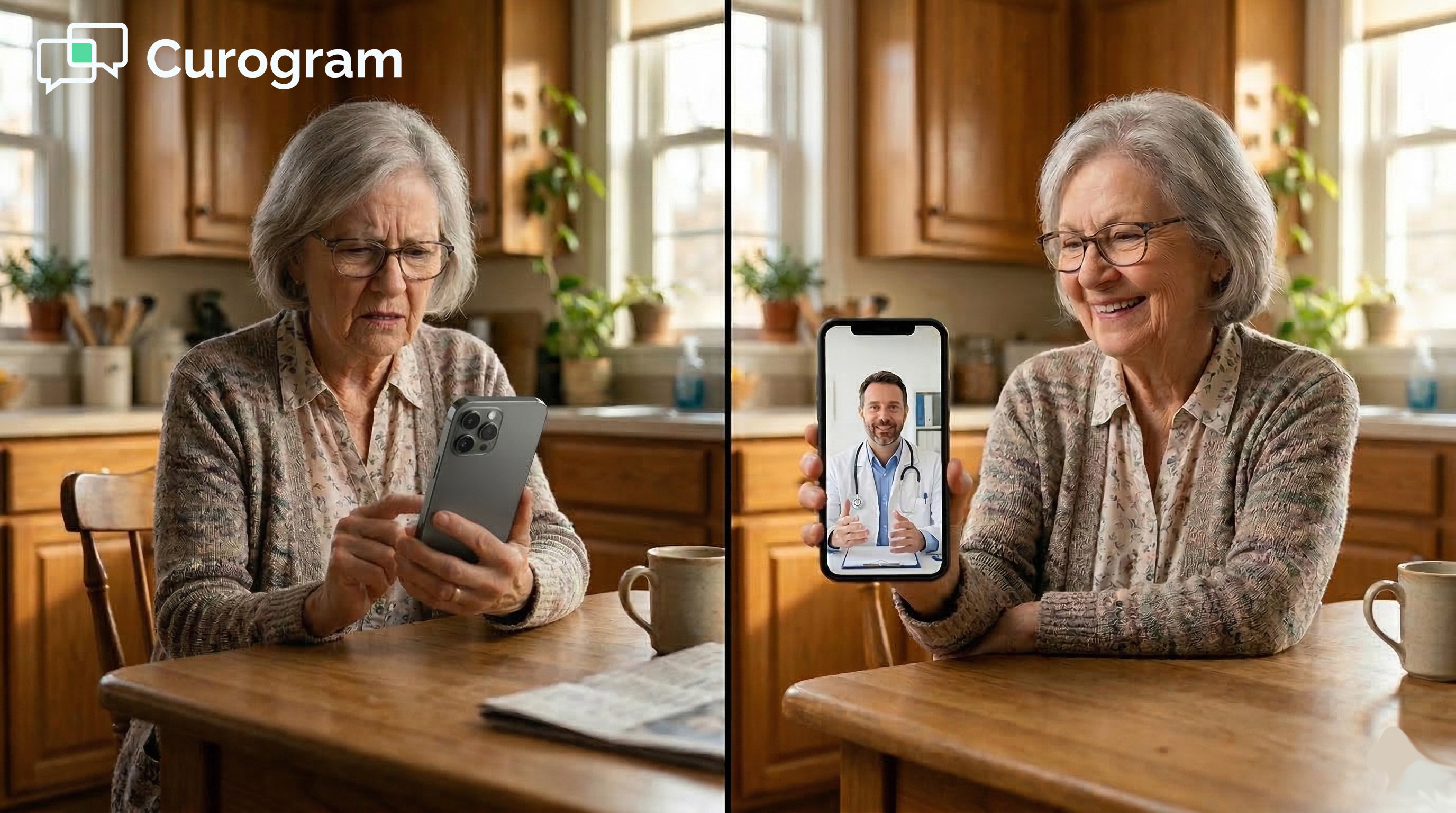
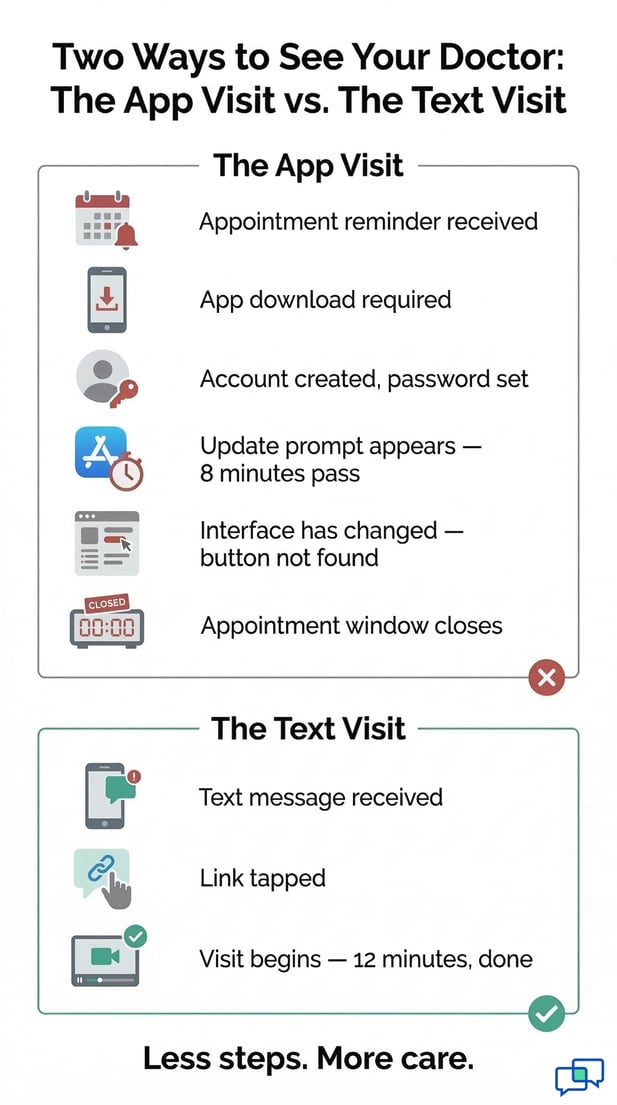
She found the sticky note, opened the app, and was met with a required update. Eight minutes later, she logged in. The interface had changed. She could not find the video visit button.
By the time her daughter talked her through it by phone, the appointment window had closed. Eleanor was embarrassed. She told the scheduling team to book her in person from now on.
That was not a technology failure. It was a design failure. The platform was built for people who use apps daily.
Eleanor uses a phone to text her grandchildren and take calls. That is a very different user.
App updates are routine for most users. For older or less tech-comfortable patients, an update is a disruption with no clear steps.
It changes layouts, moves buttons, and resets the mental map the patient had built. Even a small interface change can reset confidence entirely.
Many elderly patients write passwords on paper. That is not careless. It is rational. But it adds a step that fails under time pressure.
When a patient has 10 minutes before a video visit, hunting for a sticky note, typing a password, and navigating a changed app is too much friction. The appointment is lost before it begins.
Enterprise eCW networks serve patients across every age group and comfort level. A 32-year-old who works in tech navigates healow without a second thought.
A 78-year-old retired teacher finds it hard. A 45-year-old parent could figure it out, but not in the 10 minutes before a sick-child visit.
The app-dependent telemedicine model works well for the first patient. It fails the other two. This creates a two-tier system inside the same network.
Tech-comfortable patients get the convenience of a virtual visit. Everyone else is pushed back to the waiting room or defers care entirely.
The divide is not about clinical need. It is about technological comfort. And that is a gap the platform, not the patient, should bridge.
Table 1: Who App-Based Telemedicine Leaves Behind
|
Patient Group |
Common Barrier |
Typical Result |
|
Elderly patients (65+) |
App updates, changed interfaces, passwords |
Returns to in-person or defers care |
|
Patients with older devices |
App compatibility and storage limits |
Cannot install or run the app |
|
Busy parents |
No time to set up another healthcare login |
Skips the visit or postpones |
|
Rural patients |
Slow data speeds make large app downloads hard |
Fails to download or connect |
|
Limited English speakers |
Complex app navigation without language support |
Gives up before the visit starts |
When a patient fails to connect for a telemedicine visit, they do not just miss one appointment. They lose trust in virtual care as a whole.
Eleanor did not just give up on healow. She gave up on the idea that video visits could work for her.
She now believes telemedicine is "not for people like me." That belief was caused entirely by friction, not by any limit in what she can do or gain from virtual care.
That perception spreads. Patients talk to family and friends. Word travels that "the app is a hassle." Adoption drops far beyond the people who had the direct bad experience.
Telemedicine accessibility depends on making the experience work the first time. Every failed connection is a patient who may never try again.
When telemedicine is too hard to use, the effects go beyond missed calls. Eleanor's heart failure needs regular review.
Her doctor might need to adjust a medication after a short 15-minute visit. But if Eleanor cannot get into a virtual visit and her daughter cannot drive her, that adjustment gets delayed by weeks.
For enterprise eCW networks, every patient locked out by app friction is a patient at risk of delayed care.
The barrier is not just an inconvenience. For patients with chronic conditions, it is a care access problem with real health consequences.

The fix does not require replacing eClinicalWorks or overhauling the clinical workflow. It requires changing one thing: how the patient gets into the visit.
SMS-launched telemedicine cuts the patient experience down to its simplest form, and that simplicity is what makes it work for everyone.
Curogram connects directly with the eCW schedule. When a telemedicine appointment is on the books, Curogram sends a text to the patient's phone a few minutes before the visit.
The message is plain and clear: "Hi Eleanor, your video visit with Dr. Singh starts soon. Tap here to join."
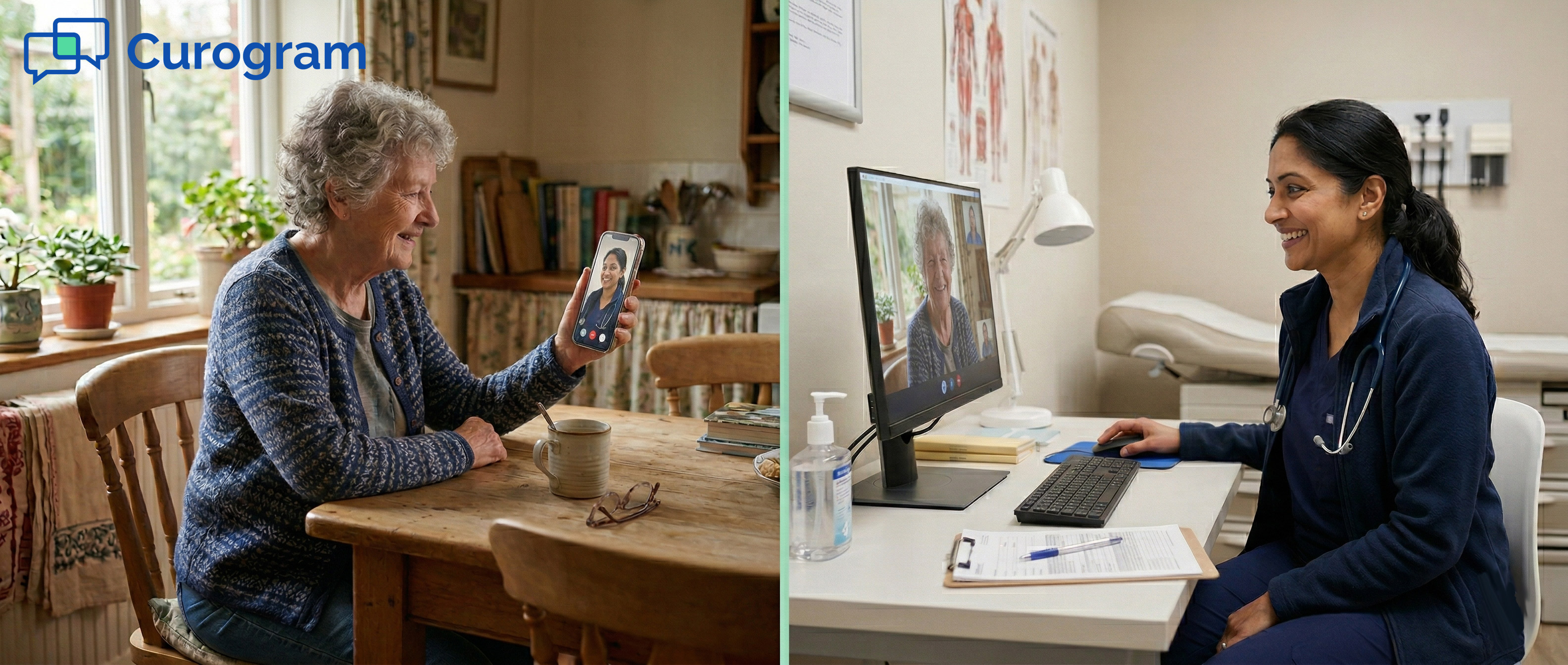
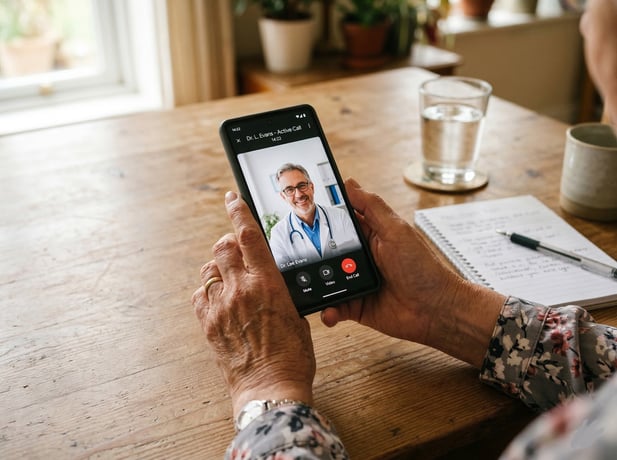
Eleanor taps. Her phone browser opens. She sees herself on screen. Dr. Singh appears. The visit begins. She did not download anything.
She did not log in to anything. She performed the same action she does when her daughter sends a photo: she tapped a link in a text message.
That is the entire patient experience. The technology between Eleanor and her doctor has been reduced to zero friction.
The browser-based video opens with the camera active. The patient sees their own feed and waits for the provider to appear.
There are no settings to configure, no menus to find, and no buttons to press except a large red "End Call" button when the visit is done.
For elderly patients, the simplicity is the whole point. For younger patients, the speed is the feature.
For the network, it is the reach: one experience that works for every patient in every demographic.
After the visit, Dr. Singh documents it in eCW as normal. Eleanor receives a follow-up text with any next steps or instructions. If she has a question later, she replies to the text.
Her message routes to the care team through Curogram's HIPAA-compliant messaging. The entire care journey happens through her phone's message inbox, without a single app.
For enterprise eCW networks serving large, mixed patient groups, SMS-launched telemedicine is not just a convenience upgrade.
Patient experience for a virtual visit built on text messaging is an equity tool.
Patients with limited English can receive the join link with simple instructions in their language. Patients on older phones connect through their built-in browser without worrying about app compatibility.
Patients in rural areas avoid downloading a large app over a slow data connection. Patients with disabilities that make app navigation hard can join with one tap.
The text link levels the field. It makes virtual care available to every patient the network serves, not just the ones who already feel at home in an app store.
Table 2: SMS Visit vs. App-Based Visit at a Glance
|
Step |
App-Based Visit |
SMS Text-Link Visit |
|
Step 1 |
Download the app (may require storage space) |
Receive a text message |
|
Step 2 |
Create an account and set a password |
Tap the link in the text |
|
Step 3 |
Log in (retrieve password if forgotten) |
Browser opens automatically |
|
Step 4 |
Navigate the app interface to find the visit |
See yourself on screen |
|
Step 5 |
Handle update prompts if required |
Wait for doctor to join |
|
Step 6 |
Join the visit, if all steps completed |
Visit begins |
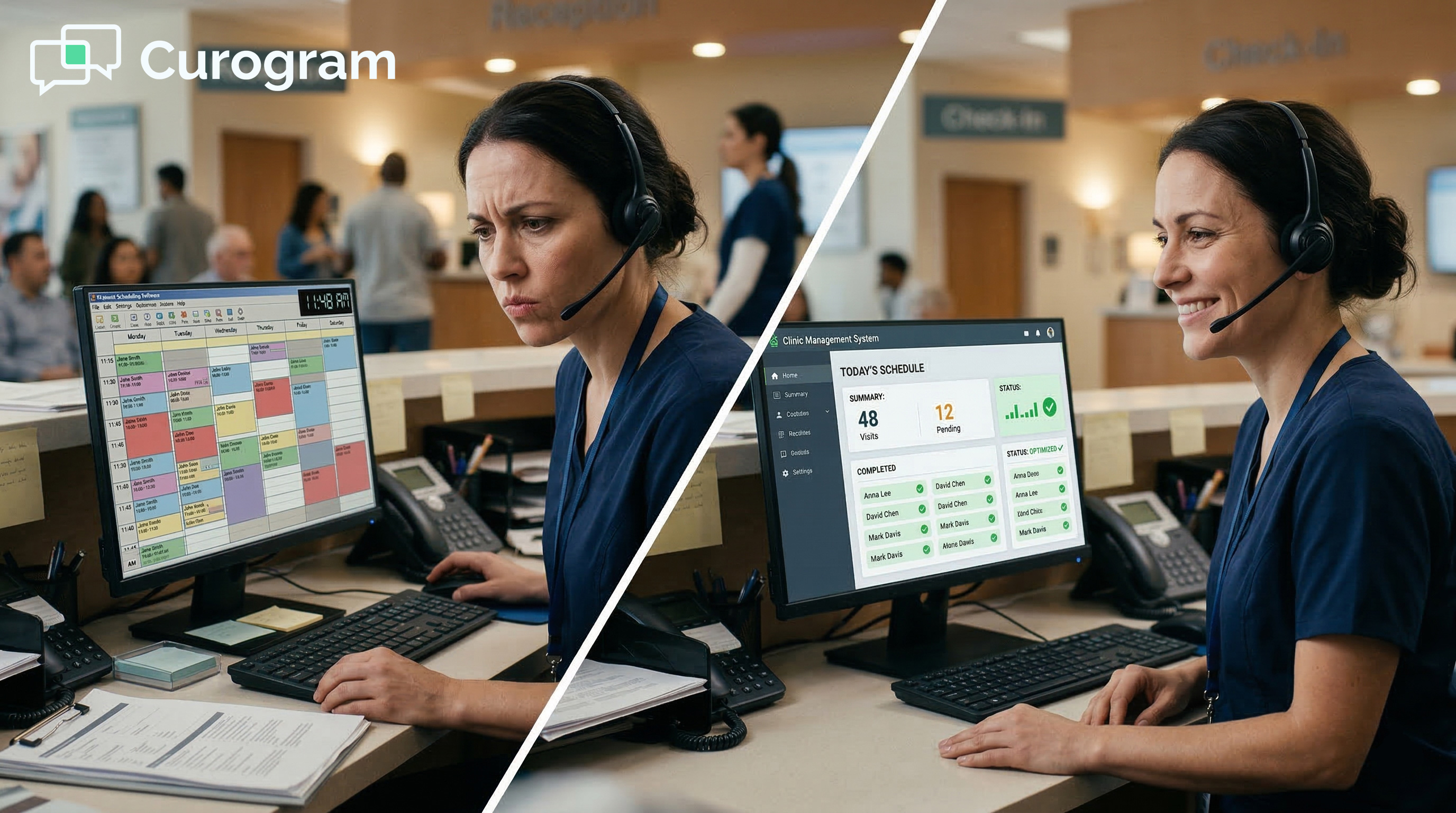
Because Curogram integrates with eCW, the workflow for the clinical team does not change. The provider sees the telemedicine appointment on their usual eCW schedule.
They click to start the visit on their end. Curogram handles the patient side automatically.
There is no separate platform to manage. No patient portal to train staff on. No new login for the front desk.
The clinical documentation still happens in eCW. The patient communication happens through Curogram. Each tool does what it does best.
eClinicalWorks is for your clinical documentation. Curogram is for your patients' way into the exam room.
The impact of removing app friction is not abstract. It shows up in who actually shows up.
When the barrier is gone, patients who avoided telemedicine start using it, and using it consistently. Here is what that looks like in practice.
Eleanor's first SMS-launched video visit is on a Wednesday afternoon. The text arrives on her phone. She taps. She sees herself.
Dr. Singh appears at 2:00 PM. They review her weight, her blood pressure log, and a medication side effect she had been putting off mentioning.
Dr. Singh adjusts one dosage and schedules a follow-up in two weeks. The visit takes 12 minutes.
Eleanor did not need her daughter to drive. She did not fight with an app. She did not feel embarrassed or technically lost.
She felt like she was talking to her doctor, because she was. Two weeks later, the follow-up text arrives. She taps again. Connects again. Dr. Singh confirms the adjustment is working.
That evening, Eleanor tells her daughter, "I saw Dr. Singh today. It was easy. I just tapped the message."
Her daughter, who had been managing drive schedules for three years, exhales. The technology finally stopped being a problem.
Networks that move to SMS-launched telemedicine see a real shift in who uses virtual care. Telemedicine utilization climbs across all age groups.
The most dramatic gain comes from patients 65 and older, the group that benefits most from avoiding travel.
Based on our internal data, practices using Curogram's SMS-based approach see no-show rates fall significantly.
In one case study, a medical center reduced no-shows from 14.20% to 4.91% in just three months, three times better than the industry average. When patients can join a visit with a single tap, they show up.
The patient telemedicine experience transforms from "download an app to see your doctor" to "tap a text to see your doctor."
The cognitive load drops to zero. The steps required drop to one.
Telemedicine stops being a product patients must adopt and becomes invisible infrastructure that connects them to their care team.
That shift matters for patients like Eleanor. But it also matters for the 45-year-old parent who would never have time to set up yet another healthcare app.
The patient experience of a virtual visit should feel like getting a text from a friend, something so natural and low-effort that the technology itself disappears. When that happens, virtual care reaches everyone.
Based on our internal research, practices using Curogram see appointment confirmation rates above 75% on average.
That number reflects the broader truth: when the process is easy, patients engage. They confirm. They show up. They follow up.
For enterprise eCW networks that serve hundreds or thousands of patients, closing the telemedicine accessibility gap has a real impact.
More completed visits mean better chronic disease management, fewer gaps in care, and stronger patient-provider relationships across every specialty from cardiology to behavioral health.

App-based telemedicine was never the problem. The app itself was. Any step between the patient and the provider is a risk.
Downloads, logins, updates, and navigation each take a patient who might have connected and turn them into a patient who gave up.
The solution is not a smarter app. It is no app at all.
Curogram's SMS video visits remove every step between a text message and a video call. The result is a patient experience that works for a 74-year-old with heart failure, a 45-year-old with three kids, and a 60-year-old in a rural county with slow cell service. It works for everyone because it asks almost nothing of anyone.
For enterprise eCW networks, the call to action is clear: stop losing patients to app friction.
Every patient who avoids telemedicine because of a bad experience is a patient who may delay care, miss follow-ups, or drift from the practice entirely.
Schedule a demo today and give every patient a one-tap door to their doctor's virtual exam room.
Frequently Asked Questions
Yes, because there is nothing to "use" in the traditional sense. The patient receives a text, taps a link, and sees their doctor on screen.
There are no settings to change, no menus to find, and no accounts to manage. If a patient can tap a link in a text message, they can join a Curogram video visit.
They can tap the same link in their text message again. The session persists, so the provider does not lose the connection. There is no need to re-authenticate or restart. This is a key advantage over app-based platforms, where closing the app often requires a full re-login before the patient can reconnect.
App downloads often require the latest operating system or a certain amount of storage. Older phones can fail both requirements.
A browser-based video visit runs on any modern browser without needing an install. This means patients with older phones face no compatibility barriers when joining via a text link.
All patient messaging through Curogram runs on a HIPAA-compliant platform. The visit link is sent directly to the patient's verified phone number and expires after use. Patient follow-up messages also route through Curogram's secure system, so the clinical team receives them in a protected inbox rather than an open SMS thread.
A failed connection does not just cost one appointment. It shapes how the patient sees all virtual care. Patients who struggle with an app tend to label the whole idea of telemedicine as "too complicated."
That belief often spreads to family and friends. SMS-based visits prevent the first failure, which protects trust in virtual care before it has a chance to erode.
💡 eClinicalWorks telemedicine with zero-download, browser-based video visits lets enterprise networks launch virtual appointments directly from the...
💡 eWhen patients can't join a virtual visit, the fallout hits fast. Front desk staff spend 5 to 15 minutes per call walking patients through app...
💡 Reducing telehealth no-shows at Prime Clinical practices starts with removing tech barriers. When patients must download an app, create an...