
1 min read
A Definitive Guide to Charge Capture Medical Billing
💡Charge capture medical billing turns each service a patient receives into a billable line on a claim. The work starts at registration, moves...
6 min read

Ask a practice leader where revenue leaks, and you get one answer. In a January 2026 MGMA Stat poll, 48% named denials and appeals as their biggest source of leakage. Only 23% pointed at the front end.
Those two buckets hold mostly the same money. Experian Health surveyed 250 revenue cycle leaders in 2025. Half named missing or bad claim data as the top denial driver, with incomplete patient registration data close behind. Registration makes most of those errors, and the denial queue is just where they turn up 30 days later.
Search how to improve medical billing process, and you get twelve strategies of equal weight. The ranking below is seven, ordered by how much money each frees per hour of staff effort. The two biggest fixes sit outside the billing office entirely.
Three leaks account for most of what a practice fails to collect. Each one is measurable this month, without a consultant.
MGMA has put first-submission denials at 7% to 8% for four straight years. Its 2025 Financials and Operations report says targeted fixes can push that under 5%. In the Experian survey, 41% of providers now see more than one claim in ten denied, up from 30% in 2022.
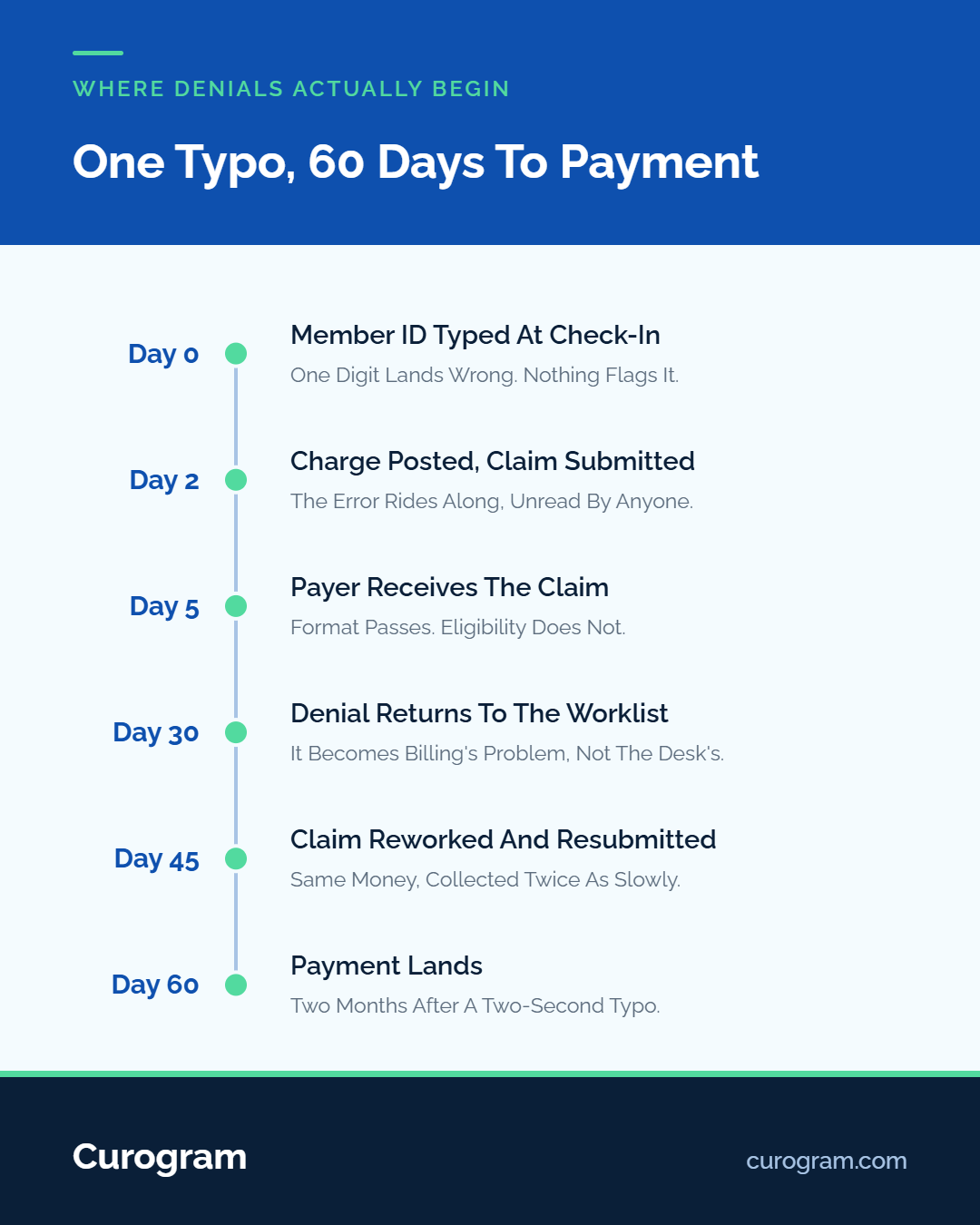
A transposed digit in a member ID does not fail on the day it is typed. It fails 30 days later, and by then the person who typed it has seen 600 more patients. That delay is why the front desk rarely gets blamed for a denial it caused.
One practice in MGMA's July 2026 poll kept insurance A/R inside 28 days. Self-pay balances pushed its total to 32. The claim side was working; the patient side added four days to the whole practice.
Patients now carry more of the bill than they used to. KFF found 88% of covered workers had a general annual deductible in 2025, averaging $1,886 for single coverage, with 34% in plans above $2,000.
Across the sector, MGMA puts the lag between visit and submitted claim at three to seven days. Its advice: close encounters within 72 hours, post charges inside two. Every day a charge waits adds a day to days in accounts receivable, before a payer has even seen the claim. Weak charge capture shows up here first.
Coding gets the training budget. Registration gets whoever is at the desk that morning. Reverse that and the clean claim rate moves faster than any coding refresher will move it.
Run eligibility at booking, then again 48 hours out. Plans end. Employers switch carriers. A patient covered in March may not be in April, and catching that before the visit turns a denial into a two-minute conversation at check-in.
CAQH put the remaining prize at $21 billion in its 2025 Index. That is what full automation of the still-manual and half-manual transactions would save. Eligibility is the one most practices think they already fixed.
Clipboard intake gives a member ID two chances to go wrong. The patient writes it. Staff key it in. Digital intake forms cut the second chance by writing answers straight into the chart, and they let the patient photograph the card instead of a receptionist reading it upside down.
Forms filled at home also come back more complete. A patient on their couch will look up a policy number. A patient in a waiting room writes what they remember.
 Work Denials on a Clock, Not a Backlog
Everything above is prevention. This part is recovery, because even a practice that has done real work to reduce claim denials will still get 5% of them back. Most denial handling then fails on sequencing rather than skill. A $60 lab denial gets the same attention as a $2,400 procedure nine days from its appeal deadline.
Pull the denial worklist every morning. Sort by dollar value first, then by days remaining on the appeal window. Work the top of that list before opening anything else, and log the denial code as you go.
One MGMA respondent described an RCM overhaul that took days in A/R from 67 to under 34. Nothing in that description was exotic. It was denial follow-up that happened daily instead of weekly.
Export last month's denials. Group them by CAR code and count the codes, not their dollar value. Take the top five and trace each one back to the step that created it.
CO-16 with a missing member ID traces to registration. CO-197 traces to the prior authorization step. CO-29 traces to charge posting lag. Once you can name the step, you fix a workflow rather than retraining a person who was never the cause.
Run this the same week each month. Two cycles in, you will see whether last month's fix held, which is the only way to tell a real medical billing process improvement from a good month.
In 2024, practices collected 72% of copayments at the time of service but only about 27% of other patient-due balances. The rest becomes statements, phone calls, and aged A/R.
Groups that improved patient payment collection in MGMA's October 2025 poll named the same three moves: collect at the time of service, give clearer estimates, and hold registration staff to both. No new software appears on that list.
Give front desk staff a script and a number they can quote. A patient who hears $85 at check-in pays it far more often than one who receives $85 in an envelope five weeks later.
MGMA's own advice is blunt: mailing three paper bills 30 days apart means you are financing your own receivables. A secure text-to-pay link reaches the patient in minutes and takes two taps to clear.
One caveat from that same poll deserves repeating. A practice leader reported texts failing because patients assumed they were scams. Send from a consistent number, name the practice in the first line, and never ask for card details inside the message itself.
A billing dashboard with 20 metrics gets read once. Four numbers, reviewed monthly against a benchmark, will tell you whether the six fixes above are holding.
|
Metric |
What good looks like |
What it tells you |
|---|---|---|
|
Clean claim rate |
95% or better on first submission |
Whether registration and coding are catching errors upstream |
|
First-submission denial rate |
Under 5%, against a 7% to 8% sector norm |
Whether your denial fixes are preventing or just recovering |
|
Days in A/R |
Under 40, split by insurance and self-pay |
Which side of the ledger is adding the days |
|
Time-of-service collection |
Copays near 72%, patient balances above 27% |
How much of the patient share you are handing to your statement cycle |
Benchmarks from MGMA Stat and MGMA's 2025 Financials and Operations data report.
Split days in accounts receivable by payer and by self-pay. A single blended number hides the practice with clean insurance A/R and a patient balance problem, which is the most common version of this we see.
Curogram is not a billing system and does not replace one. It sits alongside your EMR and practice management software and handles the two ends of the medical billing workflow that touch the patient.
Up front, Secure Online Patient Forms gather demographics, insurance, and consents before the patient arrives. Answers write into the chart, so nobody retypes a member ID.
At the back end, Text-to-Pay sends the balance as a secure link by text. The amount sits behind that link, never in the message body, which is what keeps it HIPAA-safe.
Both connect with your current system through Curogram's EMR integrations. The platform is HIPAA-compliant and SOC 2 Type II certified. Your coders, clearinghouse, and payer contracts stay where they are.
Pick one fix and give it 30 days. Export last month's denials, count the top five codes, and trace each to the step that created it. That single export usually settles the argument about whether your problem is coding, registration, or the patient balance tail.
Then measure again in 60 days. Revenue cycle management does not improve because a plan was written. It improves because one number moved and somebody noticed.
See how Curogram handles digital intake and text-to-pay alongside your current EMR. Book a demo and bring your last denial export.

1 min read
💡Charge capture medical billing turns each service a patient receives into a billable line on a claim. The work starts at registration, moves...

1 min read
 Jo Galvez : 2/8/26, 9:00 AM
💡 Medical practices can speed up cash flow and reduce patient A/R days by up to 65% with a medical text-to-pay solution. Traditional paper billing...

1 min read
 Aubreigh Lee Daculug : 1/18/26, 2:00 PM
💡Paper billing costs clinics around $7 per transaction once you account for printing, postage, and staff time. Text-to-pay reduces that cost to...